Best of DTM (4: advice for students)

fullsizeoutput_35c.jpeg

Probably most of DTM is for jazz students anyway, but I got a bit more direct about how one might practice after taking a job at NEC. Consult the Manual has the relevant material.

A lot of what’s in the NEC stuff is what any competent teacher would tell a jazz class. However, three essays were especially fun to write:

Judge Not. Lest Ye Be Not Judged (the preliminary round of the Monk Competition)

Theory and European Classical Music (includes performances of Miriam Gideon and Vivian Fine)

Air de Ballet (advice for dance class pianists)

Looking ahead, I have at least two or three more NEC missives to do, about source material for harmony, how to use the computer for practice, and about the magical “feet in three.”

Best of DTM (3: European Classical Music)

fullsizeoutput_41

Some of my history with the fully-notated side of the tracks is found at the NewMusicBox discussion with Pat Zimmerli. Zimmerli himself was very important to my development, as were Gregg Smith and especially Sophia Rosoff and Mark Morris.  I couldn’t have played The Rite of Spring with the Bad Plus if I hadn’t worked with Mark first.

At Sonatas and Études one can find the longer DTM pieces about formal composition. It’s kind of a mixed bag. Probably these essays aren’t as deep as the jazz essays. All of DTM is a kind of “practicing in public,” sharing my haphazard and decidedly non-academic researches into source material, and that amateurism is most evident in Sonatas and Études, possibly because I’ve spent so much less time arguing in bars about classical music than jazz.

Five of my favorites:

Endellion Idyll  is a photo blog of Mark Padmore’s amazing festival in Cornwall.

Mixed Meter Mysterium (on Stravinsky) is less distinctive than most of DTM simply because there is so much Stravinsky reception already. However, as far as I know, this is the only look at the issue of Stravinskian “feel.”

Peter Lieberson on Record This overview took a year of listening to write. Looking at it now I want to take another year to listen again…

Glenn Gould plays Byrd and Gibbons (and Sweelinck) Why not find the scores for the famous record?

The Gate Is Open (on Charles Rosen, with Matthew Guerrieri) Rosen is a godfather to DTM, and I’m influenced by Guerrieri as well.

I certainly could write about Ligeti, although he’s reasonably covered (perhaps not with fellow jazzers though). Schnittke is another big one, although in his case there is so much to hear that I don’t know yet. On the other hand, not knowing everything about Wuorinen didn’t stop me from weighing in for Charles’s 80th birthday at NewMusicBox.

Lera Auerbach and Thomas Adès are two of my favorites from roughly my own age group; if the opportunity arose I’d certainly love to interview them.

What’s more likely is further writing about pianists and 20th century piano music. This is my deepest bench. Well, we will see what the future brings…

Best of DTM (2: Crime Fiction)

fullsizeoutput_2e.jpeg

Under Newgate Callendar there are long essays about books.

In my twenties, I discovered the wildly prolific Donald E. Westlake and his pen name Richard Stark. When on tour in those years, going to a used bookshop in a new town in the hopes of finding a missing Westlake or Stark was a reason to live. With the advent of online shopping, I quickly completed the canon. (I still kind of regret paying $100 for Up Your Banners, one of the weaker entries.) My future wife told me to write Westlake a fan letter: After all, there couldn’t be that many people who had read every single Westlake novel. I took a missive to Mysterious Books, and they gave me an address. Not long after, Don and Abby came to the Village Vanguard to see the Bad Plus and we struck up a friendship.

It was shocking and sad when Don suddenly died, and I wrote a survey of his complete work in a single day. Later on I expanded the overview on two occasions. Just now I went through and buffed up a few sentences and transitions:

Donald E. Westlake: A Storyteller Who Got the Details Right

I felt something “click” when I first completed the tribute to Don. It’s much easier to make a written critique of words than of sound. I have learned a lot about how to be a critic when taking on non-musical topics.

Thinking about crime fiction is also a practical investigation for my work as a composer and performer. Genre is genre no matter what the art form at hand.

Classic bebop is a frame. Those that love bebop enjoy the way varied instrumentalists fill that container with blues, swing, and a certain kind of abstract and discontinuous logic. You play the head, blow, and play the head again to take it out.

In crime fiction, you know there are going to be tensions and puzzles with guns. In the end, the answers are going to be revealed, and someone is going to pay for their sins.

I suppose I have read Agatha Christie, Dashiell Hammett, Rex Stout, and Raymond Chandler the most. This is the baseline, this is Bird and Bud.

The author who might have done the most to upend the expectations of that baseline was Charles Willeford. In my view, he is misunderstood by casual crime fiction fans at large. I have done my best to set the record straight in a massive overview:

I Was Looking for Charles WillefordNothing Is Inchoate, or, “When Did You Get Interested in Abused Children, Helen?” plus two interviews,  Don Herron and Ray Banks.

Ross Thomas and Eric Ambler have long been two of my favorite thriller writers for their wonderful prose and dour politics.

Ah, Treachery! (Ross Thomas)

Come Out of the Darkness Into the Light of Day (Eric Ambler)

I could see myself writing overviews of K.C. Constantine and Patricia Highsmith, and if someone actually assigned me those projects I might do them. I know Rex Stout so well but what could I write that hasn’t been already said? The same but even more so goes for Agatha Christie, Raymond Chandler, and Dashiell Hammett. They all have sufficient coverage in our culture.

However, I did write an essay on the scores for the cinematic adaptations of Raymond Chandler:

Marlowe’s Music 
Best of DTM (1: quick posts)

fullsizeoutput_3e.jpeg

When I counted last week, I found there were 1.1 million words on DTM.

Infinite Jest is 543,709 words, or half as long. My beloved cycle A Dance to the Music of Time (12 short novels) is “only” a million. (Wikipedia: List of Longest Novels.) I’m going to stop assuming everyone has read all of this darn blog.

Most of the best things are in the table of contents. But here is a selection of stand alone posts that are personal favorites. Many of them were written quickly and deserve better editing.

Institutional Racism Redux (Ginger Baker)

Notes on Albert Murray Memorial

Meet me at 20th and Federal (Tootie Heath and Sam Reed)

Romanticism (Dashiell Hammett’s apartment and favorite crime films)

Choruses/Chori (McCoy Tyner and Thomas Adés)

Crowd Control (modern police armament)

The Name is Bond (note date)

When in Doubt, Read a Book (Herman Hesse, Clifford Jordan, Mark Leibovich)

Official Endorsement (of John Bloomfield and Dorothy Taubman)

David Baker’s Bebop to Bartók

Albert Ayler at 80

Modern Composition (Guillermo Klein, Tim Berne, Marc Ducret, Jason Moran)

Steinway, Sweeney, Paulson, and Trump

The Last Gig (Barry Harris at the Vanguard)

It was the 50s (the black magazine Duke and the Jazz Review)

Pops Slept Here (Louis Armstrong House)

The Story of the Wind (Emahoy Tsegué-Maryam Guèbrou)

Pop Musicology

Adès, Braxton, Barry, Beethoven

Visiting Monk’s birthplace Rocky Mount with David Graham

Thanksgiving for Sophia Rosoff

West Coast Piano (Hampton Hawes and Jimmy Rowles)

Happy Birthday Joseph Haydn

Frederic Rzewski is 80

Dance to the Music of Time (personal updates)

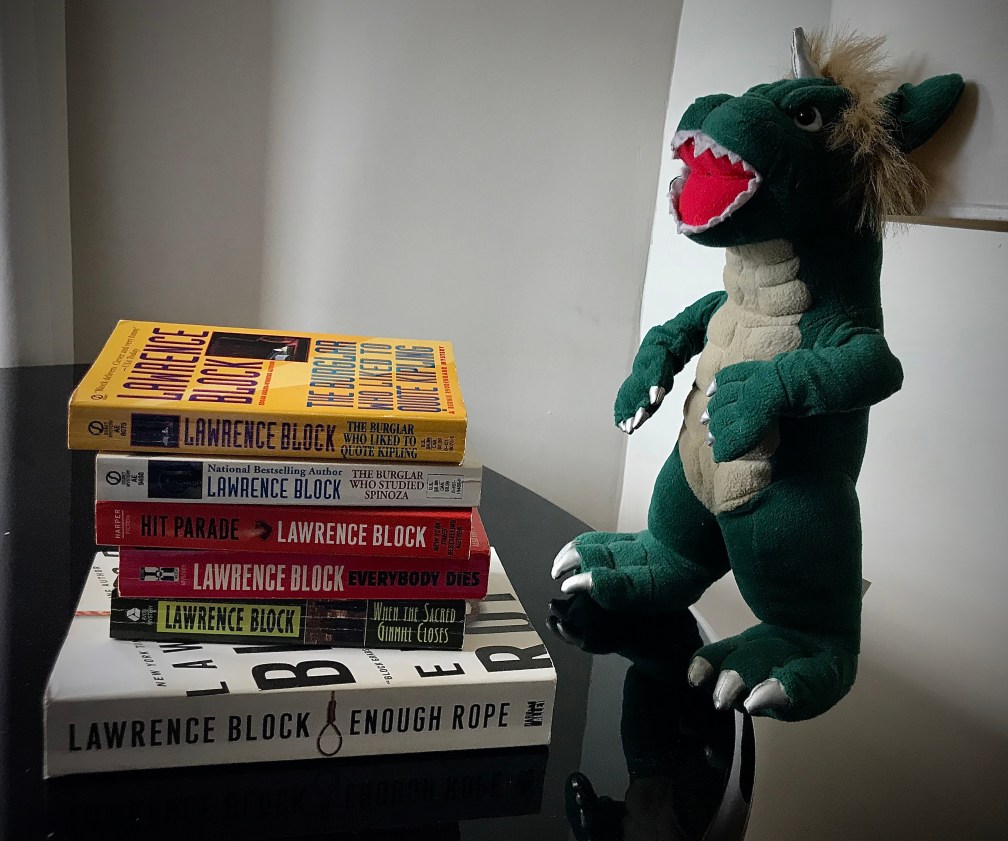
Birthday Wishes to Lawrence Block

fullsizeoutput_db8.jpeg

I’m taking the day off today, and my course is clear: rereading some favorite books by Lawrence Block, who turned 80 yesterday.

Block has long been one of my favorite authors, especially for three series characters: the alcoholic quasi-P.I. Matthew Scudder, gentleman thief Bernie Rhondenbarr, and introspective hit man Keller.

All the novels offer sardonic commentary on human misbehavior, and most of them concern the island of Manhattan. Indeed, Block “owns” New York City like no other crime writer.

Scudder’s New York City is a jungle, at times terrifying and ultra-violent. For many of his fans this is the definitive modern “tough P.I.” series. Bernie’s New York City is a ribald playground of silly cons and priceless art. This genial set of tall tales pairs neatly with the Dortmunder series by Block’s old friend, Donald Westlake. Keller’s New York City is a existential question, a quirky series of choices where the answer usually ends up being, “Yep, I’ll kill this person, too.” Yet, somehow, after reading a Keller book, one feels happy and refreshed.

For first time readers I’d suggest When the Sacred Ginmill Closes for Scudder, The Burglar Who Liked to Quote Kipling for Bernie, and Hit Man for Keller.

There are also many Block standalones. A stone classic for deep Block fans is the profoundly noir espionage saga Such Men are Dangerous, published a half-century ago under the pen name Paul Kavanagh. Just recently The Girl With the Deep Blue Eyes offered a delightful riff on the pulp tradition that started Block’s career.

In the end, we read Block for his voice. Laughter and suspense are unforced.  Each sentence just falls into place after the next.

It’s a big birthday, one of those that ends in a zero, but it is Block’s readers who are are celebrating, for there is not just a new Scudder novella on the way but also a graphic novel adaptation of Eight Million Ways to Die by John K. Snyder III that Block himself says is exceptionally good. I loved the Darwyn Cooke adaptations of the Richard Stark books so I’m looking forward to checking out Snyder’s take on Scudder.

Well, that’s all for now, it’s my day off, and I need to get back to The Burglar Who Liked to Quote Kipling. But I’ve gotten to know Larry a bit in the last few years and wanted to give a birthday shout. And: truly: if you’ve never cracked open a Block classic, what are you waiting for?

Related DTM:

Lawrence Block blindfold test.

The Crimes of the Century.


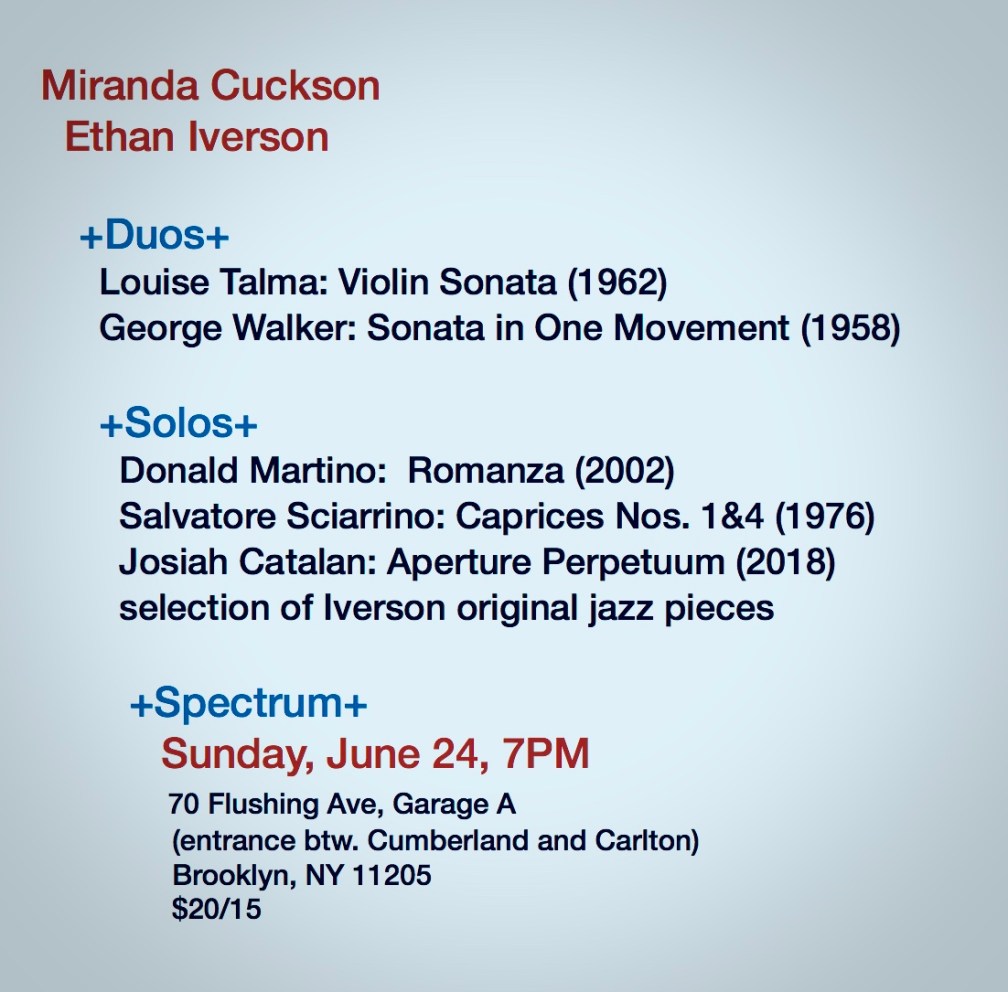
Concert at Spectrum

fullsizeoutput_daf

These violin sonatas by Louise Talma and George Walker are both in a “Midcentury American” style I love so much. Miranda Cuckson loves that era as well: Indeed, her extraordinary solo album of Ross Lee Finney was my introduction to another major voice from that era.

Both Talma and Walker studied with Nadia Boulanger, and in fact the Talma sonata was written as a tribute to Boulanger for her 75th birthday. As far as I know, neither sonata is played that often, and in both cases I have found only one recording. The Talma recording with Catherine Tait and Barry Snyder is good. Walker with his son has some editing problems. If anyone has a line on other recordings I’d be curious to hear them!

I met Talma briefly when I worked with the Gregg Smith Singers in the early 90s; she was also a mentor of my teacher Sophia Rosoff.  Walker is still around — he and Lorraine Gordon were born the same year — and I interviewed him for DTM a while back.

(Periodic reminder to DTM mavens that Walker’s book Reminiscences of an American Composer and Pianist is one of the best things I’ve ever read.)

related:

Interview with Miranda Cuckson
Program notes to Fine, Gideon, Talma
Interview with George Walker

RIP D.J. Fontana

Longtime Elvis Presley drummer dies at 87.

It must be said, the “stop time” breaks in “Jailhouse Rock” are a hell of a thing. 1957.

 
In the obit, Fontana says, “I think the simple approach comes from my hearing so much big band music. I mixed it with rockabilly.”

Once they start playing time, Scotty Moore on rhythm guitar plays even eighth notes while Fontana plays swing eighths.

American music.