Honoring Jabali at Healdsburg

There are two days of “Honoring Billy Hart” at Healdsburg Jazz Festival this coming weekend. This is simply a must-see for jazz fans in the greater Bay area.

June 4 begins with Quest, the classic foursome with Dave Liebman, Richie Beirach, and Ron McClure, followed by Enchance, a new edition of Billy’s famous 1977 A&M album with Eddie Henderson, Oliver Lake, Joshua Redman, Craig Taborn, and Dave Holland.

June 5 starts with the current Quartet with Mark Turner, Ben Street, and me, followed by a new edition of the burning working band that lasted a decade and recorded for Gramavision and Arabesque, Oceans of Time, featuring Mark Feldman, Craig Handy, Chris Potter,  David Fiuczynski, David Kikoski, and Cecil McBee.

This is really kind of an unbelievable collection of all-stars. I’ve been involved behind the scenes a tiny bit and have noted approvingly how everyone has dropped other plans and consented to work for a nominal fee in order to honor Jabali.

“Billy Hart, Honored in Healdsburg, Picks His Five Most Important Recordings” by Andrew Gilbert is a worthy read (I admit I’m quoted as the lead).

Next week TBP plays on the West Coast, including TBP Josh Redman at the Playboy fest. Sign up for Floyd Camembert Reports for general tour spam and an occasional Easter Egg not found on DTM…

A Great Guy, With a High Standard of Musicianship

New DTM page: Interview with Houston Person.

This interview is in advance of a week at the Village Vanguard June 14-19: My quartet with Ben Street and Billy Hart featuring Houston Person.

Of course Ben and Billy and I are very familiar with each other, and in fact we plan to play a trio feature for Billy every set drawn from the repertoire of the Billy Hart Quartet.

The surprise is Houston Person.

Houston is 81 and arguably the last of the line in terms of an old-school blues and ballads tenor saxophonist. His sound is big and furry. It sounds like he is gruffly speaking to you; perhaps he’s even offering some kind of recrimination or an authoritative directive to act more honorably in the future. After a particularly bluesy phrase, you start up from your chair and promise, “I will!”

At the end of the day, the tenor saxophone is my favorite instrument. I’ve been blessed to play a lot with peers who are avatars: Mark Turner, Bill McHenry, Joshua Redman. But as a fanboy nothing tops little moments with older greats. One time Dewey Redman was in my apartment. He took out his horn and we played Ornette Coleman’s “Broken Shadows” together. That was it.

Likewise, two months ago Houston Person showed up for our first duo rehearsal. He’s a gregarious man who wants to make sure everybody is laughing first. It’s impossible to park in my neighborhood (informally called “Park Nope” instead of “Park Slope”) yet he laughingly found a space a block over. I could see that this was someone who always walks between the raindrops.

Inside, Houston took out his horn, I played a little intro, and he offered a perfect chorus on the old torch song “Once in a While.” Again, that was it.

One of my first little jazz tapes was a session of Harry “Sweets” Edison and Eddie “Lockjaw” Davis with Kenny Drew and good European musicians in Denmark. I listened to this over and over. It sounded like Sweets and Lockjaw were talking while they played.

Lockjaw had one of those old-school tenor sounds. No one is greater than John Coltrane, but in his wake the sonic concept of the instrument was irrevocably changed, with the sound getting more focused.

Tenors before Coltrane had more leeway. There was lots of vibrato: it was even furry, burry, or murky. There was less emphasis on nailing complex changes, although there was actually more detail per note. Transcribing Lockjaw Davis on a slow blues or ballad is essentially impossible compared to transcribing a post-Coltrane tenor.

In the interview Houston talks a lot of different tenors. He’s open to it all. But he particularly wants credit given to the blues and ballads tenors of his youth.

There are some who try to bring back some furry and burry to the tenor today, and more power to them. But calling Houston essentially the last of the line is not just about his sonority, it is about the complex social mechanism that brought his music into being.

A striking anecdote from the interview is about how Houston learned about Sonny Rollins. While in college at South Carolina State College (which of course was then a segregated school), a basketball player from New York City stopped his pre-game warm up to show Houston some Sonny Rollins licks on the horn.

This, ladies and gentlemen, is the real 20th-century jazz.

Houston is well-known in some circles but not in others. Frankly it is too long since he has played the Village Vanguard.

Ron Carter got it right away. When I told Ron I hired Houston for a week, Ron nodded his head and said, “You want to learn how it goes.”

Exactly.

Sonny at 19

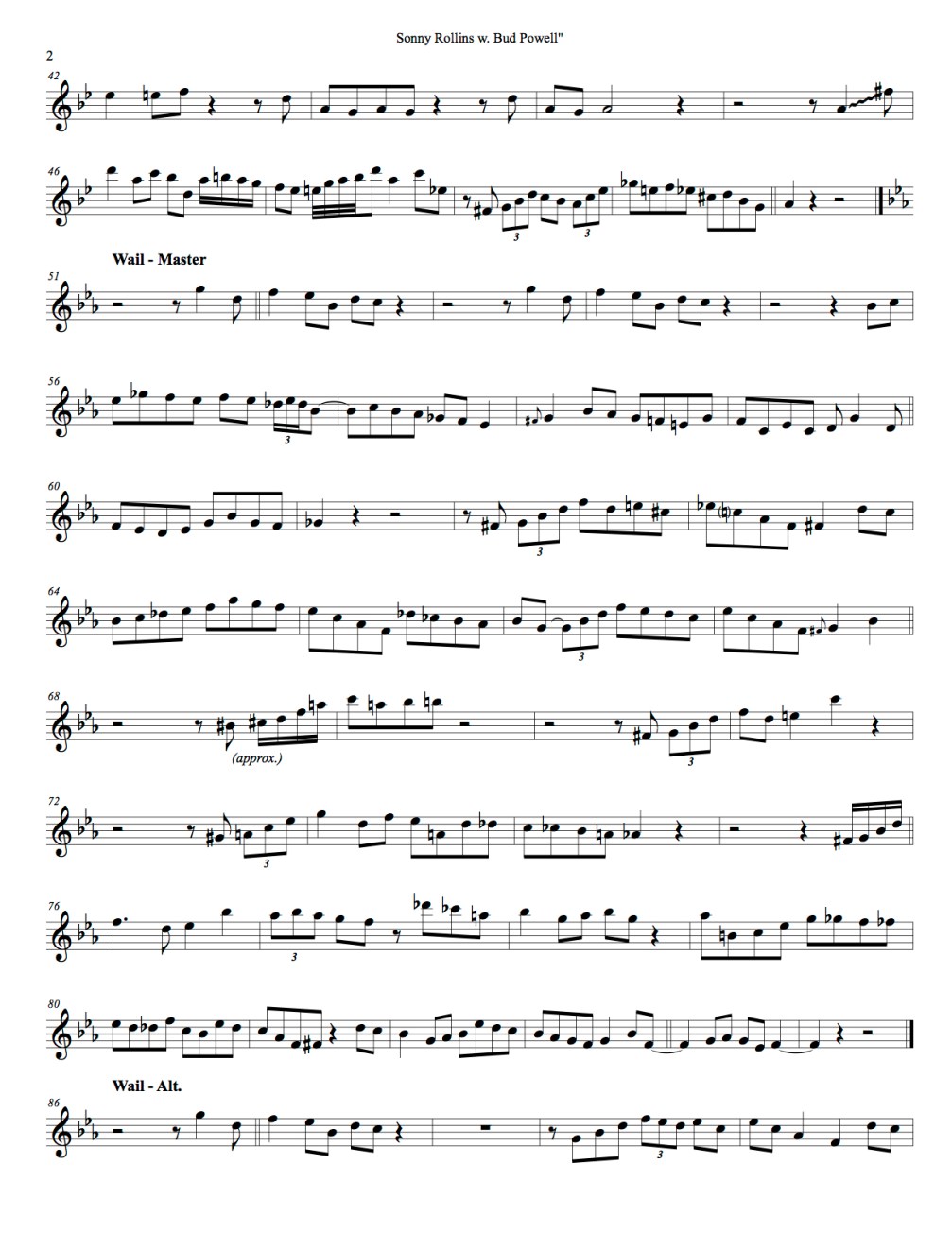
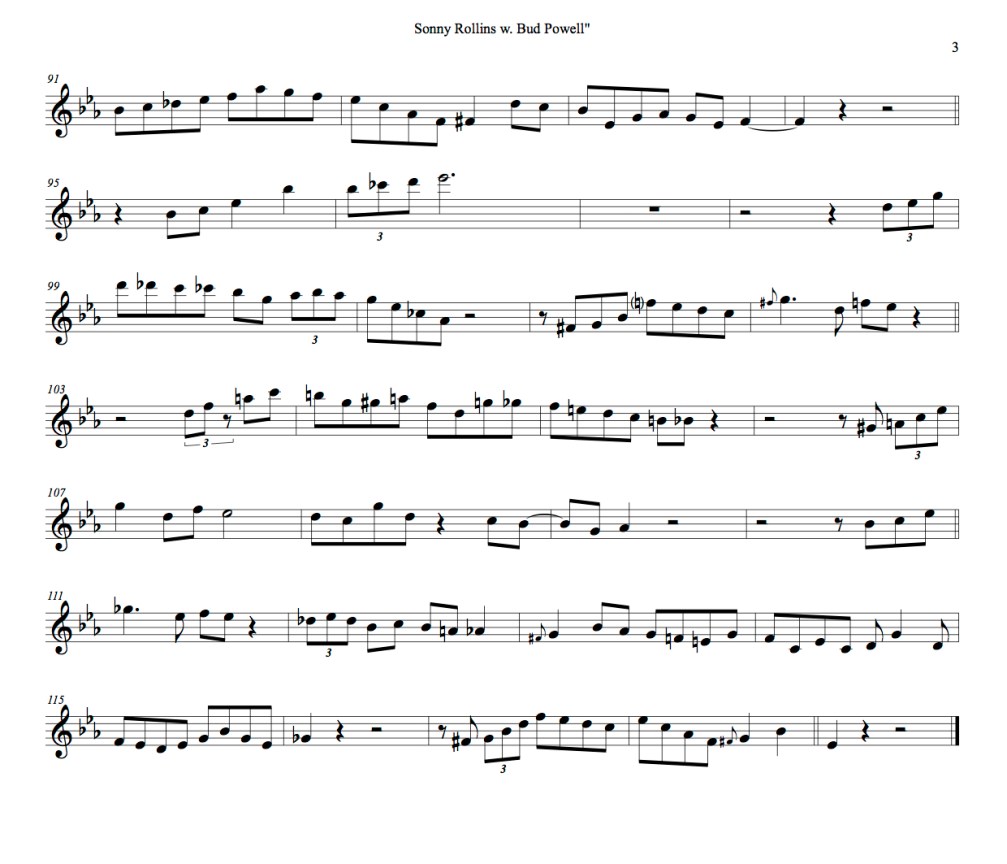
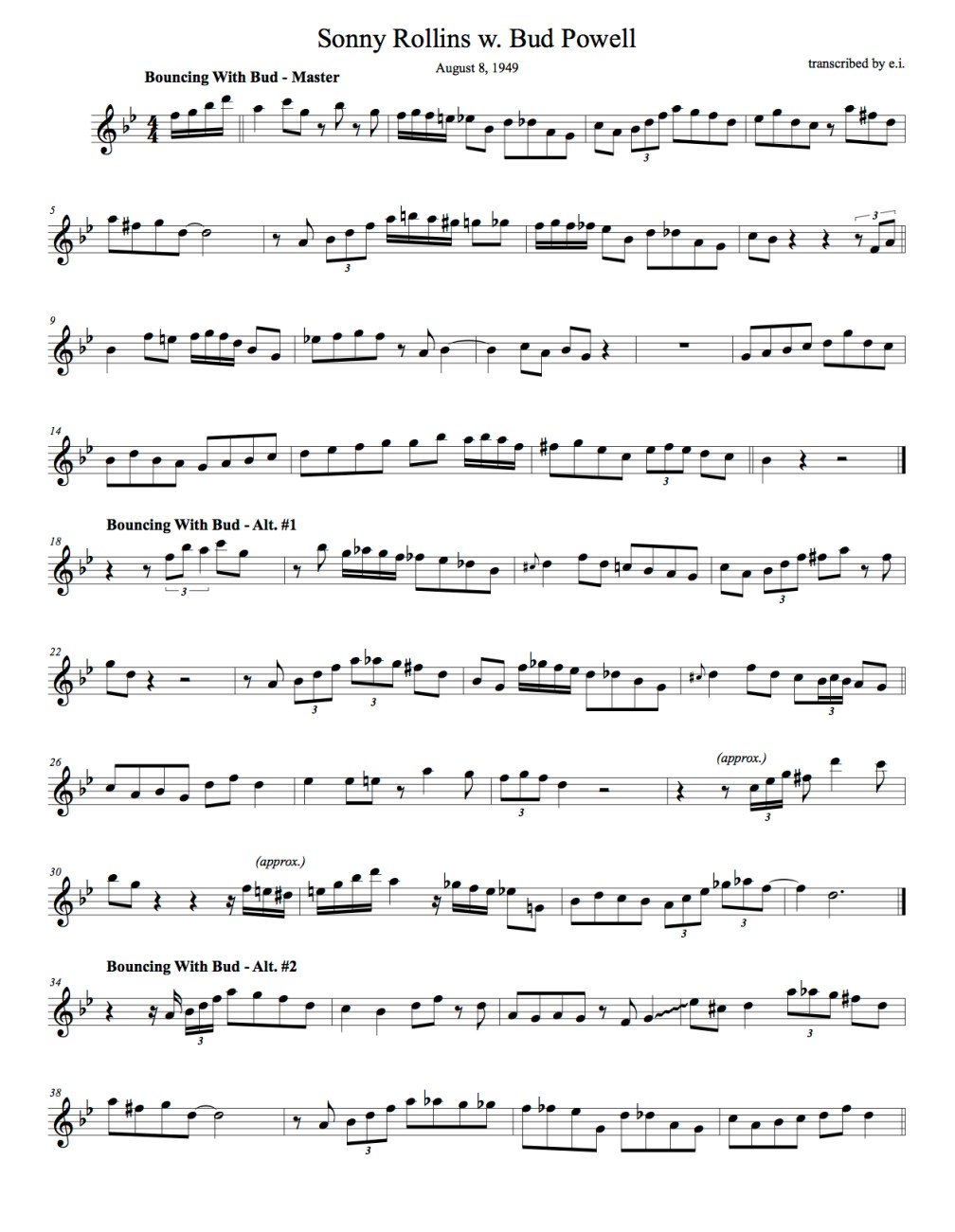
It was great for my education to transcribe Sonny Rollins’s solos with Bud Powell Modernists on Sonny’s first record date but now these don’t fit with the expanded argument in progress…

sonny bud 1Sonny bud 2Sonny bud 3

“Bouncing With Bud” master:

“Bouncing with Bud” alternate #1:

“Bouncing with Bud” alternate #2:

“Wail” master:

“Wail” alternate:

Musical Austerity, Musical Plenty

The late Masabumi Kikuchi has a testament, the solo piano concert Black Orpheus just released on ECM.

It was an honor to get to know Masabumi a little bit. He was the real deal, a 20th-century scoundrel/genius/artist in solitary and stubborn pursuit of his greatest work. The best tracks on Black Orpheus are perfect music.

I was pleased when Manfred Eicher asked me to contribute liner notes. As far as I am concerned, Masabumi is part of the history of this music.

Ben Ratliff review of Black Orpheus.

Masabumi Kikuchi DTM interview.

Masabumi believed in one thing: trying to make each note a private singularity. Of course he had influences, he even made concept albums, but “being Masabumi and no one else” was the end goal.

That’s always the goal for every serious poetic artist, although in the postmodern era it gets harder and harder to do. As Mark Turner says, “It takes longer to be great now because there is so much more to learn.”

Speaking of Ben Ratliff and the pursuit of knowledge, I learned a lot reading Ratliff’s latest book. Every Song Ever: Twenty Ways to Listen In an Age of Musical Plenty is a manifesto of the postmodern age, declaring that is our duty to take on all kinds of music with equal seriousness.

“Musical plenty” is very much our moment. Perhaps it will remain our moment until the human race outgrows the personal computer.

The question remains: How deep are you listening to all that “plenty?” Ratliff hears a tremendous amount, and his fluid and poetic prose style is always a pleasure to read. His mildly sardonic yet utterly sincere attitude when addressing Mariah Carey or Grateful Dead fandom is almost a kind of genius.

Ratliff was first known as a jazz critic, not as a general music critic, but an important harbinger of his eclectic tastes was an early insistence on Afro-Cuban as essential to jazz. (Most jazz players know this but it few critics have emphasized it like Ratliff.)

The real point of something like Every Song Ever: Twenty Ways to Listen In an Age of Musical Plenty is to make the reader go buy some records. Ratliff got me with Patato & Totico.

There are many distinctions to Patato & Totico, the record made in 1968 with Totico Arango singing over Patato Valdés’s percussion, accompanied by Arsenio Rodríguez on tres, Cachao Lóoez on bass, three players on claves, and a five-man vocal chorus. It is the closest thing the the 1960s New York rumba community—an exile Afro-Latin culture that regularly gathered to play in public spaces—had to an authoritative document.

(…)

Its tracks are poetic rituals, not like most of what we listen to in this world. They’re street-rumba tracks, but they’re untrue to street-rumba reality: they are not field recordings or standard, flat, fast-and-cheap documents. They include a guitarist, or actually a tresero: categorically an ingredient not normally heard with rumba, and specifically the best tresero ever to have lived. 

I can’t remember the last time a CD refused to leave my home stereo player quite like Patato & Totico. It just stays in there. I play it for everybody who comes over. What an album, perfect in every way. The presence of tres and bass make it perhaps especially relevant for comparatively unhip jazz players like myself, a gateway to assimilating a tiny bit more detail about the vast mysteries of Afro-Cuban music.

Billy Hart knows a lot about Afro-Cuban music. The very first time I went to his house he played field recordings from Africa and Los Muñequitos de Matanzas.

There’s a new release of a historical gig, Getz/Gilberto ’76, a night at the Keystone Korner with João Gilberto playing Gilberto music with Stan Getz’s quartet with Joanne Brackeen, Clint Houston, and Billy Hart.

Of course, I am a Billy Hart disciple and devotee, but: Jabali deserves a special award for his stunning drumming on Getz/Gilberto ’76. The subtle syncopations of Gilberto’s guitar are matched perfectly by Billy Hart, first by “simple” dry cross-sticking clave patterns and then by peaceful undulations with the whole complement of drums and cymbals. Billy definitely studied for this one.

I’m actually in Brazil right now. It’s raining softly: the window is open slightly: João Gilberto is singing.

While the blues fest was raging outside in Paraty last night I was in bed, reading Murray Talks Music: Albert Murray on Jazz and Blues, a new volume edited by Paul Devlin. Sincere thanks to Devlin for this important labor of love.

Murray was kind of like Masabumi Kikuchi in a way, a man committed to one precise vision. Part of their genius was to be provocative. Thomas Chatterton Williams’s recent important article about Murray in The Nation posits Murray and Ta-Nehisi Coates as antipodes.

At any rate, Murray is rare touchstone writer for jazz. Indeed, there’s an argument that the later career of Wynton Marsalis and the entire edifice of Jazz at Lincoln Center is founded on Murray’s work. This is the only case of a major jazz musician treating the work of a major jazz writer with such reverence.

I’m still reading Murray Talks Music –the highlight so far is Murray’s interview of an outspoken Billy Eckstine–but wanted to mention it on DTM in order to preview an event at the National Jazz Museum of Harlem on Wednesday (that I’ll be very sorry to miss): Murray Talks Music: A Book Party and Discussion.

Related DTM:

Notes on Albert Murray Memorial

Study Up on Albert Murray by Paul Devlin.
 

Tones for Overton

New DTM page: Hall Overton, Composer, a vast expansion on an old solipsistic DTM article called “Six Degrees of Hall Overton.” Indeed, there is hardly anything of the old essay left, although there’s still the score to “Polarities No. 1” (but with a new recording).

For (probably) the first time since 1954, New York will be able to hear a performance of the unrecorded Overton Piano Sonata at an ACA concert at Spectrum May 26. The companion piece of my own composition is titled, “Another Tonal Salvo” (an anagram of “hall overton sonata”).

DTM’s coverage of classical music has been uneven. The best thing is the interview with Marc-André Hamelin. Also important is the interview with George Walker. Refurbished and updated with comments on recent recordings are the overviews of Irving Fine and Peter Lieberson (the latter is now much improved).

All the classical music pages on DTM are collected under the nav Sonatas and Études.

Fashionable Crime

My good friends Vince and Rosemarie Keenan have taken an alias for the first of a new series. Welcome, Renee Patrick, and so pleased to meet your frothy debut novel Design for Dying.

The Keenans and I have spent many hours discussing books, movies, and television, usually of the old-fashioned kind: the classics of film noir and the golden age of mystery. It makes perfect sense that these experts would create an expert homage to 30’s glamour and danger.

Their detective mastermind is true-life costume genius Edith Head, but truthfully Head is in the rather remote position of a Nero Wolfe. The action is carried by Lillian Frost, an Archie Goodwin who wears out the shoe leather while searching for clues.

The danger for a book like this is taking itself too seriously. The retro Nate Heller mysteries by Max Allan Collins have enjoyable historical detail but Collins’s naturally gritty and noir affect becomes awkward when, say, Heller seduces Amelia Earhart.

Far from attempting to be noir, Design for Dying is intentionally funny, perhaps especially when interacting with famous historical figures. After meeting Bob Hope at a costume fitting, Frost almost talks with him at a party:

I would have gone down to enjoy the show were it not for a frantic blur of movement to my right. A dressed-for-the-links Bob Hope was signaling me with his fingers, his eyebrows, the tip of his nose — and the fact he’d stepped away from his handsome wife, Dolores, to do so gave me the impression he was trying to arrange an amorous assignation. I responded with a flurry of nonsensical gestures, indicating either to steal third base or meet me at the boathouse, then beat a hasty retreat to the left.

Another great joke for mystery buffs is about the identity of the murderer. Read it and you’ll see.

The seriousness of the book is not about the mystery, but about the craft of Hollywood. Tribute is paid to all the lesser known talents who are just as responsible as the famous stars for a great movie. This topic is explicated in Renee Patrick’s Q & A at “My Favorite Bit.”

Vince and Rosemarie are in coming to New York this week to meet, greet, and sign at Mysterious Books Tuesday at 6:30. I’ll be on tour in South America, and truthfully it breaks my heart a little bit that I will miss them in my town, especially after all the hours they have spent showing me a good time in Seattle.

—-

New DTM nav collects my crime fiction criticism under Newgate Callendar. This is not just a misspelling of the 19th-century journal of English crime The Newgate Calendar but actually stolen whole hog from Harold C. Schonberg, the eminent New York Times classical music critic who worshipped Josef Hofmann, wrote an intimate book about Vladimir Horowitz, and dismissed Leonard Bernstein, Glenn Gould, and Pierre Boulez: Schonberg also wrote reviews of mystery novels in the Times under the pseudonym “Newgate Callendar.”

I began writing up crime fiction for DTM with an overview of Donald E. Westlake after Westlake’s passing. The last time I saw Don he was cautiously optimistic about signing a deal allowing the early Parker books (which Don wrote under the pseudonym Richard Stark) to be adapted to graphic novels. He said he approved of the visual style and was pleased the artist promised to retain as much text as possible.

The artist was Darwyn Cooke, of course. The comic book world has been rocked by Cooke’s shocking death from cancer yesterday. Cooke’s Parker adaptions have been lauded both by Stark fans and comics fans. One of my favorite passages in Stark is the long sequence of heists in The Outfit. Cooke’s solution to condensing all that action, including different styles of art for each theft, is simply brilliant.

Winnsboro Cotton Mill Blues

Is music political? Of course, and never so more than in the current conversation. Indeed, it is absurd to consider the recent tidal wave of Beyoncé’s Lemonade as divorced from politics. Amazingly, Beyoncé is actually making headway on progressive issues with the general populace.

There is a price, a kind of corporate tax any truly major pop artist has to pay when part of the industrial complex — I nearly capitalized Tidal in the previous paragraph — but, then again, all progress comes at a price.

Lawrence Block makes the helpful suggestion that all artists are driven first by ego and avarice.

This is the fundamental problem with most overtly political stances within less mainstream music like jazz. My hero, Charlie Haden, made records that all but proclaimed that he was a Communist…but the personal reality was that Charlie refused 5-star hotel rooms that didn’t have thick enough towels and sent back salads that didn’t have enough blueberries.

Traditionally I suspect jazz’s most impressive political power was through understatement. When listening to Count Basie with Tootie Heath, I asked Tootie if the Count’s music was political. He replied: “Of course! Think of what it meant in 1940, to have all those black musicians in suits looking good and swinging so hard.”

Absolutely.

Still, if you look at the wonderful autobiographies of Basie band stalwarts Dicky Wells and Marshall Royal, changing the world was a possible side product (at best). Most of the discussion is of getting paid and getting laid.

One person who walks the walk as well as talks the talk is Frederic Rzewski. I commend Zachary Woolfe for two articles in the New York Times:

In His Notes, Protest, and Politics

A Primer to One of America’s Most Political Composers

This coverage in support of three concerts at Bargemusic tonight, tomorrow, and Sunday. I’m about to get on a plane to Europe otherwise I would be there.

My favorite Rzewski disc is North American Ballads and Squares on Hat Art. In Ballads he wildly deconstructs protest songs in a theatric and virtuosic fashion.

Rzewski improvises the cadenzas, too. Indeed, he is the rare kind of classical pianist-composer who can improvise non-tricksy, deeply felt, tonal/atonal cadenzas at the drop of a hat.

The best place I know to hear Rzewski improvise on the music of another composer is his Cornelius Cardew recital We Sing for the Future! (Cardew was another political composer who practiced what he preached.)

On hand at Barge to assist will be violinist Miranda Cuckson. Miranda’s Melting the Darkness was one of my favorite discoveries last year, and now there is a new ECM record of Béla Bartók, Alfred Schnittke and Witold Lutosławski with the equally brilliant Blair McMillen.

This duo plays LPR on Tuesday. Highly recommended.


Agamemnon Hears You

Last night Sarah and I went to the Met, where we were absolutely floored by a production for the ages: Richard Strauss’s Elektra, sung by Nina Stemme, directed by Patrice Chéreau, conducted by Esa-Pekka Salonen.

The staging and costumes were unusually bare bones for the Met. Salonen’s interview with Alex Ross about Chéreau is extremely helpful. This Elektra is opera as theatre, not opera as spectacle.

For another experienced opinion, read Anthony Tommasini’s rave review.

My first real exposure to Strauss was a performance of Salome in Finland in my early twenties. It was one of the greatest things that had ever happened to me, and I spent serious time running down scores and records of Strauss’s major works.

Strauss has ended up being the source of several of my best opera-going experiences, not just most famous modernist psychodramas Salome and Elektra but also the meta Capriccio and the static-but-lush Die Frau ohne Schatten.

Like everyone else I also adore the Metamorphosen for 23 Solo Strings and Four Last Songs. There’s  a lot more to explore, though: Parergon zur Sinfonia Domestica is what I champion as an overlooked Strauss masterpiece.

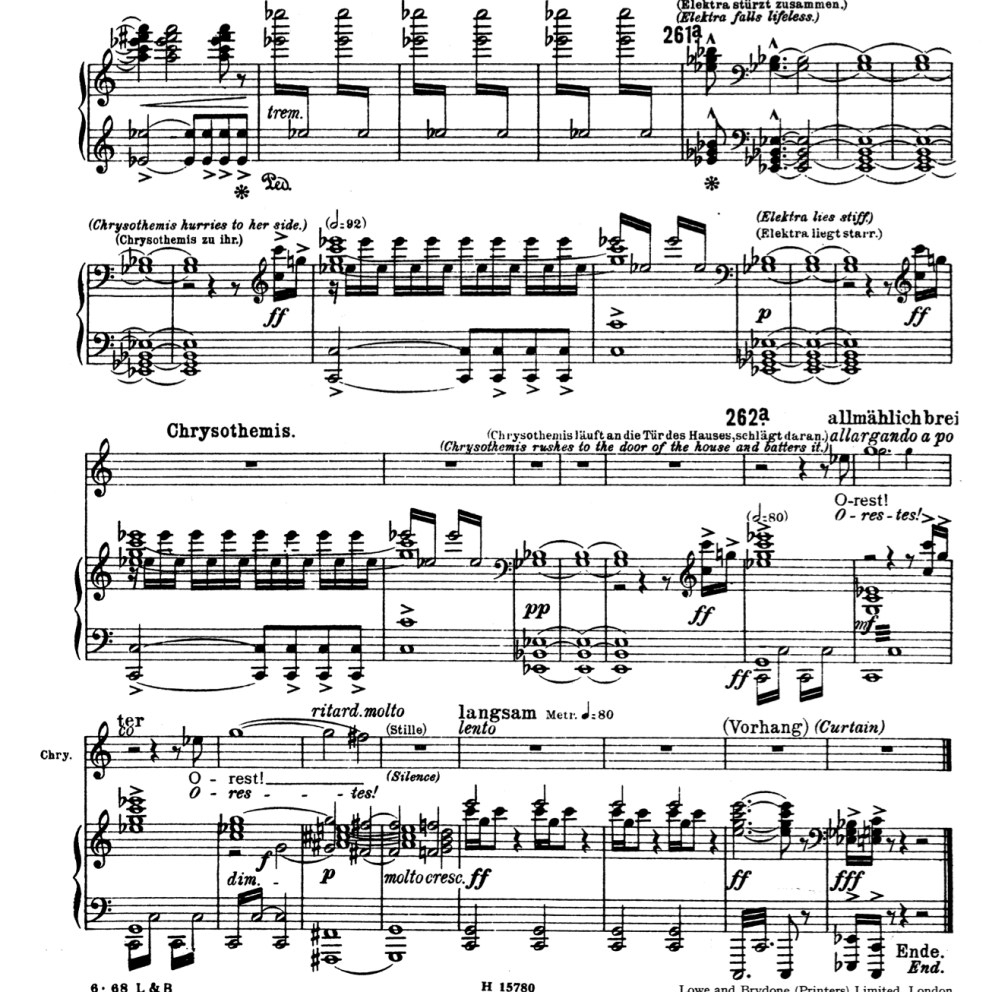
In Elektra, Strauss goes to the cliff and contemplates true atonality. The chromatic orchestral roar when the title heroine recognizes her brother remains shocking today (let alone what it must have sounded like in 1909).

In the end, though, Strauss’s genius is the manipulation of tonal harmony for ironic effect. For the final pages, we are either in C minor or Eb minor. Then there is the most brutal and dissonant resolution (the last vocal note is an unresolved F#) to repeated uniform blocks of C major.

Elektra end


Never has C major been so hollow.

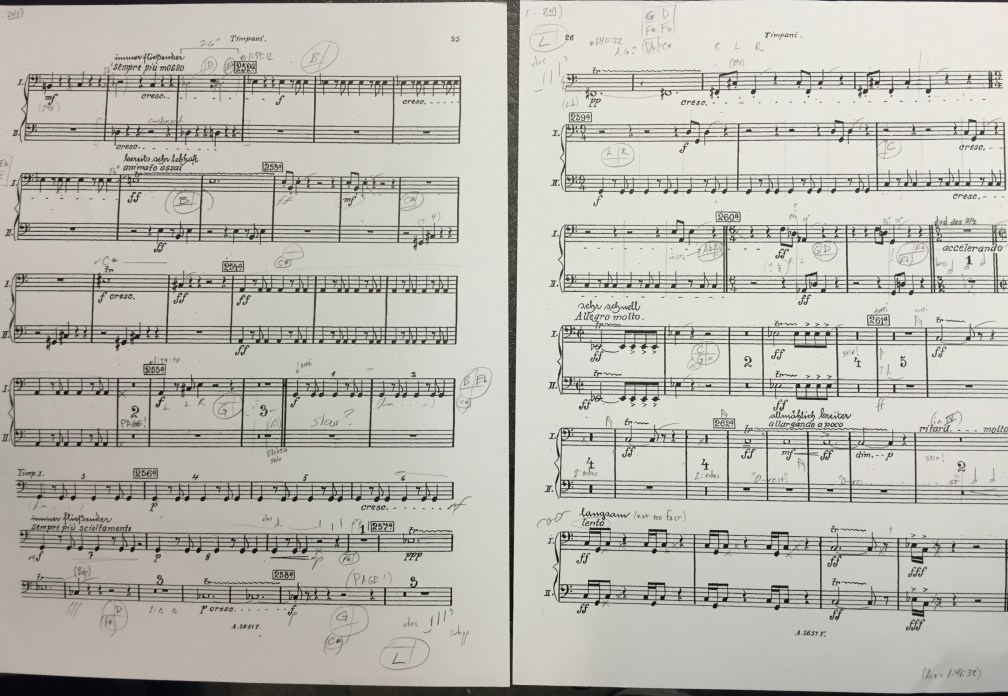
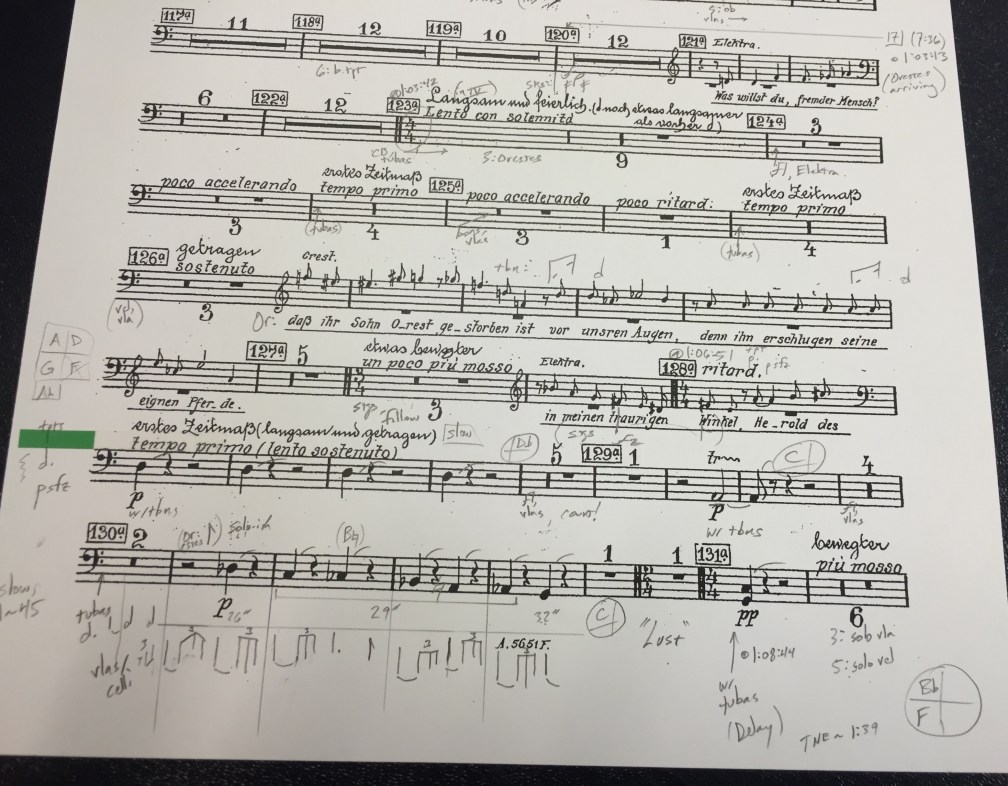
Afterwards we visited percussionist Jason Haaheim backstage. Last year when we saw The Rake’s Progress I took a lot of photos, now archived at the end of my longer Stravinsky essay. Feeling like I couldn’t top that photo extravaganza this time — and frankly rather drained from have just watched Elektra! — I simply took a few shots of Jason’s annotated tympani score.

tymp 1tymp 2

Jason’s scribbles include cues and notes on how to get from tuning to tuning correctly. According to Jason this is one of the hardest tympani parts in Grand Opera. There are seven tymps in total, manned by Jason and Rob Knopper.

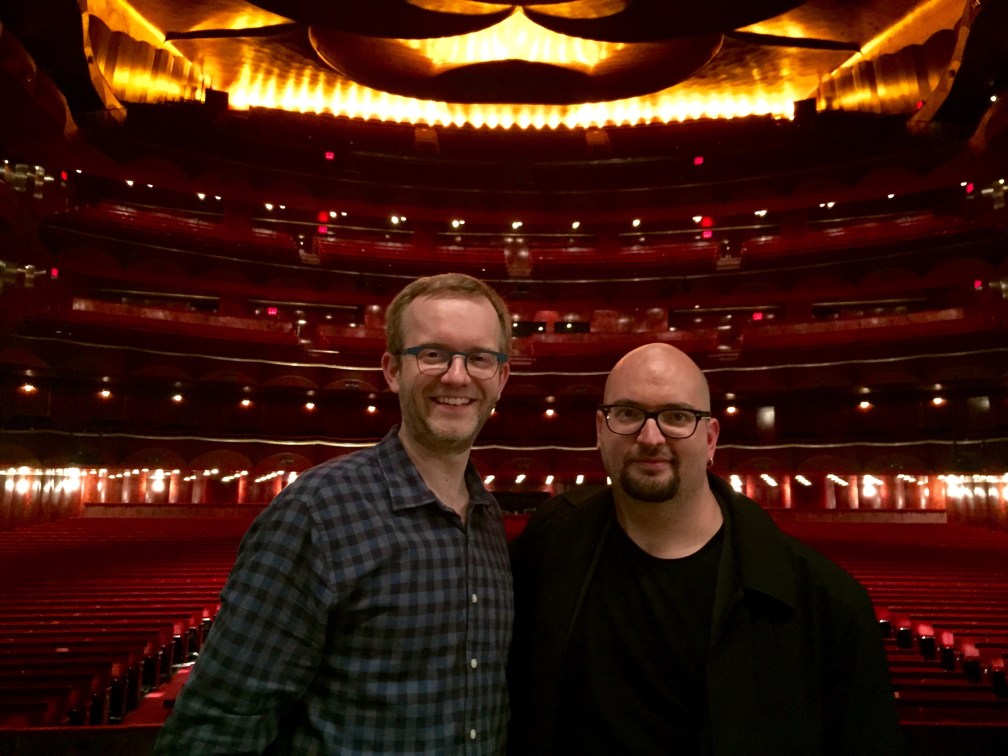
Sarah’s photo of Jason and me on the empty stage:

jason and ethan

The drama is done, the blood has flowed, each member of the audience is ready for group family therapy…but don’t worry, the crew was hard at work resetting the scene. There’s one more performance of Elektra Saturday night, closing out the Met’s season.

If You Want to Fly an Airplane, It Won’t Take Off Without Resistance

New DTM page: Interview with Wayne Shorter.

Very sorry to have recently lost the marvelous BBC program Jazz on 3. Through Peggy Sutton I interviewed Keith Jarrett, Django Bates, Gunther Schuller, and Henry Threadgill. The Wayne Shorter interview was something Peggy and I worked on for years to make happen; in the end I did it under the oversight of Chris Elcombe as Peggy was on vacation.

The “voice” Jez Nelson interviewed me a couple of times, the last on the occasion of Paul Bley’s passing. And Jazz on 3 also taped The Bad Plus in concert, perhaps most memorably at a gig with Django Bates. In fact I believe that TBP/Bates gig may have even been Jazz on 3’s idea!

At any rate, certainly Tony Dudley-Evans is correct when he says that for the last 18 years, Jazz on 3 was a “leading influence in the development of the UK scene.”

Thank you all! Hope to see you in London the next time I’m there.