True Stories

Highly recommended: T-Rex, a mighty documentary about the first truly great female boxer, Claressa Shields. Claressa is from the hard luck town of all hard luck towns, Flint, Michigan, and the documentary is profound comment on the American condition. T-rex concludes with her first Olympic victory in London; Claressa just won her second gold medal in Rio.

T-Rex is currently streaming on Netflix.

My wife, Sarah Deming, has a cameo in the opening scene of T-Rex and cheered on Claressa from the stands in Rio. She profiles Claressa in a forthcoming major boxing anthology from University of Chicago Press and yesterday just got her first byline in the New York Times:

“How Boxing Got Me to Face my Fears.”

Another valuable related piece in the Times is by Jaime Lowe: “Women’s Boxing has Been In the Shadows for Too Long.”

Steinway, Sweeney, Paulson, and Trump

Halfway through an evening of comedy, Victor Borge would pause and offer a kind of quick commercial related to his inability to properly play the instrument onstage:

“Ladies and Gentlemen, the Steinway people would like me to announce that this is a Baldwin piano.”

The hedge fund founded by John Paulson, Paulson and Co., owns Steinway pianos. Paulson has supported Donald Trump for some time and was recently named an economic adviser to Trump. As far as I know, this post is the first to make the Trump/Steinway connection explicit to an arts audience.

It is also the right place  for a few words about former CEO Michael Sweeney, who oversaw the recent revitalization of Steinway, loved jazz and art, but left because he and Paulson couldn’t get along. 

From Fortune:

Fortune 1Fortune 2

From Bloomberg:

Bloomberg 1Bloomberg 2

(…)

Bloomberg 3

(…)

Bloomberg 4

This past spring Steinway and Sons opened a beautiful new showroom just north of Bryant Park. Piano mavens mourned the loss of the old building on 57th street (“where Horowitz first played for Rachmaninoff!”) but insiders were actually cautiously enthusiastic about the palpable currents of reinvigoration coming from the staid standard bearer of excellent pianos.

Jazz musicians were especially excited, because Steinway’s CEO Michael Sweeney was obviously interested in diversity. When I met Sweeney late last year I was rather dumbfounded to be in the presence of a major corporate player who was always talking about artistic exploration and achieving excellence by any means necessary.

Sweeney had been a successful entrepreneur in a variety of situations but this was his first time working with an instrument company. He sure seemed to catch on fast. You could ask Sweeney anything about pianos and he had a detailed answer at the ready. He loved the factory in Astoria and all the legendary workers there.

At the opening night showroom gala, Yuja Wang played. A safe choice: she’s awesome and very popular. Sweeney introduced her as “one of the top classical pianists in the whole world” and he wasn’t wrong.

The other musical guests were a duo of Jason Moran and Robert Glasper. To my jazz readers that may seem also like a safe choice, but actually at a classical event this was rather radical. At one point Glasper got up and asked for a wine glass from the front table. He proceeded to stick the glass straight into the innards of his instrument — undoubtedly one of the “top pianos in the whole world” — possibly in part to prove that the more street-wise elements of Houston were representing at this frankly rather absurd gala for the 1%. (There was good musical reason for the wine glass as well: Glasper got a nice percussive sound from it.)

Sweeney was responsible for the programming of the gala, and he wasn’t just having a one-night stand with jazz, either. Sweeney was taking his time and learning more about the scene. At his suggestion, the two of us went to see Craig Taborn at the Jazz Gallery where he showered enthusiastic praise on Henry Threadgill when we were all in the elevator together.

Steinway is eagerly hawking the Spirio these days (mentioned in the Hamptons article above, the item J. Michael Evans wants to sell “to the Chinese, online.”) The Spirio is a fabulous toy for the ultra rich: a concert piano with a computer inside that reproduces a live pianist “exactly.” It’s a profound 21st-century upgrade of a player piano.

Sweeney explained to me: “A concert pianist will take two years with us picking out their B. It’s a once in a lifetime purchase for them, and we are delighted to take the time with whatever they need, that’s what Steinway is for. With the Spirio, though, a businessman walks in, sees the demonstration for 10 minutes, and writes a check for $110,000 on the spot because he’s buying for his mother or his kids.”

Sure enough, that weekend when I was at the Met Opera, the program had a prominent ad for Spirio for Mother’s Day. I mean, if you love your Mother, surely she deserves a Spirio!

To his credit, Sweeney was eager for his artists to figure out reasons for the Spirio to exist unrelated to the upscale market. Those “art” reasons aren’t entirely obvious, because the sound of Tatum or Horowitz coming out of the Spirio is less exciting than Tatum or Horowitz on record, simply because the soul isn’t present. Still, there is surely potential in the Spirio for creative exploration — Glasper and Mark Bradford got a shot at an unprecedented collaboration — and as an educational tool the benefits are manifold. Watching the keys move is especially mesmerizing when it is a jazz performance, perhaps recalling the days when everyone had to learn James P. Johnson’s “Carolina Shout” from a player piano.

My own tentative idea for Spirio was to transcribe and record some classic boogie woogies by Meade Lux Lewis, Pete Johnson, Albert Ammons, Jimmy Yancey, and Big Maceo Merriweather. I’d make formal scores suitable for classical musicians eager to replace that silly Morton Gould “Boogie Woogie Etude” with something more authentic. At any rate it would be great practice for me and a way to shine a light on master American musicians rarely mentioned around high-end pianos. Perhaps I could record into the Spirio accompanied by a fabulous drummer to help me swing harder and give the (drummerless) final track another kind of mysterious human element.

I suggested this to Sweeney, who immediately asked, “Which drummer?”

“I dunno: Nasheet Waits?”

“Great. He’s a Ludwig artist, and we need some good drums in the building anyway. Let’s get a set he likes and keep it around.”

The CEO of Steinway was saying his offices needed a good set of drums on hand! This may seem like nothing much, but trust me, this was a revolution.

Well, hopefully that revolution will continue and Sweeney’s ideas will still have sway at the company, but Sweeney isn’t at Steinway anymore. Last week he moved on, citing differences with the owner, John Paulson.

At the opening gala, John Paulson’s speech was comprised of the kind of self-congratulating “Wow, we’re great!” material that is standard issue from most rich people who appreciate rare art mainly for exclusive status and commercial potential. That didn’t bother me, because God knows us artists need our corporate sponsors. However, afterwards a friend warned me that there was a dark side to Paulson’s hedge fund activity before the housing crash.

Two weeks ago Paulson was named to Donald Trump’s economic team. Democracy Now! covered the news with a bit called,  “Trump’s All White Male Economic Team Includes ‘Financial Crisis Villain’ John Paulson”:

Democracy

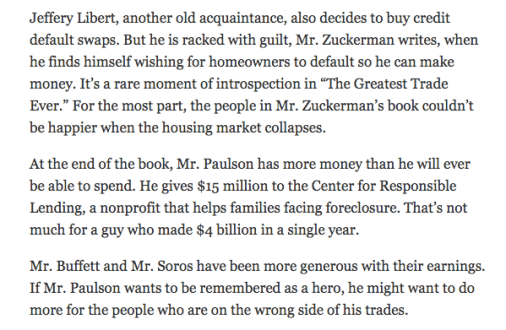
There are those that don’t regard a fervent lefty like Matt Taibbi as a flawless source. Indeed, for many financiers, Paulson is essentially a hero for bucking the odds and betting against the house. The 2009 Devin Leonard New York Times review of Gregory Zuckerman’s The Greatest Trade Ever: The Behind-the-Scenes Story of How John Paulson Defied Wall Street and Made Financial History is compelling, perhaps especially in conclusion:

leonard

At it turned out, Paulson has gone on to be a serious philanthropist, with massive gifts to the Central Park Conservancy ($100 million) and Harvard ($400 million), although neither of those benefactors were “on the wrong side of his trades.” (Both gifts had pushback from the left, with Malcolm Gladwell tweeting amusingly about the latter.)

There also is an argument that Paulson’s involvement with Steinway is almost a kind of philanthropy. Steinway seems genuinely committed to excellence first and foremost. Some say their current pianos are better than ever. I’d doubt that Paulson himself is overseeing it all personally, making sure that only the finest materials are on hand while crafting this most deluxe of tools, but he certainly hasn’t done anything to harm the brand. Considering how often a new corporate owner destroys the value of a beloved arts or entertainment icon, “not harming the brand” is actually doing a great job.

(I’m curious to see how this all goes forward without Sweeney around. In the timeline, Sweeney got there before Paulson and he was promoting the artistic mandate before the purchase by Paulson and Co. On the other hand, while I was obviously impressed with Sweeney, I have no idea if Sweeney was really doing a good job as CEO for the company in general.)

As we all know, the politics around big money are usually pretty bad. In music, probably most of the major instrument makers, record labels, festival production companies and colleges make corporate decisions that range from mediocre to despicable when considered in strictly humanitarian terms.

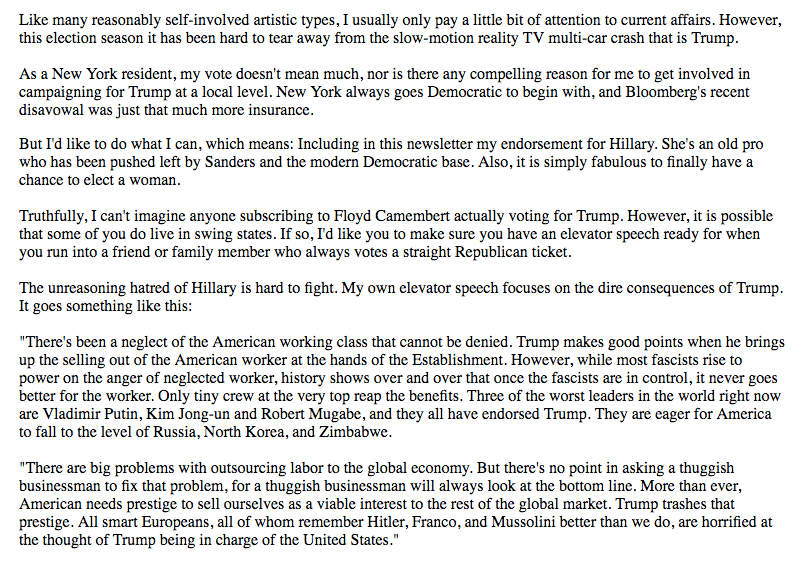
Still, getting into bed with Donald Trump crosses a line. Recently I wrote my community in the newsletter Floyd Camembert Reports:

floyd

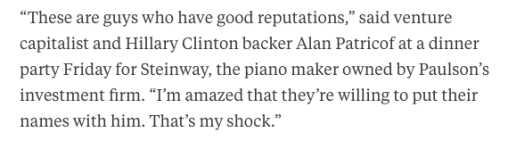
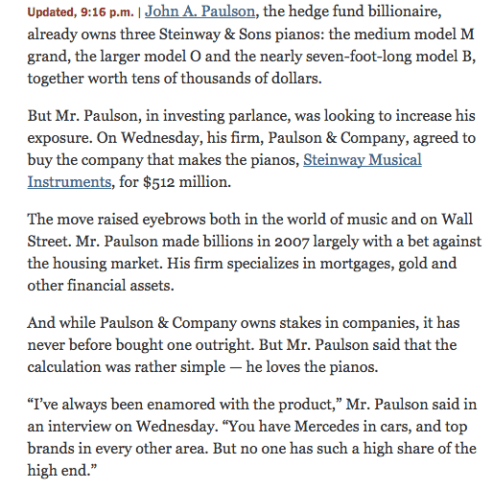
When Paulson bragged about buying Steinway in the New York Times, he sounded like Trump. It’s easy to see how they might get along:

NY times 1NY Times 2

With the Paulson/Trump alliance in full effect, I can’t in good conscience keep asking promoters to go out of their way to provide me with Steinway pianos.

I’m not calling for others to automatically follow my lead. Hey, if I played Rachmaninoff concertos for a living, I probably would regard a constant supply of exquisite pianos a necessity, not a luxury. And I hasten to add that everyone I’ve worked with at Steinway is qualified and helpful, and am sorry to lose a couple of nice professional friendships with this post.

(Update, November: Now that Trump is President-Elect, I do call on a consortium of high-profile Steinway artists to join forces and repudiate that relationship. You can play your Rachmaninoff concertos on new Fazolis, Yamahas, and Bosendorfers — and of course older Steinways — just fine.)

As a bohemian jazzer it is easy enough to go back to cheerfully accepting what’s in front of me every night with equanimity. In the end, a piano is just a tool. Whenever I’ve been confronted with a bad instrument, I’ve asked myself, “Would this low-grade tool stop Thelonious Monk, Bud Powell, or Paul Bley from creating miraculous human art?” (I know the answer is “no,” because some of their greatest records were made on terrible pianos.)

While on verge of becoming a full-scale Steinway artist I enjoyed some nice privileges, like getting a cheap rate for a magnificent D for the latest Bad Plus record It’s Hard and a good deal for my nice Boston at home. However, the piano on TBP’s Made Possible is a top-notch Yamaha, and it surely does the job. In fact, many of our fans think that is our best record.

As of today, it seems that Trump is doing everything he possibly can in order not to get elected, so perhaps I’m overreacting. But I do think my fellow pianists should at least be aware of this jarring dissonance at the top end of Steinway’s (pay) scale.

After all, while we all love beautiful things, part of our greater worth is the company we keep.

(UPDATE, a few days later: In interviews, reporters have been eager to nail down my relationship to Steinway. Was I a Steinway artist? To clarify: No, I was not. In pre-Sweeney years I was at Steinway picking out pianos only twice for ECM recordings with Billy Hart. The only piano store I had a relationship with for decades was the indie shop Klavierhaus, who supplied a few Faziolis to gigs and a Steinway for the TBP Rite of Spring record. Gabor Reisinger was my friend there, and sadly and shockingly he passed away at a very young age.

A year and a half ago Sweeney attended a night at the Village Vanguard where I played with Jason Moran, Stanley Cowell, Kenny Barron, and Fred Hersch. Sweeney wondered why I was the only one onstage who wasn’t a Steinway artist and gave his staff a mild mandate to make me one. He also became personally friendly with me and began bending the rules so that I would have Steinway benefits.

However, no one can become a Steinway artist unless they own a Steinway. I went to the factory but couldn’t afford the Steinway I really wanted, so I settled for a Boston, also thinking I would save up and trade in for a real Steinway in a couple years. Sweeney told me I could ask for pianos whenever I wanted for gigs and recordings, so I expected everything to be gravy.)

Modern Composition (Guillermo Klein, Tim Berne, Marc Ducret, Jason Moran)

In the past couple of months, the internet has offered a bounty of valuable articles about classical music, all at least somewhat interconnected:

Will Robin’s dissertation on “indie classical.” Unusually for a dissertation, this is a riveting read chronicling recent history.

A conversation with Paul Griffiths by Matt Mendez. I’ll have more to say about Griffiths on DTM in the future; Mendez impressed me very much with his liner notes to Peter Lieberson Vol.3, reviewed on DTM here.

Kevin Volans on the state of the modern classical composer. Some hated this but I found much food for thought, especially the detailing of government involvement in the careers of Boulez and Stockhausen and the crucial idea of “vocation.”

Philip Clark on the end of the great composer. Clark is onto something, but his attempt to take down Thomas Adès a peg or two is bewildering. (Probably best to chalk that up to some kind of byzantine perspective impossible to understand unless you come from England.)

Joshua Kosman’s rebuttal to the two above pieces. (Understandably, Thomas Adès tweeted approvingly of Kosman’s article.)

Joe Phillips looks at “indie classical” from the vantage point of race. Unsurprisingly, the news is not good. There’s something to be done here, a think piece going from Volans’s famous (and now perhaps dated) string quartet White Man Sleeps into Phillips’s essay….

“Reflection on Risk” by Ashley Fure. Darmstadt, a key town for 20th-century composition, is the provenance of this compelling analysis by a significant young composer.

—-

Four recent releases by artists in the “jazz” category show how much modern improvising musicians are concerned with composition.
IMG_1665

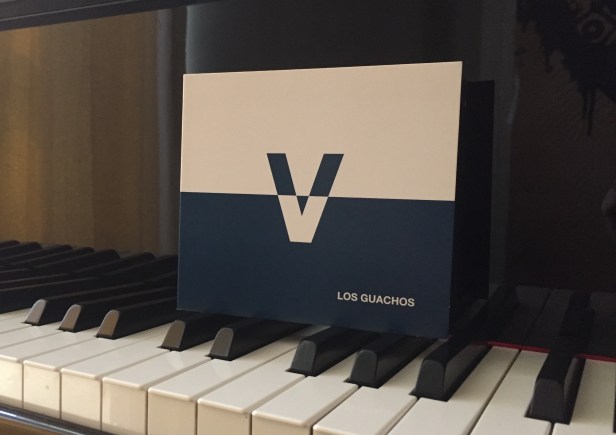
Anyone excited about the idea of “indie-classical” should rush to hear Guillermo Klein’s masterful Los Guachos, V. There’s all the tuneful rhythmic drive anyone could wish for, in this case seen through the prism of Argentinian folklore. Some of the greatest living jazz musicians are in the orchestra, so everything lays right, not least due to the presence of drummer Jeff Ballard.

There’s not so many improvised solos to be heard on V. Guitar hero Ben Monder gets to shred on “Si No Sabes 4/4” and Diego Urcola blows some tart trumpet on “Si No Sabes 9/8” but that’s about it. The focus is on detailed composition throughout.

However, Klein would not be able to get the effects he does without a committed band of heavyweights. Everyone has been in Los Guachos for years and years at this point. They honor the composer but they also play the music like leaders themselves.

Two suites dominate the disc. The first three pieces are a marvelous deconstruction of the changes to “Back Home Again in Indiana,” better known these days as “Donna Lee.” The second is a long exploration of a few key generative ideas in Suite Jazmin. (Speaking of dissertations: unpacking Klein’s compositional devices is a worthy topic for a talented scholar.)

Steve Reich is a common inspiration these days, but what makes the difference on V is Guillermo’s command of jazz harmony. More accurately, it is simply harmony: the movement of the 12 pitches through keys. V is where process and phase music needs to go! True masters of harmony like Klein — even Reich isn’t quite there on the harmonic tip — are needed to rescue post-minimalism (especially “indie classical”) from dead ending into banalities.

After the heady suites there’s a surprise, a straight cover of unconventional jazz icon Andrew Hill’s anthem “Ashes” that smoothly transitions into Klien’s own ballad “Quemando Velas.” This unlikely pairing shows the distance Klein is trying to cover with his personal conception of twisted romance.

I’ve been a fan of Guillermo’s for a long time. However this album might be the first one to really capture the magic of seeing the band live on a good night. Klein is also obviously still growing as a composer. The future awaits.
IMG_1664

High modernism did its best to kill off the personality of the performer. God bless those specialists that strive to execute every dot, dash, and dynamic marking in Babbitt or Boulez.

Perhaps one of the most successful general uses of high modernism is in avant-garde jazz, where an improviser can summon a similar kind of discontinuity with off-the-cuff ease.

I asked Tim Berne how many originals he had recorded. He grunted and said, “I have no idea.” I’m going to guess it is about 250 pieces over the course of something like 40 records. Talk about a working-class composer! He just produces and produces his beautiful and crazy music.

There’s been an evolution in Berne’s artistry but there hasn’t been that much evolution. He’s a pure spirit.

Around Tim the bands change. Snake Oil with Oscar Noriega, Matt Mitchell, and Ches Smith is flexible chamber ensemble. High modernism is second nature to Mitchell, and Smith doubles on vibes and expanded percussion, so at times the group really has a “classical” kind of cast.

However, unlike some avatars like Henry Threadgill or Steve Coleman, Berne would never tell his players how to select pitches to use while improvising. As a result, the “composition is begun when the players are selected,” as Duke Ellington might have said.

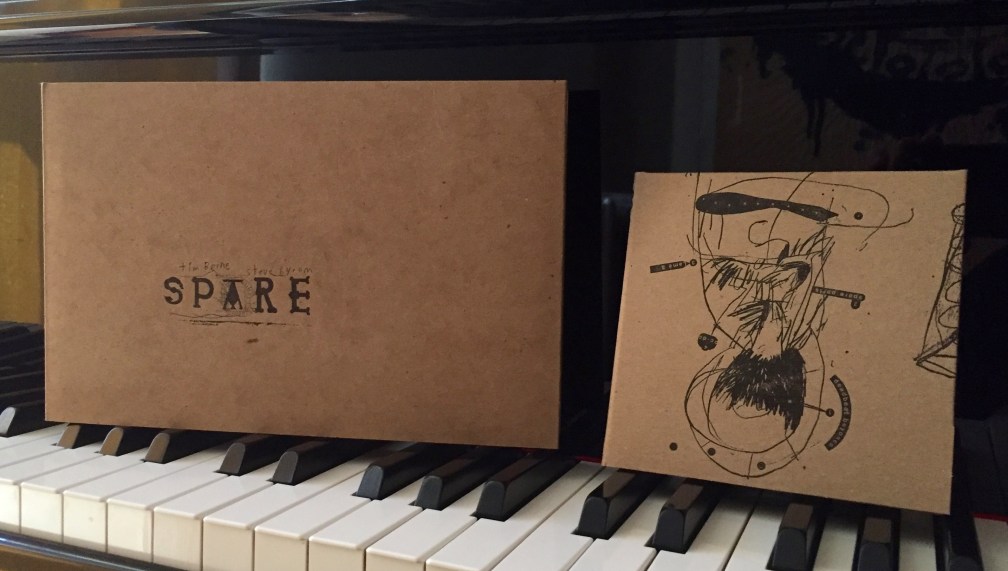
Berne’s latest record is the deluxe package Spare, which includes a burning CD of a ferocious live Snake Oil gig (hello, intoxicating Matt Mitchell solo rumination that opens the album!) alongside a thick book of photos by Berne and art by long-time collaborator Steve Byram.

It is a lovely punk coffee table book, but the music is what matters most. Listening I’m reminded of Tim’s vast influence. Hundreds of musicians play this way today: cadenzas, duos, and free-for-all improvs linking thorny material in suite-like fashion. Tim himself comes out of Julius Hemphill and the AACM, of course, but Berne’s own fierce set of solutions is what others others have emulated time and time again for so many decades now.
IMG_1663

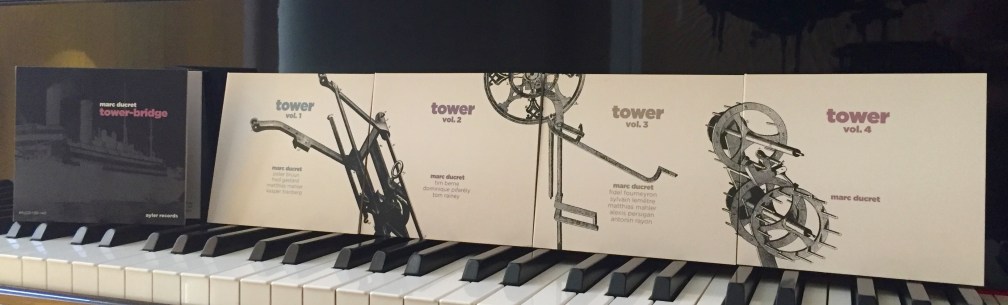
Certain musicians in Europe have been some of the strongest purveyors of high modernism in a jazz or improvised context. Thanks to Tim Berne, I’ve become aware of six recent CDs from brilliant guitarist Marc Ducret. The covers of Tower volumes one through four make a little interlinking art project when you lay them next to each other. Tower-Bridge is pair of live gigs from the related tour.

Everything is based on Vladimir Nabokov’s Ada and the related short story “The Vane Sisters.” Ducret himself explains:

Marc Ducret Tower project

This project initiated in 2008 is an attempt at transposing in the musical world a short chapter from Vladimir Nabokov’s “Ada”, in which the writer weaves a whole labyrinth made of mirrors, memories and correspondences, eventually building a form which in turn leads to his other books, themes and emotions. I wanted to use only musical means to “transcribe” this process, without having to quote excerpts of the book or literary explanations; therefore I chose to write music for three different bands, following the “design” of the mentioned chapter.

The first group, “Real Thing #1”, is a Franco-Danish quintet with Kasper Tranberg (trumpet), Matthias Mahler (trombone), Frédéric Gastard (bass saxophone), Peter Bruun (drums), and myself on guitar. The band performed its first concerts in a French-Swiss tour in May 2010. The music was recorded during two days in the middle of the tour and published by Ayler Records as “Tower vol. 1”. Since then the quintet has been presented by such festivals as Copenhagen Jazz Festival, Pori Jazz and Jazzdor Berlin. New concerts are planned on the first half of October 2013.

The second group, “Real Thing #2”, is a Franco-American quartet with Dominique Pifarély (violin), Tim Berne (alto saxophone), Tom Rainey (drums) and myself on guitar. The quartet toured in Germany, Luxemburg and France in September 2010. The band recorded “Tower vol. 2” at the Studio Sextant (Malakoff, France) during that tour.

Each of these two groups plays one half of the music; the third band, “Real Thing #3”, is a sort of “chamber” ensemble including Fidel Fourneyron, Alexis Persigan and Matthias Mahler, on trombones; Antonin Rayon on piano, Sylvain Lemêtre on percussion and myself on guitar. This group gives all the musical “solutions” to the first two halves played by #1 and #2, commenting their music and putting it into a new light. The sextet played for first time in October 2011 at Le Triton (Les Lilas, nearby Paris). “Tower vol. 3” will be recorded in December 2012 and published in the spring of 2013.

The three groups have played separate concerts and can also be superimposed, with endless possibilities of different arrangements of the same basic musical material – presented in the same concerts or in two evenings.

The whole Tower project reached a new dimension with the Tower-Bridge orchestra. This name has been given to the three groups together, i.e. twelve musicians playing extended versions of the whole music. The band was premiered at La Cave Dimière (Argenteuil) on November 9th 2012. The concert served as an opening for a tour consisting of ten concerts across France.

Marc Ducret, July 12th 2013

The albums are quite dissimilar in effect. This is a lot of music to digest, and my notes are merely first impressions:

Vol. 1 thrashes around with heavy drums and blistering guitar solos over odd-meter vamps. Ducret’s command of modernist composition is undeniable.

Vol. 2 Berne and Ducret are close associates, so this quartet with all-weather companion Tom Rainey makes sense from the get-go. The first thing we hear is about five minutes of subway background noise and feedback. Violinist Dominique Pifarély is a new name to me, but what a soulful player.

Vol. 3 is the most immediately charismatic disc of the bunch, and possibly the most through-composed. Berne told me he thought it was one of the greatest albums of recent times. The lack of conventional drums gives the icy sonorities an unusual transparency. Stravinsky’s Agon and Requiem Canticles come to mind (bells and trombones) and perhaps also the hocketing horns of Louis Andriessen.

Vol. 4 offers Ducret solo. The whole disc is fairly thorny and discontinuous until the end, a very brief cover of a Joni Mitchell tune, a superb WTF? moment.

Tower/Bridge combines all the musicians. While the scorching free-for-all moments are expected, it’s good to hear that the compositional integrity is maintained. The themes are clear and it is really fun to hear the interlocking vamps beefed up into a little big band.

Taken as a whole the series is entirely successful. As this music gets closer to classical composition it makes sense to create on a larger and larger canvas. I can’t think of anything else filed amongst my “jazz” records with the sort of ambition displayed by Marc Ducret’s Tower project. Bravo.
IMG_1666

Jason Moran has been busy storming the castles. He’s been so impressive, winning awards, getting elite positions, connecting the dots.

Indeed, I was a little worried that he might be neglecting the piano. I’ve seen other great instrumentalists like Yo-Yo Ma and Wynton Marsalis become a little less interesting after taking on the whole world.

A few months ago I went to the Park Avenue Armory — where, of course, Jason was curating a series of heavy concerts — to see his solo piano set. Frankly, I was astonished. This was one of the best solo piano gigs I’d ever seen. (Much better than Keith Jarrett’s at Carnegie Hall a couple of weeks previously.)

Afterwards I joked to Jason, “Better put this out fast, before I steal some and release it first.” Well, The Armory Concert is out already as a download from Bandcamp, and I am definitely not listening to it much more: I just don’t have time to be swayed so easily by a charismatic contemporary.

Among other things, Jason impresses with a full set of original music that prizes organic development. Melodies and harmonies appear and reappear but the argument always moves forward. Actually, a fair comparison is Jarrett’s Facing You, which remains one of Keith’s greatest discs, and (as far as I know) the only Jarrett solo piano album that takes complex pre-conceived sketches as a starting point.

What separates Jason from the rest of the music on the above page is the Afro-American experience. I don’t think there needs to be black stuff in improvised music, but it certainly doesn’t hurt — although if you use it, you need to own it.

When Jarrett played a casual slow blues at Carnegie Hall, it sucked. At the time I thought it wasn’t just the innate laziness of the pianist that was the problem: the glorious full concert Steinway on a major stage was also the problem.

The canonical Philadelphia drummer Donald Bailey once told me, “I don’t like grand pianos. Upright pianos are better for jazz.”

I wouldn’t go as far as that, but it’s true the music of Thelonious Monk and Bud Powell is not conceived for elite concert situations. They sound great on a concert grand in a big hall, of course, but they sound just as great or even better on an upright in a noisy club.

(Undoubtedly Keith would sound great playing the blues in somebody’s living room at a party. Getting him there to do it would be the only problem.)

At the Armory Jason had some serious Steinway to work with. He even tweeted the number: 415. Jason really has to double-down to play the blues on that motherfucker, and delivers the goods on a lacerating “South Side Digging.”

On the other hand, “All Hammers and Chains” is in the style of a relentless Ligeti etude, a feat of virtuosity that was undoubtedly aided by a piano that gave so much back.

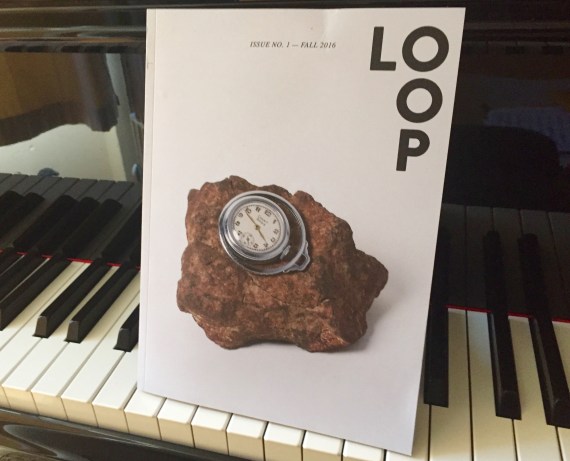
Among other projects, Jason has begun a magazine about jazz: LOOP. There are only 500 copies, so I ordered mine before spreading the word.

It’s really a little art mag, with much attention to photography and layout. Indeed, the highlight may be Jamaaladeen Tacuma’s utterly disarming essay about the boutique black men’s clothing store Tacuma runs in Philadelphia. Other contributors include Steve Coleman, Cassandra Wilson, Matana Roberts, Greg Tate, Walter Smith, J.D. Allen, Eric Revis, and Kendrick Scott. I read LOOP avidly: when I set it down, I was only disappointed that there wasn’t much more. Fortunately, it says “Issue No. 1” on the cover.

End of an Era

Friday, August 5: It’s the last day Ben Ratliff is working at the New York Times. Tomorrow he is a free man! Congrats Ben! Take a break! You deserve it after almost exactly 20 years of service to New York’s music community!

NY Times Popcast: A Send-Off for Ben Ratliff w. Jon Carmanica.

A few months ago I discussed Ben’s latest book on DTM. There’s also tentative plans for some follow-up questions: watch this space.

I know Ben, of course, and we’ve talked a fair amount over the years. He’s reviewed me quite a lot. I’ve never gotten a pan but he’s always called it like he saw it. After the opening night of trio with Charlie Haden and Paul Motian at the Vanguard, Ben was slightly skeptical in the next day’s paper. Charlie called me right away, furious. I waited out Haden’s diatribe against jazz critics, knowing that Ben was right to withhold fulsome praise. (That gig jelled more towards the end of the week.)

On the other hand, I received a different phone call from Billy Hart when a set at Fat Cat was reviewed in the Times. “How does he know all this?” was Billy’s simple question. Billy was unused to a jazz critic who could write clearly about how the drums fit into the history of the music.

One night at Birdland, I said hi to Motian, who responded, “Did you see what the New York Times said about me? They said I’m spooky!” (The Paul Motian interview in The Jazz Ear is one of the best documents of Motian in his own words.)

I could go on with Ratliff anecdotes. Truthfully he was an incredible asset for not just the three members of The Bad Plus but also for other musicians in our circle: Bill McHenry, Guillermo Klein, Jason Moran, Masabumi Kikuchi, many others.

Perhaps I’m biased, but it’s hard for me to imagine that there’s not a better way to understand New York jazz from 1998 to 2008 than starting with Ratliff’s coverage for the Times.

Giants kept dying off: the biz shrunk: Ben’s interests crystallized. In recent years Ben made a real shift, giving his attention mostly to various kinds of comparatively popular music. I personally care much less about all that stuff but reading Every Song Ever gave me tremendous respect for his vision.

It’s Ben’s own choice to leave the paper, and with the success of the recent book Ben is poised to become an icon among general music critics. Excelsior! And, thank you.


All in the Family (Sarah Deming, Garrison Keillor)

For several years my wife Sarah Deming has been on a profound journey with boxing and writing. A milestone was reached this summer: Richardson, known to us all as Africa, is competing in the Olympics. Four years ago Africa was the guest star in Sarah’s Kickstarter financing a visit to the Olympics in China; this year he was the primary motivation.

Sarah’s writing about boxing is appreciated within the community. Most of it has been blogging reportage, but there is a major essay on Claressa Shields in a forthcoming boxing anthology edited by Carlo Rotella and an amusing piece about to run in The New York Times. There’s also a YA novel about boxing in the works. What I’ve seen of it is fabulous.

Her current Kickstarter made weight in a matter of hours. More money is of course always useful, and the rewards are top-notch. Even if you don’t contribute, you should head over and take a look at the video.

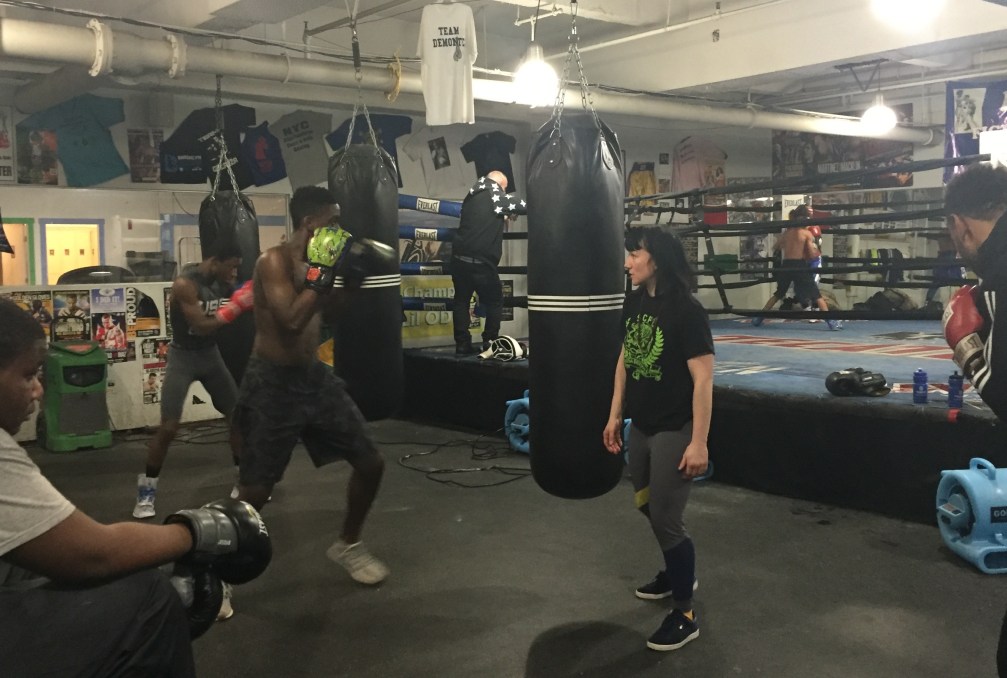
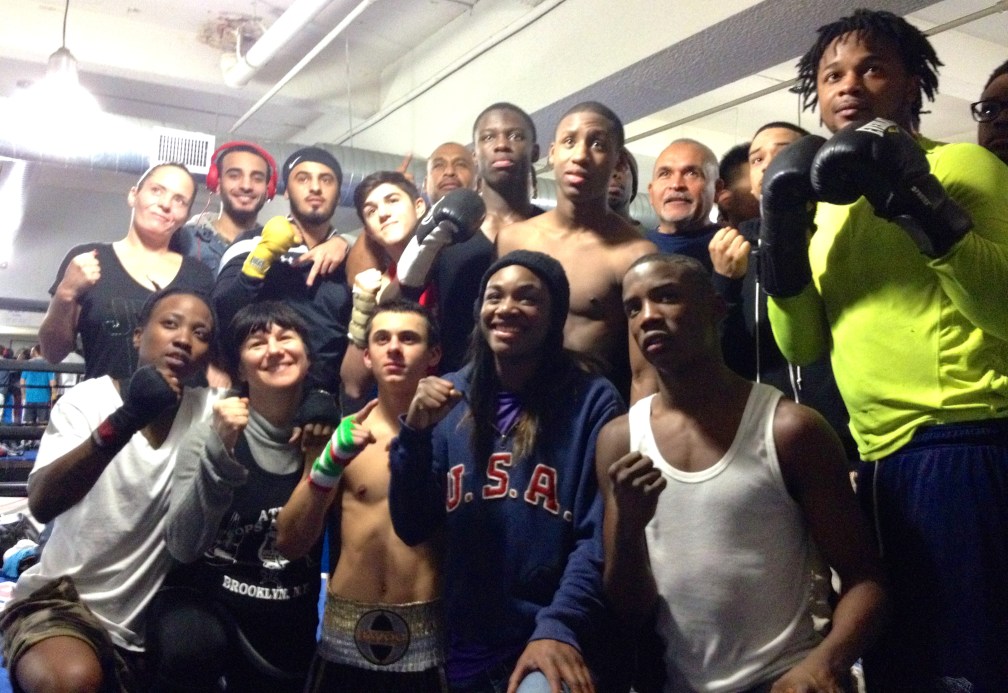
Just for fun, here are two of my own iPhone snaps of Sarah at her gym, Atlas Cops and Kids:

Sarah at gym

Claressa w atlas cops and kids

It was a special day when Olympian Claressa Shields stopped by the gym.  (Claressa in front w. USA sweatshirt, Africa dead center raising the black glove.) 

—-

Garrison Keillor is also a kind of family member. Lake Wobegon could easily be Menomonie (where I grew up) or Two Harbors (mom) or Duluth (dad).

Although I’ve only listened to Prairie Home Companion once in a while over the years, every monologue was always profoundly satisfying. Since the final “News from Lake Wobegon” aired a couple of weeks ago, I’ve been listening to old episodes on YouTube. Truthfully, the man is a genius. While discussing the minor travails of his mild-mannered Lutherans, Keillor is superbly relaxed despite being in the throes of creative fantasy.

There’s a real connection between great comics, great hip-hop MCs, and great jazz musicians. They all know their material, but when the stars align there is room to follow a new thread to an unexpected place. The shock of discovery amplifies the beauty of the statement for both performer and audience.

Many Midwestern artists that move outward to play a larger stage owe Keillor some kind of debt. One day a few years ago I got a phone call from Stanley Crouch: “Ethan? I saw Altman’s Prairie Home Companion last night. Yeah, I think I understand The Bad Plus a little better.”

In my opinion, the New York Times review of the last Keillor performance by Dwight Garner, while positive, was not positive enough. There’s no need to raise questions about Keillor’s legacy. It’s right there in front of us. Dial up a “News from Lake Wobegon” and — especially if you are from the Midwest — you will laugh and you will cry.


RIP Gregg Smith

[UPDATE: New York Times obit.]

For a few years in the early Nineties I was the rehearsal pianist for the Gregg Smith Singers. It was fabulous training. Everything was new to this Wisconsin farmboy! My girlfriend was a Smith singer, and touring was a madcap adventure that lived on scandal and gossip.

Most important was the music itself, of course. Through that job I briefly met many composers, including several that have gone on to be important in my more recent studies: Hale Smith, Louise Talma, William Duckworth, and Leo Smit.

I played piano for a few pieces in performance. The best was Irving Fine’s The Choral New Yorker, which lay the groundwork for my eventual centennial overview. I remember Gregg telling me that he thought that Irving Fine and Ravel had the best command of harmony, that each chord in their works was a jewel. (“Jewel,” ok, but “best” is a highly debatable opinion.)

Gregg loved all sorts of music, and addition to a steady diet of modern choral composition he would give masterclasses in the Monteverdi Vespers. I asked a lot of questions, and he was always very kind. There was one point when I kept him after rehearsal to look at something in the score of Vespers. Gregg must have liked my enthusiasm for learning, for he suggested I play Hindemith’s The Four Temperaments with orchestra at his music festival in Saranac Lake. I refused, thinking (quite rightly) that it was beyond my capabilities.

One time a percussionist didn’t show for a performance of a Charles Ives Psalm, so I stepped in to play the chime part. It didn’t go so well, and afterward Gregg teased me about how uneven the “bings” and “bongs” were.

For theatrical effect, I was playing the chimes from the back of the hall (not that excuses my performance). Indeed, it was Ives that gave Gregg the inspiration for “Music in Space,” perhaps his most distinctive contribution to latter-day choral music. All of the “Space” repertoire was interesting, but I particularly remember Leo Smit’s sparkling round “Lenten is Come,” sung by the chorus in four (?) parts spread around the venue.

Wow, this brings back memories! “Music in Space,” by God. I just placed an order for the CD to hear this repertoire again. Looking at the tracklist, I’m sure I was the rehearsal pianist for everything, in some cases for the choir’s premiere performance.

It was a great couple of years for me, working with Gregg, his wife Rosalind Rees, and the rest of the singers. Roz had a beautiful voice and was very easy to accompany in her solo features. Another personality that stood out was Walter Richardson, an African-American basso profundo who brought down the house with “Old Man River” at the “cabaret” gigs. We would change keys depending on how low he wanted to go that day.

And of course there was Karen Goldfeder, my girlfriend and soon-to-be first wife. Impossible to believe this was all over twenty years ago!


Albert Ayler at 80

The two Albert Ayler records that I still know best were staples of my high school-era listening: a CD reissue of Vibrations (with Don Cherry, Gary Peacock, and Sunny Murray) and an LP twofer of The Village Concerts (the later band with brother Don Ayler and strings).

Vibrations is well-recorded and has marvelous playing by all members of the quartet. Don Cherry’s casual, unfettered melodies offset Ayler’s fulminations perfectly; Gary Peacock’s initial virtuosic salvo with Ayler remains one of the glories of his extensive discography. (Much better known historically than Vibrations is Spiritual Unity, which was then impossible to find; I didn’t hear Spiritual Unity until much later.)

On The Village Concerts, the individuals are less important than the overall Salvation Army message. The logical comparison is to Charles Ives: famous Ives songs like “General William Booth Enters into Heaven” or “At the River” fit right next to this aesthetic. One time I played Ayler’s “Light in Darkness” for Mark Morris, who loved it, exclaiming, “This is the kind of band I want to have myself!”

There’s great joy in Ives and Ayler, but there is also intense sadness. At his darkest Ayler is a cry of unremitting pain. One of the more profound Ayler tracks is “The Truth is Marching In,” recorded at the Village Vanguard in 1966 with  Don Ayler, Albert Ayler, Call Cobbs, Michel Samson, Bill Folwell, Henry Grimes, and Beaver Harris. The head is two parts, a hymn and a march. The march breaks off mid-stride and the tenor solo plunges deep into the abyss. 

Ayler told Nat Hentoff, “It seemed to me that on the tenor you could get out all the feelings of the ghetto. On that horn you can shout and really tell the truth. After all, this music comes from the heart of America, the soul of the ghetto.” 

To this day, Ayler remains one of the icons of civil rights-era progressive jazz. However, with some exceptions, the public soundtrack for the fight against racism has mostly been a long list of danceable hits. The power of Amiri Baraka’s glorious prose in Black Music (for years the most significant text about Ayler) obscured how little impact avant-garde jazz had within the black community. Stanley Cowell told me, “I was playing angry free jazz in the 1960’s, totally against the man, but when we looked up to see who was in the club all the faces were white!” Ta-Nehisi Coates’s recent memoir Between the World and Me  discusses a fair amount of music but almost no jazz, let alone avant-garde jazz. 

The more practical application of Ayler’s chaotic poetry has been elsewhere. Main exponents of noise rock, punk, and other experimental genres frequently claim Ayler as an influence. In his way, Ayler is a gateway drug into jazz for those with a theatrical rock and roll orientation. Recently the editor of Pitchfork, Mark Richardson, delivered a meticulous and technically accurate overview.  My old Impulse twofer of The Village Concerts had a superb liner note by Robert Palmer, for years the chief pop music critic at the New York Times.

It helps that Ayler has a Story: experimental, religious, black, underground. There’s even the appropriate tragic coda, a body found in the East River, circumstances unknown. But this may be another case where the Story occasionally gets in the way of the music.

Ayler’s saxophone was incandescent. But there were other great blowers of experimental horn, then and now. The other major part of Ayler’s contribution was as a composer, giving us all those melodies seemingly carved out of an old hymnal with a blunt instrument. Perhaps Ayler was second only to Ornette Coleman in terms of generating instantly memorable themes.

The Ayler records of standards and spirituals have great saxophone playing but a more conventional context there is seldom a coherent band concept to speak of. Admittedly, not all the musicians are always that good: it seems like Ayler’s pianist of choice Call Cobbs could barely follow the most basic of changes. On “Down By the Riverside,” Ayler is threading like Dexter Gordon but the hapless “swinging” band can’t get from A to B. Another fascinating listen is “Summertime” at dirge tempo with a European rhythm section, where the rhapsodic saxophone engulfs the square accompaniment. (Don Cherry spoke of Ayler playing “Moon River” at a “ballad medley” European jam session with other great American tenor saxophonists and winning the day.)

In the end it is too much work to find consistently great music in these awkward straight-ahead circumstances. But the moment the themes are composed by Ayler himself, the energy coheres. The direction is clear. It becomes impossible for the music to fail. All impediments fall away, we shall transcend to a higher truth together. 

The definite Ayler performance may be the medley of gorgeous Ayler themes at Coltrane’s funeral with Don Ayler, Richard Davis, and Milford Graves. There isn’t even any blowing, except that near the end Ayler repeatedly screams to profoundly eerie effect as his brother sounds the last trump. I first heard a bootleg of this many years ago, then it came out on the deluxe Revenant set, now it’s just up on YouTube. On Albert Ayler’s 80th birthday there is no better use of six minutes of your time than dialing this up, closing your eyes, and mourning our humanity.

Notifications

Thanks very much to the Jazz Journalists Association for awarding Do The Math “Blog of the Year” for the second time. If someone is considering starting a jazz blog, one helpful practice is simply linking to others. Probably certain now-defunct blogs of yore would still be here if they had felt part of a conversation. If you link to DTM I promise to link back.

Next Thurday, I’m giving a free masterclass in Brooklyn. Sign up for Floyd Camembert Reports to get complete details.

The news is not good. On the other hand, the news has seldom ever been good: it is just that social media has sped up the cycle of shock, agitation, and regret.

As a jazz musician living in Brooklyn I have no contact with anybody that would even begin to think about voting for Trump. However, after the Brexit debacle, I’ve been wondering what the hell I can do to make sure Clinton wins instead. I guess one thing is: Hey! If you read and love DTM and you live in a battleground state, please think about upping the Dem’s ground game sooner rather than later!

The chaotic aftermath of Brexit has made me think of a favorite (and very English) exchange from the radio play of Hitchhiker’s Guide to the Galaxy by Douglas Adams:

PROSSER: Come off it, Mr. Dent. You can’t stand in front of the bulldozer indefinitely. This expressway has got to be built, and it’s going to be built!

ARTHUR: Why’s it got to be built?

PROSSER: What do you mean, “why”? It’s an expressway. You’ve got to build expressways! You were quite entitled to make any suggestions or protests at the appropriate time, you know.

ARTHUR: Appropriate time?! The first I knew about it was when a workman arrived at my home yesterday and said he’d come to demolish the house!

PROSSER: But Mr. Dent, the plans have been available in the local planning office for the last nine months!

ARTHUR: Yes, well, as soon as I heard, I went straight round to see them. You hadn’t gone out of your way to call attention to them, had you? I mean, like actually telling anybody.

PROSSER: The plans were on display–

ARTHUR: On display? I had to go down to the cellar to find them!

PROSSER: That’s the display department!

ARTHUR: With a flashlight.

PROSSER: The lights had probably gone out.

ARTHUR: So had the stairs.

PROSSER: But you found the notice, didn’t you?

ARTHUR: Yes, I did. It was “on display” in the bottom of a locked filing cabinet stuck in a disused lavatory with a sign on the door saying, “Beware of the Leopard.”

IMG_0333-1280

Back with Brahms and Overton at the Barge

This weekend: Johnny Gandelsman and I play the three violin sonatas of Johannes Brahms at Bargemusic.  

Saturday, June 25 at 8 

Sunday, June 26 at 4  

To round out the program I’m reprising Hall Overton’s rare Piano Sonata.

The three violin sonatas of Johannes Brahms have been in constant circulation since their premieres in the late nineteenth century. It is an honor to get another opportunity to work on this immortal music.

I first played with Johnny back when I was Mark Morris’s music director; more recently he’s been in Yo-Yo Ma’s Silk Road Ensemble and helped found the string quartet Brooklyn Rider. He’s a wonderful musician who really understands the language of 19th century chamber music. We first tried out the Brahms together about five years ago.

No. 1 G major, op. 78

Vivace ma non troppo. 6/4 isn’t associated with Bach, Handel, Mozart, Haydn, or Beethoven. Brahms reached back to the pre-Baroque era to find the big six, which he appropriated for several important sonata forms including the First Piano Concerto and the Third Symphony. In op. 78 he carves up the six into twos, threes, and fours, occasionally even making nines along the way. This swinging base supports a dotted melody of rarified beauty.

Adagio– Più andante – Adagio. Horn fifths in the piano suggest Beethoven, although the violin’s song is a rather dark and mysterious nachtmusik. Contemporary scholars now believe the Più andante funeral march was a direct response to the death of young Felix Schumann, son of Robert and Clara, named for Mendelssohn, and author of three poems Brahms set as lieder in op. 63 and op. 86.

Allegro molto moderato. The melody and “raindrop” accompaniment for this spacious rondo in minor come from Brahms’s op. 53 songs “Regenlied” and “Nachklang.” The first contrasting theme is a bit gypsy, the second quotes and then transfigures the horn melody from the Adagio. Towards the end the sun comes out at last and Brahms’s most perfect violin sonata ends in radiant major.

No. 2 in A major, op. 100

Allegro Amabile. What is this, a waltz? Not exactly, but it must lilt somehow. The odd phrase lengths and intertwining parts make this hard to parse. My own interpretation is that these melodies reflect the way Brahms was with women: he loved their beauty but needed to keep his distance. Aleksandar Madžar intriguingly suggests that the temperament should be more like Richard Strauss than Beethoven. In the development section Brahms nearly quotes Chopin, a rare event.

Andante tranquillo – Vivace – Andante – Vivace di più – Andante – Vivace. Two forms of rustic behavior: looking at the sky, then a country dance. The violin pizzicatos are effective, especially with Johnny’s kind of natural swing.

Allegretto grazioso (quasi andante). Again, a pretty tune is rendered diffuse by odd phrase lengths and surprise hand-offs between violin and piano. This movement can be played with too much intensity; it’s better to just let it roll through, although the dark diminished chords must have some menace. Johnny suggests that an upright piano — like the pianos usually seen in photos of Brahms — would be just fine for the casual intimacies of Op. 100.

No. 3 in D minor, Op. 108

Allegro. Direct and passionate, the third is the “hit” of the violin sonatas. Although it is the easiest to interpret musically, the piano part is technically the hardest: even Vladimir Horowitz and young Arthur Rubinstein drop some notes on early recordings.

The opening rising fourth in the violin informs the work in ways both obvious and devious: Arnold Schoenberg admired Brahms’s sophistication, calling it the “principle of developing variation.”

Adagio. A perfect, heartfelt song for the violinist. Even at a slow tempo, Brahms can’t stop himself from dividing up his threes into twos, which is one reason not to play his adagios too slowly.

Un poco presto e con sentimento. F-sharp minor flickers past in a short movement reminiscent of some of the solo piano Intermezzi.

Presto agitato. Brahms wasn’t always comfortable writing uptempo finales, but here he delivers a proper daredevil tarantella. It’s still Brahms, though, so — just as throughout most of these sonatas — the melodic material is constantly shifted between piano and violin, daring the ear to follow a rich and remarkably contrapuntal texture.

Jan Swafford’s biography of Brahms is a wonderful read. Swafford mentions a few times that Brahms was a lousy person to play chamber music with. Brahms stared at the page, playing his own way, ignoring the the other musicians. Interesting to know, especially since for many he is the greatest composer of chamber music.