“L.A. Confidential” and “L.A. Commonplace”

James Ellroy’s thoughtful and appreciative note on the late Curtis Hanson in Variety sent me back to take another look at the adaptation of L.A. Confidential. It’s a very good movie, especially good for the era, but not worthy of inclusion in the pantheon. The movie attempts to invoke gritty crime films from the Seventies and the film noir from the Forties but inevitably offers a homogenized product from the Nineties.

This criticism is informed by my admiration of the book, which remains one of Ellroy’s finest achievements.

SPOILER WARNING: I’m about to give away all the surprise plot twists for both book and movie.

The very first scene in the book stars Buzz Meeks in a massive shootout at a hotel, which Meeks doesn’t survive:

Dudley Smith stepped through flames, dressed in a fire department greatcoat. Meeks saw his suitcase – ninety-four grand, dope – over by the mattress. “Dud, you came prepared.”

“Like the Boy Scouts, lad. And have you a valediction?”

Suicide: heisting a deal Dudley S. watchdogged. Meeks raised his guns; Smith shot first. Meeks died – thinking the El Serrano Motel looked just like the Alamo.

“Alamo”: a massive shootout is indeed a trope of the classic Western, usually taking place at the end of the movie, which Ellroy subverts by placing at the beginning of his story. It also subverts the idea of a conventional whodunit, as Ellroy tells us right away that Dudley Smith is a villain.

The movie restores the conventional mystery plot (revealing Smith only as the villain much later) and the Western shootout ending.

At the conclusion of the movie, the two remaining heroes live and Dudley Smith dies with a bullet in the back from Exley. In the book, Smith stays active and essentially untouchable. He is never completely killed off or dishonored, not even in Ellroy’s sequel, White Jazz.

Early on in the movie, Smith tells Exley he shouldn’t become a homicide detective unless he is willing to shoot a guilty man in the back if that man couldn’t be convicted in court. Exley eventually makes good on Smith’s rules by shooting Smith in the back. This is conventional, even hokey, movie writing.

In the book, Exley is driven mostly by ambition. He wants glory for himself within the LAPD, partly because he is competing with his decorated police officer father. It is his father who delivers the sermon about shooting men who can’t be convicted, but Exley already knows how game the system: He’s supposed to be a war hero who killed a lot of Japanese, but actually Exley faked the evidence.

In both book and movie, Exley shotguns three black men (innocent of the Nite Owl murders but guilty of rape) after they escape prison. In the book Exley is on a secret solo mission and the culprits are meek, unarmed, with their hands in the air. In the movie, those deaths become a shootout where the black men shoot an officer before Exley returns fire. The director wants the hero to be less complex, more of a clear “good guy.”

In the book, women are just not that important for any of the men. White and Exley are at odds with each other, both have an affair with Veronica Lake look-alike Lynn Bracken, but the crime story brings them together to solve their differences. They don’t butt antlers like two stags over a doe. In the movie, White and Exley fight over Bracken, and this big explosion of male passion rather undoes the ending of the movie. What do all the men and the women now feel about each other? In the book, there was less passion on the table — even the “movie actress look-alike” conceit helps show how women exist only on the surface for these heartless men — so the organization of the couples for the final wave goodbye makes a little more sense.

Another big movie fight, where White and Exley join forces to beat up D.A. Ellis Loew, isn’t from Ellroy. Indeed, Exley’s snarky line, “Was that how you used to run the ‘Good Cop-Bad Cop?’” seems lifted out of a banal crime film starring Bruce Willis or Mel Gibson. In Ellroy, when White wants an answer from a recalcitrant but essentially harmless witness, he just shoves the man’s hand into a garbage disposal, a shocking technique again unacceptable for a hero in a Hollywood movie.

Ellroy’s slick Jack Vincennes has various reasons to feel guilty but his waters may run deepest: Vincennes is finally drawn into becoming a valuable detective partly because he is aroused by perverted smut linked to the Nite Owl massacre. He achieves a kind of redemption before a random shot from a tangential criminal kills him off.

Before Vincennes dies, though, he joins a meeting with Exley and White where they figure out the whole conspiracy together. This is a great scene, one of the best “chain of logic” scenes in crime fiction. In the movie, we never see the three protagonists come together, even though this is really the whole moral of Ellroy’s story, such as it is:  Three dark men find a little light when they join forces against a greater evil, with brainwork and teamwork being the most important binds between them.

Admittedly, Vincennes does have a good death with a good clue in the movie. It works so well that it was lifted wholesale by Steven Spielberg a few years later for Minority Report, a cinematic adaptation likewise considerably less dark and complex than Philip K. Dick’s short story. Still, it is rather frustrating that this shocking death of a main character has to “mean something,” at least when compared Ellroy’s hard-core existentialism. In the original, Vincennes dies not to leave a clue, but dies simply because he is in a story by James Ellroy.

—-

I’m not saying all movies need to follow the book: Point Blank veers from The Hunter to wonderful effect; The French Connection dwarfs the source. There is an argument that the Coen brothers should have taken more license with No Country for Old Men.

I’m coming on so strong because Ellroy’s esoteric vision is worth standing up for. One of the reasons to read Ellroy — one of the reasons to spend time in that sewer — is to look unblinkingly at tarnished souls. Do we dare redeem these rogues? Is it acceptable to root for a hero that has a rotten core? How can there possibly be a satisfying ending to this sadness?

Making the heroes and the plot more conventional demean the ethics of the author. “There is no Hollywood sign!” proclaims Ellroy. In Hanson’s adaptation, that Hollywood sign gets a fresh coat of paint.

hollywood

(image stolen from hollywoodsign.org)
Listening to Lowell Davidson

I have long admired Lowell Davidson Trio with Gary Peacock and Milford Graves on ESP. Davidson was supported by Ornette Coleman and an influence on Keith Jarrett, with an approach somewhere between the fury of Cecil Taylor and the romance of Paul Bley.

On Uncle Paul’s Jazz Closet, Paul Motian’s niece Cynthia McGuirl has been posting rehearsal tapes and other exceptionally rare artifacts with Davidson, Motian, and others.

The latest podcast has a fair amount of Davidson/Motian duo. It is a bit harsh sonically (the drums are too loud: there was just one mic in the room) but some amazing piano is in evidence.

The legend is Jarrett got interested in using Motian for his own music after hearing a tape of Motian with Davidson: the drummer known for delicate brushwork with Bill Evans was also a ferocious avant-gardist! I’m not sure of the chronology. The Harvard Crimson review of a gig of Davidson, Peacock, and Graves together in 1965 implies that Davidson performances in Boston were reasonably common. Jarrett was in Boston ’63-’64. However Davidson was also frequently in New York working with Ornette.

Other Jazz Closet podcasts featuring Davidson are an episode co-hosted by bassist John Voigt and an episode with 1988 Davidson tapes released by multi-instrumentalist Richard Poole two years ago. “Round About” is an especially gratifying listen. On both episodes are intriguing trios with Voigt, Tom Plsek, and Joe Morris: musicians who knew Davidson create vibrant pieces from Davidson’s graphic scores.

Cindy’s podcast commentary is valuable, including readings from Motian’s still unpublished autobiography. Motian explains some of his history with Davidson and how a 1976 trio tape of Davidson, Voight, and Motian was sent to ECM but the tape had deteriorated. However, I’m also still curious about what Jarrett could have heard of Davidson and Motian together in the mid-sixties.

It’s a shame so much of this music has been lost forever. “Gone in the air,” as Eric Dolphy said.

Time and Place(ments)

All jazz fans know the great drummer and composer Joe Chambers. Chambers can play anything but originally came to prominence in the 1960’s as part of a group of black jazz musicians who were seriously interested in contemporary classical composition: Tony Williams, Sam Rivers, Herbie Hancock, Bobby Hutcherson, Andrew Hill, Joe Henderson, Richard Davis, Wayne Shorter, many others. Their most experimental work is on Blue Note, often with telling album titles like Oblique, Components, or Contours.

Chambers’s brother Stephen was on the scene at that time as well. He took the name Talib Rasul Hakim and had an important career as a concert composer. According to Wikipedia his teachers were Morton Feldman, Ornette Coleman, Margaret Bonds, Robert Starer, Hall Overton, Chou Wen-Chung, William Sydeman, Hale Smith, and Charles Whittenberg.

Sadly Hakim passed away in 1988. A few things were recorded. I’ve known the piano piece Sound-Gone for a few years from Natalie Hinderas’s invaluable record of Afro-American piano music. However tonight I’ve discovered something just as intriguing: Placements, a long sectional work for percussion and piano recorded in 1975. The percussionists are Barbara Burton, Joe Chambers, Omar Clay, Warren Smith, and Wilson Moorman. The piano soloist is firebrand Stanley Cowell.

I emailed Stanley to see if he remembers how much was notated. Stanley replied that as far as he can recall, it was all composed, although “I am pretty sure I could not read all those clusters in the middle section. Those must’ve been improvised with some direction.”

As with Sound-Gone, Placements takes a while to get going. Probably the first few minutes would be more effective live. However, the mallet motifs and piano flourishes that gather steam around the seven-minute mark are utterly compelling. The work as a whole is a fascinating document from a vanished era.

From the Folkways LP Talib Hakim/ William Bolcom / Howard Swanson / Frederic Rzewski ‎– New American Music Volume 3.

Gershwin Comes Home

All jazz pianists love George Gershwin’s songs as vehicles for personal exploration. However, Gershwin’s concert music is a rather different kettle of fish.

The topic of cultural appropriation seems more rife than ever. It’s not that Rhapsody in Blue is so bad, exactly, it’s simply that the huge popular success of this trite work has obscured the greater artistic successes of the great early jazz musicians, especially great black jazz musicians like Jelly Roll Morton and James P. Johnson. (Any recording of Morton or Johnson is more important than any recording of Rhapsody in Blue. Period.)

Still, the history of American art is the history of working with what we’ve got. Plenty of later jazz greats fooled around with Rhapsody in Blue when they were kids. A few years ago Marcus Roberts went in and reworked Rhapsody in Blue with his own hot licks and a genuinely swinging rhythm section.

Gershwin’s Concerto in F is a better piece than Rhapsody in Blue — it might even be the best “jazz” piano concerto overall — but it is hardly perfect. The fabulous tunes can’t hide the tinsel used to connect disparate elements. Like most versions of jazz for symphonic forces, it is a fancy musical theatre piece that thinks that it is cooler than it really is.

Last night at the opening concert of the 175th season of the New York Philharmonic, Aaron Diehl took this challenge head on. Aaron can play the blues for real, and made the bold choice of replacing Gershwin’s lightweight sketches in the slow movement with tremendous stomping and shouting from his own imagination. Since Aaron was a classical prodigy, he also had no problem navigating the rest of the work when it made sense to play the original virtuosic piano part. There was a pleasing balance of Gershwin and Diehl throughout all three movements: the final effect left me with the suspicion that this was the best performance of Concerto in F ever done.

Gershwin is finally getting the treatment he deserves from pianists who can draw from the whole spectrum. The next step is for the orchestra to slim down, lose the conductor, memorize, and take more personal freedom and responsibility. The future of American music awaits.

Back to School

A sincere thanks to Joan Anderman for a lovely profile in the Boston Globe: “A jazz pianist’s spot at the corner of history and what’s new,” prompted by my new position teaching piano in the jazz department at New England Conservatory.

Billy Hart is also on faculty at NEC: on Friday at 1 PM we will give a joint masterclass with Ben Street, free and open to the public. The next afternoon we play a short set at the BeanTown Jazz Fest @ the Berklee Stage at 1:45 PM, also free. (Mark Turner is with Tom Harrell in Chicago, otherwise he’d be there too.) Sunday the full Billy Hart quartet plays two sets for Duke Performances in Durham.

In Joan’s article I’m quoted accurately as saying, “Jazz in the classroom is some kind of malarkey.”

For more context, a Q and A I recently did with James Hale may be illuminating. Some of these comments were compressed and used in Hale’s excellent piece in the October DownBeat, “Stars on Campus.” A PDF of the full article, which includes discussion with Rudresh Mahanthappa, Steve Lehman, and Miguel Zenon, will be included in the next Floyd Camembert Reports.

1. What influenced your decision to take the teaching position at NEC?

It’s a great school with an impressive faculty. When I visited and gave a masterclass, I was impressed with the level of the student pianists. They were so good! Yet I also feel like I have information to share that might help.

2. Do you see this current trend toward leading recording/performing artists taking full-time teaching positions as a reality of current recording/performing economic environment, a reflection of how many current recording/performing artists also have advanced post-secondary degrees… some combination of both?

Sure, all of the above, although in my case I don’t have a college degree, I’m a dropout. However I have always had a kind of scholarly slant. Teaching is very much an outgrowth of my work writing and interviewing on my blog Do the Math.

3. How is the teaching position going to affect the way you approach your own career as an artist? Are their sacrifices that must be made to manage an academic career in addition to composing/recording/touring?

It’s not a heavy workload: I’m supposed to be there seven days a semester, although I plan to be very energetic and dedicated when I’m there. I guess ask me this question after I’ve tried it for a year!

4. What do you hope you can bring to students that academics who haven’t focused on recording/performing can’t?

Well, there is something practical I might have to offer about building a career. Students always want to know, “How can I make it?” and I guess I have a few answers.

5. Do you see your role as bringing a view into the “real world” of being a musician into the classroom as well as the academic “basics” of music theory?

Actually, I think my strongest suit is analysis of historical jazz. This of course is also what I offer on Do the Math. Do we really understand Bud Powell or McCoy Tyner yet? I’m constantly working on how and why the greatest jazz musicians did what they did, and I am eager to learn if students are receptive to my theories.

I don’t plan to teach how I make music myself. This is also like Brahms or Bartók, both of whom flatly refused to teach their own music.

In general I don’t like the cults of jazz education. Lennie Tristano was first: More recently Steve Coleman, Kenny Werner, Dave Liebman, Richie Beirach, Barry Harris, Wynton Marsalis and others have systems — or at least specific ways of disseminating information — that they teach as “the way.” I love all the music those musicians make, but don’t approve when their personal methodology takes over a classroom.

When I was in a masterclass with Liebman in high school, he told me flatly, “You play too much like Thelonious Monk. Here’s some Phrygian chords like Richie Beirach would play, this is hipper.” He was wrong to do this, he should have encouraged my idiosyncrasy and worked on drawing out my own individuality from a Monkish perspective. I wasn’t auditioning for a gig with Liebman, I was auditioning for a gig playing the kind of music I wanted to make.

6. I’m sure you’ve heard the criticism from some corners that jazz has suffered since the rise of jazz education programs in the 1980s and ‘90s. Some people have decried the loss of great “learn on the bandstand” teachers like Art Blakey and Betty Carter, and the growing emphasis on classroom-learned technique over the traditional oral learning. I’m interested in hearing your response to that, but also to whether you think that the move of musicians like yourself, Myra Melford, Tyshawn Sorey, Vijay Iyer, Rudresh Mahanthappa and so many others into academia in recent years will have an impact on the next generation of jazz artists.

This is a valid criticism. Jazz was better when it was closer to being a super-advanced folk music than anything academia could offer. However, we are where we are, and those of us who really love jazz need to deal with what we have.

I’m hoping my role will be to help young musicians to acquire basics, frankly more like if they still had a chance to audition for Blakey or Carter. That’s the kind of impact I want to have: Get to work, youngblood, and compare yourself to who you adore, whether it is Stan Getz or Julius Hemphill. Need some help figuring it out? Let’s talk about it, I might have some ideas on how to study.

Shaping personal aesthetics isn’t my role. Who you are is between you and your gods.

Another big interview that just landed is the really nice long-form discussion with A. Noah Harrison, “Music with a Capital ‘M’: An Interview With Ethan Iverson of the Bad Plus.”

Speaking of going to school, I decided it was time to try to make a record with Ron Carter. The Purity of the Turf is just out on Criss Cross. The blurb:

The Purity of the Turf is kind of a “bucket list” moment for Ethan Iverson, who has always wanted to make a record with famous bassist Ron Carter. Iverson chose drummer Nasheet Waits to fill out the trio because Waits represents the avant-garde as well as swing. Criss Cross records offer a level playing field, with everyone recording in the same studio in a single day: Thus the sporting title, The Purity of the Turf. The repertoire is mostly originals and jazz classics. A surprise highlight is the solo piano tribute to the late Paul Bley, ‘So Hard it Hurts’ by Annette Peacock.

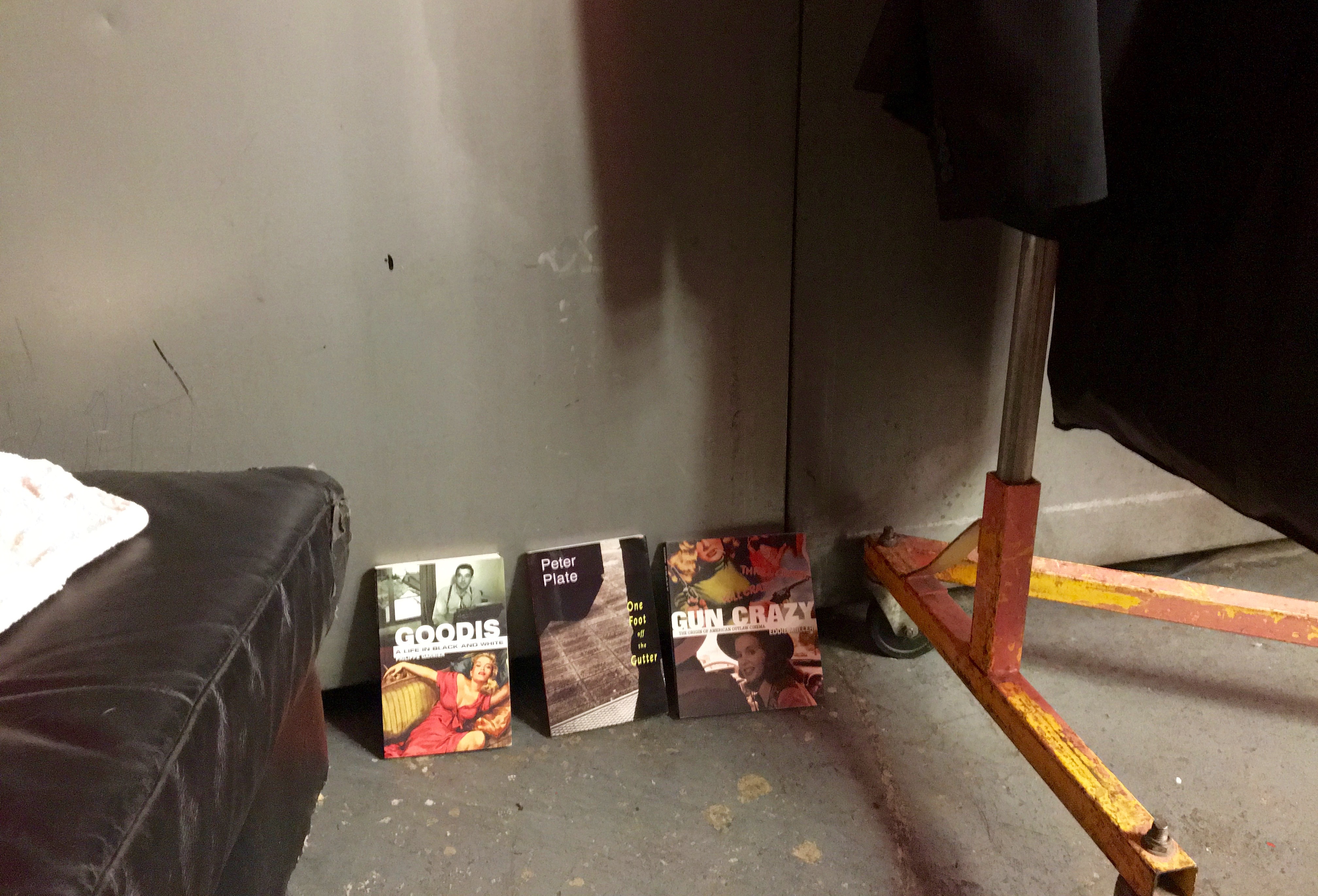
Down There (David Goodis, Philippe Garnier, Eddie Muller, Peter Plate)

down-there

David Goodis retains a reputation as being a soulful and tough “poet of the losers” partly because this is who his audience wants him to be. For many years that audience was largely French, so it makes sense that his biographer is Philippe Garnier, a film and literary critic who ventured to America in the 1980s on assignment to look up Goodis’s friends and family. Just recently David Goodis: A Life in Black and White was finally translated into English with Garnier’s update on Goodis reception since the first edition.

A Life in Black and White is a riveting read, absolutely essential for crime fiction buffs interested in the history of the form, perhaps especially for Garnier’s expansive and humorous history of how American pulp fiction was translated into French literature. The material specific to Goodis is similarly revelatory, although there are also moments that reveal Garnier’s spectacular lack of tact. (Garnier can be sardonic or catty about his subjects after interviewing them, a choice hard to imagine coming from an American biographer.)

I’ve explored the most famous Goodis titles more out of a sense of duty rather than out of love. The atmosphere is compelling but the details are haphazard. Perhaps because great directors and screenwriters could ignore those details, Goodis’s basic plot ideas have proven to be good fodder for movies: Indeed, I’d argue that the minor cinema classics Dark Passage, Nightfall, and Shoot the Piano Player are all better than the books.

However, it may also simply be that I just don’t hear Goodis’s music correctly. Amusingly, I chose The Blonde on the Street Corner for my “Crimes of the Century” list, which (I now discover according to Garnier) is one of the least-respected novels by serious Goodis fans. Blonde on the Street Corner is a novelization of a semi-autobiographical Goodis screenplay first embraced and then rejected by a studio boss at Warner Brothers. The book is overblown and sentimental, but it has a naturalness (probably because it comes from Goodis’s life experience) that I found more compelling than the fantastical conceits that dominate his crime novels. (In Shoot the Piano Player, the absurd idea that a pair of hoods would be smoking matching pipes isn’t from the source book Down There but nonetheless makes sense for Goodis.)

Garnier’s observations about the adaptations are some of the high points in A Life in Black and White:

Comparing Nightfall to Tourneur’s seminal noir Out of the Past is inescapable, and it’s led aficionados (of noir, of Goodis, and of Tourneur) to dismiss Nightfall as a minor title in their respective filmographies. You read a lot of “Burnett Guffey is no Nicholas Musuraca,” etc. Of course he isn’t. This is the 1950’s, and television had made its mark on cinema aesthetics. By 1956, the studios were fully aware that feature films would have a second life on TV, and they had had started to instruct their directors to shoot films, especially those in black and white, flatter and less contrasty, just as they also pushed for a style favoring close-ups, which looked better on the small screen.

—-

A Life in Black and White is published by Black Pool, the boutique imprint established by Eddie Muller, aka the Czar of Noir.

Muller himself has produced Gun Crazy: The Origin of American Outlaw Cinema, a look at a movie beloved by not just film noir fans but by cinephiles in general. In a valuable introduction, Muller explains his love of this movie and why he was compelled to write a book, including the following key bit:

Around the time I first encountered Gun Crazy, I also became seduced by the auteur theory, largely through the influence that critic Andrew Sarris’ regurgitation of the concept, borrowed from journals such as Cahiers du cinéma and Sight & Sound, had on a new generation of film writers. I gullibly bought in, believing that movies were the product of directors in the same way novels were the product to writers. In the intervening 40 years I’ve overcome this intellectual blindness. I now argue regularly against the absurdity of auteurism, even if it’s merely to insist, when creating program notes for a film festival, that screenwriters and producers receive equal credit….Readers of this volume will, I sincerely hope, never again refer to Gun Crazy as “a film by Joseph H. Lewis,” or “Joseph H. Lewis’ Gun Crazy.”

Muller makes good on his manifesto by showing where each and every idea in the finished film come from, whether the original story, the screenwriter, the cinematographer, or someplace else. It was a golden era for Hollywood, and Gun Crazy’s complex history gives Muller the perfect opportunity to take the lid off and show us how it all really worked. Muller’s prose is smooth and engaging and the photos are spectacular.

Both David Goodis: A Life in Black and White and Gun Crazy: The Origin of American Outlaw Cinema are only available online directly from Black Pool Productions.

—-

It’s not just David Goodis: A fairly common convention among noir authors (and their fans) is to suggest a troubled past even though not all those scribes have actually ever been that down and out.

San Francisco author Peter Plate has walked the walk as well as talked the talk. Plate has been a squatter in the Mission district and at times verged on being utterly homeless. His books are not always classified as crime fiction, but stories that come from that close to the bone inevitably interact with the seamiest side of humanity.

Plate’s brilliant and searing One Foot Off the Gutter (1995) uses the charred remains of a buddy-cop police procedural as a framing device for a serious novel about American fantasy and reality. A must-read for fans of noir: Not your average glamorous, heroic, or sentimental noir à la Goodis, but the really truthful and existential kind of noir.

Those commonplace italicized “thoughts of a deranged killer” chapters in commercial thrillers have become a banal cliché. Still, one can understand why a serious author would want to attempt to understand why strange people do the crazy stuff they do. One Foot Off the Gutter has perhaps the most convincing unreliable narrator that I’ve ever read.

I sat in the kitchen contemplating my vocabulary. I wanted to enrich my understanding of language. As a policeman, I needed to sharpen my oral skills. Starting alphabetically, I summoned the first noun that came into my head. Anxiety: now there was a nice word. I rolled it around on my tongue, relishing what it meant and how it sounded. Anxiety had a clean ring to it; a word that never stood in one place, but always had the energy to travel. I admired that quality, the power to go places and do things.

Charles Willeford’s deconstructed masterpiece New Hope for the Dead is a possible ancestor, as the cop protagonists of both books are looking for a place to live (although Willeford is comparatively comic). Ex-con Edward Bunker is another logical reference, although Plate is a much better writer. Certain passages of One Foot Off the Gutter are strikingly reminiscent of James Ellroy, to the point of suggesting that Ellroy’s L.A. Quartet is a direct influence on Plate. (One Foot Off the Gutter is also part of Plate’s Mission Quartet.)

However, Ellroy writes his fantasies, whereas Plate writes his reality. I will be reading more of Peter Plate.

Avatar in Residence

cse-kctwgaqw1kx

“Night 11” picture stolen from Miles Okazaki’s twitter feed

Henry Threadgill got in touch yesterday, saying that I should put something on my blog about Steve Coleman’s month-long gig at the Stone. One of Threadgill’s points was that back in the day, Thelonious Monk or Charles Mingus would play for a month or sometimes much longer at the same New York club, especially the Five Spot.

The Stone is not too far from where the Five Spot used to be.

Along with Wynton Marsalis, Steve Coleman is arguably the most influential musician of his generation. Coleman has never stopped pushing or refining his point of view. Threadgill is right: one simply must go see the man, his band, and his personal vision of the music getting a chance to work it out for a month in an East Village dive.

Fred Kaplan previewed the residency in the New York Times.


I wanted to make my world more hermetic, and really find my own sound

New DTM page: Interview with Pat Zimmerli.

The Patrick Zimmerli Quartet with John Hollenbeck, Chris Tordini and me performs at LPR on Saturday September 10 and at Ars Nova Workshop in Philadelphia Sunday September 11. The repertoire is an hour-long Zimmerli suite called Clockworksa commission from Chamber Music America’s 2015 New Jazz Works Program. Read the interview for more information and context about this unique voice in American music.

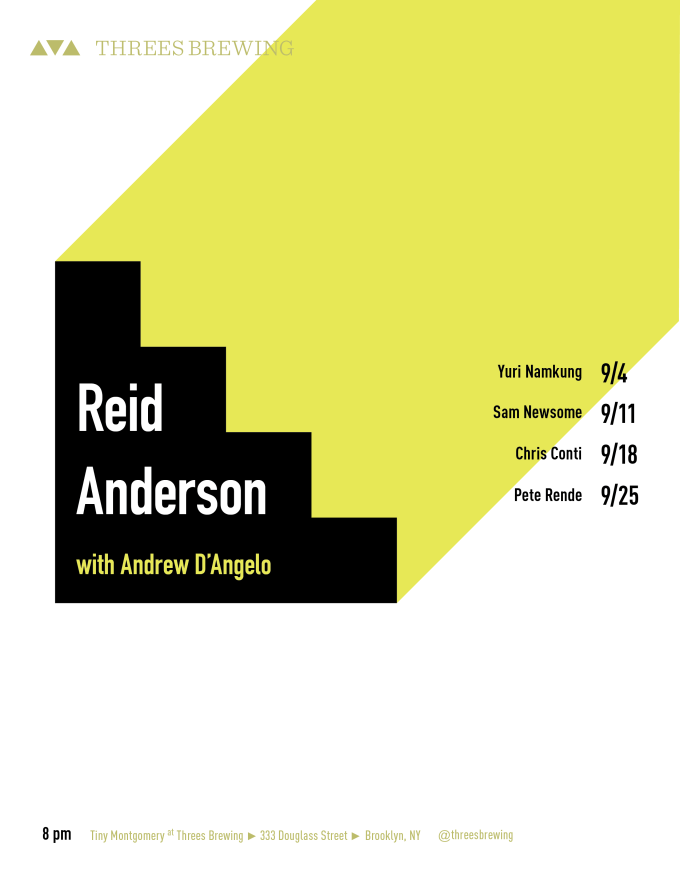
Also in September, the very great Reid Anderson has a residency at Threes Brewing in Brooklyn. Reid will not be playing the bass but will be manning a computer, offering original compositions that interact with a live improvisor, in this case Andrew D’Angelo. The others on the card will be offering unexpected spice. Recommended.

3B_Sept_Reid_WEB