Classical ECM

71863ihktwL._SL1400_.jpg


Steve Reich, The ECM Recordings (3 CD set)

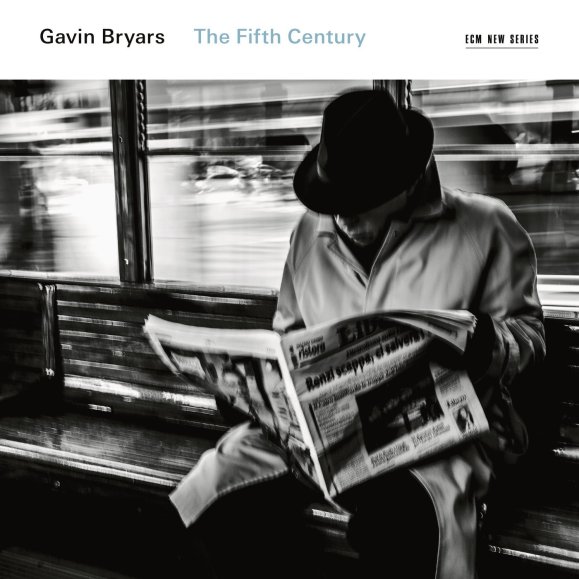
Gavin Bryars, The Fifth Century

Kim Kashkashian and Lera Auerbach, Arcanum – Dmitri Shostakovich, Lera Auerbach

Miranda Cuckson, Blair McMillen, Bela Bartók, Alfred Schnittke, Witold Lutoslawski

Manfred Eicher’s label began documenting jazz and improvised music in 1969 with Mal Waldron’s Free at Last. About a decade later ECM got involved with classical and fully-notated music as well, beginning with Music for 18 Musicians by Steve Reich. Just out is a lovely box that anthologies all of Reich’s ECM output including Music for a Large Ensemble, Octet, Violin Phase, and Tehillim. It’s essential music, with Paul Griffiths’s insightful new liner notes being another reason to acquire this specific collection.

During this era Reich still had real intimacy with the performers. The ensemble on Tehillim (which remains my personal favorite Reich composition) was a working band made up of great musicians with ties to jazz and world music including Jay Clayton and Glen Velez. The later Nonesuch recording is “classical music” compared to this more folkloric and jazzy effort. The other indisputable masterpiece in the box is Music for 18 Musicians, partly thanks to the sheer beauty of the recorded sound.

Of course ECM is renowned for quality sound reproduction, especially in genres compatible with ambient reverberation. The brand new recording The Fifth Century is perfect for the label, a meditative work for chorus and saxophone quartet.

I’m not that familiar with Gavin Bryars, nor have I heard his previous ECM releases. For some reason I thought he was in the “experimental music” or “post-minimalist” camp. To my surprise and delight The Fifth Century is rich with conventional harmony exploited by a master composer unafraid of high craft.

Bryars himself namechecks John Dowland and John Tavener; other references might include Ralph Vaughan Williams and Herbert Howells. (Howells is perhaps especially relevant to the a cappella women-only Two Love Songs encoring after The Fifth Century.) The librettist is 17th-century English mystic Thomas Traherne. In his excellent liner notes, Brian Morton (who I know best as the knowledgeable British jazz critic who co-wrote the indispensable Penguin Guide to Jazz with Richard Cook) begins with a scene from a famous spy novel, The Honorable Schoolboy by John le Carré.

All this is to say this is some real English material, except that the work is performed by American forces, the mixed choir of The Crossing conducted by Donald Nally along with the PRISM saxophone quartet. Each and every member of both groups is a master of pure tone untouched by vibrato.

The whole cycle of The Fifth Century is beautiful, but a standout track is “Eternity is a Mysterious Absence of Times and Ages,” which just suspends and sustains, the voices and horns melting and moving imperceptibly through the void. It’s hard to believe these foggy sounds are saxophones, they seem to emit from mother earth herself.

ECM’s biggest classical music successes have been with living composers who explicitly reject high modernism: first Reich, then Arvo Pärt. Bryars can also be seen in that continuum, and there’s at least a fighting chance (if it got used in a movie or something) that The Fifth Century could get a foothold in popular culture in the way that Music for 18 Musicians and Tabula Rasa did.

However Eicher has not repudiated those making a valuable contribution with comparatively inaccessible formal music. In the ECM New Series catalog there are thorny gems like Herbert Henck’s traversal of Jean Barraqué’s brutal Sonate pour Piano and a great disc of chamber music by Harrison Birtwistle (which I reviewed for The Talkhouse).

Also just out is Kim Kashkashian and Lera Auerbach’s Arcanum. Auerbach’s own composition is in the Russian tradition of Shostakovich and Schnittke, so she is a natural for arranging Shostakovich’s ironic and amusing 24 Preludes for viola with piano. Auerbach’s treatment is straightforward, intended to give violists something to pair with Shostakovich’s ultimate statement, the Viola Sonata. In this case it’s a good feature for Kashkashian’s dark sound and effortless facility.

More important is Auerbach’s major work Arcanum, a kind of sonata in four well-wrought movements. According to Auerbach, Arcanum’s topics are intuition and death. A certain amount of expected passionate gloom motivates the first two selections, “Advenio” and “Cinis.” Goblins appear in the scherzo “Postermo,” and I’ll be dammed if there isn’t a proper Beethoven-ish transfiguration of minor into major. Like Schnittke, key centers are undermined through theatrical dissonances: Kashkashian has to reach up top for a final unresolved note in “Postermo,” a special effect she has to do an octave higher to close the searching “Adempte.”

While essentially a modernist and abstract piece, Arcanum shows there is still plenty to work with when a composer of Auerbach’s subtlety harnesses the ancient forces of tonality. Auerbach’s a wonderful pianist as well (her stunning solo album Preludes and Dreams makes the case for her being a significant virtuoso) and Kashkashian sounds delighted to premiere a major contribution to the relatively restricted repertoire for her instrument.

Like The Fifth Century, Arcanum again points out how crucial ECM is to presenting the best of current formal composition.

Earlier this year the label offered Miranda Cuckson and Blair McMillen in a program of Bartók, Schnittke, and Lutoslawski. It is comparatively unusual for Eicher to record New York classical musicians in standard repertoire but there is certainly no reason why he shouldn’t: Cuckson and McMillen are both in the top echelon of the town’s freelancers, musicians who seemingly can play anything.

Cuckson has an interesting mind. She pens valuable liner notes and her commitment to modernity has rivaled Paul Zukofsky, the elder violin star/curator of New York new music. However, it is hard to imagine Zukofsky recording a solo effort with as much natural charisma as Cuckson’s extraordinary microtonal recital Melting the Darkness (with works by Xenakis, Haas, Bianchi,  Burns, Sigman, Perez-Velasquez, and Rowe).

For ECM Cuckson first appeared on Vijay Iyer’s Mutations, a work closer to a modernistic classical ethos than jazz, yet also an occasion that suggests Cuckson’s versatility across the full NYC spectrum.

The current recording is mostly concerned with reasonably obdurate pieces. Bartók’s Sonata no. 2 for Violin and Piano is a masterpiece: it’s also about as far as the composer got in terms of transfiguring folk influences into unrelenting modernism. To make the austerities acceptable a kind of rhapsodic freedom is required, and Cuckson and McMillen certainly deliver the goods.

Alfred Schnittke first announced his “polystylism” in his 1968 Violin Sonata No. 2, “Quasi una Sonata.” The straight G minor piano stings bounce against disjunct dissonances. I’ve heard this work a few times. While Schnittke himself liked it enough to re-orchestrate for chamber ensemble and Cuckson writes of the inspiration of first learning it during college, I myself don’t feel that it is fully cooked, at least compared to the many Schnittke masterpieces of the 70’s and 80’s. However there’s no doubt it needs the occasional airing, at the least to help show how this genius arrived at his future path.

The violin and piano Partita by Lutoslawski predated his orchestration as Partita for Violin and Orchestra for Anne-Sophie Mutter. The original instrumentation helps disclose Bartókian affinities in the rhythmic sections, and perhaps shockingly even a hint of American blues in the “Largo.” The work as a whole is an easy and fun listen. Those new to complex classical music wishing to explore this excellent disc might want to start with the Lutoslawski, who (in this instance) expresses abstract ideas in the most direct manner.

—-

A shout out to the marvelous pianist Blair McMillen, who I keep missing chances to see live. I also keep waiting for solo CDs of all this wonderful new and old music Blair plays about town and all of the world. Alvin Singleton told me that a recent McMillen performance of Singleton’s “In My Own Skin” was “unbelievably powerful.”

I haven’t connected with you yet, Blair, but I expect you’ll see this blog post one way or the other, so I’m just letting you know, I have my eye out…
The Last Gig

I got to the Vanguard early last night because I wanted to see how it all went down.

A few years ago, I asked Barry Harris how many trio gigs he had played in New York with another drummer besides Leroy Williams since their first record, 1969’s Magnificent! He thought about it for a moment and replied, “One.”

The bass chair has been held by Ray Drummond for a couple of years now, a perfect solution. (Previous iterations of Chuck Israels and Earl May had been hotly debated by Harris fans.) So there was no surprise that there was no rehearsal and certainly no soundcheck for the group last night. Whatever Harris wants to play, everyone has done it already or can learn it quickly enough.

Around 8 PM Drummond and Williams showed up and set up onstage. A few minutes later Barry (who is turning 87 next week) was escorted down the steep Vanguard stairs. He went straight to the side of the stage, drummer’s corner: No need to relax in the kitchen. At 8:30 the lights went off and the audience quieted down. Still seated, Barry announced, unseen and off-mike, “On bass: Ray Drummond!” Applause. “On drums: Leroy Williams!” Applause. “On piano: the wonderful! the magnificent! the eloquent! the amazing! Barry Harris!” and moved to the Steinway.

“This first number is, as always, one for the ladies.” The trio’s got one really serious gait left in their pocket, which is medium slow swing. “She” moved like a sinuous lizard baking in the sun. No one alive can do it better.

The point is simply that every articulation, every note, every essential aesthetic choice, is authentic. Barry’s lines have always been vocal: these days the announce mic is right by his head the whole time, so you can hear just how singing (not to mention grunting) it all really is. And swinging! For almost 50 years Barry and Leroy have been trying to out-late each other on those upbeats. Ok, at this point it is probably slowing down a bit here and there but, damn, that is some mystical placement.

For the second number Barry said, “I want to see if I can still play fast,” and jumped into “Just One of Those Things.” He’s not really firing like he used to, but the intention of every bebop line was still utterly correct on a primeval level.

For many years I slept on Barry Harris. I liked him but it wasn’t until I was in my 30’s that I started realizing how heavy he really is. He’s a contentious character, a man who sees the evolution of this music since 1954 as mostly a mistake. But the other side of it is that this music only truly exists when a master is making it right in front of you.

The trio is at the club through Sunday.

UPDATE: After posting, Mark Stryker sent along this clip, which has the vibe of Barry today. Great camera angle! I just stole a voicing or two. 

Violins, Veils, Tears

c-sharp-minor

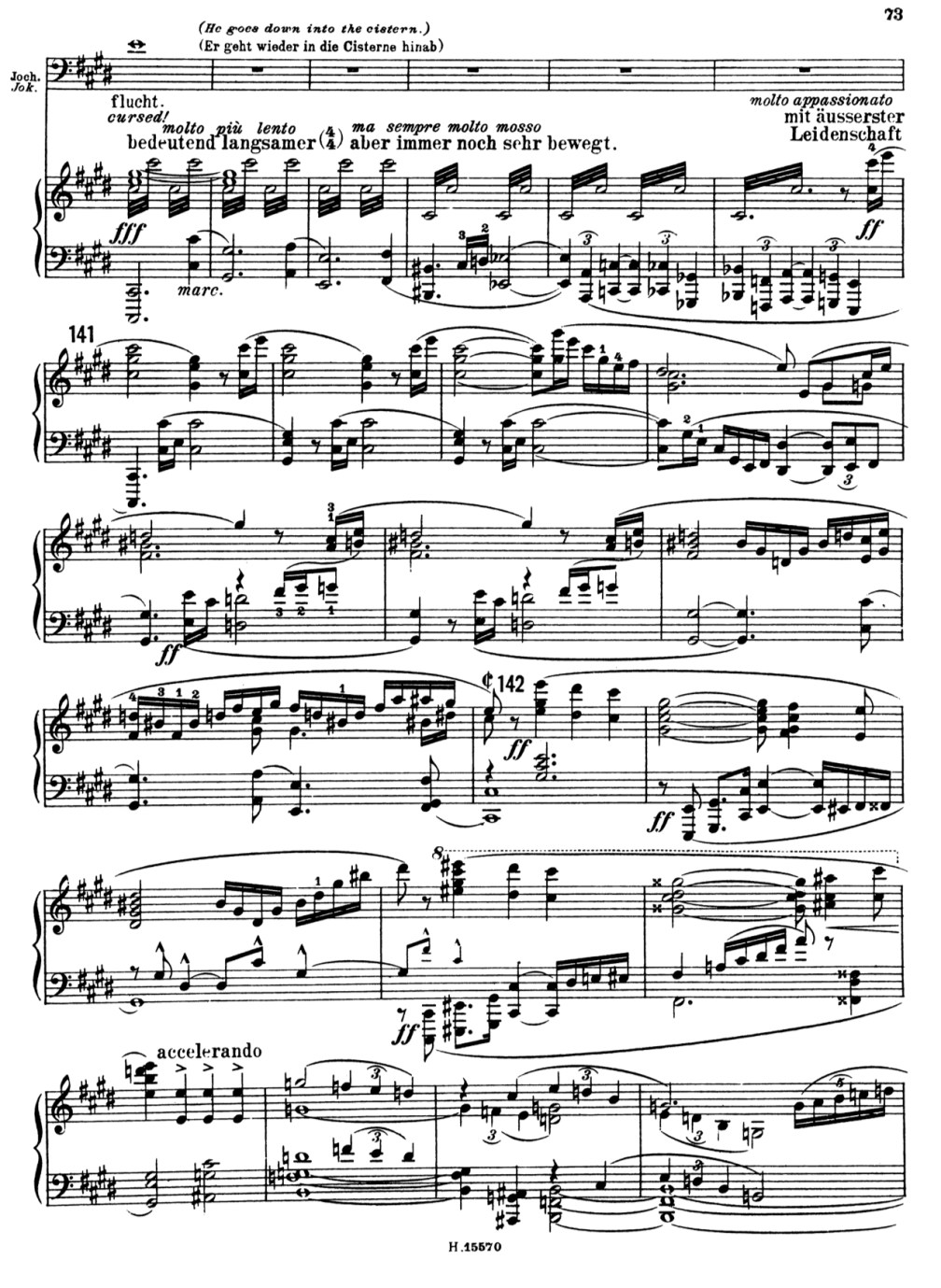
A favorite moment in C# minor, when Jochanaan rejects Salome and returns to his cistern

Grand Opera is a rich tapestry of not just the work itself but also any given opera’s reception and performance history. The story of Richard Strauss’s Salome is especially relevant both to political freedom and musical evolution: Oscar Wilde was in jail for “Gross indecency with men” at the time of the debut of Wilde’s play Salome (and future Strauss libretto); Arnold Schoenberg, Giacomo Puccini, Alban Berg, and Gustav Mahler were at the Austrian premiere in 1907; the opera was banned in various places; the chromatic and even polytonal harmony has vexed music theorists for a century; even last night at the Met the audience got to enjoy the mildly lewd question of, “Are we going to see the star get naked?”

Great art remains timeless. Strauss’s music is mostly sublime and Wilde’s pre-Freudian family psychodrama rings disturbingly true. Indeed, while looking at rich and fat Herodes (wonderful Gerhard Siegel) in charge of his amoral family, it was impossible not to think of a pack of Trumps a few blocks away in their Tower.

The flaw in the opera is the “Dance of the Seven Veils.” Strauss’s music is frankly crass Orientalism, and the final effect is really no more profound than the obligatory “underworld characters in a Moscow strip club” scene found in most modern action movies. Still, Patricia Racette danced with grace.

More importantly, Racette sang and and acted this role of roles with beauty and fire. Jürgen Flimm’s production (designed by Santo Loquasto) was solid and professional. A new touch were grim and silent winged figures that slowly gathered after Salome’s demand for a head on a charger. These harbingers of death were especially effective in concord with James F. Ingalls’s superb lighting. In the pit 105 musicians unified under Johannes Debus.

Everyone should see Grand Opera at least once a year, there’s nothing else like it. Salome runs though December 28. Many thanks to Met percussionist Jason Haaheim, who also appears in a previous post about Elektra at the Met.


Give the Drummer Some

Kudos to Cindy McGuirl for releasing the absolutely essential The Compositions of Paul Motian, Volume 1: 1973-1989. Full details at Uncle Paul’s Jazz Closet.

This is the best folio of a major jazz composer I’ve ever seen, partially just because the charts are in the composer’s own hand. Comparing the score to the record answers all questions. Motian’s script is gorgeous.

Cindy will release the second volume if enough copies of the first volume sell. You know what to do.

—-

Paul’s death left a big hole in the scene. The drummer who has kind of eased into a new prominence and perhaps is even taking over some of Paul’s duties is the very great Andrew Cyrille.

John Coltrane called his late music not “free” or “rubato” but “multi-directional.” Joe Lovano told me something profound about Cyrille, “All the tempos are one tempo.” When I asked Andrew directly about his feel, he said, “You just simmer the vegetables on the grill.”

I’ve been enjoying both Proximity and The Declaration of Musical Independence. The first is a brilliant duo with Bill McHenry. Bill has a profound understanding of melody, and this bare bones session brings out something really correct in Bill’s playing.

ECM has a long track record of getting the most mellow and ambient work out of avant-garde masters. The Declaration of Musical Independence continues in this tradition. It’s impossible to imagine a more listenable set of experimental music. Bill Frisell is a perfect choice; Richard Teitelbaum adds just enough crunch; Ben Street is wayward and mysterious.

Aidan Levy also did a nice job getting more commentary from Andrew about his discography in a Bright Moments feature.

Fall Hiatus

Linda Evans and Gretchen Corbett.png

My desktop wallpaper: Linda Evans and Gretchen Corbett in THE ROCKFORD FILES

DTM will be back around December. Probably I’ll be tweeting once in a while. The newsletter, Floyd Camembert Reports, will include an “email lesson about blues piano” composed for my NEC students for while I’m away on tour.

Tomorrow, October 25, Mark Turner and I play duo at Mezzrow.

November 22 I’ll be playing a standards gig with Ben Street and Eric McPherson as part of Konceptions Music Series at Korzo. We are at 9, the estimable Ches Smith is at 10:30. This is kind of a warm up for January 24-19, when the Iverson/Street/McPherson trio joins forces with Tom Harrell at the Village Vanguard.

The Bad Plus will be on tour in November and December, including a stop at a new (to us) NYC venue, Rough Trade on November 21.

The new site has been reasonably busy since opening doors in late April. Thanks for reading.

Interview with Ben Ratliff

Evolution (RIP Bobby Hutcherson)

Interview with Alvin Singleton

Praise for Hail, Caesar!

James Ellroy’s L.A. Confidential

Listening to Lowell Davidson

Gershwin Comes Home (Aaron Diehl plays Concerto in F)

Interviews about NEC and TBP

Down There (David Goodis, Philippe Garnier, Eddie Muller, Peter Plate)

Memories of Connie Crothers (by Marta Sanchez)

Interview with Patrick Zimmerli

Interview with Ken Slone (creator of Charlie Parker Omnibook)

Steinway, Sweeney, Paulson, and Trump

Modern Composition (Guillermo Klein, Tim Berne, Marc Ducret, Jason Moran)

Interview with Charles McPherson

Albert Ayler at 80

Interview with Houston Person

Hall Overton, Composer

Winnsboro Cotton Mill Blues (Frederic Rzewski)

Red’s Bells (Red Garland)

Interview with Wayne Shorter

Briefly Noted

The following miscellany is dedicated to the recently deceased Ed Gorman, indefatigable writer, reader, and editor. Gorman’s short stories could be really great: “False Idols” uncovers some dark truths about those of us who love to collect the past, perhaps just like Gorman himself, who did so much to keep the names of a certain generation of pulp authors in print. (“Fallen Idols” is found in the utterly marvelous collection The Black Lizard Anthology of Crime Fiction, naturally edited by Gorman himself.)

Laura Lippman, Wilde Lake. Lippman has moved into a kind of Ruth Rendell or Donald Westlake-type situation, where books about a series character (in Lippman’s case P.I. Tess Monaghan) alternate with more experimental stand-alone novels. Her latest is a surprise, a piece of Americana somewhat in the tradition of “the narrator comes of age” tale beloved by Joe Lansdale and Stephen King. Wilde Lake is perhaps even some kind of response to To Kill a Mockingbird. Lippman’s prose is superb, and the compelling story is supported by rich Maryland detail. There’s no doubt that Lippman has become one of my few “must read” authors.

Ruth Rendell, Dark Corners. The final Rendell is good, but truthfully I found the ultimate Inspector Wexford, No Man’s Nightingale (2013) a stronger statement. In general, I prefer Rendell when she’s navigating a conventional mystery. Dark Corners succeeds at a kind of creeping psychological terror, of course — it’s by Ruth Rendell, after all — but the absence of any kind of whodunit undercuts the forward motion, possibly because the details of modern English life don’t ring quite true. (No such complaints about her non-whodunit masterwork A Judgement in Stone.)

Alex Marwood, The Darkest Secret. I picked this up thanks to a rave blurb by Lippman. Marwood’s milieu is horrible wealthy English families, and truthfully this work is essentially harrowing. Marwood looks at her characters with an unflinching gaze, but also has compassion for the innocent children begat from these tainted souls. Excellent, depressing, edgy, very much of our current moment.

Keigo Higashino, A Midsummer’s Equation. The tradition of proper mystery is in good hands with Higashino. Simple and unglamorous detection — knocking on doors, chasing the clues, never a gunfight or a chase — seems to suit a Japanese aesthetic, or at least it suits Higashino, whose relatively slender output contains some of the greatest straight murder mysteries ever written.

Domenic Stansberry, The White Devil. This is an unusual tour de force, a reworking of the Jacobean tragedy The White Devil by John Webster (1612) into a modern American noir with a heavy emphasis on corrupt Italian religion and politics. The classic nexus of sex and death is given an extra frisson with a hint of near-incest. A compelling read, I’ll be looking for more Stansberry.

Anne Holt, The Lion’s Mouth. Settled and productive societies are a good backdrop for crime stories. Holt’s Norwegian books satisfy, modern thrillers of taste and just enough action. The Lion’s Mouth is best when going behind the scenes in the Oslo political system.

Kazuaki Takano, Extinction (AKA Genocide of One). These days some of the most exciting work seems to be in the genre of the techno-thriller. When I picked up Extinction I did little else until finishing it. While the godfather of the techno-thriller, Michael Crichton, essentially had right-wing politics — and his heir Tom Clancy was even worse — more recently this genre has offered stunning political exegesis. Charlie Huston’s Skinner (DTM review) remains a favorite; Takano also joins the top-tier with this thoughtful tale of the next stage in human evolution.

All the above books are new, but I also finally experienced an important book from a couple years ago.

Wesley Stace, Charles Jessold Considered as a Murderer. Stace’s mainstream novel has some of the finest writing on music I’ve ever seen in fiction. (The research notes at the back of the book are extensive.) It’s worth reading for the music alone, but I’m not meaning to imply that the rest of it isn’t exceptional as well. Anthony Powell might be a slight influence on Stace’s breezy yet passionate portrayal of the atmosphere in England between the world wars. Jessold is work of great ambition, and also justly acclaimed. Alex Ross gets a cameo.

The next Lee Child, Night School, is due in November. I’m enough of a Jack Reacher fanboy to have immediately thought of how pleased Reacher would have been with this massive full flask of “Real American” coffee at the hotel breakfast in Rouen.

img_1822

On the plane home I watched three movies, something I never do, but I guess it was time to catch up.

Fast & Furious 6. I didn’t know this was a documentary! Actually: Watching a movie that was only cliches was oddly soothing. Every single scene was something I’d already seen several times before, so the film took on a kind of humorous “meta” aspect. The biggest problem was the CGI for car chases and stunts. I want that squealing Detroit iron to feel like actual human experience. Where’s Bill Hickman when you need him?

Batman: The Dark Night is one most ethically challenged wastes of time imaginable. It’s okay to like it if you are eleven or twelve years old, but if you are eleven or twelve years old you shouldn’t be watching this kind of graphic violence and torture. Of course, some of the acting is good…but what whole lot of false moralizing from a man who dresses like a bat.

The Nice Guys was great! I went in with no expectation and ended up laughing uncontrollably. Russell Crowe and Ryan Gosling kill it in comic roles. Of course the last half hour isn’t as good, standard operating procedure for comedies that think they need to go big or go home.

While on the surface The Nice Guys may seem like the most corrupt or reprehensible member of this random set (in the first scene, a porn actress dies after a car crash while posed like a centerfold), in truth in it soars in a much purer atmosphere than Fast & Furious or Dark Night:  The Nice Guys is the only one of these three films that seems to know that it is a sin.

Behold

The Coen brothers just keep at it. Hail, Caesar! is a sophisticated meditation on art, politics, and religion. What do you believe in? Why you believe it? Is simply making a good piece of entertainment worthy of faith?

The story takes place on the set of early Fifties Hollywood, where the Coen’s get to recreate the glories of the dream factory while simultaneously making fun of the conventions. Channing Tatum’s delightful dance number leading a group of sailors though benign destruction of a bar works on multiple levels.

The hero, Eddie Mannix (Josh Brolin in the role of a lifetime), is a fixer. He does whatever job needs doing to make the pictures happen. Mannix’s morality is in question, but not more than the morality of anybody else: Communists, Capitalists, Christians.

At one point the Coens have a kind of stand in, a sophisticated and outspoken rabbi. When the rabbi growls (asked about the ethics of portraying Jesus a movie), “I haven’t an opinion,” this actually means “It’s too complicated to really know.”

Another loaded answer is when the boy playing Jesus is asked (on the cross) if he is a principal or an extra. “I think I’m a principal” he stammers. (Or is it, “principle?”)

Hail, Caesar! is packed with those incredible surreal comic moments that remain a Coen signature. The precise and subtle lines in the script encourage the cast to give their all. Highest recommendation.