The great bassist passed away at 85 last week. I recently wrote about his early years for JazzTimes. Gary and I spoke briefly on the phone before publication, he appreciated the comments and said they were accurate.
One to listen for a memorial is December Poems, which is mostly solo, elegiac in tone, and quite gorgeous. All of Peacock’s work with Paul Bley is by definition outstanding. However the last disc of the ’60s, Mr. Joy with Billy Elgart, is a notable masterpiece and should be better known.
Peacock is now most famous for the extraordinary trio with Keith Jarrett and Jack Dejohnette. All their records have value, but I will always have a special soft spot for the freewheeling early sessions, the 1983 studio music, Standards Live, and Still Live.
Jazz historians tend to see America as an integrated society, but that wasn’t the case for a long time. (Perhaps our country is still not integrated to this day.) A corrective to the narrative can be found in Soul Jazz: Jazz in the Black Community, 1945-1975 by Bob Porter. I’m learning a lot from this excellent book.
In the post-war era, as the big bands faded away, the black musicians that wanted to experiment with abstraction went into bebop while those that wanted a steady paycheck went into R&B. All the musicians essentially knew the same information, and there was plenty of interplay between the two styles. Bebop groups could still play dances and R&B groups had plenty of virtuosity. Someone like John Coltrane could work in both idioms proficiently: two of Coltrane’s early jobs were with Dizzy Gillespie (bebop) and Earl Bostic (R&B).
Porter discusses Hal Singer as a key figure. Singer turned one hundred late last year in Paris; according to Wikipedia, “He is the last surviving male survivor of the Tulsa race riot.”
Singer’s “Cornbread” was a no. 1 Race Records hit for the Savoy label in 1948. It’s one of the earliest “honking sax” pieces and proved to be wildly influential. You can hear all of ’50’s rock and roll coming out of “Cornbread.”
R&B owes a lot to the driving left hand ostinatos of boogie woogie. Collecting examples of jazz piano greats playing boogie woogie is one of my hobbies, so I was delighted to learn the groovy shuffle powering “Cornbread” is performed by Wynton Kelly, all of 16 at the time.
Tootie Heath told me about playing house parties and dances in Harlem with Mal Waldron in the ’50s, where they dealt in exactly the same style as “Cornbread.” “We played that shuffle all night,” Tootie said. (Walter Davis offers this kind of two-handed lope on “Greasy” from Jackie McLean’s New Soil in 1959; thanks to Mark Stryker for the tip.)
Back to 1948, Elmo Hope gets more of a piano feature with Joe Morris on “Boogie Woogie March.” The band is stocked with major modern jazz stylists including Johnny Griffin, Percy Heath, and Philly Joe Jones.
(If you are wondering why the ’50s Miles Davis groups with Philly Joe Jones had such superlative feel, the drummer’s immaculate shuffle with Joe Morris may provide part of the answer.)
I’d never guess that as Elmo, but I’d have at least a tiny shot at guessing that it was Sun Ra playing boogie with Wynonie Harris in 1946. Herman Blount is just a little “out” on “Dig this Boogie.” (“Out” in good way, of course.)
Hank Jones might have played in some R&B bands, I’m not sure. At any rate Hank recorded a distinctive minor-key boogie (replete with train effects) for his otherwise conventionally great 1958 jazz LP The Talented Touch, “Let Me Know.”
By 1958, boogie had pretty much had its day, gone the way of ragtime and Harlem stride. Oscar Peterson might have been the only major jazz practitioner to steadily keep some boogies in rotation, although Keith Jarrett has occasionally glanced at the style.
Benny Golson gave us a rare exception when he and Art Farmer re-formed the Jazztet in the 80s. Golson’s surreal “Jam ‘n Boogie” featuring excellent pianist Mickey Tucker is on the Jazztet’s 1983 album Nostalgia. Tucker also recorded a version on Blues in Five Dimensions. On both recordings, Tucker plays a few “straight” choruses at the top before the modernist hard-bop ethos kicks in.
At the height of the pre-war boogie craze, back in the late ’30s and early ’40s, the acknowledged specialists of the style included true masters like Pete Johnson, Albert Ammons, Meade Lux Lewis, and Jimmy Yancey. Yet most of the name jazz pianists played and recorded at least one boogie, including Earl Hines, James P. Johnson, Art Tatum, Erroll Garner (whose 1944 “Boogie Woogie Boogie” includes some bebop harmony) and the rest.
A particular favorite of mine is “Little Joe from Chicago” by Mary Lou Williams from 1939. Last week for my socials I casually tracked a “play along” with the track slightly sped up (117%) and the pitch lowered 12 cents.
(Thanks to Hyland Harris for recommending the Bob Porter book and for finding the Wynonie Harris/Sun Ra track.)
Tonight at 8 PM (EST) I’m going to check out Malaby / Hébert / Mintz: The Under Turnpike Trio at Arts for Art. Tony Malaby’s blurb is inspiring:
In 2016, Billy Mintz, Hill Greene, and I were supposed to play one of AFA’s InGardens sets but were cancelled because of noise complaints. On our way home to New Jersey, Billy and I played two long and fulfilling sets under the turnpike. When the pandemic started we talked about meeting there and hitting as soon as things calmed down a bit. One afternoon, John Hébert called with that desperation to hit and play music so we organized the first Under the Turnpike session and have met there since. The noise of traffic from the turnpike above and skateboarders’ crashing boards has become part of our sound. I’m so happy to have this place close by and share it with two of my oldest friends. – Tony Malaby
As any serious DTM reader knows, Scott Wollschleger is one of my favorite “new” composers, and I’m very happy that Steve Smith featured Scott and pianist Karl Larson for the post “Double Vision” at Night After Night. The substantial interview is a goldmine, and of course the music (which sees YouTube release thanks to quarantine conditions) is wonderful.
Matthew Guerrieri has been meditating on Bach (among other things), joking, “I have been doing my part to uphold the classical-music hegemony by practicing Johann Sebastian Bach under lockdown—practically a cliché at this point, but when has that ever stopped me before?” The whole post is delightful.
My quarantine “Carolina Shout” is up, I’m pretty pleased with it. Among the props is a David Nyvall sculpture on loan from Daniel Pinkwater.
Oh, and “All the Things You Are” anagrams as “Reheating a Holy Lust.” (Just thought you should know that.)
It’s all too easy to get caught up in doomscrolling Twitter. I’m trying to stop, but at this point I’m certainly an addict. The recent article “Human Sacrifice and the Digital Business Model” by Geoff Shullenberger was helpful.
It is an arena for perpetual conflict driven by an accumulation of grievances collected in a mass program of decentralized surveillance. We are incentivized, by the coded logic of the social media platforms where public engagement now takes place, to find reasons to hate each other. The algorithms that encourage and reward particular behaviors on Twitter and Facebook play on our deepest human instincts and desires to create spectacles of symbolic violence and sacrifice.
Until I turn off the app for good — it’s hard to give it up while one’s career is hanging by a thread during a pandemic — I’m doing what I can to be a positive force, celebrating what I love.
Recently American classical music Twitter theorists — a small but noisy bunch — were all over the timeline. Opening progressive shots included comments like, “‘Bach wrote some of the greatest music known to mankind’ is the kind of language we need to change if we’re going to begin breaking down classical music’s racist problems,” and, “Beethoven was an above average composer—let’s leave it at that.”
Fine. Germany and associated European empires can make their own rulings on Bach and Beethoven. Americans could practice leaving that dominance hierarchy alone, anyway…
…For what I find relentlessly irritating is that Americans have their own great (I’m not afraid of the term) musicians, and this heritage seems to get further obscured by these academic culture wars. In essay after essay by those seeking to demand multiculturalism and racial justice, names like Duke Ellington, Thelonious Monk, and John Coltrane are rarely present.
Irritation produces scolding, and I’m trying so hard not to do that (let alone succumb to “our deepest human instincts and desires to create spectacles of symbolic violence and sacrifice”). Instead, I tweeted out the following:
A lot of American musicians are arguing about music theory on twitter. There’s no one theory of music that’s gonna make you a finished American musician. Americans are blessed to be impure from the git-go. It’s fabulous. FWIW, I have already written a lot about this topic:
2) “In 2019, our feverish culture war includes hand-wringing about the participation of African-Americans in ‘classical music,’ in this case referring to music that holds European-based presentation as the ideal.” Remembering Harold Mabern, Larry Willis, and Richard Wyands.
3) “Charles McPherson suggested to me that the songbooks are generally how jazz musicians learned European harmony, and I suspect he’s right. Indeed, before fakebooks, the piano players had to have the sheet music.” Deepening Your Relationship to Musical Theatre.
4) “Early black jazz musicians worked over the European harmonic system to include an African aesthetic.” Lil Hardin Teaches the Blues.
6) “In some circles, ‘jazz harmony’ is held to be a valid discipline. It’s not. ‘Harmony’ is the correct discipline.” Theory and European Classical Music.
7) “Consecrated jazz drummers have less metronomic time than rock and fusion drummers for a reason. The beat is connected to the cycle of life and playing with an ensemble.” Rhythmic Folklore.
8) “Magic happens at the drum kit when the four limbs are slightly desynchronized. Any truly swinging or funky drummer does not always place the articulations of the two hands and two feet at exactly the same time.” Threepenny Review Table Talk bit on Hands and Feet.
9) “Duke Ellington, Thelonious Monk, and McCoy Tyner all share the basic European information but their non-European information is harder to pin down. They relate harmony to rhythm in a ‘jazz’ way but intellectual analyses of these procedures are rarely convincing.” Theory of Harmony.
I maintain that great jazz fixes diversity issues in a flash. Much more to come from DTM about this astonishing and endlessly satisfying music.
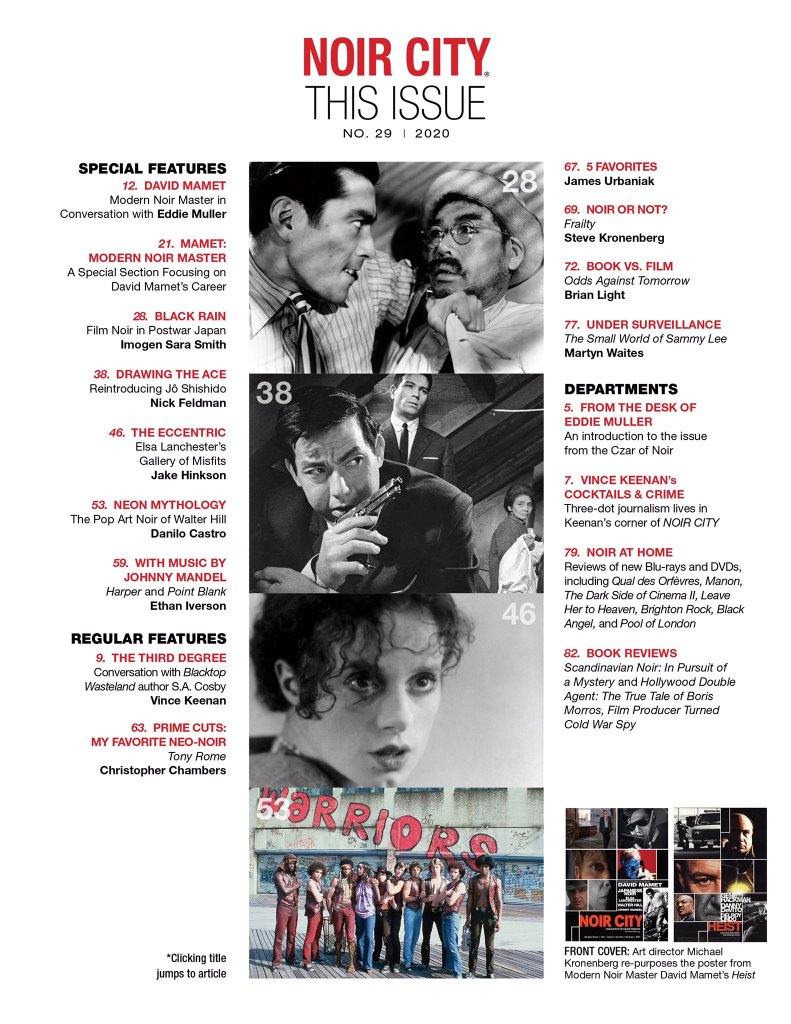
The latest issue of Noir City is out, which includes my appreciation of the Johnny Mandel scores for Harper and Point Blank.
There’s actually quite a lot of music-related material in this issue: David Mamet talks the motivic appeal of Glenn Gould and Bach during his interview with Eddie Muller, Brian Light looks at Odds Against Tomorrow with a famous score by John Lewis (Paul Motian told me that was some of his favorite music), Martyn Waites makes a case for The Small World of Sammy Lee starring Anthony Newley, better known as the lyricist of “Goldfinger,” and there’s even a redemptive reading of Sinatra’s Tony Rome by Christopher Chambers.
In what is a rather bizarre crossover in my own life, Vince Keenan reviews Wendy Lesser’s book Scandinavian Noir. Vince and Wendy are two of my editors and friends but have never met — maybe I’ll be able to arrange that at some point…
The whole issue is a knockout. (David Mamet and Walter Hill fans seriously need this one.) Subscribe at the Film Noir Foundation.

 DO THE M@TH