L.A. Story

One of the best things about playing Catalina's (we are there tonight and tomorrow as well) is the proximity to Amoeba on West Sunset Boulevard. 

On CD I got the terrific Ray Bryant Trio on Prestige, thanks to a strong recommendation by Mike Kanan.  This was just before I heard of Bryant's passing.   More from DTM soon;  for now, watch videos of Bryant solo and trio.  (I don't recognize the bassist and drummer; if you know, leave a comment in the last Forumesque.)

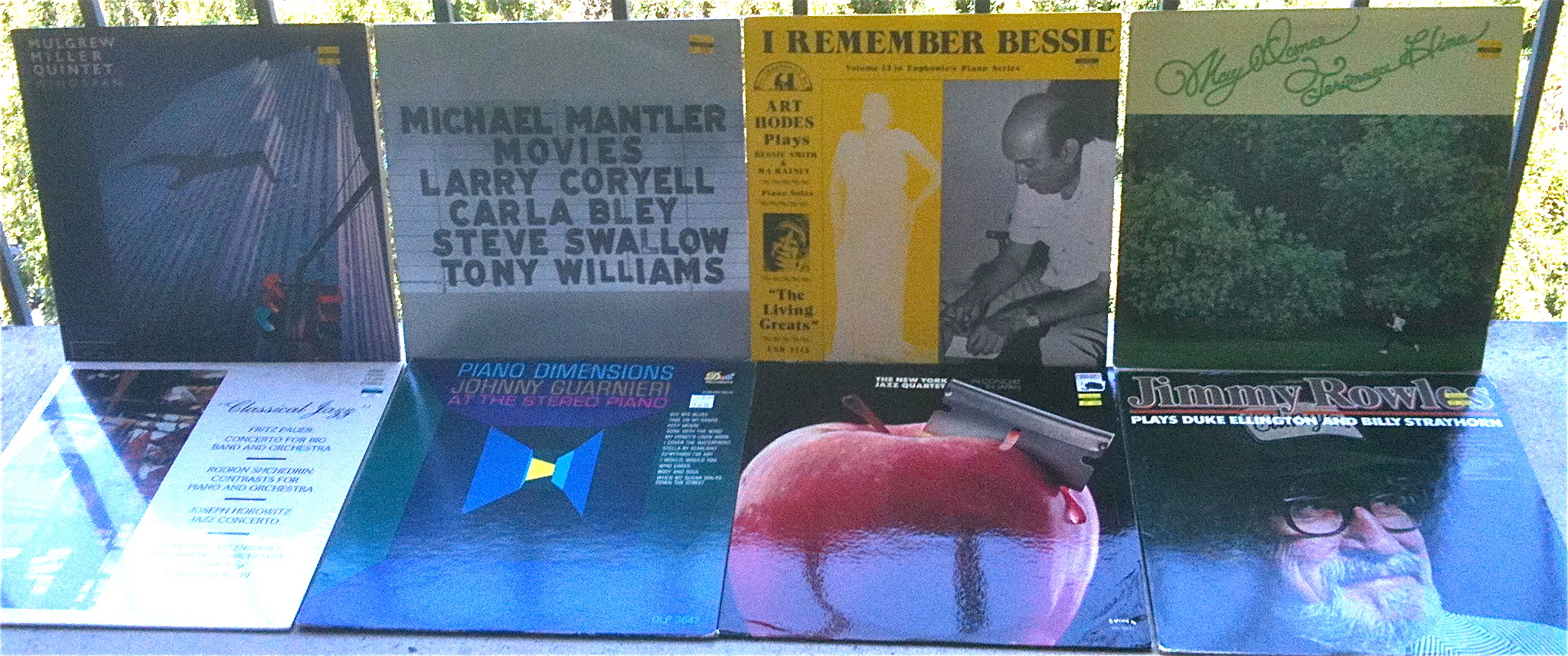
The LP's are comparative rarities:

IMG_1397

Mulgew Miller, Wingspan.  I looked everywhere for this when working on my Young Lions post but could only find ultra-expensive copies. I've heard it is one of Mulgrew's best albums.

Michael Mantler, Movies.  I used to have this.  As I recall it has some of the best Tony Williams rock drumming on record.

Art Hodes, I Remember Bessie.  Great cover photo.

Terumasa Hino, May Dance.  1977 with John Scofield, Ron Carter, and Tony Williams.  At some point I will have all the Ron/Tony records…

Classical Jazz.  Uh, what is this?  Sealed for $1.99?  It's a piano concerto composed and performed by Fritz Pauer, an Austrian musician I'd like to learn more about.  Intriguingly Pauer also plays works by Rodion Shchedrin (legit post-Shostakovich Russian) and Joseph Horowitz (British light music).

Johnny Guarnieri, Piano Dimensions. There's a little later Guarnieri in my collection, it hasn't made as much of an impression as the 40's stuff.  This seems to be his only record from the '60s.

The New York Jazz Quartet, Concert in Japan.  Frank Wess, Roland Hanna, Ron Carter, Ben Riley.  I used to have this too but it was pretty scratched up.  Long tunes.

Jimmy Rowles, Plays Duke Ellington and Billy Strayhorn.  Huh, I can't remember seeing this before.  Solo.  Rowles is unquestionably one of the best pianists for this repertoire.

Every Time We Say Goodbye

In Los Angeles, tonight through Sunday:  The Mark Morris Dance Group performs L'Allegro, il Penseroso ed il Moderato at the Dorothy Chandler Pavilion.

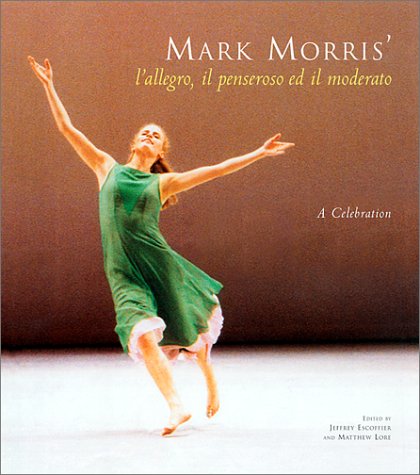
Julie Worden is on the cover of a really nice book about the Morris masterpiece.

9781569246313

After 17 years of performing L'Allegro, this weekend's performance will be Julie's last.  She's hanging up her dance shoes, leaving the Dance Group and heading off into the wild blue yonder.

In the arts, there are those who first offer elegance and those who first offer passion.  Julie offered passion.  Even in a company crowded with wonderful performers, Julie had something to make you notice and say to yourself, "This movement really means something to this dancer."

She was great in everything, but owned L'Allegro, Grand Duo, Going Away Party, I Don't Want to Love, and All Fours. I will never forget One Charming Night, where she was the virgin and Morris was the vampire:  It was one of the most hair-raising things I ever expect to witness.

The past tense is a little premature, for Julie is onstage for a few more more nights and her future will include beautiful movement.  But honestly I feel rather elegiac.  It is the curse of the dance profession that the fragility of the body prematurely mutes innate artistry.  Julie is doing the right thing by leaving at the top of her game. If you see her this weekend she will be unforgettable.

Julie_worden

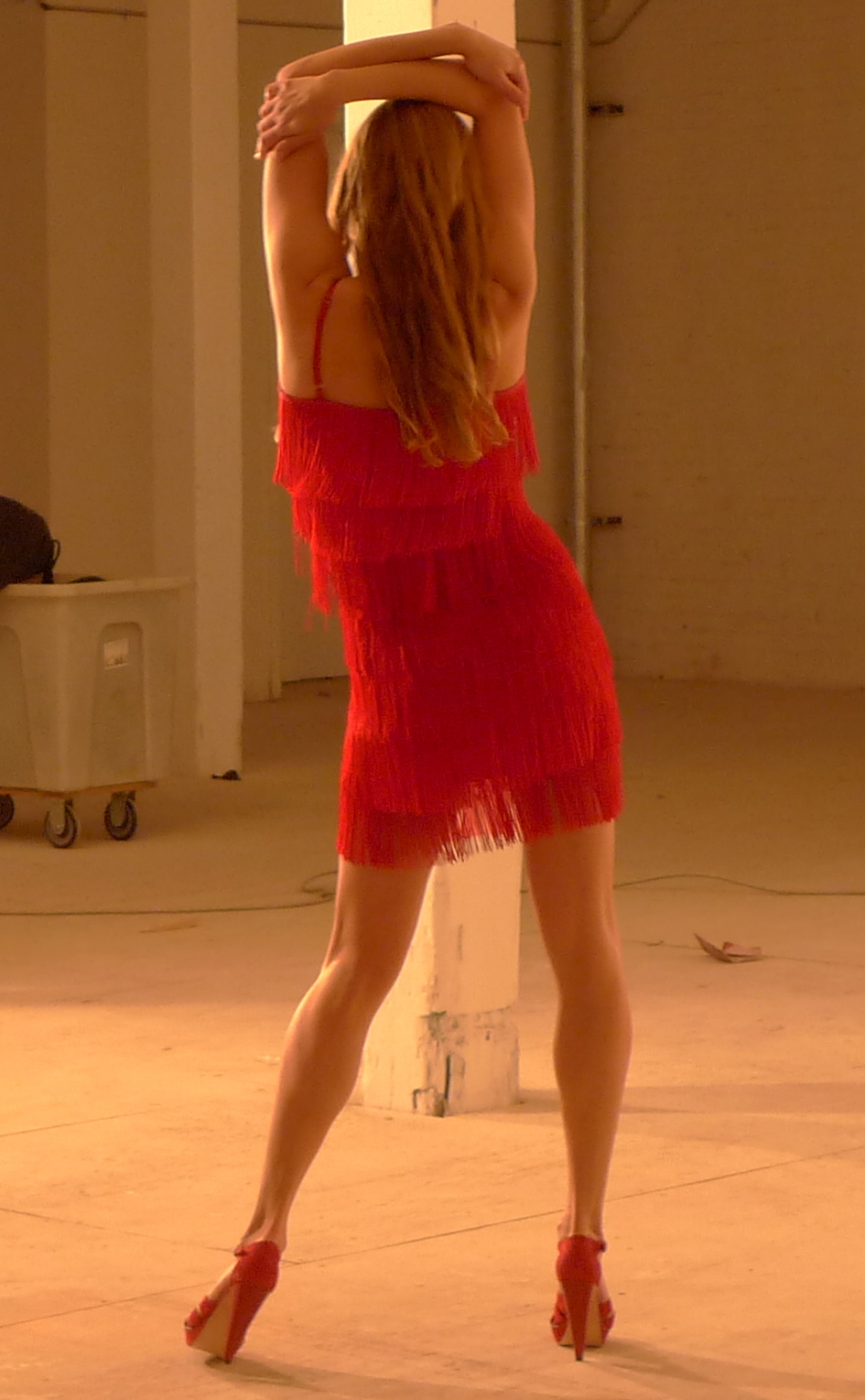
(photo by Cristina Guadalupe, taken during the Babbitt video session)

Julie's own words of wisdom:

Extensive Time Out interview by Gia Kourlas.

Hometown interview by Harriet Howard Heithaus.

"Drinking with Divas" by Sarah Deming

I don’t think rhythm can be taught.  It’s something outside of yourself that you have to just exhale and open into.  Overly intellectual artists sometimes have difficulty with this, because there is a striving, a kind of reaching in advance of the beat.  But rhythm is about being almost late.  It’s about the bottom.  Sometimes when the company is most fatigued, that’s when we’re the most together.

Carl Constantine Kosak Revealed

On Monday K.C. Constantine appeared at Festival of Mystery in PA, and even got his photo taken.

I've been wondering what happened to Constantine.  I've read all the Mario Balzac books at least twice.  To call them "police procedurals" is technically correct but also misses the point:  They are intensely political and sociological novels chronicling the small-time wins and losses of a small-town police chief.  In some books there isn't even a murder.  (The major crime is usually the death of the American Dream.) 

Perhaps now all Kosak fans can unite and demand that more tales of Rocksburg be commissioned and published.  Not really sure if Kosak fans could get all that much done, though.  If we are like the characters in the stories, we spend most of our time in bars, drinking alone or complaining to other bored drunks about how everything has gone to hell. 

That last bit doesn't sound that appealing, does it?  However, these books really are among the greatest in the genre.  I suspect the fan favorite (if such a category exists among us misanthropes) is Always A Body to Trade, which will teach you the most about how the criminal justice system works this side of The Wire.

Benny Carter/Ed Berger

When I saw Ed Berger a couple of weeks ago, I told him, "I want to talk to you about Benny Carter sometime, I don't know his work the way I should." 

I'm frankly bowled over that Ed sent me a copy of the massive two-volume study, Benny Carter: A Life In American Music Ed's father Morroe began the process and the first edition came out in 1982, by which time Ed was Benny Carter's road manager.  Every time I've seen the revised and expanded 2001 edition (credited to Morroe Berger, Ed Berger, and James Patrick) I've said to myself, "Someday…"

Turning a few pages tonight I can already see that Benny Carter:  A Life In American Music lives up to its reputation as one of the greatest jazz books.

Ed also included a couple of late Carter CDs on the Evening Star label. 

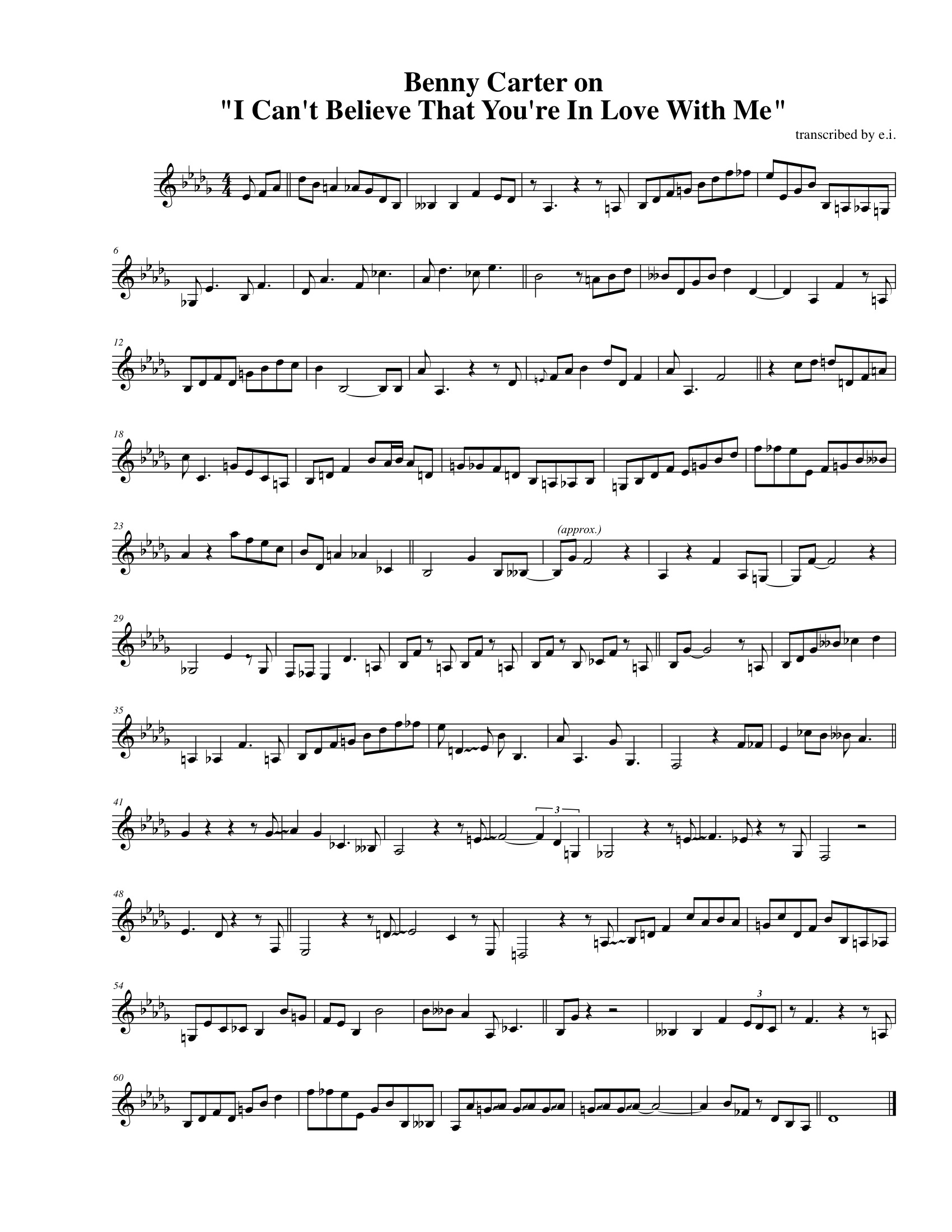
To celebrate receiving all this bounty, I transcribed a famous Benny Carter solo.

0001vJ


Benny Carter on

(click to listen)

This is in 1940, from the "Chocolate Dandies" session with Coleman Hawkins, Roy Eldridge, Bernard Addison, John Kirby, and Sid Catlett.  Hawkins plays great, Eldridge plays even better, but Benny Carter trumps them both with this futuristic monster.  It's Lee Konitz's favorite Carter solo.

 (I have this on the budget Proper box Coleman Hawkins:  The Bebop Years, which is highly recommended for those wanting to explore 1940's-era small group jazz.)

The only three albums by Benny Carter I owned before today are splendid.  Further Definitions is an important library staple with a magnificent performance by Jimmy Garrison.  (Back to the future: Garrison is tethered to Jo Jones.)  Central City Sketches is probably Carter's most famous album from the late years.  And right now I'm spinning Count Basie's deeply swinging Kansas City Suite from 1960, composed by Benny Carter. 

Colm "Red" O'Sullivan, another authority, tells me I must hear Gillespie/Carter Inc. from the 70's on Pablo.  I have mixed feelings about Pablo dates but if Red says it's great I gotta check it out.  And from the Berger book I'm eyeing trio and quartet sessions with Teddy Wilson, Earl Hines, and Jimmy Rowles.  Not to mention these two Evening Star CDs… Thanks again, Ed!

It’s Saturday Night

Just back from Smalls, where the Stacy Dillard trio with Diallo House and Ismail Lawal holds forth every other Saturday at 1:30 AM.

Their all-original book contains mystical vamps, roaring swing, and odd-meter melancholy.  House's passionate rumble reminds me of Fred Hopkins a bit, or maybe Jimmy Garrison. Lawal has some of Nasheet Waits's mystery but with a tighter, Roy Haynes-ish crackle.  Dillard is both conceptual and virtuosic on tenor and soprano.

It's weird, wonderful music that has a lovely balance of order and chaos.  The Dillard-House-Lawal trio is possibly the most intriguing NYC band at the moment.

A Good Gig

6 A.M., April 1, 2011, Albert Einstein Medical Center, Philadelphia…The nurse who came in to greet us said, "I'm sorry, all the machines are down.  Your surgeries will need to be rescheduled."

[WHAT!]

"Ha!  April Fool!"

(True story.)

After that bracing, heart-attack-inducing prelude, my wife Sarah Deming gave her left kidney to her mother, Ruth Deming.  For more backstory see The Spiral Staircase and The Belle of Cowbell.  (I particularly enjoyed the Rodeo post of S's, and I see R says, "I could never reconcile the way the composer Igor Stravinsky looked w/ the raw sexual power of the music. Esp. the accompanying dancing. Remind me to ask Ethan when I wake up from the Long Sleep to tell me about music and sexuality."  Yep, that's my mother-in-law.)

Sarah is fine and Ruth is already putting that new kidney to use.  Bravo. 

A few early-morn candids including brother Dan:

IMG_1227

IMG_1237

IMG_1248

Through Years of Endless Springs

The press release for TBP plays Stravinsky:

WORLD PREMIERE OF THE BAD PLUS’S “ON SACRED GROUND: STRAVINSKY’S RITE OF SPRING”

Commissioned by Duke Performances the work debuts on Saturday, March 26, at Reynolds Theater, Duke University

February 8, 2011, Durham, NC – The Bad Plus has been commissioned by Duke Performances to create a reappraisal and rearrangement of Igor Stravinsky’s iconic Rite of Spring.  This undertaking is co-commissioned by New York’s world-renowned Lincoln Center for the Performing Arts.  The world premiere of this groundbreaking work will be performed by The Bad Plus on Saturday, March 26, at 8 pm in Reynolds Theater in the Bryan Center at Duke University. 

For the past ten years The Bad Plus—bassist, Reid Anderson; pianist, Ethan Iverson, and percussionist, David King—have created a wealth of critically acclaimed work.  With nine releases since 2000, the group has received acclaim from sources such as The New Yorker (“The Bad Plus are the Coen Brothers of jazz”), Rolling Stone (“as badass as highbrow gets”), The Village Voice (“If the stars align, they will mow you down”), CMJ (“somewhere between refreshing and downright awe-inspiring”) and Billboard (“purists tremble while the vanguard flocks”).

The project sprung from the collective minds of members of The Bad Plus and Duke Performances’ director, Aaron Greenwald.  The challenge was to transform Stravinsky’s iconic orchestral work, one that famously caused a riot at its Paris premiere, into a compelling work for a trio known for bending and breaking genres. 

While The Bad Plus has previously arranged and performed Stravinsky’s “Variation d’Apollon” along with work by Ligeti, Nirvana, Wilco and Pink Floyd, taking on the task of arranging the entire Rite of Spring is both a monumental challenge and part of a natural progression for a group relentlessly in pursuit of the best of music.

Composed and arranged over the course of a year plus, the performance will be accompanied by a multi-media presentation by architect Cristina Guadalupe and filmmaker Noah Hutton.

In addition to the foregoing commission, The Bad Plus has been working with Duke graduate student composers and has engaged in artists-in-residence activities both on campus and in the community.  The trio’s engagement with Duke graduate composition students centers on the group’s reading, performing, and critiquing students’ original work.  This ongoing process, which includes three one-week residencies for the group, will culminate in The Bad Plus performing and recording student compositions. 

This unprecedented and ongoing commission and residency project represents a bold step for the trio as well as Duke Performances, an organization already nationally known for adventurous, forward thinking programming. 

WHO:  The Bad Plus
WHAT: On Sacred Ground: Igor Stravinsky’s Rite of Spring
WHEN:  Saturday, March 26, 8 pm
WHERE:  Reynolds Theater, Bryan Center, Duke University
HOW MUCH:  $34 • $26 • Duke Students $5

**NOTE: IMAGES OF PERFORMERS ARE AVAILABLE.  FOR IMAGES OR MORE INFORMATION, PLEASE CONTACT KEN RUMBLE (ken.rumble[at]duke.edu)

On Feb. 23 I'm participating in recital celebrating the music of Vivian Fine, Miriam Gideon and Louise Talma.  More info here.  I'll put up the full program notes next week.  This concert is going to be a spectacular one-off;  anyone interested in Sophia Rosoff or her teaching must go.

March 1 through 6 I'll join Larry Grenadier and Paul Motian at the Village Vanguard, playing  standards, bebop tunes, and some originals (especially by Paul). 

Larry and I haven't played together all that much, but I always really enjoy it. 

Felix Rossy did a bootleg recording of a quartet gig last year with Konitz, me, Larry, and his dad Jorge.  One trio moment worked out well, and both Larry and Jorge said it was fine to post on DTM.

Stella

After Larry begins with a few choruses on "Stella by Starlight,"  Jorge and I come in, expecting to support or dialogue with Lee.  But Lee lays out, and this "comping" becomes a kind of "anti-solo."  At the end of the excerpt, Jorge lets loose with some intense blowing over Larry's incredible groove.  This is entirely acoustic, by the way:  not even a bass amp.

Larry and Paul can be heard together on the wonderful On Broadway Vol. 4:  Or the Paradox of Continuity.

Bruce Arkin and Bob Bowen

Shocking accidental deaths of sincere jazz musicians —

Bruce was an integral part of the Barcelona scene. One night I really enjoyed a set of his quartet at the Jamboree with Albert Bover, Chris Higgins, and Jorge Rossy, the same band on his album Wake Up!; we talked serious jazz, and the next day he brought me a DVD stacked with hours and hours of priceless rare Sonny Rollins on mp3. I still have that disc, marked, “B. Arkin’s Sonny Boots vol. 1.” A music lover for sure and a fine saxophonist — his MySpace is still up, with a nice version of “Invitation.”

Bob Bowen I didn’t know personally, but I knew his bass playing a little bit from records with Ohad Talmor and Lee Konitz. He was right in there. See the IBeam memorial page.

The only response to deaths of your peers is a cliché: Live each day as if it will be your last. Sincere condolences to all of Bruce and Bob’s friends, loved ones, and families.


Guest Posts: Aaron Diehl, John Hollenbeck, Mark Stryker

(Four essays reprinted from old DTM, all originally posted in early 2010.)

One Never Knows: An Unexpected Encounter with John Lewis and the Modern Jazz Quartet (by Aaron Diehl)

I was not very familiar with John Lewis or the Modern Jazz Quartet
until I heard Fontessa (1956) in college. Loren Schoenberg, my
jazz history professor, dedicated an entire class to the album. It was a
lesson on programmatic structure. The selections were carefully chosen
and placed for the purpose of constructing a musical narrative from
start (“Versailles”), to finish (“Woody’n You”). What immediately struck
me about the ensemble was their overall balance—the warm, dulcet
quality to their timbre. Underneath the refinement, though, lie the
seductive and intoxicating characteristics of the blues and groove.

As my interest grew, finding written music for the group was
challenging, until Loren called one day offering a job helping Mr.
Lewis’ wife, Mirjana, organize an endless archive of her late husband’s
tapes, scores, parts, and manuscripts. I recognized the value of the
opportunity when Loren first approached me, but I could never have
envisioned the long-term impact the almost six month task would impress
upon my musical education. My time spent with Mrs. Lewis was full of
anecdotes about her husband, and during my afternoon visits to her home,
she would play a succession of MJQ recordings. I never had the honor of
meeting John Lewis, but through Mirjana’s reflections, I began to get a
sense of the warm, gentlemanly persona that he possessed. He was
reserved and quiet, yet adamant and persistent about his ambitions. As
the late pianist Dick Katz once told me: “John always got his way, and
the longevity of the MJQ is a testament to that.” The group was together
48 years, albeit with a hiatus from 1974 to 1981.

It was not difficult to tell that Lewis was unbelievably
organized—many of his draft manuscripts were very clear and neatly
arranged, and well kept (some of them, such as “Spanish Steps,” date
back to the late 50’s). When sifting through the music, I saw scores
ranging from solo piano to symphony orchestra. Titles such as “The
Legendary Profile,” “Skating in Central Park,” and “Concorde,” popped up
frequently, and there were multiple arrangements of “Django” just for
the MJQ alone! The engraved scores included all of the parts, but those
who have seen footage of the group probably noticed that Milt Jackson
had everything memorized. He possessed a photographic memory, and Albert
“Tootie” Heath even mentions this in his DTM interview. All of the music has a copyright under MJQ Music,
Inc., the publisher for the ensemble, and their headquarters were housed
in a small office inside the Ed Sullivan Theater (where the Late
Show with David Letterman
is taped). I worked there for the first
few months of this project, and it was like being in a time capsule from
the 1960’s—the smell of old reel boxes and onionskin paper permeated
the air, and the most advanced piece of technology in the room might
have been a typewriter.

The publisher is still in existence — there’s  a website where one
can ostensibly rent or purchase material including jazz and classical
works by J.J. Johnson, Lalo Schifrin, Gunther Schuller, et al. — but
attempting to order anything is futile at best. Paul Schwartz, who
managed the company for decades, recently retired. MJQ Music is now
beginning the process of having its music administered by Hal Leonard,
and it is uncertain when the charts will become available. I called Hal
Leonard via the phone number listed at the top of the website, inquiring
about renting an arrangement of “Django,” and unfortunately nothing is
ready yet.

Anyone willing to take on the task of transcribing some of the MJQ
arrangements will notice that the tonal clarity and balance of the
ensemble are such that there is not too much ambiguity or question about
what is being played. Percy Heath’s bass is always heard, and as those
who transcribe know, this can be crucial in determining the harmonic
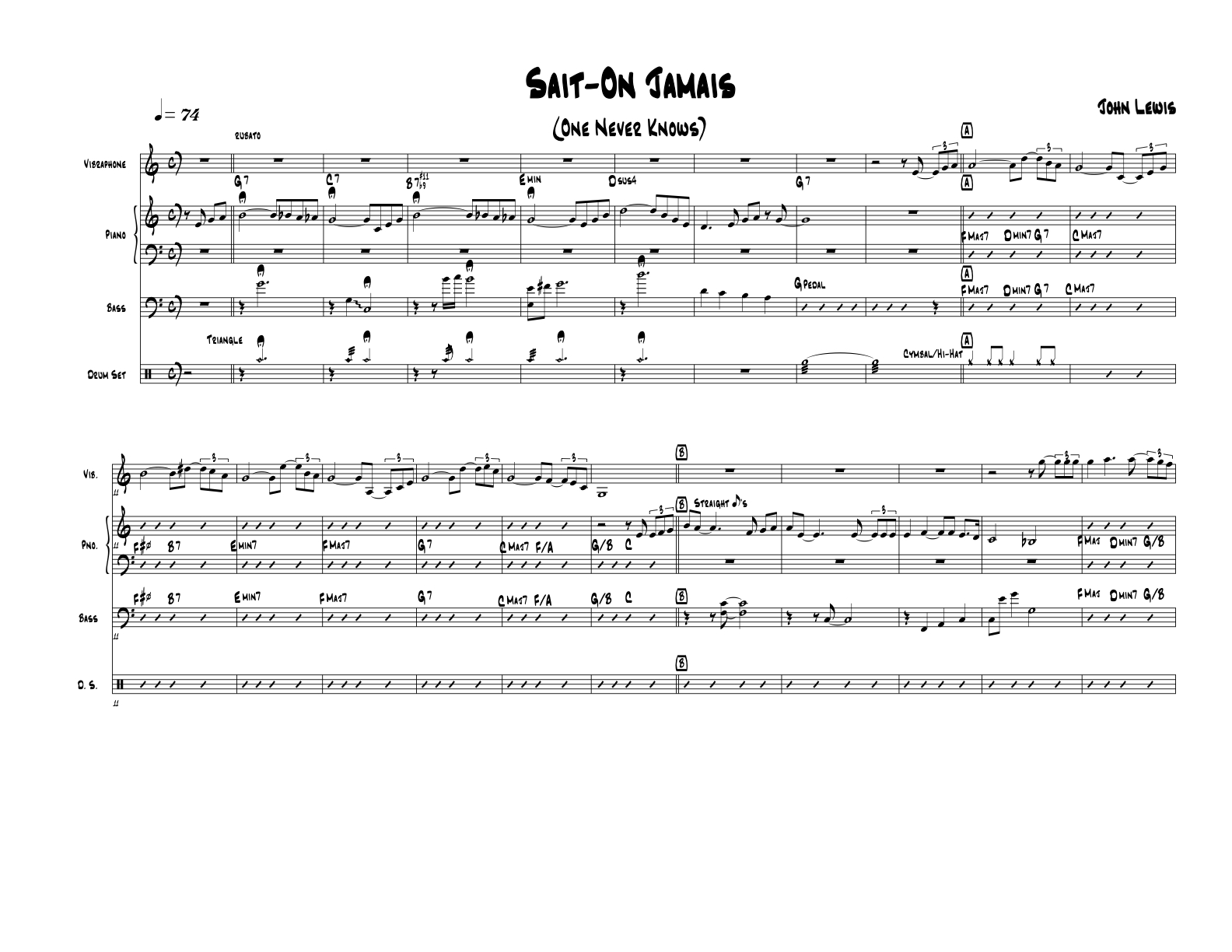
movement. Here’s a few pages of my own transcription of “One Never
Knows,” from the soundtrack of No Sun in Venice (1957). 

Sait-on jamais

I highly recommend this album, as it also premiers another MJQ
staple, “The Golden Striker.” Unfortunately, I have not been able to
track down the film yet. Anyone out there who might know where I could
find it?  

“One Never Knows” has a 24-bar ABA’ theme, but the piece in its
entirety is a longer, through-composed work that develops the melodic
material throughout the course of the arrangement. Part of the genius of
Lewis was his departure from the standard format of
melody-solo(s)-melody, creating a listening experience that is
unpredictable and fresh. Even on a blues (usually for this the MJQ
played one of Milt Jackson’s), there would be some type of interlude
between solos. On Jackson’s “Cylinder,” for example, after the
vibraphone solo in D-flat, the band would typically play a 4-bar
interlude leading into the piano solo, now in a new key of B-flat. As
simple as it appears on paper, it adds a new level of interest to the
ear. These qualities are especially exemplified on Blues at Carnegie
Hall
from 1966. The ensemble makes use of various grooves
(shuffle, boogaloo, swing, etc.), tempos, and key signatures. All of the
pieces on the album are blues-centered, with Jackson’s compositions
making up most of repertoire (Ray Brown’s “Pyramid” is the first track,
and there are a couple of pieces in the middle by Lewis). It was the
ideal showcase for Milt, who loved to play the blues, and would play
them all night if he could.

The virtuosic nature of Jackson’s playing could make one believe that
the vibraphone’s role in this music greatly surpassed the others. I am
discovering that Lewis and drummer Connie Kay had a massively crucial
responsibility in shaping the overall timbre of the group. I recommend
the Complete Modern Jazz Quartet Prestige and Pablo Recordings,
which chronicles the band from 1952 to 1985 (Atlantic just needs to
release a box set like this, and we’ll be set). Within the span that the
Prestige and Pablo recordings cover, you can hear the difference in
approach between Kenny Clarke (he was the first drummer), and Kay, who
replaced Clarke in 1955. Kay maintained a more delicate, and
multi-timbral approach, all while keeping a strong beat with Percy. This
was a perfect fit for Lewis’ style, although I can never get enough of
the early records with Clarke, especially on takes of “La Ronde” and
“All the Things You Are.”  Similarly, Lewis had a very distinct linear
way of accompanying that added a contrapuntal texture to the music. Even
when comping in a block chord fashion, he would form some type of
melodic nugget, and riff on it for a while. Percy Heath was the “glue”
in the group, holding everything together with his warm tone, and fat
beat.

Next Monday night, I will be performing the music of the
Modern Jazz Quartet at Dizzy’s Club Coca-Cola along with Rodney Green,
David Wong, and Warren Wolf. Will we be able to replicate the MJQ’s
sound precisely? Of course not. But their concept has been a source of
inspiration for discovering our own musical identity, both individually
and as a unit. Subtlety, nuance, structural variety, and a solid groove
are powerful assets in jazz; John Lewis, Milt Jackson, Percy Heath, and
Connie Kay left a treasured blueprint for that model. It would be a pity
not to capitalize on any opportunity that allows us to gain a closer
understanding of how momentous these four men were in the history of
20th Century music.

— Aaron Diehl

Saving the World, One Composition at a Time (by John Hollenbeck)

Several recent events: the December celebration of Bob Brookmeyer’s 80th
birthday; my father’s passing in May; my interaction with students at
the Jazz Institute Berlin; and the coming of a new year, have coalesced
in my mind and prompted me to strive harder to write music and (maybe
more importantly) work on myself personally. I would like to offer some
thoughts on how these two activities can actually be worked on
simultaneously. In other words, how the process of composing music can
be used to enrich and improve oneself and thereby have a positive
influence on humanity.
 
Mostly through DTM’s “blogroll”, I have
recently made a concerted effort to keep up with the rest of the music
blogosphere.  It makes perfect sense that the majority of blogs I’ve
read focus mainly on the end results and the final product of a
musician’s efforts. I know (especially after trying in vain to write
this essay) that the innards of creation are difficult to put into words
and perhaps not as blog-worthy, but I have always been fascinated by
the experience a musician has during the creation of a work. I’ve spent a
lot of time thinking and talking to others about “the process” of
composition and how this can affect the music that one writes.  But a
surprising offshoot of this emphasis on the process was the discovery
that it could also alter my personality and be a vehicle for personal
growth if I remained open and aware during the tough, decision-making
moments of any compositional practice. I find this insight very helpful
in those moments when the “results” seem so important and potentially
stressful.

Based on my experiences with the solitary spiritual
practice of meditation, I have come to see how the practice of
composition can give one the same opportunity to confront his/her
vulnerabilities. We composers sit alone in a room focusing for long
hours and making seemingly peaceful decisions.  These decisions we make
as we compose will not harm others, nor will they most likely be
life-changing in the same way that a surgeon’s decision could alter a
life dramatically. Yet how we behave and what we choose when we are
alone in a room with no one watching is significant – these solitary
moments can often reveal aspects of our character that we would much
rather avoid. These decisions can set a precedent, positive or negative,
for future decision-making and behavior which will extend far beyond
the scope of composition into everyday living.

When composing we
are bound to hit walls and obstacles which challenge us and force us to
confront our weaknesses as composers, but also as human beings. To give
one example, I and I know other composers have encountered those
moments, when in the thick of composing we suddenly step back and
realize that we are writing something that has already been written –
and it could even be that we are rewriting our own music (!) or it could
be someone else’s piece we really like. I believe that what happens
next in this process is very important.

 There are many options
but I usually consider these four possibilities.

1) Go
ahead with the composition as it is and hope no one will notice.

2)
Throw it away!

3)  Keep tweaking it and putting it through my
personal “filter” until it has become something “new” and original.

4) 
Acknowledge it and then make the piece an arrangement of the original.


I
have at some point chosen each of these four options over the course of
my career, but have opted for #3 most of the time. That is the one that
feels honest to me. But maybe more important to me is to have been
aware enough to come to this point where I recognize I need to make one
of these choices, and to be fully open and conscious as I face the
decision-making moment. What I have found is that if I am present and
aware, I can not choose #1.

When challenged and confronted by our
own limitations in the composition process, I see it as an opportunity
to develop character. I would expect that if a person is in a room alone
and follows a path of deceit, chances are pretty high that in the
future it will be easy, maybe even habitual, to be dishonest.  Small
decisions like this can set a precedent for the future. If we are alone
and no one is watching us, yet we do our best to see our motivations
clearly and make honest decisions based on principle (and not on the
pressure of an impending deadline for instance), then we end up leaving
that room having become a better person. For me, this honest soul
searching has become the greatest reason to practice composing – the
process of composing with a vigilant, self-reflective mind can help me
to become a better person, and thereby makes the world a better place.
This may strike some of you as cheesy, but it’s an approach I have come
to truly value.

Of course, the results of our compositions are of
importance, but by giving the actual practice of composition a stronger
emphasis, it can be meaningful to a composer on any level and at any
time. It can take some of the pressure off needing to be successful all
of the time, and allows one to appreciate the moment (even the painful
ones!) by shifting the emphasis to an awareness of the process rather
than focusing on simply achieving the goal. I have chosen composition
for this essay because it’s what I do, but I believe that any activity
where we are forced to deal with our own “inner game” can become an
ethical and/or spiritual practice if we choose to make it so.

— John Hollenbeck

The next two are linked:  I wrote a little bit about a Charles McPherson gig, and Mark Stryker sent in his marvelous profile originally published in the Detroit Free Press.

—-

The Real Bop (by ei)

Lou Donaldson likes to tell the young’uns, “If you could have heard the
real bop, it would have scared you half to death.”

Charles
McPherson is in town through Sunday at the Jazz Standard with Tom
Harrell, Jeb Patton, Ray Drummond, and Willie Jones III. Last night the
band was still learning the book but that was part of the charm:  I
watched McPherson navigate the mildly tricky changes of Harrell’s
“Papaya Vacation” for what looked like the first time.  The threading was still flawless but with just a hint more vulnerability than usual.

McPherson
is 71; he’s is only 19 years younger than
Charlie Parker (and was 16 years old when Bird died).  His style is
distinct from Bird — it’s more liquid and varied — but McPherson has
never felt the need to develop past pure bebop.  He’s not a conservative
musician, though:  he was comfortable playing amidst all sorts of
madnesses in Mingus’s band for at least a decade, and last night he took
more chances than anyone else. 

All the music was good, but the
best pieces were the blues:  McPherson’s “Bud Like” opened the set and
Bird’s “Billie’s Bounce” closed it.  On both McPherson was especially
authoritative, swinging, and disjunct.  You can never guess what a
master bopper will play next, and when they hit it just right you feel
the surprise in your solar plexus.

Ray Drummond always has
exactly the right feel for this kind of music.  I’m always more likely to go see any given straight-ahead
jazz group if Drummond is holding it down.

In the
1950’s Grange Rutan was briefly married to another master bopper, Al
Haig.  Dizzy Gillespie nicknamed her “Lady Haig,” and that is the
sobriquet she places proudly on the cover of her memoir Death of a
Bebop Wife
.  The dead wife is not Rutan but Haig’s third wife
Bonnie, who many believe was murdered by Haig while in a drunken rage.

Al
Haig is on many important records with Charlie Parker.  The fabulous
Bird, Haig, Percy Heath, Max Roach date has been mentioned several times
on this blog already.  But I also enjoy the non-Bird trio sessions with
Bill Crow and Lee Abrams from the same era, which is superior cocktail
piano at its best. (This is not a criticism – I love superior cocktail
piano.)

I’ve always wondered why there wasn’t more from or about
Al Haig.  Now I know.

Unfortunately, Rutan’s book is in need of a
hard edit.  Among many other distractions, a visit to a psychic is
extraneous and surely the late Ross Russell would not be pleased with
how his complete correspondence with Rutan is reproduced undigested. 
(“Dear Grange, thanks for your two notes and the jazzy Christmas card.”)

Ultimately, however, this book is hypnotic and overwhelming.  I
know of nothing else that shows the seamy underbelly of jazz like Death
of Bebop Wife
does.  Among the unique items are Walter Bishop’s
bad but heartfelt poem about his grief that a white pianist had the gig
with Bird, trumpeter Bitsy Mullen’s description of a long threesome with
a groupie (she said, “One-Way Haig,” when the pianist refused to give
her oral sex), and Robert Sleckner’s disgusting “My So-Called Tribute.” 
(“The mattress Bonnie was found dead on I made into a sofa bed, and
later, when I was a single person, I used it for my bed; I ignored the
urine stain on the mattress and turned it over.”)

The book’s
trajectory is non-linear, but Rutan is smart to put the long
transcription of Haig’s grilling by detectives Kaytack, Sperlazzi, and
Snack precisely at mid-point.  It’s a brutal exhibit. Perhaps Haig is
suffering from shock, but based on this document I suspect Haig was
guilty:  His story doesn’t make sense.

While Rutan is obviously
exorcising her demons in respect to Haig the man, she offers nothing but
love to Haig the musician, a sentiment echoed by many other great
players throughout the book. In the end I found myself wanting to hear
more Al Haig.

(Cadence books: Death of a Bebop Wife)

Reminiscing by Ear (by Mark Stryker)

CHICAGO — Armed with a portable CD player and a small stack of discs, I
set up shop in Charles McPherson’s hotel suite here in the Windy City,
where the veteran Detroit-bred alto saxophonist is in the midst of a
recent weeklong stand at the Jazz Showcase. McPherson, one of the
headliners at this week’s Detroit International Jazz Festival, is one of
the most potent musicians to emerge from Detroit’s mid-century cauldron
of bebop. He has had a major career, working extensively with giants
like Charles Mingus and recording prolifically. Still, he remains a
musician’s musician rather than an industry star.

McPherson is
not an innovator but a profound stylist instead, who has etched his own
distinctive identity within the template of classic bebop. He is revered
for the luminosity of his tone, the rapturous momentum of his
improvisations and the cliche-free purity with which his phrasing
channels the spirit and language of Charlie Parker. At 66, he’s playing
the most expressive and startling music of his career.

McPherson
agreed to forego a typical interview in favor of an informal listening
session — an entertaining way to get inside the head of a jazz
musician. Not only do you get an insider’s view of the art, the
discussion inevitably opens a window on aesthetic priorities and
triggers memories of former associates and war stories. I chose
recordings that mirror the broad arc of McPherson’s career, from his
Detroit roots and deep understanding of Parker to a landmark 1971 LP
with Mingus and a late ’90s CD that documents the current state of his
art.

We meet at noon as McPherson’s wife and 13-year-old daughter
are leaving to explore downtown Chicago. McPherson settles into the
sofa. He is of medium height, athletically built and, despite
salt-and-pepper hair, looks a decade younger. The prodigious afro he
once sported has been scaled back, but the bushy mustache remains. He is
an enthusiastic and lucid conversationalist, his thoughts unwinding in
complete paragraphs.

Barry Harris Quintet — “Burgundy”
from Newer Than New (Original Jazz Classics/Riverside) Sept.
28, 1961

No one was more responsible for McPherson’s life in
jazz than Barry Harris, the Detroit-born pianist and bebop guru who
mentored countless musicians in Detroit and later in New York. McPherson
was 15 when he began studying with Harris, who was 10 years older.
McPherson made his recording debut in a small role with Mingus in 1960,
but this 1961 date with Harris was his coming out LP. He was 22.

Harris’
breezy original “Burgundy” opens with Latin rhythms before shifting
into a swinging groove for solos. A look of concern falls across
McPherson’s face. “I haven’t heard this in 30 years,” he says. “I’m
scared to listen to me.”

A suave piano solo draws praise, and so
does 21-year-old trumpeter Lonnie Hillyer, another Harris disciple from
Detroit. Little known, Hillyer died of cancer in 1985. “He wasn’t a
bravura trumpet player,” McPherson says. “But he played as well or
better than a lot of others in terms of the loftiness of the musical
statement.”

McPherson’s playing lacks the sagacity, strength and
individualism of his mature work, and he grows increasingly
uncomfortable listening. He makes me stop the disc halfway through his
solo. “I hear so many things that are immature in my sound and the
timidity of the playing,” he says. “I hear too much caution, which
speaks of an insecurity. It’s not easy to sound good young, and some of
it has to do with the equipment – the mouthpiece, the horn. I can tell
my mouthpiece is too small. I didn’t know any better.”

McPherson
grew up on Detroit’s west side, near Harris and the Blue Bird Inn, the
epicenter of Detroit’s modern jazz scene in the 1950s. McPherson soaked
up the sounds nightly in front of the club “Barry would come out on the
break and one day he said to come by his house where he’d hold court.
We’d ask questions like, ‘What do you play here and what scales go with
this kind of a dominant 7th chord?’ He was exploring for himself and
showed us what he was finding.

“Pretty soon I was going over
there every day. There was an aura of intellectuality in Barry’s house.
Barry would do the New York Times crossword puzzle every day, and he’d
zip through it. He was a reader. One day I came home from school and I
had my report card, and he asked to see it. I was a C student; I didn’t
try for anything more than that. He saw the C’s and he said, ‘You’re
quite average, aren’t you?’ I said, ‘Well, I’m passing.’

“He
said, ‘You can’t be average and play the kind of music you’re trying to
learn. There’s too much going on. Charlie Parker is not average. Your
heroes are above average.’ It was like a little epiphany. It totally
changed my life. I put in more effort and instead of being a C student I
got A’s. I started getting interested in literature. I read Henry
Miller’s ‘Tropic of Capricorn,’ and I started reading philosophers, for
instance, Francis Bacon, Kant, Schopenhauer. In Detroit, in this bebop
niche we had, to be considered hip meant that you had to know about
Charlie Parker and people like that, but you also had to know about Kant
and Schopenhauer, Nietzsche and Bertrand Russell, and you had to know
about art. We were like 17.

“People like Barry and (baritone
saxophonist) Pepper Adams were so smart that we learned about bebop and
all that. But they were able to say, ‘Oh, Marc Chagall painted that.’
That influenced us.”

Charlie Parker — “Willis” from The
Washington Concerts
(Blue Note) Feb. 22, 1953

Fifty
years after his death in 1955 at age 34, alto saxophonist Charlie
(Bird) Parker remains a pervasive influence. Parker, Dizzy Gillespie,
Bud Powell and Thelonious Monk were the architects of modern jazz (or
bebop) in the 1940s, but Parker was the movement’s Prometheus and its
defining virtuoso. Musicians gravitate toward Parker’s bootleg nightclub
recordings because, unshackled by the constraints of the 3-minute
record, he stretches out for thrilling chorus after chorus. The best
performances reveal streaks of demonic inspiration, and freedom he
rarely matched in the studio.

Parker’s one-nighter with a
Washington, D.C., big band finds him soloing brilliantly without benefit
of a rehearsal or music, coping on the fly with unexpected key
modulations and breaks in the arrangements. His ears are so sharp he
hears around corners, soaring over the pedestrian charts like an Icarus
immune from the sun. McPherson’s delirious style is rooted in this
wilder Parker. He is enthralled by the solo on “Willis,” a bebop tune
based on the harmonies of “Pennies from Heaven.” Parker’s sly quote from
Stravinsky’s “Petrushka” brings a knowing smile, and McPherson marks
the end of startling double-time passages by saying, “Beautiful!”
Parker’s phrases grow daringly long and asymmetric, notes explode from
the horn like fireworks and his tone thickens into a songful wail.

“What
can you say?” begins McPherson. “It’s virtuosity. It’s musicality. It’s
imagination. It’s intellect. It’s emotion. It’s perfect instrumental
playing and creative spontaneity.”

What do you hear in Bird’s
playing that others may overlook?

“I hear the rhythm. Now, people
hear technique and virtuosity, and I certainly hear that. Charlie
Parker was so proficient in so many ways you can take your pick. But to
me, the area of rhythm and phrasing is what is so spectacular. There are
two things that give you variety: sequence and rhythm. When you think
about musical phrases, sequence and rhythm give you animation. When
you’re improvising, you want a balance of tension and release
rhythmically but also harmonically and melodically.

“Bird does
all those things really well. The balance of tension and release gives
you surprise. Starting phrases on odd parts of the beat creates tension
— not starting on a downbeat because that’s what people expect.

“You
can slice the beat into little bitty pieces and start a phrase at the
16th note or 32nd note level. Bird is great at that. This is what I want
to do, and this is what great players do. I like to be totally
rhythmically free. I like to think like a drummer. Harmony is a given,
but the main event is how I phrase the harmony. More important is how I
put everything together and the story I’m telling. The main event is the
human soul being expressed.”

Charles Mingus —  “The
Chill of Death” from Let My Children Hear Music (Columbia) 
Nov. 18, 1971

McPherson joined bassist-composer Charles
Mingus in 1960 shortly after arriving in New York. He and Hillyer were
recommended to Mingus by former Detroiter Yusef Lateef. Mingus
auditioned them at an afternoon jam session at a coffeehouse, hired them
on the spot and had them report to work that night. Mingus’ aesthetic
was gloriously chaotic. Lush Ellingtonian colors collided with roiled
textures, searing intensity and extended forms. Mingus also loved
Charlie Parker and in McPherson found a fresh disciple to fold into his
sound world.

Let My Children Hear Music, a masterpiece
with an expansive ensemble of winds, brass and strings, includes a
Mingus recitation of his own heart-of-darkness poem to dense and
brooding accompaniment. McPherson then improvises freely against a
hallucinatory backdrop. “Oh, wow,” McPherson says softly at the sound of
Mingus’ voice: The chill of death as she clutched my hand/ I knew
she was coming so I stood like a man.

McPherson was given no
music and told to react to the abstract sound around him. “This is
pretty good,” he says. “It didn’t make me cringe. What I’m consigned to
do is not easy. There’s no (standard harmony) or sequential
construction. And look what this is about: The emotions are foreboding,
mystery and fear. How do you play that? I don’t know if melodicism is
what you need. Dissonance might be what’s called for. I did some of this
fairly well, but there were some areas where I think I get too tonal.
If I did this now, I’d be less concerned with trying to be melodic. I’d
think about how to melodically handle dissonance.”

McPherson
worked with Mingus off and on for a dozen years, and it was often
stressful. Mingus was a large, Buddha-shaped man and famously volatile,
known for firing musicians at will, carrying a knife, berating audiences
and resolving conflict with his fists. “Our first night on the gig at
the Showplace, Mingus proceeded to tear up a Steinway grand piano
because the club owner owed him money. He went in and pulled the strings
out of the piano one by one.

“And then he wanted to kill
(saxophonist) Eric Dolphy because he was quitting the band. He reached
in his pocket and got his knife, and said (imitates Mingus’ gruff
rumble): ‘Eric, get your knife out.’ And Eric who was a very sweet and
intelligent person, said, ‘Aw, Mingus, I don’t have no knife.’ Mingus
says, ‘Well, wait a minute. I’ll buy you one.’ And he goes to a store
across the street and buys a knife and comes back and says, ‘OK, we’re
each going to kill each other right now.’ Eric says, ‘Oh, Mingus,
c’mon.’ Of course nothing happened. That was my first gig.”

Charles
McPherson –“Fire Dance” from Manhattan Nocturne (Arabesque)
April 1997

McPherson recorded three CDs for Arabesque in
the 1990s, teaming with front-rank rhythm sections and essaying
original songs, jazz classics and standard ballads. A whirlpool of
Afro-Cuban rhythms defines McPherson’s “Fire Dance,” and his solo
unleashes a tsunami of melody on top of a propulsive vamp. “I’m glad I
stopped before I ran out of ideas,” he says. “I’ve heard things where I
thought it would have been better to stop a chorus or two earlier. If
you compare this to that first solo you played, at least I can say that
there is a progression toward better playing of the horn and just
playing music better.

“You gotta have the wedding of head and
heart. Your technique has to be up to par so that when inspiration
fails, technique saves you. And you may have inspiration but you gotta
have the technique to execute. It’s left and right brain, intellect and
emotion. The combination makes for the best art. When you practice,
that’s the conscious mind. You’re learning mundane things: academics,
the idiom, instrumental technique. But when you perform, you should play
from the unconscious mind.

“The act of playing is an act of
humility. The conscious mind has to sit to the side and observe the
show. When you learn to do that you are no longer a prisoner of your own
empirical experiences – I am a man. I am a white man. I am a black man.
You’re no longer restricted. Now you can plug into what Carl Jung
called the collective unconscious.

If you can plug into that, you
can play above your empirical experience. The connections are already
there. The real act of creation and genius is when you can do that.”

— Mark Stryker

SF Televideo Celebrations: Doctor Who, Buffy, X-Files, Hitchhiker’s Guide

(reprints from old DTM with a new bit at the end)

Modern Mythic: Tom Baker and Sarah Michelle Gellar (2007)

Doctor Who initially ran from 1963 to 1989. The popular reboot began in 2005. Discussing the show’s entire history from 1963 to 2007 has gotten complicated, so my shorthand designations are:

Doctor Who = the complete older show that ran from 1963 to 1989
new Who = the current series
TB = the years that Tom Baker played the Doctor

This essay is only about TB. My “expertise” was acquired while still in elementary school: The most important event in my day was getting home by 4:30 to watch a half-hour episode on PBS. Eventually, in fifth grade, I took second-place in the Chicago Doctor Who Convention Costume Contest as the Doctor. I won as Baker’s predecessor Jon Pertwee, because I didn’t feel worthy enough to imitate Tom Baker.

After getting serious about music, I turned my back on Doctor Who. But one can’t disregard one’s formative experiences. In my early-twenties, prompted by my first trip to England, I rediscovered the show and started collecting the videotapes. I thought this was just harmless nostalgia, of course. Surely I was now too old to ever form a significant relationship with another fantastical television series…

Hah. Ten years later, my wife showed me an episode of Buffy the Vampire Slayer, starring Sarah Michelle Gellar, and I was instantly hooked.

The shows are very different.

++ TB is a kids’ show (although it has a major adult following). BTVS is for teens and up.

++ TB is firmly science fiction/space opera, and BTVS is firmly fantasy/supernatural. There is a TB that is about vampires (“State of Decay”), but it also involves space ships and takes place on a far-away planet. There is a BTVS that involves an alien (“Listening to Fear”), but it is called to earth by a local god.

++TB is not the product of any one imagination, but BTVS was created and overseen by Joss Whedon.

++ While there are companions who travel with the Doctor in the TARDIS, there is no one as remotely important to the plot as the Doctor. In BTVS, Buffy is surrounded by friends and enemies who get their own important story arcs.

++TB is English, and BTVS is American.

++TB is formatted as half-hour episodes that make up two- to six-part serials. BTVS is made up of 45 minute episodes that, while usually complete in themselves, end up being part of the longer soap-opera of the season. All seven seasons of BTVS also comprise an arc. This is not the case with TB with the exception of its 5th year, the Key to Time.

While there are also countless other differences, large and small, between the shows, there are also a surprising amount of similarities. As far as I know I’m the first to anthologize them:

++ Both TB and BTVS ran for seven seasons: TB from 1974 to 1982 and BTVS from 1997 to 2003.

++ The first three years of TB were produced by Philip Hinchcliffe, and the look and feel of the show was very consistent. In year four there was a new producer, Graham Williams, and the show opened up a bit, at times uncertainly. Many TB fans would consider the first three years “the classic years.”

Likewise, the first three years of BTVS took place at a high school. Joss Whedon was the hands-on producer at all times, and the look and feel of the show was very consistent. In year four BTVS changed networks, Whedon began looking after the spin-off Angel as well, the characters were now at college without the same place to go to every day, and the show opened up a bit, at times uncertainly. Most BTVS fans would consider the first three years “the classic years.”

++ Season six of TB has a lot of broad humor installed by the new script editor Douglas Adams (author of The Hitchhiker’s Guide to the Galaxy). The sci-fi genre is made fun of in sophisticated ways.

Likewise, season six of BTVS has a lot of broad humor from the Trio, spoofing nerd culture. The fantasy genre is made fun of in sophisticated ways.

Certain fans are incensed by this humor, and really hate Douglas Adams or the Trio for their lack of respect. I have always enjoyed the fun, and certainly find it infinitely preferable to the cheerlessness of the last season:

++ Humor vanishes in both shows’ final year. It’s a grim trudge to the end, often with a new level of incoherence in the story line and a rather sudden and desperate proliferation of new characters (Adric, Tegan, and Nyssa in TB, the potentials in BTVS).

—-

TB was made when the BBC brimmed with wonderful, blue-collar entertainment talent. They could make something out of nothing, and nothing was what they often had to work with.

BTVS is comparatively high-budget and glossy. Indeed, I thought I wouldn’t like BTVS because it was next door to teen soaps like The O. C. or Dawson’s Creek. That’s not true. Whenever there is a too much sentimental romance, a howling, vicious vampire will burst on to the set and the Slayer will draws her stake and kill.

Probably an independent observer would judge BVTS as the greater show overall. However, in the heart and mind of this author, TB does manage some kind of ineffable magic (a magic admittedly based in nostalgia) that puts it on the same playing field.

From Doctor Who: The Unfolding Text by John Tulloch and Manuel Alvarado, “Send up: Authorship and Organization”:

The disagreement over audiences and dramatic values between [Graham] Williams and [John] Nathan-Turner itself raised quite dramatically the ways in which an institution like Doctor Who can vary according to different production and professional practices.  This chapter will look at ways in which variations within professional ideology materially affect production practices; and further, at ways in which professional values that are ostensibly identical can themselves be inflected differently according to pressure from within and outside the television industry.

From the anthology Buffy the Vampire Slayer and Philosophy: Fear and Trembling in Sunnydale, “Brownskirts: Fascism, Christianity, and the Eternal Demon” by Neal King:

The quasi-fascist philosophy that justifies Buffy’s slaying concerns me in my next discussion. I will outline the show’s cosmology and by doing so, set up my imaginary Buffyverse, just to make my point about the show’s potential for fascism. I conclude with a better solution to this problem, one that stretches credulity less and eliminates the show’s nasty streak of racism. The important characteristics of the existing Buffyverse that prime it for fascism include elements of a Manichean racism (tempered by an Augustinian division of the world’s evils), adherence to primal and state authority, and formation of citizenship in ritual combat. I consider these in turn.
 

If you want to keep me out of your hair, just give me a new book of TB or BTVS analysis.

While The Unfolding Text is mostly held back by overly turgid prose, that chapter is one of the most interesting things I have ever read. Douglas Adams is interviewed extensively in counterpoint with producers Graham Williams and John Nathan-Turner, and it gets quite gritty and revealing.

As far as Buffy and fascism goes, I have never studied philosophy. Those who have will undoubtedly protest that I need to actually read Augustine for real…

…but that is just not going to happen. Fear and Trembling in Sunnydale is the closest that I am ever going to get.

I’d love to read a book that took a serious look at the acting performances of Tom Baker and Sarah Michelle Gellar.

Similarities between the stars:

++ While neither was famous at the time of landing their roles, they were both seasoned acting professionals. Baker, 30 at the start of season one, had played many stage roles like Macbeth and had one important movie credit, the villain in Ray Harryhausen’s The Golden Voyage of Sinbad. Gellar, while only 19 at the beginning of BTVS, had been acting since the age of four and won an Emmy for her work on All My Children.

++ They both were divas, especially after the shows proved popular. 

++ They were both the ones to call a halt to production. While there are conflicting stories about Baker, it seems reasonably certain that he said to the producer, “Don’t you think it is time for a new Doctor already?” (Whether he expected his bluff to be called is unclear.) Regardless, at the time, the British press were told that Baker wanted to move on.

In the American press, it was made clear that the decision to end BTVS was Gellar’s.

++ After the series were over, both would refuse to do more with the show, at least at first. “The Five Doctors” had make do with outtakes of Baker from a previous episode and a mannequin from Madame Tussauds.

The 100th episode of Angel, “You’re Welcome,” was initially written to conclude the Buffy/Angel story, but then Gellar pulled out.

While we are told that both were simply too busy to participate, it is ridiculous to think that Baker or Gellar couldn’t have made time to do these small but meaningful projects if they had wanted to.

The main thing about both of them however, is this:

++ They transmit their character in a pure, natural fashion. Whenever they are on screen, the viewer can relax. Both actors take whatever the production crew has thrown at them that week in stride. Their total commitment keeps the viewer from disengaging.

After all, like all television ever made, these two shows have a constant collection of flaws and blemishes. Even in the best television shows, there is just not enough time and money to get it all right. The star needs to carry the day.

TB can flag when Baker isn’t there to move it along.

In BTVS, the situation is much more complicated, since there is so much invested in every character. Indeed, many consider the “multiple character story arcs” one of the most innovative and important aspects of BTVS. (Ironically, New Who emulates many details of BTVS, including giving the Doctor’s companions their own story arcs.) The group casting of Alyson Hannigan for Willow, Nicholas Brendon for Xander, and Anthony Head for Giles was wonderfully fortuitous. Whedon justifiably called them, along with Gellar, the “core four.” 

Overall, the person with the harder gig is Gellar. Baker simply needs to be a genial madman, first eating a jelly baby and then furiously accusing an alien of attempted genocide. Gellar needs to reach much deeper. She has to be (among other things) a perky girl, a lover, the bereaved, a seer, and, of course, a fighter.

One of the most telling Gellar performances is in “I Will Remember You,” from the spin-off show Angel. I accept David Boreanaz. He’s fine. The idea of him taking a vampiric place in the long line of “brooding Los Angeles private eyes” on Angel was solid.

But compared to Gellar, Boreanaz is average. On “I Will Remember You,” Buffy and Angel reprise their usual double-act of heartbreak and demon destroying. Gellar is phenomenal, going from stern ass-kicking to goofy immaturity to mushy love to further ass-kicking and, at last, deep heartbreak.

Seeing this episode made me realize I was not going to keep watching Angel. Television needs the power of a star to keep me interested, and Boreanaz is just not that kind of star. 

According to my rough calculations, there are about 70 hours of TB. My favorite Baker performances include:

Ark In Space A desperate, almost action-movie type of performance
Genesis of the Daleks  Even Baker-haters love him in this one. When he gives Davros the history of the Daleks, his voice is chilling
Pyramid of Mars Casual callousness, a genuine alien
The Deadly Assassin Poking fun at stuffy home planet Gallifrey, plus getting tortured in a vivid dream
The Talons of Weng-Chiang Baker imitates Sherlock Holmes. Racist but great
The Stones of Blood The debate with the interstellar jailers is superb
City of Death 10 out of 10. Perhaps best intro to TB for a newbie
State of Decay The presence of old-timers Barry Letts and Terrance Dicks means that this story is by far the best in the otherwise disappointing last season. Baker responds beautifully 
Logopolis  The last serial has a weak story and weak companions. However, Baker is absolutely King Lear

According to my rough calculations, there are about 108 hours of BTVS. My favorite Gellar performances include:

Prophecy Girl Vulnerable and invincible
Innocence A bad morning and death everywhere
Homecoming  Pure bitch-fest with Cordelia
The Wish The alternative universe episodes allow Gellar to shine
The Zeppo The greatest meta-TV I’ve ever seen puts Buffy on the sidelines in favor of Xander; still, the Gellar scenes have the juice, too
The Prom  The normal girl and the heroine in dialogue
Hush Powerful acting by all concerned, with far fewer lines to deliver than usual
Fool for Love In James Marsters, Gellar has someone who can actually threaten to steal a scene from her. But the Slayer triumphs
The Body  As shocking as TV gets
Once More, With Feeling The greatest episode of TV ever broadcast? Gellar is not the best singer of the cast, but her segments are among the most moving 
Normal Girl Again, the alternative universe episodes allow Gellar to shine

The slightly sombre coda to this celebration is the guarded assertion that these were Baker’s and Gellar’s best roles. Baker is now over seventy, and while he has done plenty of work since TB, none of it is immortal. Gellar is of course much younger, and has already starred in some high-profile movies (she’s good in them, too). However, there really hasn’t been something with the electric charge of BTVS for her yet.

It probably doesn’t matter if neither ever gets a genre-defining role again. They both were called to duty, “chosen” not unlike Buffy Summers herself. They should be honored as the caretakers of our modern myths.

Far Out in the Uncharted Backwaters of the Unfashionable End of the Western Spiral Arm of the Galaxy (2009)

Televideo is a valuable analgesic for those incessantly on tour. Consuming pop culture about 15 years too late to be of much commonplace social use is a frequent “strategy” of mine: For much of 2009, I have been watching Chris Carter’s celebrated The X-Files with pleasure. iTunes vended me the first four seasons. It’s been a great ride, but I think I’m done: I don’t need to watch the next five series or see the movies.

I’m quitting because the mytharc is becoming too prominent. The Cigarette Smoking Man? Blah. I’ve already been tempted to skip episodes when William B. Davis is credited as guest. That big story – which I understand runs through all nine seasons and the movie, too – has already stretched to the point of logical nonsense. In coming seasons, there will surely be even more reversals and revelations to strain credulity even further.

Apparently, some of the hardcore fans love the mytharc, going so far as to watch those episodes all in a row, skipping the standalone “monster of the week” stories. But for me, the standalone episodes are the reason to watch The X-Files.

Television requires star power. A weekly show will always suffer from budget and time constraints. But we don’t need perfection if we get to watch a cherished hero do new stuff every week. In the X-Files, we have not just one hero, but two: Scully and Mulder. They are just so great. Two of the prettiest humans (Wendy Lewis pointed out to me how attractive just their mouths are; we could watch just the mouths forever) with mellifluous voices are placed in government suits and badges and exhibit deliberately square acting styles.

I’d happily listen to an audio-only mix-tape of Scully and Mulder technical discussions and expositional info-dumps. From “2Shy”:

SCULLY: It’s a metacarpal from Lauren MacKalvey’s hand. In life, bones have the tensile strength of forged iron. Even in death, they remain strong. But look at this. (she squishes the finger with a clamp)

MULDER: (referring to the vial of slime) What did this turn out to be?

SCULLY: It’s organic. Mostly hydrochloric acid similar to what is secreted by the gastric mucosa.

MULDER: It’s similar to stomach acid?

SCULLY: Almost identical, only twice as acidic. I also found trace amounts of pepsin, which is a digestive enzyme.

MULDER: So you’re saying that this did that?

SCULLY: I don’t know how else to explain such accelerated autolysis.

MULDER: (pointing at the remains in the drawer) What’s in here, Scully? Theoretically it should contain the same cellular components as her various tissues—skin, muscle, blood …

SCULLY: In some broken-down form, yes.

MULDER: In the results of your chemical analysis did you find anything missing?

SCULLY: (looks at him strangely) Missing?

MULDER: Yeah.

SCULLY: I don’t think so. (looks at chart) All the body tissues were accounted for …. except there were extremely low almost trace amounts of adipose.

MULDER: Fatty tissue. That could explain the weight discrepancy.

SCULLY: What weight discrepancy?

MULDER: The ME recorded Lauren’s weight at 122 but her driver’s license had her at 165.

SCULLY: She probably lost weight since the license was issued.

MULDER: No, actually Lauren’s roommate said she was quite nervous about meeting this guy because she put on some weight recently.

SCULLY: (stumped) What possible motivation could the killer have for removing his victim’s fatty tissue? I mean, who do you think we’re dealing with here?

MULDER: I don’t know.

Again, it is how Gillian Anderson and David Duchovny deliver this nonsense that makes it so wonderful. (I mean “nonsense” with love: this is really a very solid episode written by Jeffrey Vlaming.)

The mytharc episodes promote sentimental backstory at the expense of unruffled surface. Scully and Mulder’s personal involvement in conspiracy and extreme possibility is dangled in front of the viewer. Rather than making me more curious, I get bored. Dream sequences, abducted sisters, cancerous lesions, personal vendettas, go away! I want the sexy robots who are good with guns back.

The mytharc’s nadir so far was the crass hijacking of Native American spirituality in the interlinked episodes connecting seasons two and three. Mulder’s pretentious dream-musings while being saved by chanting tribesmen? Unforgivable. Mulder is not “spiritual,” he is a pod.

Going ethnic is usually wrong for the X-Files, anyway. The white worlds of medicine, the army, suburbia, business, etc. are the milieus where the show is most successful. Bland backdrops show Scully and Mulder in their most subversive light. We keep looking at them, wondering what is really going on. When we aren’t told too much about them, they are engagingly mysterious.

A lot of the best episodes of the X-Files have as much darkness, suspense, and terror as I’ve seen on mainstream TV. This is why I watch the show, of course.

But a few episodes jumped out as being not just suspenseful but credibly humorous, besides. A quick internet search revealed all: Darin Morgan was the writer of many of my favorite stories. 

Morgan’s history with the show is intriguing: he began by playing one of the series’s most memorable monsters, the Flukeman. Then he wrote “Humbug,” “Clyde Bruckman,” “War of the Coprophages,” and “Jose Chung’s ‘From Outer Space.” He concluded his relationship with the show onscreen as the humble villain in season four’s finest episode, “Small Potatoes” (written by Vince Gilligan, another of the show’s best writers, and the man responsible for Breaking Bad).

There’s a good article on Morgan by Jonathan Kirby at Popmatters which summarizes Morgan’s importance. He’s got dry humor, spectacular command of meta, and an ability to generate dialogue which actors clearly love to speak, usually by allowing the stars to be even weirder than usual.

Scully eats a cricket in “Humbug,” cleans her clothes and gun in “Coprohages,” and is a fanboy of thriller writers in “Chung.” These details don’t sentimentalize Scully: she’s still mysterious perfection. Morgan just makes her an even more interesting mysterious perfection.

I began watching The X-Files because I’d read how influential it was to my favorite show, Buffy the Vampire Slayer. I regard the “final” episode of Buffy to be the musical, “Once More With Feeling.” I acknowledge that there are good stories after that in season six, and that there are even memorable episodes of season seven. But the final song (and line) of “Once More With Feeling” is “Where Do We Go From Here?” This open-ended question is where I want to end Buffy, before that show implodes under a too-weighty mytharc.

Now with the X-Files, I declare the “final” episode of the show to be “Small Potatoes” from season four. I don’t want to watch the grueling series of surprises and ham-fisted tying-off-of-knots sure to come. I want my last image to be Eddie Blundht (played by Darin Morgan) dressing down Fox Mulder. For all his obvious unattractiveness, Blundht is a “normal guy” who therefore has more success with girls than Fox Mulder:

EDDIE: I just think it’s funny. I was born a loser, but you’re one by choice.

MULDER: On what do you base that astute assessment?

EDDIE: Experience. (Eddie leans forward) You should live a little. Treat yourself. God knows I would if I were you.

(Mulder gets up and leaves. Scully is in the hallway. She has watched and heard the conversation on a TV monitor. He signs out with the guard.)

GUARD: Good day, sir.

(They walk down the hall together, neither looking very happy. Scully’s arms are folded, but then she unfolds them and puts her hands in her coat pockets. Mulder is fiddling with his sleeves and looking down at the floor as he walks.)

SCULLY: I don’t imagine you need to be told this Mulder, but you’re not a loser.

MULDER: Yeah, but I’m no Eddie Van Blundht, either. Am I?

I’m in Manchester, England at the moment, and will pick up the new Hitchhiker’s Guide to the Galaxy book tomorrow since it came out yesterday. I’m against this thing on principle (can’t Douglas Adams lie in his grave in peace?), but I guess I’ll have to at least take a look.

A friend sent me this very excellent article on 30 years of Hitchhiking by Jenny Turner, which I endorse in every regard.

One of the wonderful things about the BBC TV version of HG2G is how it stops before it’s own mytharc gets bloated. At the end of the televideo, there are still as many questions left as answers given.

Unfortunately, that’s not really true of the books: While there are brilliant passages in Life, the Universe, and Everything and the following two volumes, the first two books (and the material of the televideo) The Hitchhiker’s Guide to the Galaxy and The Restaurant at the End of the Universe are the immortal displays of effortlessly spun gold.

In the sequels one begins to see the seams and the recycling. I cannot believe that there is a fan out there that really approves of how Adams “ties-off-the-knots” at the end of the depressing Mostly Harmless. That’s the real appeal of Eoin Colfer’s sequel: to see if there is life after death after all.

However, Adams’s knot-tying in Mostly Harmless is infinitely more acceptable than the gross violation perpetuated by the Hollywood movie, which ties the knots off so completely and happily that the greatest surrealist dark-humored sci-fi work in history is rendered as what? A romantic comedy!?!  The producers should have been fed to the Ravenous Bugblatter Beast of Traal.

Before HG2G, Adams spent a season as script editor for Doctor Who. He even contributed one of the most beloved stories of the era, “City of Death.” My own personal “arc” in the 1980’s was not unique to a certain kind of geeky American boy, one who loved early, “scary” Tom Baker Who around 8-9 yrs; loved Adams-era “funny” Baker Who at 10-11; and loved the BBC TV HG2G at 12-13.  It was a logical progression.

I’ve finally checked in with the wildly successful Who reboot. (Televideo is a valuable analgesic for those incessantly on tour…) It’s a lot better than I feared, and David Tennant is an authentic TV star.  However, Tennant is leaving, and so is Russell Davies, the mind behind the coup.

The good news is that Davies is being replaced by Stephen Moffat, who wrote several of the best episodes of new Who. But I’m worried that this show is suffering under the weight of too much mytharc, like Buffy the Vampire Slayer and The X-Files. Let’s hope Moffat senses the danger and just promotes great new plots for his first season, refraining from digging for more backstory and connecting links to every character that ever was on the show, etc., etc.

I was reminded of Moffat’s “Blink” (season three Doctor Who) last week when watching Howard Gordon and David Greenwalt’s “Synchrony” (season four The X-Files; Greenwalt also wrote several of my favorite episodes of Buffy). Both episodes deal with time travel and its uncomfortable paradoxes. Both superbly show how limitless genre entertainment can be in the hands of the right technicians.

Darin Morgan; Stephen Moffatt; David Greenwalt; Howard Gordon; Vince Gilligan. I began this rambling post by praising TV stars, and its true I tune in to see Gillian Anderson, David Duchnovy, David Tennant, and Sarah Michelle Gellar give me a thrill. But it’s the technicians – technicians of the sacred, really, the witnesses of the heroes – who give the stars the fuel to entertain us. A cup of Douglas Adams-brewed tea raised to them, those writers who never get the name recognition accorded those who are lucky enough to speak their lines.

— 

Don’t Even Blink (2010)

 (The following was just written to follow up on the above)


Regrettably, Steven Moffat did not take Doctor Who in a less sentimental and overblown direction, but rather the reverse. The only thing I really like about the recent season is Matt Smith as the Doctor. He’s great.

How sad that the Weeping Angels of Moffat’s previous success “Blink” have become a part of the current season’s mightily emotional mytharc in such a banal way. In “Blink,” the Angels were a superb one-off. Part of what made them unusual was how they never apologized or explained anything. They also didn’t kill anybody.  Now, in “The Time of Angels” and “Flesh and Stone,” the Angels not only talk, but even taunt the Doctor while breaking neck after neck of fearful human victims.

I wonder what that old technician of the sacred, Terrance Dicks, thinks of the current show? Dicks kept his characters more or less within the frame of possibility. Now the Doctor is a superhero who solves everything through magic, fantasy, and soulless CGI. Probably Dicks can’t speak up, but another Terrence, writer Terry Pratchett, has, in a blog post that was roundly condemned by Who fandom. I heartily endorse Pratchett’s criticism – and also his capitulation with the inevitable: “I will watch again next week… After all, when you’ve had your moan you have to admit that it is very, very entertaining, with its heart in the right place.”