(Four essays reprinted from old DTM, all originally posted in early 2010.)
One Never Knows: An Unexpected Encounter with John Lewis and the Modern Jazz Quartet (by Aaron Diehl)
I was not very familiar with John Lewis or the Modern Jazz Quartet
until I heard Fontessa (1956) in college. Loren Schoenberg, my
jazz history professor, dedicated an entire class to the album. It was a
lesson on programmatic structure. The selections were carefully chosen
and placed for the purpose of constructing a musical narrative from
start (“Versailles”), to finish (“Woody’n You”). What immediately struck
me about the ensemble was their overall balance—the warm, dulcet
quality to their timbre. Underneath the refinement, though, lie the
seductive and intoxicating characteristics of the blues and groove.
As my interest grew, finding written music for the group was
challenging, until Loren called one day offering a job helping Mr.
Lewis’ wife, Mirjana, organize an endless archive of her late husband’s
tapes, scores, parts, and manuscripts. I recognized the value of the
opportunity when Loren first approached me, but I could never have
envisioned the long-term impact the almost six month task would impress
upon my musical education. My time spent with Mrs. Lewis was full of
anecdotes about her husband, and during my afternoon visits to her home,
she would play a succession of MJQ recordings. I never had the honor of
meeting John Lewis, but through Mirjana’s reflections, I began to get a
sense of the warm, gentlemanly persona that he possessed. He was
reserved and quiet, yet adamant and persistent about his ambitions. As
the late pianist Dick Katz once told me: “John always got his way, and
the longevity of the MJQ is a testament to that.” The group was together
48 years, albeit with a hiatus from 1974 to 1981.
It was not difficult to tell that Lewis was unbelievably
organized—many of his draft manuscripts were very clear and neatly
arranged, and well kept (some of them, such as “Spanish Steps,” date
back to the late 50’s). When sifting through the music, I saw scores
ranging from solo piano to symphony orchestra. Titles such as “The
Legendary Profile,” “Skating in Central Park,” and “Concorde,” popped up
frequently, and there were multiple arrangements of “Django” just for
the MJQ alone! The engraved scores included all of the parts, but those
who have seen footage of the group probably noticed that Milt Jackson
had everything memorized. He possessed a photographic memory, and Albert
“Tootie” Heath even mentions this in his DTM interview. All of the music has a copyright under MJQ Music,
Inc., the publisher for the ensemble, and their headquarters were housed
in a small office inside the Ed Sullivan Theater (where the Late
Show with David Letterman is taped). I worked there for the first
few months of this project, and it was like being in a time capsule from
the 1960’s—the smell of old reel boxes and onionskin paper permeated
the air, and the most advanced piece of technology in the room might
have been a typewriter.
The publisher is still in existence — there’s a website where one
can ostensibly rent or purchase material including jazz and classical
works by J.J. Johnson, Lalo Schifrin, Gunther Schuller, et al. — but
attempting to order anything is futile at best. Paul Schwartz, who
managed the company for decades, recently retired. MJQ Music is now
beginning the process of having its music administered by Hal Leonard,
and it is uncertain when the charts will become available. I called Hal
Leonard via the phone number listed at the top of the website, inquiring
about renting an arrangement of “Django,” and unfortunately nothing is
ready yet.
Anyone willing to take on the task of transcribing some of the MJQ
arrangements will notice that the tonal clarity and balance of the
ensemble are such that there is not too much ambiguity or question about
what is being played. Percy Heath’s bass is always heard, and as those
who transcribe know, this can be crucial in determining the harmonic
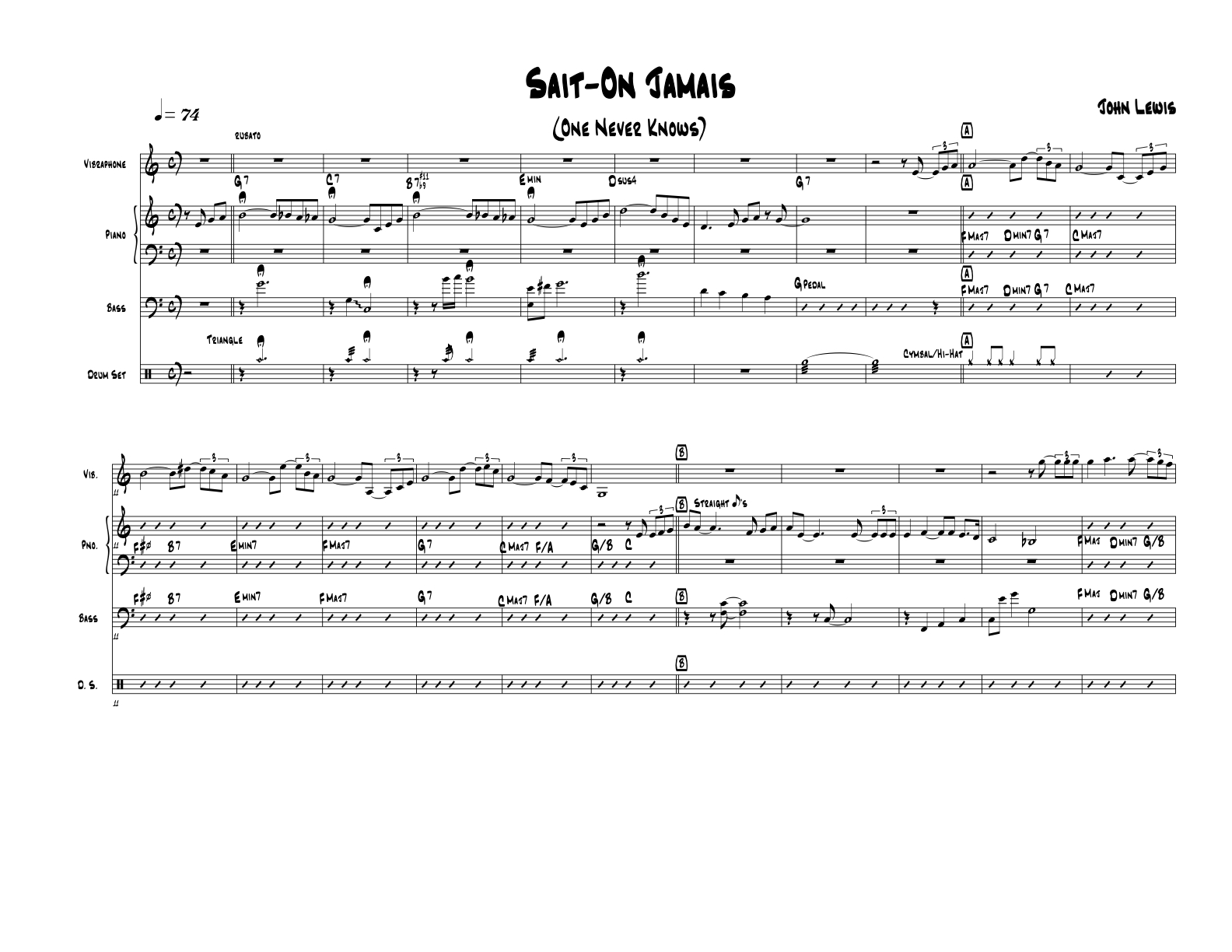
movement. Here’s a few pages of my own transcription of “One Never
Knows,” from the soundtrack of No Sun in Venice (1957).
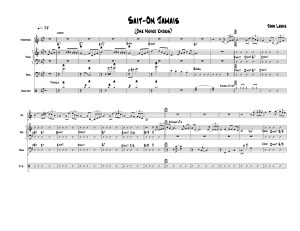
I highly recommend this album, as it also premiers another MJQ
staple, “The Golden Striker.” Unfortunately, I have not been able to
track down the film yet. Anyone out there who might know where I could
find it?
“One Never Knows” has a 24-bar ABA’ theme, but the piece in its
entirety is a longer, through-composed work that develops the melodic
material throughout the course of the arrangement. Part of the genius of
Lewis was his departure from the standard format of
melody-solo(s)-melody, creating a listening experience that is
unpredictable and fresh. Even on a blues (usually for this the MJQ
played one of Milt Jackson’s), there would be some type of interlude
between solos. On Jackson’s “Cylinder,” for example, after the
vibraphone solo in D-flat, the band would typically play a 4-bar
interlude leading into the piano solo, now in a new key of B-flat. As
simple as it appears on paper, it adds a new level of interest to the
ear. These qualities are especially exemplified on Blues at Carnegie
Hall from 1966. The ensemble makes use of various grooves
(shuffle, boogaloo, swing, etc.), tempos, and key signatures. All of the
pieces on the album are blues-centered, with Jackson’s compositions
making up most of repertoire (Ray Brown’s “Pyramid” is the first track,
and there are a couple of pieces in the middle by Lewis). It was the
ideal showcase for Milt, who loved to play the blues, and would play
them all night if he could.
The virtuosic nature of Jackson’s playing could make one believe that
the vibraphone’s role in this music greatly surpassed the others. I am
discovering that Lewis and drummer Connie Kay had a massively crucial
responsibility in shaping the overall timbre of the group. I recommend
the Complete Modern Jazz Quartet Prestige and Pablo Recordings,
which chronicles the band from 1952 to 1985 (Atlantic just needs to
release a box set like this, and we’ll be set). Within the span that the
Prestige and Pablo recordings cover, you can hear the difference in
approach between Kenny Clarke (he was the first drummer), and Kay, who
replaced Clarke in 1955. Kay maintained a more delicate, and
multi-timbral approach, all while keeping a strong beat with Percy. This
was a perfect fit for Lewis’ style, although I can never get enough of
the early records with Clarke, especially on takes of “La Ronde” and
“All the Things You Are.” Similarly, Lewis had a very distinct linear
way of accompanying that added a contrapuntal texture to the music. Even
when comping in a block chord fashion, he would form some type of
melodic nugget, and riff on it for a while. Percy Heath was the “glue”
in the group, holding everything together with his warm tone, and fat
beat.
Next Monday night, I will be performing the music of the
Modern Jazz Quartet at Dizzy’s Club Coca-Cola along with Rodney Green,
David Wong, and Warren Wolf. Will we be able to replicate the MJQ’s
sound precisely? Of course not. But their concept has been a source of
inspiration for discovering our own musical identity, both individually
and as a unit. Subtlety, nuance, structural variety, and a solid groove
are powerful assets in jazz; John Lewis, Milt Jackson, Percy Heath, and
Connie Kay left a treasured blueprint for that model. It would be a pity
not to capitalize on any opportunity that allows us to gain a closer
understanding of how momentous these four men were in the history of
20th Century music.
— Aaron Diehl
—
Saving the World, One Composition at a Time (by John Hollenbeck)
Several recent events: the December celebration of Bob Brookmeyer’s 80th
birthday; my father’s passing in May; my interaction with students at
the Jazz Institute Berlin; and the coming of a new year, have coalesced
in my mind and prompted me to strive harder to write music and (maybe
more importantly) work on myself personally. I would like to offer some
thoughts on how these two activities can actually be worked on
simultaneously. In other words, how the process of composing music can
be used to enrich and improve oneself and thereby have a positive
influence on humanity.
Mostly through DTM’s “blogroll”, I have
recently made a concerted effort to keep up with the rest of the music
blogosphere. It makes perfect sense that the majority of blogs I’ve
read focus mainly on the end results and the final product of a
musician’s efforts. I know (especially after trying in vain to write
this essay) that the innards of creation are difficult to put into words
and perhaps not as blog-worthy, but I have always been fascinated by
the experience a musician has during the creation of a work. I’ve spent a
lot of time thinking and talking to others about “the process” of
composition and how this can affect the music that one writes. But a
surprising offshoot of this emphasis on the process was the discovery
that it could also alter my personality and be a vehicle for personal
growth if I remained open and aware during the tough, decision-making
moments of any compositional practice. I find this insight very helpful
in those moments when the “results” seem so important and potentially
stressful.
Based on my experiences with the solitary spiritual
practice of meditation, I have come to see how the practice of
composition can give one the same opportunity to confront his/her
vulnerabilities. We composers sit alone in a room focusing for long
hours and making seemingly peaceful decisions. These decisions we make
as we compose will not harm others, nor will they most likely be
life-changing in the same way that a surgeon’s decision could alter a
life dramatically. Yet how we behave and what we choose when we are
alone in a room with no one watching is significant – these solitary
moments can often reveal aspects of our character that we would much
rather avoid. These decisions can set a precedent, positive or negative,
for future decision-making and behavior which will extend far beyond
the scope of composition into everyday living.
When composing we
are bound to hit walls and obstacles which challenge us and force us to
confront our weaknesses as composers, but also as human beings. To give
one example, I and I know other composers have encountered those
moments, when in the thick of composing we suddenly step back and
realize that we are writing something that has already been written –
and it could even be that we are rewriting our own music (!) or it could
be someone else’s piece we really like. I believe that what happens
next in this process is very important.
There are many options
but I usually consider these four possibilities.
1) Go
ahead with the composition as it is and hope no one will notice.
2)
Throw it away!
3) Keep tweaking it and putting it through my
personal “filter” until it has become something “new” and original.
4)
Acknowledge it and then make the piece an arrangement of the original.
I
have at some point chosen each of these four options over the course of
my career, but have opted for #3 most of the time. That is the one that
feels honest to me. But maybe more important to me is to have been
aware enough to come to this point where I recognize I need to make one
of these choices, and to be fully open and conscious as I face the
decision-making moment. What I have found is that if I am present and
aware, I can not choose #1.
When challenged and confronted by our
own limitations in the composition process, I see it as an opportunity
to develop character. I would expect that if a person is in a room alone
and follows a path of deceit, chances are pretty high that in the
future it will be easy, maybe even habitual, to be dishonest. Small
decisions like this can set a precedent for the future. If we are alone
and no one is watching us, yet we do our best to see our motivations
clearly and make honest decisions based on principle (and not on the
pressure of an impending deadline for instance), then we end up leaving
that room having become a better person. For me, this honest soul
searching has become the greatest reason to practice composing – the
process of composing with a vigilant, self-reflective mind can help me
to become a better person, and thereby makes the world a better place.
This may strike some of you as cheesy, but it’s an approach I have come
to truly value.
Of course, the results of our compositions are of
importance, but by giving the actual practice of composition a stronger
emphasis, it can be meaningful to a composer on any level and at any
time. It can take some of the pressure off needing to be successful all
of the time, and allows one to appreciate the moment (even the painful
ones!) by shifting the emphasis to an awareness of the process rather
than focusing on simply achieving the goal. I have chosen composition
for this essay because it’s what I do, but I believe that any activity
where we are forced to deal with our own “inner game” can become an
ethical and/or spiritual practice if we choose to make it so.
— John Hollenbeck
—
The next two are linked: I wrote a little bit about a Charles McPherson gig, and Mark Stryker sent in his marvelous profile originally published in the Detroit Free Press.
—-
The Real Bop (by ei)
—
Lou Donaldson likes to tell the young’uns, “If you could have heard the
real bop, it would have scared you half to death.”
Charles
McPherson is in town through Sunday at the Jazz Standard with Tom
Harrell, Jeb Patton, Ray Drummond, and Willie Jones III. Last night the
band was still learning the book but that was part of the charm: I
watched McPherson navigate the mildly tricky changes of Harrell’s
“Papaya Vacation” for what looked like the first time. The threading was still flawless but with just a hint more vulnerability than usual.
McPherson
is 71; he’s is only 19 years younger than
Charlie Parker (and was 16 years old when Bird died). His style is
distinct from Bird — it’s more liquid and varied — but McPherson has
never felt the need to develop past pure bebop. He’s not a conservative
musician, though: he was comfortable playing amidst all sorts of
madnesses in Mingus’s band for at least a decade, and last night he took
more chances than anyone else.
All the music was good, but the
best pieces were the blues: McPherson’s “Bud Like” opened the set and
Bird’s “Billie’s Bounce” closed it. On both McPherson was especially
authoritative, swinging, and disjunct. You can never guess what a
master bopper will play next, and when they hit it just right you feel
the surprise in your solar plexus.
Ray Drummond always has
exactly the right feel for this kind of music. I’m always more likely to go see any given straight-ahead
jazz group if Drummond is holding it down.
—
In the
1950’s Grange Rutan was briefly married to another master bopper, Al
Haig. Dizzy Gillespie nicknamed her “Lady Haig,” and that is the
sobriquet she places proudly on the cover of her memoir Death of a
Bebop Wife. The dead wife is not Rutan but Haig’s third wife
Bonnie, who many believe was murdered by Haig while in a drunken rage.
Al
Haig is on many important records with Charlie Parker. The fabulous
Bird, Haig, Percy Heath, Max Roach date has been mentioned several times
on this blog already. But I also enjoy the non-Bird trio sessions with
Bill Crow and Lee Abrams from the same era, which is superior cocktail
piano at its best. (This is not a criticism – I love superior cocktail
piano.)
I’ve always wondered why there wasn’t more from or about
Al Haig. Now I know.
Unfortunately, Rutan’s book is in need of a
hard edit. Among many other distractions, a visit to a psychic is
extraneous and surely the late Ross Russell would not be pleased with
how his complete correspondence with Rutan is reproduced undigested.
(“Dear Grange, thanks for your two notes and the jazzy Christmas card.”)
Ultimately, however, this book is hypnotic and overwhelming. I
know of nothing else that shows the seamy underbelly of jazz like Death
of Bebop Wife does. Among the unique items are Walter Bishop’s
bad but heartfelt poem about his grief that a white pianist had the gig
with Bird, trumpeter Bitsy Mullen’s description of a long threesome with
a groupie (she said, “One-Way Haig,” when the pianist refused to give
her oral sex), and Robert Sleckner’s disgusting “My So-Called Tribute.”
(“The mattress Bonnie was found dead on I made into a sofa bed, and
later, when I was a single person, I used it for my bed; I ignored the
urine stain on the mattress and turned it over.”)
The book’s
trajectory is non-linear, but Rutan is smart to put the long
transcription of Haig’s grilling by detectives Kaytack, Sperlazzi, and
Snack precisely at mid-point. It’s a brutal exhibit. Perhaps Haig is
suffering from shock, but based on this document I suspect Haig was
guilty: His story doesn’t make sense.
While Rutan is obviously
exorcising her demons in respect to Haig the man, she offers nothing but
love to Haig the musician, a sentiment echoed by many other great
players throughout the book. In the end I found myself wanting to hear
more Al Haig.
(Cadence books: Death of a Bebop Wife)
—
Reminiscing by Ear (by Mark Stryker)
CHICAGO — Armed with a portable CD player and a small stack of discs, I
set up shop in Charles McPherson’s hotel suite here in the Windy City,
where the veteran Detroit-bred alto saxophonist is in the midst of a
recent weeklong stand at the Jazz Showcase. McPherson, one of the
headliners at this week’s Detroit International Jazz Festival, is one of
the most potent musicians to emerge from Detroit’s mid-century cauldron
of bebop. He has had a major career, working extensively with giants
like Charles Mingus and recording prolifically. Still, he remains a
musician’s musician rather than an industry star.
McPherson is
not an innovator but a profound stylist instead, who has etched his own
distinctive identity within the template of classic bebop. He is revered
for the luminosity of his tone, the rapturous momentum of his
improvisations and the cliche-free purity with which his phrasing
channels the spirit and language of Charlie Parker. At 66, he’s playing
the most expressive and startling music of his career.
McPherson
agreed to forego a typical interview in favor of an informal listening
session — an entertaining way to get inside the head of a jazz
musician. Not only do you get an insider’s view of the art, the
discussion inevitably opens a window on aesthetic priorities and
triggers memories of former associates and war stories. I chose
recordings that mirror the broad arc of McPherson’s career, from his
Detroit roots and deep understanding of Parker to a landmark 1971 LP
with Mingus and a late ’90s CD that documents the current state of his
art.
We meet at noon as McPherson’s wife and 13-year-old daughter
are leaving to explore downtown Chicago. McPherson settles into the
sofa. He is of medium height, athletically built and, despite
salt-and-pepper hair, looks a decade younger. The prodigious afro he
once sported has been scaled back, but the bushy mustache remains. He is
an enthusiastic and lucid conversationalist, his thoughts unwinding in
complete paragraphs.
Barry Harris Quintet — “Burgundy”
from Newer Than New (Original Jazz Classics/Riverside) Sept.
28, 1961
No one was more responsible for McPherson’s life in
jazz than Barry Harris, the Detroit-born pianist and bebop guru who
mentored countless musicians in Detroit and later in New York. McPherson
was 15 when he began studying with Harris, who was 10 years older.
McPherson made his recording debut in a small role with Mingus in 1960,
but this 1961 date with Harris was his coming out LP. He was 22.
Harris’
breezy original “Burgundy” opens with Latin rhythms before shifting
into a swinging groove for solos. A look of concern falls across
McPherson’s face. “I haven’t heard this in 30 years,” he says. “I’m
scared to listen to me.”
A suave piano solo draws praise, and so
does 21-year-old trumpeter Lonnie Hillyer, another Harris disciple from
Detroit. Little known, Hillyer died of cancer in 1985. “He wasn’t a
bravura trumpet player,” McPherson says. “But he played as well or
better than a lot of others in terms of the loftiness of the musical
statement.”
McPherson’s playing lacks the sagacity, strength and
individualism of his mature work, and he grows increasingly
uncomfortable listening. He makes me stop the disc halfway through his
solo. “I hear so many things that are immature in my sound and the
timidity of the playing,” he says. “I hear too much caution, which
speaks of an insecurity. It’s not easy to sound good young, and some of
it has to do with the equipment – the mouthpiece, the horn. I can tell
my mouthpiece is too small. I didn’t know any better.”
McPherson
grew up on Detroit’s west side, near Harris and the Blue Bird Inn, the
epicenter of Detroit’s modern jazz scene in the 1950s. McPherson soaked
up the sounds nightly in front of the club “Barry would come out on the
break and one day he said to come by his house where he’d hold court.
We’d ask questions like, ‘What do you play here and what scales go with
this kind of a dominant 7th chord?’ He was exploring for himself and
showed us what he was finding.
“Pretty soon I was going over
there every day. There was an aura of intellectuality in Barry’s house.
Barry would do the New York Times crossword puzzle every day, and he’d
zip through it. He was a reader. One day I came home from school and I
had my report card, and he asked to see it. I was a C student; I didn’t
try for anything more than that. He saw the C’s and he said, ‘You’re
quite average, aren’t you?’ I said, ‘Well, I’m passing.’
“He
said, ‘You can’t be average and play the kind of music you’re trying to
learn. There’s too much going on. Charlie Parker is not average. Your
heroes are above average.’ It was like a little epiphany. It totally
changed my life. I put in more effort and instead of being a C student I
got A’s. I started getting interested in literature. I read Henry
Miller’s ‘Tropic of Capricorn,’ and I started reading philosophers, for
instance, Francis Bacon, Kant, Schopenhauer. In Detroit, in this bebop
niche we had, to be considered hip meant that you had to know about
Charlie Parker and people like that, but you also had to know about Kant
and Schopenhauer, Nietzsche and Bertrand Russell, and you had to know
about art. We were like 17.
“People like Barry and (baritone
saxophonist) Pepper Adams were so smart that we learned about bebop and
all that. But they were able to say, ‘Oh, Marc Chagall painted that.’
That influenced us.”
Charlie Parker — “Willis” from The
Washington Concerts (Blue Note) Feb. 22, 1953
Fifty
years after his death in 1955 at age 34, alto saxophonist Charlie
(Bird) Parker remains a pervasive influence. Parker, Dizzy Gillespie,
Bud Powell and Thelonious Monk were the architects of modern jazz (or
bebop) in the 1940s, but Parker was the movement’s Prometheus and its
defining virtuoso. Musicians gravitate toward Parker’s bootleg nightclub
recordings because, unshackled by the constraints of the 3-minute
record, he stretches out for thrilling chorus after chorus. The best
performances reveal streaks of demonic inspiration, and freedom he
rarely matched in the studio.
Parker’s one-nighter with a
Washington, D.C., big band finds him soloing brilliantly without benefit
of a rehearsal or music, coping on the fly with unexpected key
modulations and breaks in the arrangements. His ears are so sharp he
hears around corners, soaring over the pedestrian charts like an Icarus
immune from the sun. McPherson’s delirious style is rooted in this
wilder Parker. He is enthralled by the solo on “Willis,” a bebop tune
based on the harmonies of “Pennies from Heaven.” Parker’s sly quote from
Stravinsky’s “Petrushka” brings a knowing smile, and McPherson marks
the end of startling double-time passages by saying, “Beautiful!”
Parker’s phrases grow daringly long and asymmetric, notes explode from
the horn like fireworks and his tone thickens into a songful wail.
“What
can you say?” begins McPherson. “It’s virtuosity. It’s musicality. It’s
imagination. It’s intellect. It’s emotion. It’s perfect instrumental
playing and creative spontaneity.”
What do you hear in Bird’s
playing that others may overlook?
“I hear the rhythm. Now, people
hear technique and virtuosity, and I certainly hear that. Charlie
Parker was so proficient in so many ways you can take your pick. But to
me, the area of rhythm and phrasing is what is so spectacular. There are
two things that give you variety: sequence and rhythm. When you think
about musical phrases, sequence and rhythm give you animation. When
you’re improvising, you want a balance of tension and release
rhythmically but also harmonically and melodically.
“Bird does
all those things really well. The balance of tension and release gives
you surprise. Starting phrases on odd parts of the beat creates tension
— not starting on a downbeat because that’s what people expect.
“You
can slice the beat into little bitty pieces and start a phrase at the
16th note or 32nd note level. Bird is great at that. This is what I want
to do, and this is what great players do. I like to be totally
rhythmically free. I like to think like a drummer. Harmony is a given,
but the main event is how I phrase the harmony. More important is how I
put everything together and the story I’m telling. The main event is the
human soul being expressed.”
Charles Mingus — “The
Chill of Death” from Let My Children Hear Music (Columbia)
Nov. 18, 1971
McPherson joined bassist-composer Charles
Mingus in 1960 shortly after arriving in New York. He and Hillyer were
recommended to Mingus by former Detroiter Yusef Lateef. Mingus
auditioned them at an afternoon jam session at a coffeehouse, hired them
on the spot and had them report to work that night. Mingus’ aesthetic
was gloriously chaotic. Lush Ellingtonian colors collided with roiled
textures, searing intensity and extended forms. Mingus also loved
Charlie Parker and in McPherson found a fresh disciple to fold into his
sound world.
Let My Children Hear Music, a masterpiece
with an expansive ensemble of winds, brass and strings, includes a
Mingus recitation of his own heart-of-darkness poem to dense and
brooding accompaniment. McPherson then improvises freely against a
hallucinatory backdrop. “Oh, wow,” McPherson says softly at the sound of
Mingus’ voice: The chill of death as she clutched my hand/ I knew
she was coming so I stood like a man.
McPherson was given no
music and told to react to the abstract sound around him. “This is
pretty good,” he says. “It didn’t make me cringe. What I’m consigned to
do is not easy. There’s no (standard harmony) or sequential
construction. And look what this is about: The emotions are foreboding,
mystery and fear. How do you play that? I don’t know if melodicism is
what you need. Dissonance might be what’s called for. I did some of this
fairly well, but there were some areas where I think I get too tonal.
If I did this now, I’d be less concerned with trying to be melodic. I’d
think about how to melodically handle dissonance.”
McPherson
worked with Mingus off and on for a dozen years, and it was often
stressful. Mingus was a large, Buddha-shaped man and famously volatile,
known for firing musicians at will, carrying a knife, berating audiences
and resolving conflict with his fists. “Our first night on the gig at
the Showplace, Mingus proceeded to tear up a Steinway grand piano
because the club owner owed him money. He went in and pulled the strings
out of the piano one by one.
“And then he wanted to kill
(saxophonist) Eric Dolphy because he was quitting the band. He reached
in his pocket and got his knife, and said (imitates Mingus’ gruff
rumble): ‘Eric, get your knife out.’ And Eric who was a very sweet and
intelligent person, said, ‘Aw, Mingus, I don’t have no knife.’ Mingus
says, ‘Well, wait a minute. I’ll buy you one.’ And he goes to a store
across the street and buys a knife and comes back and says, ‘OK, we’re
each going to kill each other right now.’ Eric says, ‘Oh, Mingus,
c’mon.’ Of course nothing happened. That was my first gig.”
Charles
McPherson –“Fire Dance” from Manhattan Nocturne (Arabesque)
April 1997
McPherson recorded three CDs for Arabesque in
the 1990s, teaming with front-rank rhythm sections and essaying
original songs, jazz classics and standard ballads. A whirlpool of
Afro-Cuban rhythms defines McPherson’s “Fire Dance,” and his solo
unleashes a tsunami of melody on top of a propulsive vamp. “I’m glad I
stopped before I ran out of ideas,” he says. “I’ve heard things where I
thought it would have been better to stop a chorus or two earlier. If
you compare this to that first solo you played, at least I can say that
there is a progression toward better playing of the horn and just
playing music better.
“You gotta have the wedding of head and
heart. Your technique has to be up to par so that when inspiration
fails, technique saves you. And you may have inspiration but you gotta
have the technique to execute. It’s left and right brain, intellect and
emotion. The combination makes for the best art. When you practice,
that’s the conscious mind. You’re learning mundane things: academics,
the idiom, instrumental technique. But when you perform, you should play
from the unconscious mind.
“The act of playing is an act of
humility. The conscious mind has to sit to the side and observe the
show. When you learn to do that you are no longer a prisoner of your own
empirical experiences – I am a man. I am a white man. I am a black man.
You’re no longer restricted. Now you can plug into what Carl Jung
called the collective unconscious.
If you can plug into that, you
can play above your empirical experience. The connections are already
there. The real act of creation and genius is when you can do that.”
— Mark Stryker





 DO THE M@TH