Every Note is True

It’s February 11, 2022. I’m 49 years old today, and my Blue Note debut is out. Happy Birthday!

Watch “First Look” with Don Was, a 10 minute talk about the record with the president of Blue Note.

Don says that when he first heard the opening choral piece, “The More it Changes,” he started to cry.


I’m very happy with this substantial profile by Martin Johnson for Tidal, “It’s Got Conviction.” My journey is not so easy to explain, but Martin gets it.


It was great fun to meet Jessica Brilli the other night in Boston. One of Jessica’s paintings is the cover of Every Note is True. Literally everyone I know who has seen the cover has said, “Wow! Great cover.”


Last night I was delighted to meet Sheila Anderson for the first time at a video taping with Larry Grenadier and Nasheet Waits for WBGO. The set was filmed at Yamaha Artist Services and will be broadcast next week to WBGO supporters. As we all know, WBGO is the greatest radio station in the world.

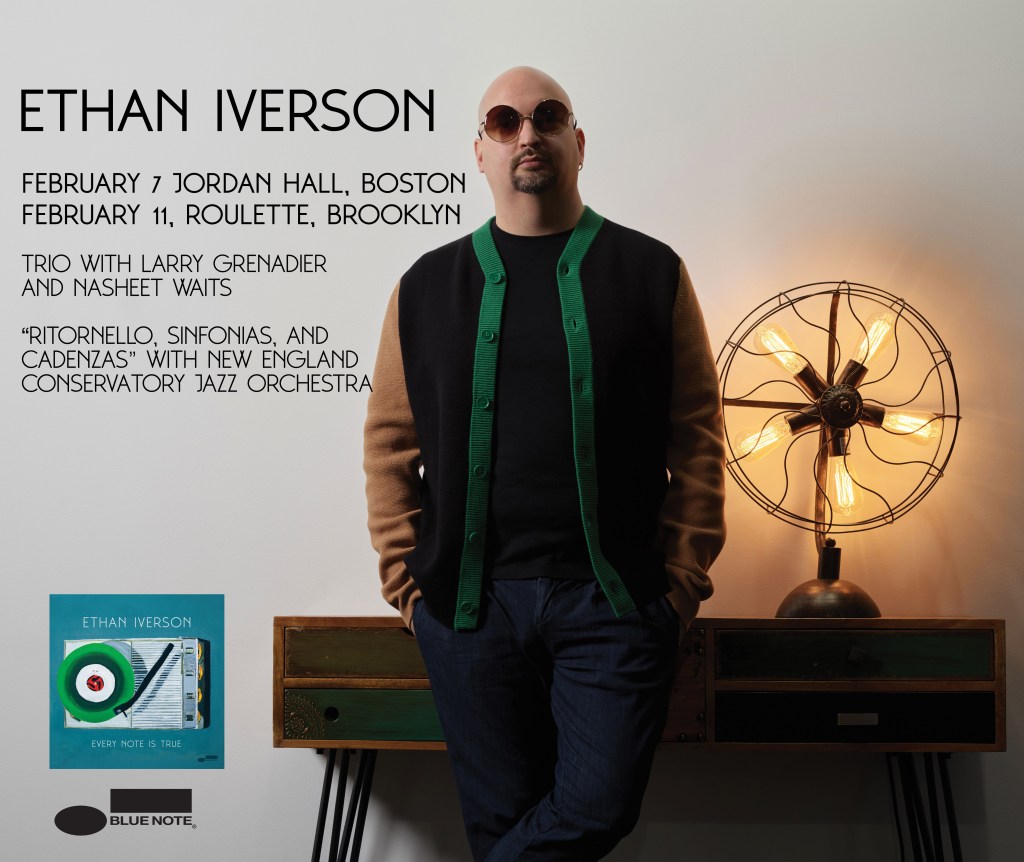
Larry, Nasheet, and I play again tonight at Roulette. The first half is Ritornello, Sinfonias, and Cadenzas played by NEC students. They did great on Monday at Jordan Hall, and are coming down on Amtrak today to do the New York hit. Thanks so much to NEC jazz director Ken Schaphorst for supporting this project!


Every Note is True. Thanks to

Sarah Deming, wife and lyricist.

Anthony Creamer, executive producer.

Larry Grenadier and Jack DeJohnette — and also Vinnie Sperrazza and Simón Willson, who extensively rehearsed the repertoire with me in the months leading up to recording.

Shane Hoshino: piano tech. Also everyone else at Yamaha Artist Services, especially Bonnie Barrett.

Andreas K. Meyer, engineer. (Andreas also did the capture of Common Practice with Tom Harrell. Top shelf!)

Don Was and the rest of the Blue Note/Capitol team: Rachel Jones, Cem Kurosman, Justin Seltzer, Melissa Cohen, Alex Anastasi, Molly Kreppel, Katie Moore, and Eileen Whelehan.

George Walker played by Steve Beck, Scott Joplin played by Lara Downes, and a little Benny Golson

Recently released on Bridge Records: The five piano sonatas of George Walker, complete, played by Steven Beck.

I wrote the notes for this release and recommend it unreservedly. Excerpt from my notes:

A sequence of piano sonatas offers one of the most direct looks into a composer’s most private and most practical obsessions, not to mention one easy way to measure the evolution (or lack of evolution) of their compositional techniques. Mozart, Haydn, Beethoven, and Schubert turned them out by the dozen. The romantics were much more cautious, with Chopin, Brahms, Schumann writing only three apiece. In the 20th century, certain Russians regained ground in terms of sheer numbers, such as Mednter (14), Scriabin (10), Prokofiev (9) and Ustvolskaya (6). 

As for the prominent Americans, Copland, Carter and Barber wrote one, Ives wrote two, Sessions three and Wuorinen four. 

George Walker is one of the few leading American composers of the 20th century to produce as many as five piano sonatas. Taken together, they securely chart a lifetime of stylistic change. Walker managed many other feats, a number of them connected to being the first black person to break through various glass ceilings: the first to be accepted at Curtis University, study with Nadia Boulanger, win a Pulitzer Prize for music, etc. But Walker is also the only major composer-pianist to have released worthy performances of virtuoso standard repertoire like the Beethoven Emperor Concerto and Brahms 2nd Piano Concerto.

Walker’s own recordings of the first two sonatas are important historical documents but also are a shade unyielding in pianistic texture. We are past due for a flexible modern master like Steve Beck to survey Walker’s vital contribution in a single serving. 

For years I’ve thought the first sonata a masterpiece, but the last one (no. 5) was a real surprise and must be one of the very best 21-century piano sonatas so far. Both should be standard repertory.

(Related DTM: Interview with George Walker.)


Lara Downes’s brand new album Reflections: Scott Joplin Reconsidered is a provocative and enjoyable listen. The set list is full of surprises, including several pieces I’d never heard before. Downes’s arrangement of the prelude from Treemonisha is gorgeous.

There is a refreshingly free approach to the original text throughout the program. Collaborators include mandolin, choir, and even DTM stalwart Kevin Sun on clarinet.

Will Liverman, baritone
Joe Brent, mandolin and vihuela
Adam Abeshouse, violin
Brooklyn Youth Chorus
Judy Kang and Chiara Fasi, violin
Tia Allen, viola
Yves Dharamraj, cello
Kevin Sun, clarinet and saxophone

From Downes’s liner notes:

To reflect on Joplin’s music and life is to consider the cross-currents of American history – how fast they move, how abruptly they collide. He was born in Texarkana just five years after Lincoln issued the Emancipation Proclamation. His parents were musical – his father, a former slave, had played the violin for plantation gatherings back in North Carolina; his mother sang and played the banjo. As a little boy, he was allowed to play the pianos in houses where his mother worked as a cleaner. He taught himself the basics, and at age 11 he started piano lessons; his teacher was a German Jewish immigrant who had ended up in Texarkana as the private tutor for the children of a wealthy lumberman. Those lessons, offered without charge, instilled a love of classical music so deep as to compel Joplin to write not one, but two, operas in a lifetime that most definitely did not welcome a Black composer into the business of writing operas. By the time he was in his teens, he was making a living as an itinerant musician, shaping a new sound called ragtime.

Ragtime exploded onto the American scene at the 1893 Chicago World’s Fair, visited by some 27 million people. The saloons, cafés and brothels that surrounded the fairgrounds resonated with the melodies of traveling ragtime musicians, including Joplin, who was there with his own band. By 1897, this music that the St. Louis Dispatch described as “a veritable call of the wild, which mightily stirred the pulses of city-bred people” had become a national craze. It was mainstream America’s first encounter with the simple but radical trick of syncopation, that displacement of the beat that causes a propulsion, a swinging of the hips, a feeling that anything might happen. Ragtime was the overture to the music of the  20th century: first jazz and swing, then soon enough R&B and rock-and-roll.


A true coup: Benny Golson has written two formal piano pieces for Lara Downes, “Classical Dreams” and “The Baby Sleeps.” Both are reserved and melancholic, and aid Downes’s quest to diversify the “classical” piano repertoire.

Most DTM readers know Golson well as one of the essential jazz greats. Listening to Downes reminded me that Golson prepared a piano folio of 15 pieces including “I Remember Clifford,” “Stablemates,” “Whisper Not,” “Along Came Betty,” “Killer Joe,” and “Blues March.” It’s the real deal, as Golson indicates in his preface:

For some of the pieces Golson writes out a hard-bop style improvisation on the changes. I’m not kidding!

This folio should probably be better known. It’s not so easy to find except in libraries. My copy is called The Genius of Benny Golson but I believe that it has come out under other titles.

Pull Quote Heaven

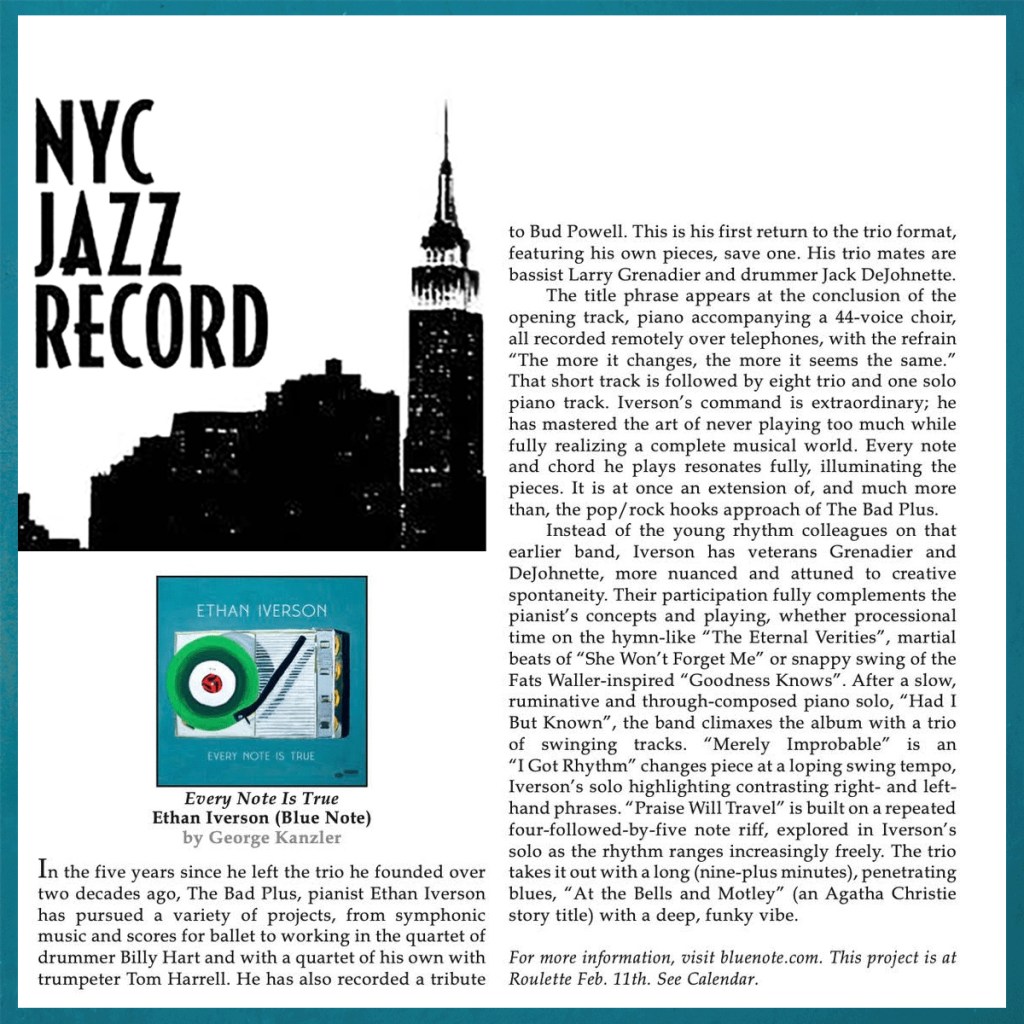
The very first review of the forthcoming record has arrived, by George Kanzler in the NYC Jazz Record.

“Iverson’s command is extraordinary; he has mastered the art of never playing too much while fully realizing a complete musical world.”

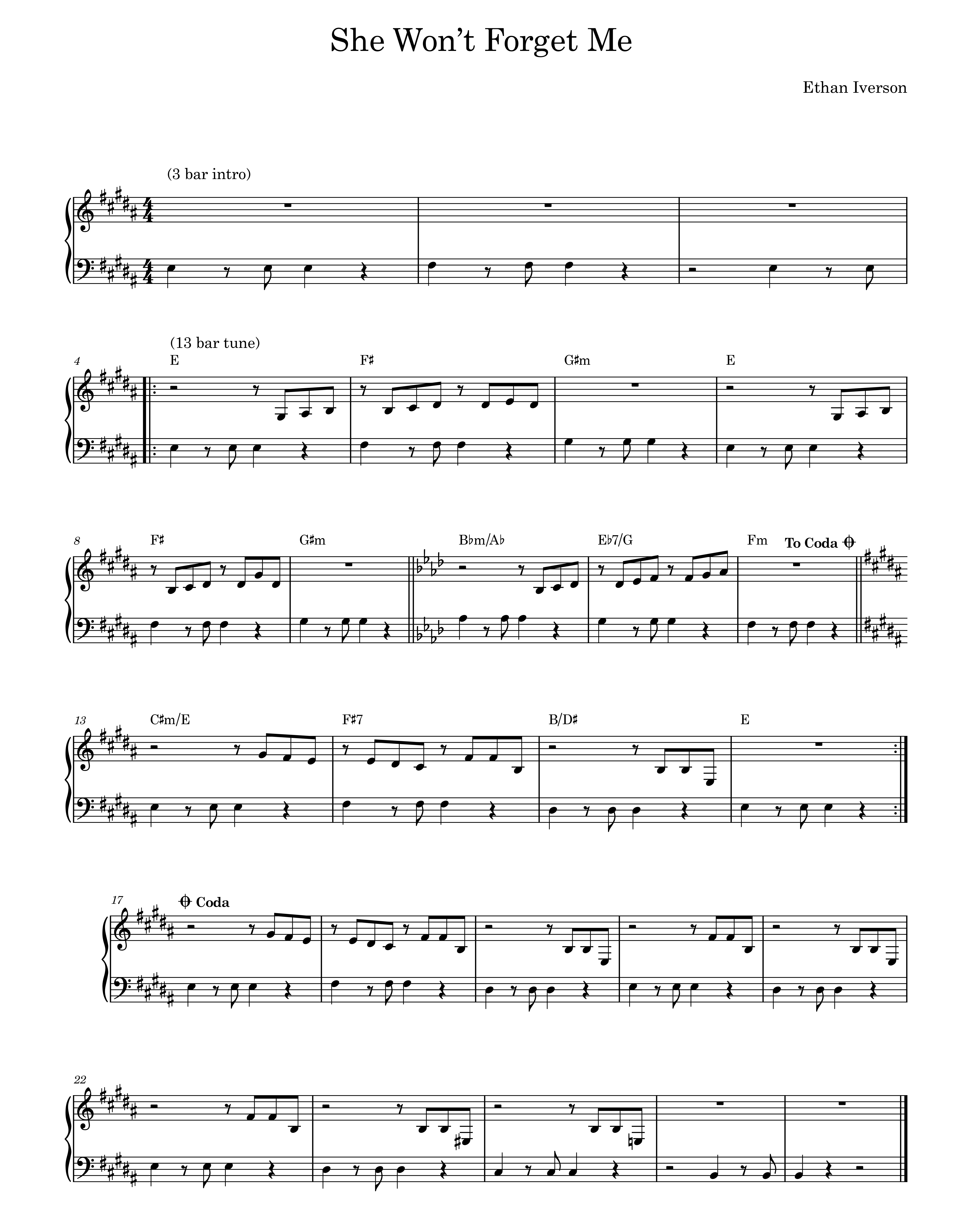
She Won’t Forget Me

In two weeks Every Note is True, my Blue Note debut with Larry Grenadier and Jack DeJohnette, is officially released in its entirety.

The last time I’ll make this plea: One of the best things a fan can do to support an artist is preorder the album on Amazon. It’s their world, we just live in it. The algorithm knows what is generating interest and supports those albums further.

One final single is out today, “She Won’t Forget Me.” At the top of the pandemic I posted quick renditions of many TV themes on my socials. For several of my non-musician friends, this was some of the best piano playing I’ve ever done. The little videos are now anthologized on DTM.

Eventually I wrote my own TV theme, “She Won’t Forget Me.” Of course, the actual show doesn’t exist yet. But we live in hope! Maybe, now that I’m signed to Blue Note, the right producer will discover my tunes…

On a nerdy level, I am quite satisfied by the hidden complexity of “She Won’t Forget Me.” It all seems quite obvious on the surface, but under the hood it has a few surprises. When I described the track to Don Was, I said it was, “as if Thelonious Monk wrote a TV theme.”

On a less nerdy level, this tune must have something to do with all the wonderful dancers I’ve known for so many years. Last night at the 10 years of Dance Heginbotham event, I worked with Amber Merkens and Maile Okamura. I played for them both when they danced for Mark Morris; now Amber is Heginbotham’s rehearsal director and Maile designs the costumes. Unforgettable.


We had the first rehearsal of “Ritornello, Sinfonias, and Cadenzas” on Tuesday up at NEC. Yeah, it’s going to be great fun to bring the students down to New York and present this 40 minutes of extended composition. I have written a lot of sonata allegro forms in the last few years, and the three “Sinfonias” are definitely among my best so far. Jordan Hall on Feb 7, Roulette in Brooklyn on Feb 11. Be there or be square!

Record Release Concerts

The gigs are on.

Every Note is True comes out on February 11.

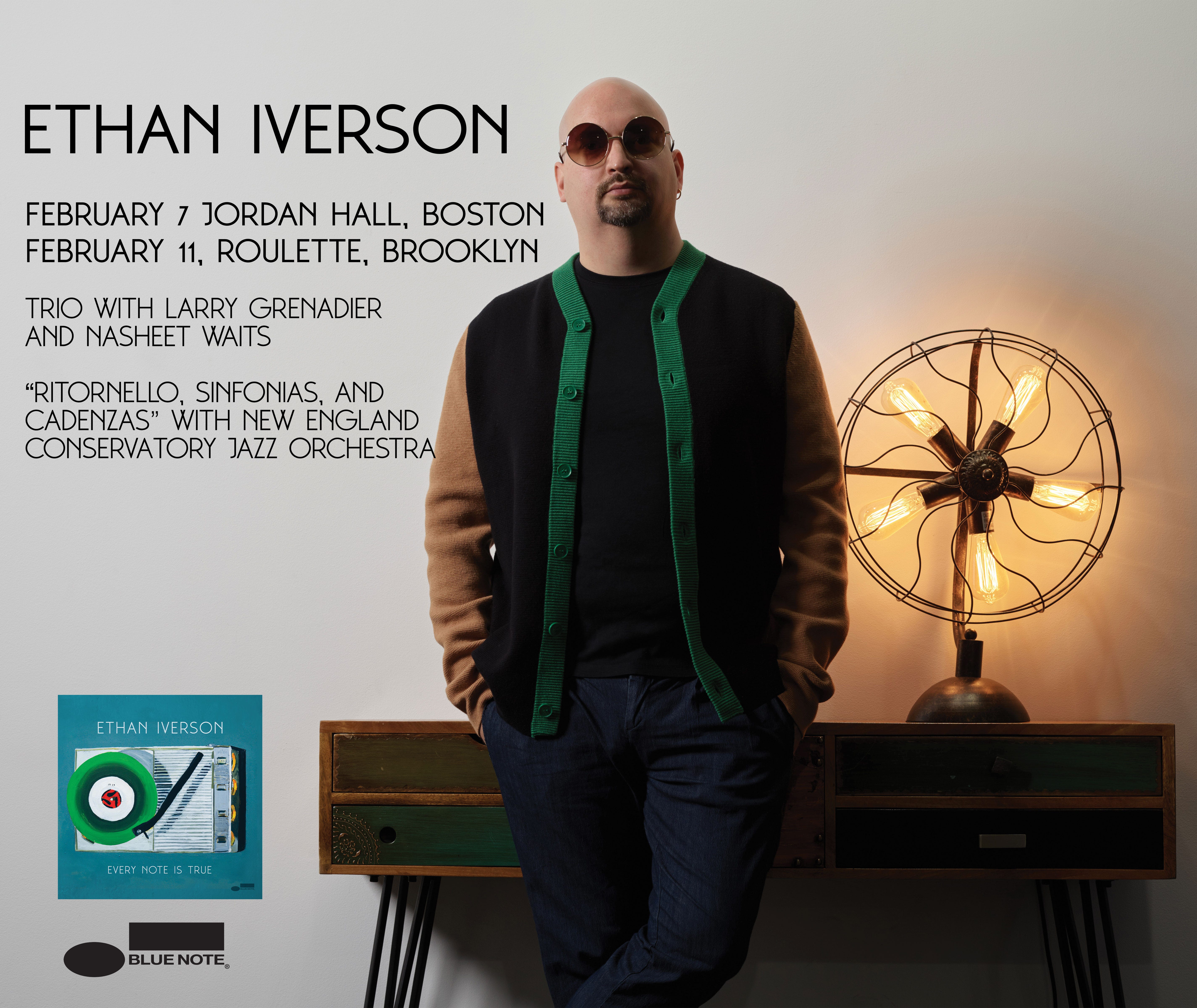
Two record release concerts

February 7 at Jordan Hall, Boston. Tix are free but must be ordered in advance. Link.

February 11 at Roulette in Brooklyn. Tix are $20 in advance, $25 at door. Link.

First set:

Ritornello, Sinfonias, and Cadenzas

“Ritornello” means “return,” a recurring fanfare in the baroque style. “Sinfonia” is a diminutive symphony, in this case three diverse sonata forms. For “Cadenzas,” soloists will rhapsodize against the ensemble. 

  1. Ritornello I
  2. Sinfonia I, “Police Woman”
  3. Ritornello II
  4. Sinfonia II, “Trumpet Canon”
  5. Ritornello III
  6. Sinfonia III, “Forgive Me”
  7. Cadenzas
  8. Ritornello and Coda

The instrumentation is modeled on Stravinsky’s Octet (with saxophones in for the bassoons) plus jazz rhythm section. The work was commissioned by the Umbria Jazz Festival and premiered in Perugia in July 2021.

Members of the NEC Jazz Orchestra conducted by Ken Schaphorst

WIll Fredendall, flute
Chris Ferrari, clarinet
Mike Cameron, alto saxophone
Shota Renwick, tenor saxophone
Mike Brem and Zoe Murphy, trumpets
Joey Dies, trombone
Weza Jamison-Neto, bass trombone
Ben Freidland, bass
Nadav Friedman, drums

Ethan Iverson, piano

Second Set:

Trio with Larry Grenadier and Nasheet Waits

Selections to be announced from the stage, celebrating the release of Every Note is True on Blue Note records. The drummer on Every Note is True, Jack DeJohnette, gracefully declined to tour…but DeJohnette suggested Nasheet Waits in his place, which was perfect as Iverson and Waits have a long history together.


Pianist, composer, and writer Ethan Iverson was a founding member of The Bad Plus, a game-changing collective with Reid Anderson and David King. The New York Times called TBP “Better than anyone at melding the sensibilities of post-60’s jazz and indie rock.” During his 17-year tenure, TBP performed in venues as diverse as the Village Vanguard, Carnegie Hall, and Bonnaroo; collaborated with Joshua Redman, Bill Frisell, and the Mark Morris Dance Group; and created a faithful arrangement of Igor Stravinsky’s The Rite of Spring and a radical reinvention of Ornette Coleman’s Science Fiction.

Since leaving TBP, Iverson has kept busy. 2017: Co-curated a major centennial celebration of Thelonious Monk at Duke University and premiered the evening-length Pepperland with the Mark Morris Dance Group. 2018: premiered an original piano concerto with the American Composers Orchestra and released a duo album of new compositions with Mark Turner on ECM. 2019: Common Practice with Tom Harrell (ECM), standards tracked live at the Village Vanguard. 2021: Big band work Bud Powell in the 21st Century featured on the March cover of DownBeat. 2022: The current release is Every Note is True on Blue Note records, an album of original music with Larry Grenadier and Jack DeJohnette.

Iverson also has been in the critically-acclaimed Billy Hart quartet alongside Ben Street and Mark Turner for well over a decade and occasionally performs with elder statesmen like Albert “Tootie” Heath or Ron Carter or collaborates with noted classical musicians like Miranda Cuckson and Mark Padmore. For almost 20 years, Iverson’s website Do the Math has been a repository of musician-to-musician interviews and analysis. Time Out New York selected Iverson as one of 25 essential New York jazz icons: “Perhaps NYC’s most thoughtful and passionate student of jazz tradition—the most admirable sort of artist-scholar.” Iverson has also published articles about music in the New Yorker, NPR, The Nation, and JazzTimes.

“For Ellen Raskin” (+ R.I.P. to Lee Server and Andrew Vachss)

Another preview track from my forthcoming trio disc with Larry Grenadier and Jack DeJohnette has been released by Blue Note. “For Ellen Raskin” can be heard on YouTube and on all the streaming services.

“For Ellen Raskin” is a tribute to an early influence, the famous writer and illustrator. Her greatest work is The Westing Game, which has consistently remained in print since publication in 1978. My vast passion for this comic puzzle knew no bounds: I even made my 5th grade teacher read it out loud to the class during story time, one chapter a week. Regrettably, I was out sick for the final pages, and when I returned, I had to give an impromptu explanatory lecture, for my classmates complained they didn’t understand the ending.

The other Raskin I read over and over was her first novel, The Mysterious Disappearance of Leon (I Mean Noel) from 1971.

Raskin was idiosyncratic. She loved wordplay, puzzles, and nonsense. Her books are deeply surreal. There’s no doubt in my mind that Raskin paved the way for my future appreciation of surreal jazz pianists such as Thelonious Monk.

At the conclusion of Figgs & Phantoms, Ellen Raskin doesn’t write “The End.” She writes, “The &.

This is just like the conclusion of a Thelonious Monk track where hits a high minor ninth. It’s obvious. Raskin: “The &.” Monk: “Clang!

Raskin’s “The &” connects to her other gifts as an illustrator and graphic designer. Wikipedia lists over twenty books graced with Raskin art, including the cover for the first edition of Madeleine L’Engle’s 1963 classic A Wrinkle in Time. The Newbery Medal is the most prestigious award in children’s literature. Both A Wrinkle in Time and The Westing Game won a Newbery.

A unique statistic: Raskin designed the cover for one Newbury winner and wrote the text for another.

I rarely play a jazz waltz, and haven’t composed one until now. Mal Waldron’s “Fire Waltz” and Wayne Shorter’s “Ju-Ju” are in my repertoire, because it helps to have something in a dark and droning zone when playing with an unfamiliar rhythm section, but I shy away from anything in the Bill Evans-ish camp of “Someday My Prince Will Come,” “Very Early” and so forth.

When contemplating recording with Jack DeJohnette, I looked through John Coltrane and Elvin Jones references, for Coltrane and Elvin are a big part of where DeJohnette is coming from. My first ever jazz waltz, “For Ellen Raskin,” is the same tempo and feel as Coltrane’s famous “Spiritual,” recorded live at the Village Vanguard in 1961, but with a harmonic structure that is comparatively light and breezy — although, hopefully, not without some Iverson idiosyncrasies, and perhaps even the kind of idiosyncrasies Ellen Raskin would approve of.

Jack DeJohnette is magnificent throughout Every Note is True, but I’m especially happy to get some primo Jack at the “Spiritual” tempo on tape.

(“For Ellen Raskin” is the second Iverson composition featuring the name of a non-musical hero in the title. The first was “Bill Hickman at Home.” As far as I know, these are the only jazz tributes to either Raskin or Hickman.)


The Westing Game is a bonafide mystery novel, and I suppose it was the first one I ever read. As I got older, my interest in crime fiction would become a major hobby.

I like thinking about genre. If we know what genre any proposed work of art is planned to be — if we really know, because we command the terrain and can speak truthfully as to what has been done before — then we can fill the container with work that supports or denies a given set of conventions.

The research I have done exploring crime fiction has informed my attitudes to everything else (including music criticism and even what I play on the piano). One of my most helpful guides was Lee Server’s Encyclopedia of Pulp Fiction Writers. Server, who died at the end of last year, is best-known for well-regarded biographies of Robert Mitchum, Ava Gardner, and Johnny Rosselli, none of which I have read yet. However, I certainly owe a debt to Server: Whatever little skill I have when writing a capsule music review comes in part from emulating Server’s superb style in Encyclopedia of Pulp Fiction Writers.

Not every author covered in Encyclopedia of Pulp Fiction Writers is truly pulp, and some of the Amazon.com reviewers are up in arms about this minor transgression. Their point is easy to understand, for everyone in that game is eager to define different genres in very precise terms. Still, Server’s commentary on two famous authors rarely classed as pulp, Ian Fleming and Raymond Chandler, affected my opinion. Indeed, both Fleming and Chandler went up a notch on my private scorecard thanks to Server.

Server didn’t just include people who fit the bill, he also bent the rules and included people when he could advocate for them with a distinctive “take.” Again, in my music criticism, I follow Server’s lead.


Andrew Vachss also died towards the end of last year. Not long after I arrived in NYC in 1991, I went through a brief Vachss phase, reading a half-dozen of the early Burke series in the then-ubiquitous Vintage trade paperback edition. Within a year or two I rescinded my invitation, and didn’t even include Vachss in my substantial overview, “The Crimes of the Century.”

After hearing of Vachss’s passing I picked up the first three Burke novels on Kindle: Flood, Strega, and Blue Belle. Vachss has real poetic flair, especially when crafting a comic description of urban decay, but what at first seems charismatic soon wilts into a one-note riff. Sexual sadism is inflicted on children, and the former heister (now quasi-PI) Burke goes on the warpath to seek vigilante vengeance.

The titles of the books are Burke’s girlfriends. These women all are simply lurid cartoons, just like the rest of Burke’s associates: the silent Mongolian assassin, the sophisticated trans streetwalker, the salt-of-the-earth black Prophet, the Jewish electronics expert who hides out underneath a Bronx junkyard. Burke relentlessly talks of this crew as his “family” in exactly the same manner that Dominic Toretto describes his associates in the Fast and Furious movie franchise.

While I will never be a card-carrying member of the Andrew Vachss fan club, I enjoyed re-reading the early Burke trio last week. Not for the works themselves, but because it was a way to time travel and re-visit a place last seen almost 30 years ago. The same is true when I pick-up The Westing Game or The Mysterious Disappearance of Leon (I Mean Noel). Probably a decade hence I will go through Server’s Encyclopedia again, not expecting to learn anything new, but simply to check in on the slow but constant evolution of my personal aesthetic.

On the late Terry Teachout (with a guest contribution by Heather Sessler)

The arts community was rocked yesterday by the sudden passing of critic/author/playwright Terry Teachout.

I’ll write more about his work in a moment, but first want to turn the DTM floor over to my buddy Heather Sessler, who kept me updated during Teachout’s long bout with a dying spouse and his surprising recent love. (When he wasn’t praising his favorite songs and movies, Teachout’s feed had something of an innocent, old-timey radio soap opera about it.)

Terry and I first met on Twitter more than four years ago. We instantly hit it off and began corresponding via long emails. I was nervous writing to him – me, a nobody in Portland, OR – Terry, an accomplished writer who seemingly knew everyone and everything, yet Terry was interested in me. He asked questions. He made me think about my answers. He took the time to listen to recordings from my junior recital and over many messages helped me choose tunes for my senior recital. He saw something special in me.

During a visit to NYC, I met Terry for Indian food near his home in Washington Heights. He was just as warm and kind in person as he was in his letters. That evening he sent me this note: 

We did stay in touch – through Hilary’s illness, my divorce, and big move to NYC. We reunited again at the Indian joint in early March 2020 just after Hilary’s transplant and before COVID shut everything down. We spoke of the future he and Hilary might have. I was hoping to meet her and get to know the person he loved with his whole being. After Hilary passed, I promised to come over and make him homemade chili and cornbread. The pandemic made a liar out of me and I am so sad that I’ll never have the chance.

Terry was generous, supportive, and made me think that I could be an artist. It is heartening to know that Terry was that kind of friend to so many people. We can grieve together knowing our lives are better because he cared.

As Heather suggests, it was not just on Heather who Terry bestowed kindness. The socials are full of people who have a similar story. Terry’s simple acts of friendship are a wonderful legacy.


The current political mood is very polarized, and just seems to get worse and worse — to the point where I fully expect that typing a sentence such as, “The current political mood is very polarized…” will get angry pushback online from people saying, “How dare you suggest our side bend to the evil Republican regime?”

Terry Teachout was an old-school Republican intellectual. His heroes included people like William F. Buckley and George Will, and never failed to mention that President Bush appointed him to the National Council on the Arts. (The blog post where he walks around the White House and reviews the art collection is quintessential Teachout.)

No one could ever say Terry Teachout wasn’t smart, and the sly dog rarely publicly spoke about his political beliefs. A 2008 article about Mike Huckabee and Barack Obama tips his hand very slightly, but the article is also simply correct in every particular: Teachout forecasts the coming schism with uncanny accuracy.

On a practical level, I was happy that Terry was a political conservative, for we need people that will argue for the arts when the conservatives control the board. On a local level, I was impressed with how he fought polarization by being sincere, polite, firmly traditional, and a stand-up gent. Online tributes have come in from hilarious/scandalous writer Chelsea G. Summers and hard-headed television avatar David Simon. To say that Summers and Simon rarely have a kind word for a conservative understates the matter! One up to the power of Teachout.


Teachout’s biographies covered Mencken, Balanchine, Louis Armstrong, and Ellington. He knew fiction and painting as well, but probably had the biggest impact as a drama critic. It is absolutely certain that losing Teachout is a true blow to regional theater, for Terry was one of the few visible NYC critics who traveled the country to see local productions.

Outside of drama, “middlebrow” may have been Teachout’s forte. His critiques of mid-century movies, music, and books that were both popular and sophisticated were full of pithy truth. I resonated with Teachout best on that middlebrow wavelength. The work of Rex Stout is a perfect example: When I wrote my pandemic-era overview of Stout, I quoted him in the piece and sent it along for him to look it over before it went live. Similarly, Mel Powell’s jazz piano was middlebrow, and my own essay on the larger career of Powell was literally a return serve to an old Teachout essay in the New York Times.


I met Terry over two decades ago when he wrote about Mark Morris. Frankly, I was surprised that someone working as dance critic knew anything about jazz. We kept in touch, and his blog About Last Night was a direct inspiration when starting Do the Math.

I liked Terry, appreciated his perspective, but also felt I owed him a favor. His 2000 profile of Morris put me on the cover of Sunday Arts in the New York Times. (Picks up phone and calls home: “Hey, Mom? Drive to Eau Claire tomorrow and get the New York Times.”) He also advised me on prose issues when I first started trying to write criticism. So, when I heard that Terry was releasing a book on Duke Ellington, I figured it was time to interview Terry for DTM.

But, after setting up the interview, it turned out I didn’t love Duke: A Life of Duke Ellington. Indeed, I wondered if I would be dishonoring my ancestors if I gave the book positive press. It was a kind of a personal crisis: I literally fell ill with a flu that wouldn’t go away. Finally, somewhat in desperation, I wrote a rebuttal to the biography, “Reverential Gesture.” Immediately my body healed and I was fit as a fiddle.

I figured springing my essay on Terry would be unfair, so I sent it along for comments. He corrected a few things and said, “Go get ’em, tiger.” The interview and my rebuttal ran side by side.

I had hoped my public disagreements with Terry would end there, but, to my dismay, I disliked his play Satchmo at the Waldorf even more than the Ellington book. Should I really keep on this thread? I couldn’t help myself, and spent an afternoon with my books putting together putting together another contra-Teachout screed, “Louis Armstrong and Miles Davis.”

In the end, I think Terry overstepped his bounds when dealing with black music, a common-enough mistake for his generation and social circle. Perhaps he treated Armstrong, Ellington, and Miles as middlebrow. However, they aren’t middlebrow. If you take on those masters, you need to bring your A-game and dig deep.

Having landed two blows, I expected Terry to drop me as friend and associate. Incredibly, he just stayed the same warm self. Especially on Twitter, he constantly signal-boosted my work. After Trump was elected, I felt a chill deep in my bones and abruptly quit interacting with anyone I regarded as conservative. Terry didn’t change, so in time I circled back and sent him further things for input.

I try not to make enemies, but stuff happens. If you have visible opinions in the world, conflict is unavoidable. After hearing of Terry’s death, I pondered his vast skill in staying above the fray and connecting people through kindness and friendship. There is definitely a lesson to be learned from Terry’s seemingly effortless and graceful deportment. I never told him I admired him for those reasons, but I wish I had.

Charles Brackeen and Mtume, R.I.P.

Charles Brackeen was a mysterious figure. I spoke to him on the phone briefly when assembling the extensive essay that accompanies the Paul Motian ECM box set. It was an enjoyable conversation, and, since I suspected this would end up being one of the few Charles Brackeen interviews, I included almost all the quotable bits in the liner notes. The relevant passage:

After the Jarrett group disbanded, Motian tried leading his first working band, a trio with saxophone and bass.  Charles Brackeen was an interesting choice.  Like Carlos Ward, he comes from the network of post-Ornette horn players: the 1968 Brackeen album Rhythm X with Cherry, Haden and Blackwell is a superb document of the Coleman school.  On Dance, the Coleman connection is furthered by the presence of David Izenzon, a bassist whose most familiar work is in the Ornette trio with Charles Moffett.  It’s a collection of important, idiosyncratic musicians who (apart from Motian) lack extensive discographies — indeed, Dance is not just Izenzon’s only album from the 70‘s but his final commercial recording.  

Brackeen is from Oklahoma, and he shares something of that Southwestern cry that characterized Dewey Redman.  Motian loved playing with Redman with Jarrett, so hiring Brackeen was a logical consequent.  Brackeen remembers playing with this trio as, “A fantastic experience.  We rehearsed at my studio in New York or on tour in Europe.  The music was accurate, simple, enjoyable, and interesting.  Paul was very experienced and was a spectacular arranger.  There were no questions.”  

During this time Brackeen was also becoming legendary for his street performances.  “That was an important part of my artistic expression.  I would play for anybody and everybody, and they called me the man who talked through the horn. I found some mechanical monkey drummers at Christmastime. First I made a costume and a hat for myself, and then I would dress the monkeys the way I was dressed, like a uniform.  

“People would ask, ‘What are you paying your band?’ or, ‘What kind of batteries are you using?’  It opened the history up.   At first I was playing standards like ‘Over the Rainbow,’ ‘Sunny Side of the Street,’ and ‘Summertime.’ But with the monkeys it was better to make up songs.  The police looked the other way, but it was against the law.  I worried sometimes about how much money I made. It was a lot! Fifteen years I did that!  They didn’t have drum machines yet, but the rappers later seemed to understand what I was doing. Nobody copied me while I was there, yet two years after I left New York they came out with rap.” 

From the opening notes of “Waltz Song,” it is easy to imagine not just Brackeen but the whole trio performing this cheerfully disorganized music on a street corner somewhere.   The tracks with soprano, “Waltz Song,” “Kalypso,” “Asia,” and “Lullaby,” are enigmatic character studies, while the tenor features, “Dance” and “Prelude,” let loose with full-throttle blowing.  Motian seems to be having fun picking non-sequitur titles:  There’s no waltz anywhere, and “Kalypso” has a taste of an AACM-style march. In the 60’s, Izenzon was often paired with other bassists — usually, he was the one with the bow — and “Lullaby” gives him a chance to reference those years via an overdub.

The engineer for Dance and the rest of the box is Martin Wieland, whom Eicher praises highly.  “He was an assistant engineer to Kurt Rapp at our very first session with Mal Waldron, Free at Last. He had just finished at the conservatory in Dusseldorf where he studied to be a sound engineer.  So, like myself, he was a beginner in the field and we used the chance to learn in every session.  He was also an excellent engineer for live recordings including The Köln Concert, almost a specialist in changing multi-track or two-track tapes during live concerts, getting there just when they are just about to run out. In the 80’s he got an offer from a radio station in a higher position and moved away from recording.  I really liked to work with him. He was one of the three important engineers who helped set the direction at ECM, along with Jan Erik Kongshaug and Tony May.”

Dance is distinctive, but Le Voyage is better.  From the first notes the group sounds more confident.  If Izenzon was connected to Ornette, J. F. Jenny-Clark was connected to Don Cherry, appearing on several of the trumpeter’s albums in the 60’s. During the 70’s, Jenny-Clark had become a major force in European jazz:  the year before Le Voyage, he had appeared on Enrico Rava’s wonderful ECM record Quartet.  A natural musician, Jenny-Clark is related to Haden in spirit and harmonic angle although the tone and phrasing comes more from the Gary Peacock school.  (According to Brackeen, Arild Andersen also played in the trio on tour.)

During Brackeen’s soprano improvisation on “Folk Song for Rosie,” Motian moves from free tempo to banging out his canonical crude swing on trashy China cymbal.  Again, not every drummer commands both worlds as convincingly as Motian.

The highlight of the album is Brackeen’s fervent, multi-hued unaccompanied tenor cadenza on “Abacus,” which seems to be the dead intersection of Albert Ayler and Dewey Redman.  There’s really far too little of Brackeen on record.  

Few other jazz bassists would attempt the tricky melody of “Cabala” with a bow.   Later on in the track, the premiere recording of “Drum Music” is stated rather slowly, especially if you know it as the raging sign-off theme concluding countless later Motian sets at the Village Vanguard.  “Drum Music” is notated in 5/4. That doesn’t really seem to matter for the free phrasing, but Paul said it was inspired by “Five,” the abstract Bill Evans tune recorded on New Jazz Conceptions.  

Only on “The Sunflower” does Brackeen’s tenor finally intertwine with Clark and Motian’s shape-shifting time.  With this kind of music, it is incorrect to say there is a Brackeen “solo”:  once the head is over, there is a trio of equals.  Everyone’s phrases follow naturally, and Motian even graces us with a little bit of clunky swing.  The title track returns to soprano and a more spacey ambience, perfect for Martin Wieland to capture every nuance.  Le Voyage should be better known: it’s surely one of the best jazz albums of 1979.

As I write above, Rhythm X is pure Ornette-school, not least because of the band. In the ’80s Brackeen put a few releases on Silkheart. Worshippers Come Nigh with Olu Dara, Fred Hopkins, and Andrew Cyrille is a good listen. Another great band! The style is no longer purely in the vein of Ornette, but also concerned with the kind of gritty post-Coltrane spiritual and modal concepts next door to Pharoah Sanders or David Murray.

It’s possible that the two Motian albums remain Charles Brackeen’s finest studio performances.


flyer courtesy Hyland Harris

Mtume had an extraordinary life in this music. From the forthcoming Billy Hart memoir:

Jimmy Heath’s son was Mtume, so named by Maulana Karenga of the US Organization, an important political group connected to the social ferment of the times. The American version of the holiday Kwanzaa was Karenga’s idea.  

Mtume played congas with Gary Bartz, Sonny Rollins, and Miles Davis. He also wrote the hit songs “Juicy Fruit,” which was successful with his own group and later sampled by Biggie Smalls, and “The Closer I Get to You,” which was recorded by Roberta Flack, Luther Vandross, and Beyoncé.  I’m on Mtume’s album Alkebu-Lan: Land Of The Blacks, which was recorded live at the East, a cultural center in Brooklyn that only allowed black people onstage and in the audience.  When I played at East with Herbie Hancock, they didn’t allow Herbie’s white wife to attend.

Mtume is a Swahili name. Most Afro-Americans go by a name originally given to them by a slave master. If you take an African name, it is a way to reject the status quo and reclaim your heritage. 

Tootie Heath was Mtume’s uncle, and Mtume named Tootie “Kuumba,” Buster Williams “Mchezaji,” and Herbie Hancock “Mwandishi” on a 1969 record date, Kawaida

As the final version of the Herbie Hancock sextet came together, everyone took a name, mostly assigned by Mtume. 

All these names mean something, or even several things. 

Herbie Hancock — Mwandishi — Composer.
Eddie Henderson — Mganga — Doctor.
Bennie Maupin — Mwile — Body of Good Health.
Julian Priester — Pepo Moto — Spirit Child.
Buster Williams — Mchezaji — The Player.
Billy Hart — Jabali — Moral Strength. 

My name, Jabali, has stayed with me ever since this era.

According to Lord, Mtume’s jazz discography includes 114 sessions. The best known are from the several years of work with Miles Davis, but he recorded from everyone from Harold Land and Sonny Rollins to Ramsey Lewis and Roy Ayers.

Listing ten LP titles featuring Mtume in the ’70s certainly evoke an era:

Gato Barbieri Under Fire
Pharoah Sanders Wisdom Through Music
Lonnie Liston Smith And The Cosmic Echoes Astral Traveling
Abbey Lincoln People In Me
Carlos Garnett Black Love
Azar Lawrence Bridge Into The New Age
Gary Bartz Music is My Sanctuary
Reggie Lucas Survival Themes
Hubert Eaves Esoteric Funk
Harry Whitaker Black Renaissance – Body, Mind And Spirit

Mtume’s important career as a hit songwriter is beyond DTM’s purview, but a 2017 interview with the Breakfast Club is a worthy watch. A few years ago Mtume got back on the radar of jazz fans thanks to a substantial debate with Stanley Crouch, seen many times on YouTube.