RIP D.J. Fontana

Longtime Elvis Presley drummer dies at 87.

It must be said, the “stop time” breaks in “Jailhouse Rock” are a hell of a thing. 1957.

 
In the obit, Fontana says, “I think the simple approach comes from my hearing so much big band music. I mixed it with rockabilly.”

Once they start playing time, Scotty Moore on rhythm guitar plays even eighth notes while Fontana plays swing eighths.

American music.


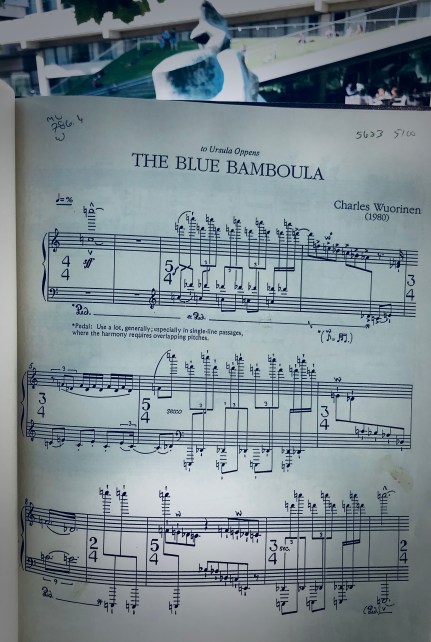
Blue Bamboula

fullsizeoutput_da1

In honor of his 80th (June 9), I’ve written about “The Syncopated Stylings of Charles Wuorinen” for NewMusicBox. Tyshawn Sorey contributed an impressive coda.

My wife Sarah Deming did a great editing job. She’s just the best.

Left on the cutting room floor was a long “background” intro. It took some time and clarified my own thinking but clouded matters in the essay.

I really wanted to get Nadia Boulanger’s name in there, mainly because she’s so important, but also because on June 24 I join Miranda Cuckson at Spectrum in performances of violin sonatas by Boulanger students George Walker and Louise Talma. Indeed, the Talma was a tribute to Boulanger for her 75th birthday.

Well, an important rule in writing is, “Kill your children,” and Sarah was right to convince me to, “Get to the point, already!” But, this is the internet, where unedited words can go on to infinity.  For those that can’t get enough Iversonian musings about 20th century composition, this is that dead child:

[Ludicrous amount of simplification and generalization begins:] Much of the most familiar concert music lacking improvisation written by American composers contains the echo of ragtime. Scott Joplin is a patron saint of Charles Ives, Conlon Nancarrow, George Gershwin, Aaron Copland, Samuel Barber, and Leonard Bernstein.

Around mid-century that influence was at its peak, going hand and hand with Igor Stravinsky and Nadia Boulanger. Stravinsky found syncopation a natural fit for his cubist phrases, and his “Ebony Concerto” is still the best piece in the conventional European concert idiom written for jazz ensemble. A stunning number of Americans studied with Boulanger, who taught Stravinsky as the greatest modern composer and encouraged Americans to “sound like Americans.” While experimentalists like Henry Cowell were on a different track (where a world music ethos was shaping the rhythmic conception), it remains the exception to the rule to find a valuable conventional American composer working from 1910 to 1950 who didn’t offer a few overt syncopations here and there.

After World War II, the syncopated flavor fell out of fashion, partly due to the discontinuous high modernism espoused by Milton Babbitt and Elliott Carter. From the other side of the tracks, experimentalists like John Cage and Morton Feldman dispensed with meter entirely. By the mid-1960s, many significant new music premieres lacked a perceptible beat.

That tide quickly turned around with the spread of minimalism in the early 1970s, where not just the meter but the harmonic language was made comparatively obvious. In the wake of starkly opposing forces —including the rise of black experimentalists connected to jazz, like Cecil Taylor and the AACM — hierarchies dissolved, and it has gotten harder to make encompassing and inclusive statements about the state of American formal composition ever since. [Ludicrous amount of simplification and generalization ends.]

I also introduced Elliot Carter as a foil but Sarah explained that was too many non-Wuorinen actors. Again, I concede the point. In case the digressive paragraph is of interest for a certain crowd:

There are varying levels of obscurity. Around the time of my Blue Bamboula immersion, I compiled a playlist of a few different performances of Night Fantasies by Elliott Carter. Night Fantasies is another masterpiece, or at least is said to be, and a slew of the greatest new music pianists have recorded it.  However, for my perhaps comparatively slow ears, nothing has ever stuck. I never learned the narrative of Night Fantasies, even with the score in hand. Blue Bamboula was Jerome Kern in comparison.

The Wuorinen piece goes along with “Peter Lieberson on Record.” 

Mr. Rob Schwimmer/Mr. Billy Hart

Next week: Thursday May 31st @ 7pm —
Solo Concert
ROB SCHWIMMER
Heart of Hearing CD Release Concert
for Piano, Theremin & the amazing Haken Continuum

at Joe’s Pub

The record at Bandcamp

I wrote the liner notes for Heart of Hearing, it’s really kind of an amazing disc. My pull quote: “Rob Schwimmer is a strikingly advanced polymath, a wizard on multiple instruments, a relentless comic, a throwback to the groovy ’60s/’70s, a repository of unlikely trivia, a summoner of strange beauty, a master of the absurd, a man with a heart of gold… In the end, Heart of Hearing is about harmony. Hallucinatory, complex, subtle pitches and people together. The 88 keys plus sine waves, a life lived in strange and beautiful music.”

Rob has been on the road with me and the Mark Morris Dance Group wowing audiences with his Theremin in Pepperland, but when he sits down at the piano at soundcheck, I wonder if I shouldn’t just give up the bench and conduct instead!

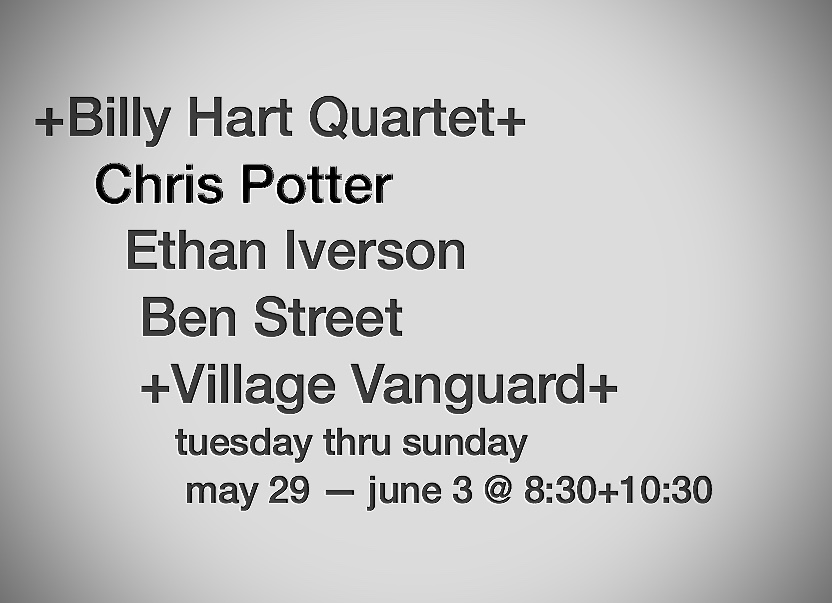
Sadly I will miss Rob’s show since I’ll be working across town. Mark Turner couldn’t make it, neither could Josh Redman, so we asked the great Chris Potter (who is on some of Billy’s older records).

fullsizeoutput_d4d


Perfida Replicata

Yesterday  Josephine Bode, Dodó Kis, and I played a set at Moers.

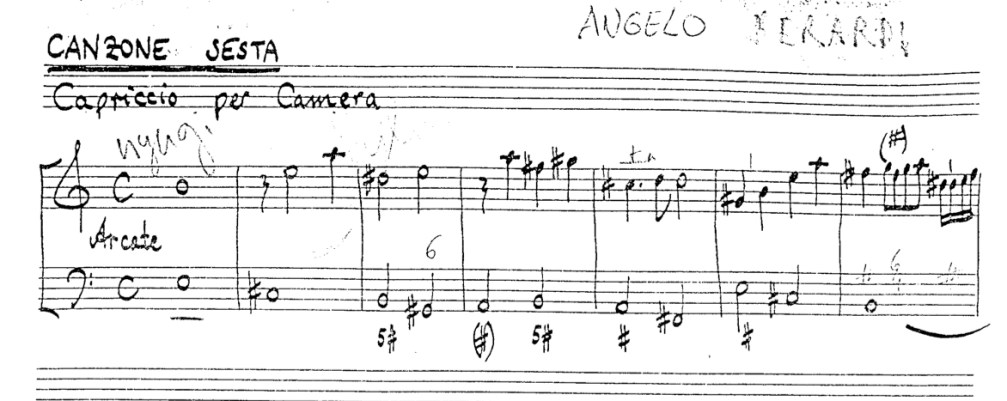
The composition that began and ended the set was a deconstruction of Angelo Beradi’s Canzone Sesta.

Canzone

In between the written statements we improvised. For the publishing information Josephine wrote down the title as “Perfida Replicata,” as that is Beradi’s marking for the final quick movement of the Canzone.

Last year at Moers I thrilled to watch Anthony Braxton play the contrabass saxophone, an instrument he more or less invented.

All recorder players have an arsenal of different sizes, but Josephine and Dodó both have a special interest in the contrabass recorder Paetzold. Dodó: “This instrument was developed by a German maker Herbert Paetzold in 1975, now it’s manufactured and distributed by Kunath.”

fullsizeoutput_ceefullsizeoutput_cf1fullsizeoutput_d15

Blues the Most

mahler

JALC and DTM have been working together on a few recent occasions.

Andre Guess wrote up the panel “A Conversation on Jazz & Race” that he hosted with Wynton Marsalis and myself for JazzTimes.  It’s really an excellent convo (if I do say so myself), although at one point I mention Mahler and both Andre and Wynton make fun of me. Fair enough, that will teach me to reference Mahler….!?

….except that I use Mahler again in the notes I supplied for the JALO plays Ornette Coleman. Well, I guess I think it works. Try imagining the opening oboe solo in “Der Abschied” as Ornette with Charlie Haden in “Lonely Woman” and see if you can’t understand what I might mean….

Official blurb:

May 18-19: The Jazz at Lincoln Center Orchestra with Wynton Marsalis celebrates one of jazz’s great original geniuses: composer, Pulitzer Prize winner, and alto saxophonist Ornette Coleman (1930–2015). 2017 Grammy Award-winning composer, arranger, saxophonist, and bandleader Ted Nash serves as music director for the evening, utilizing the Orchestra’s many colors to bring this music to life.

Iverson program notes:

Ornette Coleman’s magnificent melodies flew out of his plastic alto saxophone and changed the world. The contours were fresh and modernist, at times imbued with a frank lyricism reminiscent of European composers like Schubert or Mahler, yet always framed by deep blues ethos straight from the heart of Texas.

His early bands huddled around the blast furnace of his melodic genius and were inspired to create the rest of the orchestration. Almost by definition, tonight’s concert is not just about Ornette Coleman. It is about Don Cherry, Charlie Haden, Billy Higgins, Ed Blackwell, and the best of the rest of his invaluable collaborators.

Tonight’s concert is also inevitably about all those fellow jazz legends who went to see Ornette Coleman at the Five Spot in 1959 and 1960. Sonny Rollins, John Coltrane, Charles Mingus, and Miles Davis were all directly influenced by Ornette with Cherry, Haden, and Higgins. Was there any other time in jazz history when so many major artists reassessed their music based on a recent arrival?

The biggest influence on Ornette Coleman was unquestionably Charlie Parker. When a very young Wynton Marsalis first visited Stanley Crouch, Crouch played some Ornette on the stereo, and Marsalis thought it was Bird.

Ornette knew not just Bird but also all the other significant modern jazz musicians. In a 1960 Downbeat blindfold test with Leonard Feather, Ornette Coleman smoothly identifies Miles Davis with Bill Evans, Charles Mingus, and Johnny Hodges. That’s not surprising, but Ornette’s correct guesswork about Al Cohn with Zoot Sims and Bob Cooper with Bud Shank might surprise those still suspicious of Ornette’s jazz bonafides.

An interview with Gunther Schuller from the same era offers more conventional jazz wisdom. Ornette observes how a quarter note feels different when you pat your foot, a comment that suggests the dance floors of the big band era.

Bird, the big bands, and the blues: These are the obvious sources for the music of Ornette’s first era, the era of Ornette that remains most impossible to resist.

However, Ornette went on to explore wider horizons. In 1962, perhaps under the influence of Schuller’s Third Stream, a trio with David Izenzon and Charles Moffett assimilated modernist classical music, where Izenzon frequently used the bow for his bass and Ornette played noise violin. In 1966, perhaps to react against that kind of intellectual culture, Ornette brought in his 11-year son Denardo to enjoy naive rhythms not yet tamed by professional experience. The 1972 monument Science Fiction synthesized all that Ornette had done before but also added pop ballads (perhaps inspired by someone like Joni Mitchell) sung by Bombay chanteuse Asha Puthli. The next step was right in line with many other jazz musicians after Miles Davis’s Bitches Brew: In 1973 Ornette plugged in rock guitars and created an idiosyncratic response to fusion, Prime Time.

Ornette’s oeuvre is rounded out by a large scale symphonic work, Skies of America, various chamber pieces, and a significant soundtrack, Naked Lunch, co-composed with Howard Shore and revisited last year at Lincoln Center with Denardo Coleman, Henry Threadgill, and Ravi Coltrane.

In sum, Ted Nash has all sorts of options for arranging the music of Ornette Coleman. While Ornette’s bluesy and searing alto saxophone was an unchanging constant, the settings were fluid, and eventually Ornette addressed most of the genres of music easily accessible to 20th century Americans.

Americans have responded to Ornette’s wide-ranging vision by embracing him as a touchstone artist. Tonight’s concert is another exciting chapter of presenting new ways to explore his phenomenal contribution.
A Paragraph from Tom Wolfe

As a teenager I thumbed through my mother’s copy of From Bauhaus to Our House without understanding much of it. However, one paragraph naturally stood out. Looking at it again I am struck by the perhaps needless cruelty of the author. Still, the larger point hits home then and now.

For that matter, in most of the higher arts in America prestige was now determined by European-style clerisies. By the mid-1960s, painting was a truly advanced case. The Abstract Expressionists had held on as the ruling compound for about ten years, but then new theories, new compounds, new codes began succeeding one another in a berserk rush. Pop Art, Op Art, Minimalism, Hard Edge, Color Field, Earth Art, Conceptual Art — the natural bias of the compounds toward arcane and baffling went beyond all known limits. The spectacle was crazy, but young artists tended to believe – correctly – that it was impossible to achieve major status without joining in the game. In the field of serious music, the case was even more advanced; in fact, it was very nearly terminal. Within the university compounds, composers had become so ultra-Schoenbergian, so exquisitely abstract, that no one from the outside world any longer had the slightest interest in, much less comprehension of, what was going on. In the cities, not even that Gideon’s army known as “the concert-going public” could be drawn to an all-contemporary program. They took place only in university concert halls. Here on the campus the program begins with Scott Joplin’s “Maple Leaf Rag,” followed by one of Stockhausen’s early compositions, “Punkte,” then Babbitt’s Ensembles for Synthesizer, a little Easley Blackwood and Jean Barraqué for a change of pace, then the committed plunge into a random-note or, as they say, “stochastic” piece for piano, brass, Moog synthesizer, and computer by Iannis Xenakis. The program winds up with James P. Johnson’s “You’ve Gotta Be Modernistic.” Joplin and Johnson, of course, are as cozy and familiar as a lullaby, but they are essential to the program. The same thirty-five or forty souls, all of them faculty members and graduate students, make up the audience at every contemporary musical event. The unspeakable fear is that not even they will show up unless promised a piece of candy at the beginning and a piece of candy at the end. Joplin and Johnson are okay because both men were black and were not appreciated as serious composers in their own day.


UPDATE: Looked at Tyler Coates’s overview in Esquire, and was impressed by Coates’s concluding comment about The Painted Word: “…There’s something to be said for a writer willing to fall on his sword in order to get people talking about art.”