While unpacking and organizing today, I played prized new acquisitions. In the main they were James P. Johnson-related.
Hank Duncan. Hot Piano: A Tribute to James P. Johnson and Fats Waller. Duncan is a shadowy figure. He reminds me of Paul Lingle. When you hear Lingle or Duncan you say, “Who the hell is this and why aren’t they better known?”
This LP is cheap document, maybe a bootleg. Live performances at a small venue, perhaps a party; tubby piano; no information given. Duncan died in 1968, this LP is possibly posthumous.
The feel is perfect but his left hand is sloppy. For no respectable reason I think Duncan was a drinker, like Donald Lambert. Perhaps he’s got a bottle of booze on the piano, which doesn’t impair the swing but makes the left hand hand leaps a bit blurry, just like Lambert’s late recordings in Jersey. The most impressive tracks are on the slow side, like a seriously beautiful “Old Man Harlem.”
A bright, charming, and inaccurate “Carolina Shout” is either at wrong speed or is in G-flat (instead of G). No other tracks seem as nearly as off-key so maybe Duncan just likes the black notes.
Jim Turner: Old Fashioned Love: A Tribute to James P. Johnson. Turner is still around, like Mike Lipskin and Terry Waldo one of the remaining links to a once-glorious stride tradition. (Jim Turner website.) This recital is from 1981 and must be one of Turner’s first discs. Very impressive! His version of “Carolina Shout” is in B-flat (of all things) and sounds both respectful and a young turk who’s making this stuff his own.
The last track is “The Turner Shout” dedicated to Turner by his teacher, authentic jazz great Johnny Guarnieri. It’s a short charming rag that sounds like a real devil to play.
At least at this stage of his development, you can tell Turner is an academic whereas Duncan really lived it. However, that doesn’t invalidate Turner’s approach. Indeed, I am most happy to have this rare Euphonic Sounds LP.
Euphonic had one of the most esoteric catalogs of blues, boogies, and stride. Paul E. Affeldt died in 2004: who has the rights to his stuff? A box should really come out of the complete Euphonic.
Playing the Black and Whites: Dick Cary, Cliff Jackson, Art Hodes, and Nat Jaffe. Released 1989 in the early years of historical CD issues. Black and White was an independent 78 company who sold a few sides “during and after WWII” (according to the liner notes).
I got this CD to have Hodes’s astonishing rendition of “Snowy Morning Blues,” which I might vote as the best James P. Johnson cover yet.
Cary is known for a few key Louis Armstrong records and offers two mellow duos with George Wettling; Nat Jaffe is even more obscure but is virtuosic and pleasant enough in a guitar trio setting.
However, the other essential tracks on this compilation belong to Cliff Jackson. Somehow Jackson has mostly eluded me so far but the uptempo stride performances on “Limehouse Blues” and “Who?” are simply jaw-dropping. Giving Donald Lambert a run for his money! Unbelievable. I see “Limehouse” is on YouTube, with a fair number of similarly-astonished comments.
—
The classical LP awaiting my return was Harold Shapero’s Serenade in D for String Orchestra; Arthur Winograd conducting the Arthur Winograd String Orchestra. Completed in 1945, recorded in the 50’s, never digitally issued and now hard to find.
Much later Shapero slimmed the Serenade down for string quintet, a version that was recorded by the Lydian Quartet for one of the essential Shapero CDs.
My first impression is that little was changed in the argument when the piece was re-orchestrated. The chamber music version is charismatic but I just loved that full mid-century orchestral sound blasting out of a mid-century LP.
I haven’t yet gotten close to what some claim to be Shapero’s masterwork, Symphony for Classical Orchestra. As of now, I think the Serenade is better. A fabulous work.
These are the Bond covers I grew up with in the ’80s.
Because the movies dominate our culture, Ian Fleming’s original work can be underrated by those who care about other escapist espionage fiction. I’d argue that the books are essential to the canon; or at the least far stranger and more interesting than the movie franchise.
Like many American males, I recently thought it might be enjoyable to watch the Bond movies in order. I gave up because Thunderball and For Your Eyes Only were so bad as to be essentially unwatchable.
The most fun about that aborted project was relearning some of the early movie history I knew as a kid but had basically forgotten. Of course, broccoli is a designed vegetable – some kind of cross between kale and cabbage, just like cauliflower is – and Albert Broccoli was the younger son of the Broccoli family responsible for that vegetable’s invention. After Broccoli fell in love with the Fleming books, he decided to invest the family fortune. Broccoli acquired the rights to Doctor No, with the option to make the rest of the series, despite not knowing anything about moviemaking!
Amusingly, broccoli was a small factor in a few ways for the franchise in the beginning. Sean Connery was not a fan, and his rather “tough” attitude towards the complimentary bowl of raw broccoli outside of the casting room impressed director Guy Hamilton. And the famous opening gun barrel sequence? Albert Broccoli knew film designer Maurice Binder slightly as a boy, since Binder’s father was the first large-scale importer of broccoli into New York.
Yesterday I blogged about Skinner by Charlie Huston. In the very first chapter, Huston references Eric Ambler, which informs the reader that this is going to be a thriller with a political theme. It’s a nice touch.
I’ve now just finished the brand new All the Old Knives by Olen Steinhauer. Early on, a lead character is next to a woman reading Len Deighton on a plane. Steinhauer’s plot is not really that much like Deighton’s Berlin Game, but there are some related ideas including a romance/espionage partnership and a key airport crisis. Even chatting with someone on plane who gives up information is rather Deighton-ish. On the other hand, the last page is pure Le Carré.
Good work from Steinhauer. I’ve read the Tourist trilogy and found the characters more interesting than the Jason Bourne “badass assassin” playbook. With All the Old Knives there are no action heroes in sight, and the book is all the better for it. Highly recommended for espionage buffs.
I’ve just reread Skinner by Charlie Huston. It remains one of my favorite thrillers of recent years. Although the book ends up being a powerful warning about the current condition, along the way the reader enjoys varied vicarious thrills including much current technology: drone quadcopters, plastic guns manufactured by 3D printers, mobile robot surveillance spiders.
During an energy conference in Sweden, angry protesters confront something new on four wheels:
A new siren rises and fills the square, bounding off the faces of the tall buildings. A warning that something large and powerful is coming. At the far end of the square the police line splits open and a towering blue and high-viz truck, unholy product of a mating between a double-decker bus and a fully armored Humvee, rolls through, two water cannons above a high cab, windows covered by steel screens, a broad cow catcher mounted up front.
While I don’t see Carat’s armored water cannons on there yet, Alpine Armoring and IAG have you covered.
—
When flight MH17 was shot down over Ukraine, one of the logical questions was, “What was the gear?” Investigators decided it was a Buk SA-11 missile.
On YouTube there was already a rockin’ video of the missile system in action. It’s not totally clear to me if this video is an ad created by the company or simply the work of a rabid fan. At any rate the manufacturer is easy enough to find: Almaz – Antey, who have the slogan, “High Technologies Safeguarding Peaceful Skies.”
After MH17, I’m sure the military leaders of every country watched the YouTube video and picked up the phone to call Almaz – Antey. High-tech armament is notoriously fussy and unreliable, but now there was proof that the Buk SA-11 was a solid investment.
—
CNN anchor Rosemary Church was first criticized then fired for suggesting the use of water cannons in Ferguson. But what was used eventually seemed even more devastating. Questions were asked everywhere about the high-tech military gear. Where the heck did all that stuff even come from, anyway?
The answer was Homeland Security grants and the Defense Department’s 1033 program. Even if you are a just a small-time small town police chief, don’t worry, you can still afford to arm your team with shock and awe.
I’ve spent some time reading about Bozeman’s debate about their new BearCat. They are keeping it, unfortunately: Apparently the tearful pleas from the cop’s wives at the town hall meeting sealed the deal.
Before the vote went down, Blake Maxwell at the Bozeman Magpie offered some clear-eyed commentary on what this kind of machine means for communities. I particularly admire Maxwell’s lead paragraph about the word “rescue.” (That word is painted on the side of Bozeman’s BearCat above. Photo stolen from Bozeman Daily Chronicle.)
The prevalent usage of rescue in the media now is lipstick on a warhorse, just 11th-hour spin, and the city manager’s unflagging repetition of it has become an insult to our intelligence. The BearCat has a turret and at least 10 different “gun ports.” This vehicle wasn’t designed for handing out medical supplies or basic human necessities; it was built for killing.
At the masterclass with Ron Carter yesterday in Hartford, I mentioned the Sviatoslav Richter centennial, saying something the effect that Richter may have been the greatest 20th-century classical pianist. Ron interrupted me right away: "Yeah, but don't forget Walter Gieseking."
Fair enough. There are lots of wonderful classical pianists. Comparing them is usually pointless. I respect anybody who is genuinely competent in that esoteric profession.
—
Still, something about Richter sticks out. After Ron's interjection, I've been mulling over why I think Richter is so great.
My conclusion is rather obvious: Richter was of his time. He was 20th-century. He was an unrepentant modernist.
Everything that Richter played was informed by world war, by atonality, by Freud, by airplane travel, by recorded sound. The horrors and delights of his era were always present.
—
The vast Richter discography is complicated further by multiple versions of key pieces. One would need an extra lifetime to study the complete Richter on CD.
Off the top of my head, a selection of personal favorites:
—
Bach. From WTC II, the A minor prelude and fugue from the Phillips studio set. The prelude is somber (his teacher Heinrich Neuhaus suggested that especially chromatic Bach be played "without tone"), the crucifixion fugue strikes like a bolt of lightning.
Handel. Richter mentored several young musicians. When he got interested in the young and brilliant Andrei Gavrilov, Richter had them alternate on Handel suites. Nobody plays these suites on piano much – harpsichordists have a better chance – but hearing them as tag-team performance art makes them more accessible. On video, Richter starts the familiar "Harmonious Blacksmith" with the loudest, ugliest, longest low E imaginable. Before continuing, he stares at Gavrilov, who looks around the room in an unconcerned or even dour fashion. Russian modernist art, via Handel.
Mozart. Nope. Hard to "take over" Mozart. He doesn't fight back, so you've got to enter that space with grace. Surely there's a decent Richter Mozart track somewhere, though.
Haydn. The G minor sonata, Hob.XVI:44, is rendered with existential sadness. (Early 60s DG.)
Beethoven. A key composer for Richter. It's all great. My offhand selection is a less-familiar sonata, the two-movement Op. 54 in F major on EMI. The opening minuet has gleaming sonority and ornamentation. Perhaps the octave outbursts are almost too loud, but that's Richter for you. The answering toccata goes like the wind. A perfect work and perfect for Richter.
Since Ludvig was so important to Slava, I'll offer one more: the live Diabelli Variations on Phillips, rather late, I think 1980's. Even the out-of-tune piano seems to play a part in declaiming a passionate message. This was my first Richter record and my first Diabelli; frankly I find almost everyone else pretty boring.
Weber. I believe Horowitz was the one who started the fashion of looking for classical-era pieces by Clementi and other minor composers. Not to be outdone, Emil Gilels played some Clementi better than Horowitz and also added Weber's second sonata. Richter's retaliated by unearthing the Weber third. It's a powerful enough work, especially under Richter's strong hands. The point is clear: If we listen to Mozart, Haydn and Beethoven, we should listen to Clementi, Weber, Dussek, Hummel, and Czerny as well.
Schubert. Richter may still be somewhat controversial in long sonatas where he takes unusually slow tempos. I understand the objection; frankly I'd usually rather relax with Clifford Curzon or Wilhelm Kempff myself. On the studio recording of the intimate Allegretto in C minor D915, Richter's speed is more "Largo" than "Allegretto" but the emotion is starkly compelling. I'm not so sure of Schubert's awkward counterpoint in the brief canonic section, but if you can hear it "à la Shostakovich" that certainly helps!
Chopin. Richter played lots of Chopin but for me it can be like his Mozart, either too brutal or too straight. In the centennial celebrations I have seen several mentions of his performances of Chopin Ballades. This surprises me, I will have to go back and re-listen.
My Richter Chopin selection is an obvious one: On the essential documentary Richter the Enigma the only complete performances are of Chopin études. The earlier performance of the C sharp minor Op. 10 is white heat. Chopin would have been astonished to hear the 20th century in action with all of its brutal power. The later era étude is the "Winter Wind" in A minor. Here we can see the ultimate professional: An old man who has played thousands of recitals casually sits down and delivers this classic fingerbuster.
Schumann. One of the great LPs in my collection is the recital of César Franck and Robert Schumann on Monitor. I believe Schumann's Humoreske was barely played until Richter discovered it for modern audiences. You want to talk about your modernist pieces! The Humoreske doesn't make sense unless you have a grotesque, occasionally almost military aesthetic. The rhythms are also exceedingly complex and a technical challenges formidable. Richter solves all interpretive issues.
Brahms. The pianist didn't like his recording of the Second Piano Concerto with Leinsdorf in Boston. It's true that there are some really notable finger slips. However, like so many others, I am bowled over by the recording's raw passion. The first two moments are especially marvelous.
Liszt. The Liszt selection is obvious, the étude "Feux Follets" from at the legendary Sofia recital from 1958. It's not just the speed, it's the sonority which is so magical.
Franck. From the Monitor LP mentioned earlier, Prelude, Chorale and Fugue is the dead intersection between German and French music. There's a whiff of the sentimental and the falsely religious about this work, something like Busoni's plumped up transcriptions of Bach. However I never have a problem with this aesthetic if a truly great pianist is in residence. I can't imagine anyone playing this work better than Slava does here.
Debussy. Again for me an obvious choice: Estampes, the live recording from early 60s on DG. Somehow the piano sounds just like the gamelan Debussy was inspired by.
Hindemith. Apparently the composer himself didn't think much of his Suite 1922. I don't know why: For me, it's his best piano piece. I admit I am probably influenced by Richter's phenomenal recording from late in life. He beats the piano into submission but in this context that is perfectly okay.
Tchaikovsky. Mussorgsky. Scriabin. Prokofiev. Shostakovich. Stravinsky. Rachmaninoff. Richter's performances of composers from his homeland have special merit.
Tchaikovsky's solo piano music is frequently trivial; however, the Grand Sonata in G becomes a major work in Richter's hands.
Mussorgsky's Pictures of An Exhibition from the 1958 Sofia recital is Richter 101, frequently showing up on lists of "the best piano records ever made."
I don't know Slava's many famous Scriabin recordings as well as I should. These days when I listen to Scriabin, I'm probably listening to Sofroninsky. One hopes that the familiar anecdote is true: When the pianists met, Sofroninsky greeted the other, "Genius!" to which Richter shot back, "God!"
Richter knew both Shostakovich and Prokofiev and his biography is often focused on those associations.
While not so familiar with either of these composers nor Richter's contribution to their discographies, I am impressed with the Shostakovich Piano Quintet which shows Richter's sublime abilities as a chamber musician. The insane brilliance of the Prokofiev Second Sonata is also inarguable.
Prokofiev 2 was composed just before Richter was born. Its mechanized ironies are totally of the 20th century, and was totally understood by the pianist when he learned it a couple of decades later. This aesthetic was Richter's birthright.
As significant as Shostakovich and Prokofiev are as composers, something else may have been even more important to the young Slava than the music itself: Actually working with great composers, seeing how they made new music that related intimately to current events. Richter somehow took that attitude along when exploring the whole history of piano repertoire, making everything he touched modern, exciting, and sad.
Richter didn't record much Stravinsky. The most intriguing item is the piano concerto Movements. This is arguably Stravinsky's most recondite piece, and it shows just how curious Richter was about everything that he gave this unfriendly beast a try.
I want to conclude on an up note, so let's end with Rachmaninoff.
In general Richter was an ideal Rachmaninoff interpreter. It would be hard to make a list of recommended Rachmaninoff recordings without Richter in there somewhere.
Was Rachmaninoff a truly great composer? I'm not sure; many others wonder this question as well. But perhaps because Rach always isn't the very best music, there is extra room for re-creative genius to take over and deliver a melding of composer and interpreter.
The collection of Preludes and Etudes-Tableux on Olympia from 1971 and 1983 is essential for any piano library. Four tracks come to mind right away: The heraldic B-flat major, the proto-Prokofiev F sharp minor, the Tolstoy carriage of B minor, and the Etude 7 in C minor, the one that unleashes a great torrent of bells near the end. The bells seem joyous at first, but then it becomes clear that happiness will be denied. The bells mark the passage of time, and mourn both the loss of old Russia and the birth of the 20th century.
Donna Lewis, major pop star and singer/songwriter, has released Brand New Day with Reid, Dave and me. It’s produced by David Torn, who also wrote the arrangements, which is why we aren’t calling ourselves TBP for this one — it can’t really be TBP if I’m playing someone else’s piano parts, as cool as Torn’s are!
Donna and David were a dream to work with, and the resulting album is also dreamy to listen to. I brought it over to some friends for a listen and they went crazy for it. I suspect it will do very well indeed. If you are a collector of all things Iversonian, this is your chance to hear me as a pop pianist. I’m not gonna join Rick Wakeman or Mike Garson on a list of major figures, but I admit it’s got an interesting feel.
I always count my blessings to be associated with Reid Anderson and David King, and they really sound great on this record, too. Wow. A deep pocket.
Thanks Donna for giving us this opportunity! See you at the Grammys or something.
(EI: If my essay about Whiplashis the prosecution, this is the defense. Very special thanks to Mark Stryker.)
—
Wow, Buddy Rich. Complicated. To do him justice would demand a sprawling essay that would wind its way through jazz, celebrity, race, the sweep of 20th Century popular culture, child prodigies and child stars, the swing era, cultism, post-war big bands, jazz education, musical virtuosity, professionalism, craft and art and psychological analysis. What I offer here are just a few reflections.
What a life: Buddy was literally born into show business, joining his parents’ vaudeville act before the age of 2; he’d cap the show with a snare drum solo. By age 4 he was being billed as “Traps, the Drum Wonder.” Buddy eventually became the second highest paid child star of his era after Jackie Coogan (who most folks today only know as Uncle Fester on The Addams Family). Buddy worked briefly with Artie Shaw but became a household name with Tommy Dorsey from 1939-42 and ’45-46. (In between he was in the Marines.) He appeared in films and recorded with Prez, Bud, Bird and Jazz at the Philharmonic. Count Basie, with whom he also worked and recorded, was one of his closest friends, a father figure. Sammy Davis Jr. was another close friend. So was Sinatra – well, when Frank and Buddy weren’t trying to kill each other. Buddy was a product of show business, a product of jazz, a product of big bands and a product of an age when there was a lot of overlap between them all and the borders were porous. Buddy could really tap dance, really sing and, oh yeah, he played a little drums.
I think it’s important to remember that “Buddy Rich” and “The Cult of Buddy Rich” are different things, and it’s not fair to blame the former for the latter, even if the latter couldn’t exist without the former. I hate the cult. It grew up around Buddy because his charisma was undeniable, because his chops were truly spellbinding, because your average American (and rock drummer) has always mistaken virtuoso instrumental technique for artistry and expression, because Buddy was a media animal, and because he was a white star who came with the imprimatur of his black colleagues. Buddy was always on TV – Carson, Merv, Mike Douglas, guest spots on the Muppets, the Lucy show, etc. He was seriously funny, with great comic timing that surely came from studying all those comedians in vaudeville. He even co-starred with George Carlin and Buddy Greco in a summer replacement TV show in 1967. But he also didn’t have sustained success as a leader of his own band until launching the 20-year final act of his career in 1966. He was 48. Think about that for a minute: 48. That’s late to fulfill your ultimate destiny when you’ve already been in the business for 46 years. Nothing was given to Buddy Rich; he earned everything, and he lived as if it could all go away tomorrow, because he had gone through enough false starts and failed ventures to know that it could.
Buddy was an incredibly gifted and natural musician. He did what he did better than anyone, though I’d be the first to admit that what he did is not something I need a lot of in my life – or maybe any at all. Power, speed, precision, intensity, excitement, grandstanding, bombast. They’re all indivisible with Buddy. But there’s more to it than that. There’s swing and groove and personality (for better or worse) and a pocket – not a bebop pocket, not a relaxed pocket, not a Basie pocket, not a Mel Lewis pocket. It’s a Buddy Rich pocket. Right on the damn beat and as consistent as an atomic clock. Don’t dig it? That’s cool. Buddy doesn’t give a shit what you think. Taste and patience? Well, those lines were kinda long when Buddy came around so, to paraphrase sportswriter Frank Deford on Bob Knight, Buddy went back to take extras on bile and ego. But Buddy had high standards and expected nothing from anyone else that he didn’t demand from himself. Respect.
Buddy’s early playing grew out of Jo Jones, Sid Catlett and Chick Webb, and he once said that he learned how to play brushes by seeing O’Neil Spencer with the John Kirby Sextet. Buddy admired Gene Krupa for elevating the profile of drummers, and surely some of Krupa’s showmanship rubbed off – though it’s worth remembering that Buddy was already a showman before he was out of diapers. “I was quite clear about what my job was by the time I went with Shaw,” he once told Burt Korall. “I knew I had to embellish each arrangement, tie it together, keep the time thing going, and inspire the players to be better. My way was to keep the energy level up and push hard. This concept was strictly from Harlem. I learned from black drummers like Chick Webb, Jo Jones and Sid Catlett. In those days, the only reason you were hired was to keep the band together. It was up to you to swing the band, add impetus and drive. And it certainly helped if you had a feeling for what the arranger wanted. The function of the drummer was to play for the band, and if you were good enough, you’d be noticed.”
Buddy never lost his swing era roots, but he heard Max Roach and his contemporaries and modernized his cymbal beat and left-hand accents along the way. By the ‘70s he was playing his own brand of rock and funk convincingly. Has any drummer in jazz traveled so far, from “Hawaiian War Chant” to “Birdland”? Of course, the 1950 studio session with Bird, Dizzy and Monk is not his finest hour. What was Norman Granz thinking?! But Buddy was still trying to figure it out. Maybe it would have been better a decade later. Probably not. But I tell you what: He plays beautifully on those mid ‘40s sides with Lester Young and Nat Cole: sparkling and subtle brush work, playing for the group and not himself – just one of the cats.
I hear a lot of shuffling parade drumming in Buddy’s playing: The rudiments recombined at supersonic speed. Know who else made magic with rudiments? Philly Joe Jones – who loved Buddy (and vice versa). Speaking to Down Beat in 1976, Philly Joe said: “My favorite drummers are – and always have been – Max Roach, Art Blakey, Kenny Clarke, Buddy Rich. I always get looked at funny when I mention Buddy Rich. Shit! If any drummer looks another way when Bernard is doing his thing, he’s not only crazy but I’ll bet you’ll never hear his name get any size in music. Max don’t want to play like Buddy and I’m sure it’s the same with Art, Kenny and the others; but, really, who do you know can upstage Buddy Rich? Or get the same ovation from the audience? If you listen and watch Buddy and have hands and mind, you’ll cop something.”
Buddy drove a big band the way Sandra Bullock drove that bus in Speed, except Buddy goes faster – 100 miles an hour and in complete control, setting up figures, filling in the gaps, zooming around the drum set, having a ball just being Buddy Rich, because being Buddy Rich WAS a fucking ball. He could purr rather than roar when he wanted. He could keep his ego in check when he wanted, especially when working with his elders or distinguished contemporaries. But, shit, it was just so much more fun being Buddy Rich. It was also a big responsibility. After all, his name was on the marquee, just like it was when he was 4.
For me the best of Buddy’s own records are the early World Pacific LPs from 1966-68: Swingin’ New Big Band, Big Swing Face, The New One and perhaps Mercy, Mercy (mostly for Art Pepper’s gripping alto ballad feature, “Alfie,” and some high-energy tenor solos from Don Menza). While there were certainly young players on those bands (Ernie Watts, Chuck Findley) there were also midcareer pros with real big band experience like the very musical tenor saxophone soloist Jay Corre, alto saxophonist Gene Quill, pianist Ray Starling and others. Even a guy like trumpeter Bobby Shew, who was just 25 when he joined the first band, had already been around the block. The result is that those bands phrase, blend and swing with a naturalism and shaded dynamics that Buddy’s later bands, stocked mostly with kids just out of college jazz programs, never do. Most of Buddy’s post-1970 recordings give me the willies – the beat is too thin, the band too loud, the electric bass too dorky, the time feel too driven. The ensemble too often sounds like a halftime marching band playing “jazz.” Many Buddy enthusiasts will protest and point to the 1976-78 band that Buddy dubbed his “Killer Force” after a Hollywood shoot ‘em up starring Peter Fonda and Telly Savalas. Some fine players came through the ranks, among them Steve Marcus (the tenor saxophonist who stayed on the band for 12 years as its major soloist and straw boss, until Buddy’s death), Bob Mintzer, Barry Keiner, Dave Stahl, John Marshall and Jon Burr. Buddy himself said it was his best band. I’m not convinced. I do like parts of the 1977 LP Buddy Rich Plays and Plays and Plays (RCA) – nuclear energy, inventive Mintzer charts, good solos and a real unity of spirit – but the vibe for me is still too much jazz-as-athletic-competition.
Buddy’s own playing was more nuanced and tasteful in the early days of his band. The initial book came from the pens of Bill Holman, Bill Potts, Bill Reddie, Oliver Nelson, Phil Wilson, Bob Florence, Shorty Rogers, Don Sebesky and others. Yeah, the book doesn’t come close to Thad Jones (or Gerald Wilson), and many of those writing for Rich would do their best work in other contexts. But Buddy is such an animating spirit that he elevates the less inspired charts, and the good ones take off like rockets. The material is an interesting mix of originals, standards, flag wavers, virtuoso drum concertos (“West Side Story,” “Channel One Suite”) and covers of au courant pop tunes (“Norwegian Wood,” “Wack Wack,” “Uptight”) that attracted a younger audience without alienating the parents who remembered Buddy from the Dorsey days. This was not an easy tightrope to walk while carrying a 16-man payroll. Buddy saw it as a necessity to keep the band on the road and recording, and he pulled it off with panache and integrity. Respect.
The band at its best? Try the Basie-oriented “Basically Blues” (Wilson). Dig how Buddy guides the ensemble, swinging easy, setting up the brass perfectly and building to an honest climax in the shout. There’s real depth here. A lot of people forget that Buddy could play like this.
“Love for Sale,” arranged by Pete Meyers, who I don’t know anything about, but this is a rollicking chart. The band is tearing it up, and the thrilling speed-of-light snare drum break that Buddy unleashes at 3:53 is from another planet. I’ve heard it a zillion times and it still makes the hair on the back of my neck stand up. Every time. Elvin and Trane make the hair stand up on the back of my neck too, for completely different and more profound reasons. But how much in life honestly makes the hair stand on the back of your neck for ANY reason? So when it happens, you gotta celebrate. Fuck yeah!
“Love for Sale” stayed in the book for the next 20 years, and it’s interesting to compare the original 1967 recording with the many later versions on YouTube. The tempo is always brighter in subsequent performances, and the bands invariably sound on edge and nervous. Is it the electric bass? The young players in the band? Buddy pushing and overcompensating because he subconsciously knows that the cats aren’t really swinging? All of the above? I don’t know. But it ain’t the same.
“Big Swing Face” (Potts). The blues in F. Nothing complicated but a really well-structured arrangement with a compelling narrative arc. Ernie Watts plays his ass off, the saxophone section soli is a beaut, the band plays with expressive dynamics and Buddy’s balance of suppleness and strength is rewarding in a way that his later work rarely is. No, it’s not Mel. Yeah, I like Mel better too. There’s NOBODY like Mel. But there’s nobody like Buddy either, and Mel would tell you that too.
“Big Swing Face” – the chart and the 1967 LP – holds a special place in my personal journey into jazz. It was the first jazz record I ever owned. (Kind of Blue was second.) I was 10 years old when my older brother played saxophone in the high school jazz band, and I can still remember hearing them play this chart in concert. The way the brass instruments and saxophones flashed under the lights, the volume of the band, the drums, the fun everybody seemed to be having and the irresistible “lift” of swing all made a huge impression on me. More than anything else, that experience and Buddy’s record compelled me to want to play the saxophone and jazz. So if I have a soft spot for Buddy Rich, well, there’s history there. Still, every time I go back to those early World Pacific LPs, they sound as good as ever to me, and I trust my ears enough to know it’s not just “first kiss” nostalgia. I got hip pretty quick, and by the time I was in high school I was telling my friends that Philly Joe, Elvin and Art were hipper than Buddy. Now that I’m older I understand that hipness isn’t everything. Buddy Rich is nothing but Buddy Rich. That’s enough for one man. There’s only one of those – thank God! You don’t have to love him, and only a sycophant or a fool would love him unconditionally. I certainly don’t, but I love how Big Swing Face makes me feel. Respect.
Coda:
There’s a lot of video of Buddy and those who are interested can dive down the rabbit hole. I do want to point out some interesting odds and ends and things I tripped over while mulling this piece.
A movie short of Buddy of doing his vaudeville act was filmed in 1929. He’s either 11 or 12 here. While the video has apparently not survived the audio has. Here are two tastes:
Sinatra may not have had to worry about vocal competition from Buddy, and his pitch is, um, slippery. But, still, this is game.
A little hoofing: Buddy tap dancing with Louis DaPron, 1948
The sound isn’t great on this clip from the Merv Griffin show in 1967, but I love how clueless Merv is concerning the title of Herbie Phillips’ “A Little Trane.” The chart starts with an “Equinox” vibe and later quotes “Pursuance.” The vintage graphics during Buddy’s solo at 4:27 have a “Spinal Tap” quality.
Buddy broke up his big band in 1974 and organized a small group that was in residence frequently at a club he opened in Manhattan called “Buddy’s Place.” He recorded an LP for the Groove Merchant label called Very Live at Buddy’s Place with – wait for it – Sonny Fortune on alto and flute, Sal Nistico on tenor, Kenny Barron or Mike Abene on piano & electric piano, Jack Wilkins on guitar, a very young Anthony Jackson on electric bass and Jimmy Maeulen on percussion. It’s a great blindfold test (especially Herbie’s “Chameleon” and the Latin-rock tune “Sierra Lonely”). It’s a pretty looney record – sometimes exhilarating, sometimes bizarre, sometimes both at once. The cover is a hoot: everybody in matching uniforms – white Pierre Cardin leisure suits with yellow turtle necks, except for Buddy, who wears a dark suit. Something weird happens on “Nica’s Dream.” They don’t play the bridge during the opening melody chorus, and after the head there’s a splice at the start of Fortune’s solo that cuts a chorus in half. He plays a 16-bar A, then what sounds like an 8-bar bridge, before the form gets back to normal. I think there may be a second splice that accounts for the truncated form, but it’s hard to tell exactly. “Billie’s Bounce” is trio with Barron leading the way. He double times like crazy, plays some McCoy-like fourths AND some barrelhouse blues. I hope I get a chance one day to ask Barron about working with Buddy and this track in particular. The tempo drops considerably. This must be the only example on record where Buddy slows down (or allows the band to slow down). I’d be surprised if he actually heard this track or approved it before it was released. Here’s a youtube playlist for the whole LP.
Somebody captured on tape about an hour of Buddy’s stage announcements while he was playing his club in ’74. It’s a great window into the era and the World of Buddy Rich – his humor, stage presence, celebrity. He announces the band, points out the guests in the room – Alan King, John Newcombe (the tennis star), Joni Mitchell, among them – previews coming attractions (including trying to sign Miles for the club, which leads to a fascinating anecdote), and basically just raps to the people. Best of all is a moment a little less than halfway through the tape when Redd Foxx and Scatman Crothers – Buddy was friends with both – come up on stage to sing and jive around.
Finally, I assume that anyone reading this has already heard Buddy’s legendary tirades screaming at the band on the bus. But if you’ve somehow missed this jazz rite of passage, here it is:
I mentioned Bob Knight earlier, so here’s an interesting companion recording: Knight chewing out his Indiana team during the 1990-91 season. Both Buddy and Knight used fear as a motivational tactic – Old School.
Did you know that Buddy’s tirades were especially popular among comedians? Jerry Seinfeld explains, noting that three of Buddy’s lines made into Seinfeld.
—
Mark Stryker has been an arts reporter and critic at the Detroit Free Press since 1995 covering classical music, jazz and the visual arts. He is close to completing his book on modern and contemporary jazz musicians from Detroit for the University of Michigan Press.
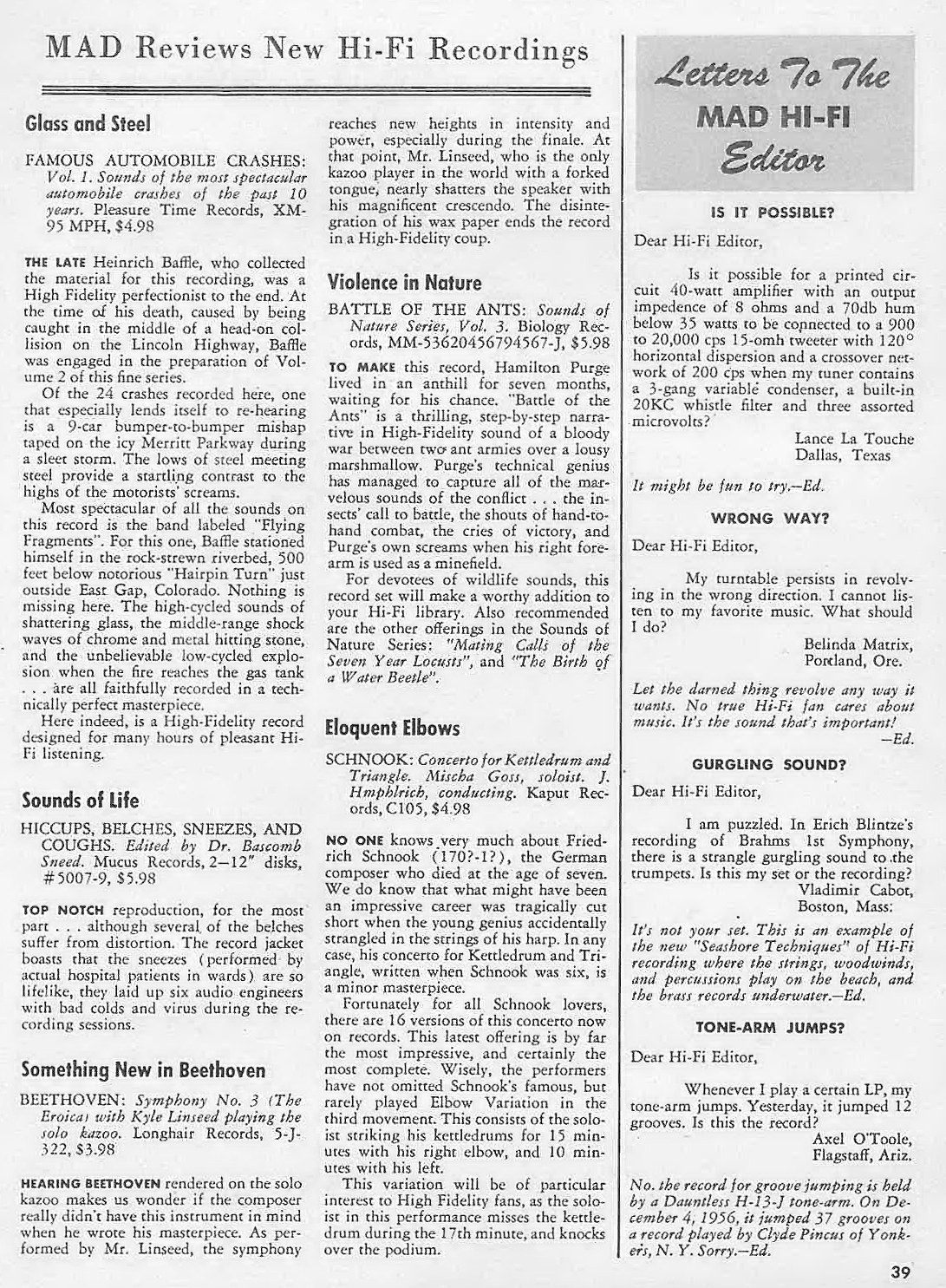
I haven’t thought of that marvelous 1958 Mad Magazine spread on Hi-Fi in decades, but it came up in conversation recently and I just found it at this forum. These days I’m most impressed by the last page, record reviews and letters to the editor.
Selma is wonderful! Highly recommended. I saw it yesterday at BAM with a packed house. So, so good. Kudos to my man Jason Moran for the score; however the real revelation for this viewer was David Oyelowo as Dr. King. Tom Wilkinson as LBJ was terrific too. When Oyelowo and Wilkinson were onscreen together it was simply electric. Now I need to catch up with the other work of director Ava DuVernay.
—
Recent reading includes two books especially relevant to MLK day:
Carl Van Vechten was multi-talented and prolific novelist, partier, photographer, and critic. He turns up everywhere when considering New York City in the 20’s and 30’s. Emily Bernard has focused on the most controversial part of his legacy in Carl Van Vechten and the Harlem Renaissance: A Portrait in Black and White.
The blurb from Elizabeth Alexander on the back of the book couldn’t be better:
An intrepid scholar, Bernard dives right into the waters of racial misunderstanding, political incorrectness, and unfettered love that drove Van Vechten’s career. This is a passionate, dead-serious exploration of and meditation on nothing less than negrophilia and its cultural yield.
I knew Bernard previously thanks to her superb essay “Teaching the N-Word,” where she mentions frequently using Van Vechten’s 1926 novel N–r Heaven in class. In A Portrait in Black and White Bernard has the opportunity to unpack N–r Heaven and its perennially provocative title in detail. It is simply a fascinating analysis.
Besides Van Vechten, I learned a lot more about James Weldon Johnson, Langston Hughes, Countee Cullen, and many other major figures of the Renaissance. I can fake my way through a discussion of black jazz of this era but I still have a lot of homework to do about fiction, poetry, and the visual arts. Thanks to Bernard I’m more intrigued than ever.
Ed Berger does jazz history a special service by getting to know his heroes while working on biographies that end up being unusually definitive. I was impressed by Berger’s big book on Benny Carter; now we have Softly, with Feeling: Joe Wilder and the Breaking of Barriers in American Music. Berger showed a final copy to the trumpet player shortly he died last year.
Wilder was a superb musician, someone of whom the phrase “could play anything” almost sells the matter short. Interestingly, in the book Wilder himself says that he was a more natural classical musician first, that playing jazz was more of an acquired study.
This is rare admission to make. Herbie Hancock told me the same thing in conversation once, but I didn’t really believe him, as Hancock has done so much with so many forms of black dance music in a manner that seems as natural as breathing. In Wilder’s case, this claim scans as more likely, at least in sense that his hard-to-find classical recital on Golden Crest is simple and perfect, not to mention that he spent his whole life in the studios, on society gigs, in Broadway pits, and even doing the occasional orchestral performance. (Apparently the exposed trumpet part in Petrushka was a Wilder specialty.)
It is easy to regret that there is not enough Wilder in free-wheeling jazz blowing sessions. Berger highlights the 1956 quartet date with Hank Jones, Wendell Marshall and Kenny Clarke Wilder ‘n Wilder, especially a long and groovy “Cherokee” with impeccable taste, charming melodic invention, and sovereign chops.
But Berger also makes it crystal clear that playing jazz was just part of Wilder’s story. Breaking of Barriers in American Music lives up to its title as Wilder helps integrate the Armed Forces, Broadway, staff orchestras, and symphonic orchestras. I was especially impressed with Berger’s research in the long chapter “A Dream Realized: Return to Classical Music (1964-1974),” much of which concerns Wilder only indirectly.
Lewis, a brilliant man, is really on to something.
In developing a hermeneutics of improvisative music, the study of two major American postwar real-time traditions is key. These traditions are exemplified by the two towering figures of 1950s American experimental musics–Charlie “Bird” Parker and John Cage. The work of these two crucially important music-makers has had important implications not only within their respective traditions but intertraditionally as well. The compositions of both artists are widely influential, but I would submit that it is their real-time work that has had the widest impact upon world musical culture. The musics made by these two artists, and by their successors, may be seen as exemplifying two very different conceptions of real-time music-making. These differences encompass not only music but areas once thought of as “extra-musical,” including race and ethnicity, class, and social and political philosophy.
Lewis than goes on to bash Cage for not appreciating jazz. This lovely bit is really the heart of the matter:
John Cage’s critique of jazz-well presented in his 1966 interview with the jazz critic Michael Zwerin-is of relatively little value as music criticism but may serve us well here as a textbook example of the power relationships that Fiske has recognized. In response to Zwerin’s query about his thoughts on jazz, Cage replies, “I don’t think about jazz, but I love to talk, so by all means, come on up” (Zwerin 1991,161).
To this African-American observer, situated in the 1990s, the interview should perhaps have ended there. From a 1960s perspective, however, we are in the presence of power, as two white males prepare to discuss “the trouble with black people” without, in the declining days of American high media apartheid, having to worry about a response. Even on a subject to which he freely admitted his lack of attention, Cage’s opinion was apparently deemed sufficiently authoritative, by the structures of media power that decide such things, for the interview to continue and, finally, to be published and reprinted.
I have two problems with Lewis’s essay. The first is the same that I have with his essential book A Power Stronger than Itself: The A.A.C.M. and American Experimental Music: a strange lack of discussion about rhythm. To me, all the true virtuosos of jazz (or Afrological or BAM or anything else you prefer to call it) are virtuosos of rhythm almost before they are virtuosos of anything else. At the very least, when separating jazz and classical players at an audition where they have to play both musics, inevitably the jazz cats will be able to play the notes of whatever classical piece (as long as it’s not too hard) but the classical cats won’t be able to play any uncomplicated jazz with the right kind of beat.
George Lewis can swing on his trombone. I’ve heard him do it! So I don’t know why he avoids the words “rhythm” or “swing” in his eight paragraphs about Bird and bebop. With all due respect, surely the Langston Hughes origin story about bebop, that it comes from
…The police beating Negroes’ heads . . . that old club says, ‘BOP! BOP! . . . BE-BOP! . . . That’s where Be-Bop came from, beaten right out of some Negro’s head into them horns.
is simply less accurate than that those accents come from ancient, exceedingly complex and intellectual Afro-Cuban drums.
But maybe Lewis is acting like some of his elders, not telling the truth about how the music gets made to protect the secrets from getting out. (I understand that discretionary attitude, although of course I wage postmodern warfare on it weekly from my outpost here at DTM.)
The other thing that bothers me about Lewis’s essay is the general conceit of comparing Charlie Parker to John Cage. I respect Cage, of course, but the idea of putting him next to Bird is simply ridiculous. Bird is so much greater. Cage isn’t even fit to shine Bird’s shoes.
Still, it’s good — especially on MLK day — to have Lewis remind me that this opinion may not be so obvious in all circles, even in spheres usually considered to be moderately informed about music.
—
On a lighter note, my wife Sarah Deming dug up the retro local access madness of Star and Buc Wild, the “Universal Playerhaters,” which she called “the best TV show ever.”
Six parts from 1999 are on YouTube. It’s totally genius. My man is quiet Buc Wild, who says little (he’s usually eating) yet somehow complements every moment perfectly. Big ups also to the tasty set. Part 4 is a good entry point, although all the clip contain comedy gold. (NSFW?)





 DO THE M@TH