Royal

THE DUKE

Duke Ellington wrote a wonderful set of themes for Elizabeth II, The Queen’s Suite. Kevin Whitehead tells the story:

In 1958, at an arts festival in Yorkshire, Duke Ellington was presented to Queen Elizabeth II. They tied up the reception line for a few minutes, exchanging royal pleasantries; our Duke politely flirted with Her Majesty. Soon afterward, maybe that very night, Ellington outlined the movements of The Queen’s Suite. He recorded it with his orchestra the following year, sent it to Her Majesty, and declined to release it to the public in his lifetime.

Posterity has judged “The Single Petal of a Rose” as one of Ellington’s finest pieces for solo piano, and is frequently played by classical pianists in transcription.

The news of the Queen’s death is wall-to-wall on every channel. A friend from England wrote me this morning, saying, “We have mentally checked out as of yesterday…many events are are being postponed….It’s staggering.”

J.K. Rowling’s stories concerning fantasy and royal bloodline have given untold pleasure to untold millions. In a viral tweet yesterday, the author explained:

Some may find the outpouring of British shock and grief at this moment quaint or odd, but millions felt affection and respect for the woman who uncomplainingly filled her constitutional role for seventy years…Most British people have never known another monarch, so she’s been a thread winding through all our lives. She did her duty by the country right up until her dying hours, and became an enduring, positive symbol of Britain all over the world. She’s earned her rest. #TheQueen

Naturally, anyone with any depth at all knows that a phrase like “The English Monarchy” implies not just stately glamor, but tremendous violence and sadness as well. This is why I like having Rowling weigh in on the royal death. Humans seem to need heroic fairytales almost as much as they need oxygen, whether it is Harry Potter or Queen Elizabeth II.

In A Question of Upbringing, Anthony Powell writes, “There is always something solemn about change, even when accepted.”


THE COUNT

Tonight is the beginning of the Harvest Moon. In Brooklyn last night, the gibbous was already stunning.

One of my first and most beloved cassettes was an anthology of early Count Basie. Most of the tape featured his famous big band, except for a lone piano feature, “Shine on Harvest Moon,” where the Count lazily spins variations over Freddie Green, Walter Page, and Jo Jones. There aren’t so many records of Basie playing standards from this era, but they are definitely an important puzzle piece, for Basie’s stark and open voicings on a Tin Pan Alley ditty absolutely foreshadow Thelonious Monk.

According to Wikipedia, the song debuted at the Ziegfeld Follies in 1908, and the composer attribution is in question. I never heard a vocal version, and am rather scandalized by the forthright request of natural light for evening lovemaking:

Oh, Shine on, shine on, harvest moon
Up in the sky;
I ain’t had no lovin’
Since April, January, June or July.
Snow time, ain’t no time to stay
Outdoors and spoon;
So shine on, shine on, harvest moon,
For me and my gal.
Myron’s World

Sunday morning: If you want an unexpected yet gratifying listen, try the Violin Concerto no. 2 by Tom Myron, recorded live in 2006 with Elisabeth Adkins and The Eclipse Chamber Orchestra conducted by Sylvia Alimena. The work is unabashedly tonal and accessible, almost cinematic, and touched with a slight Americana accent. The gregarious nature of the musical language almost hides how sophisticated the details are. Myron knows just how to orchestrate for forces, and is absolutely unfashionable in all the right ways. It’s a substantial three movement work; if you have time for only one, try the middle slow movement, which begins with the most astonishing sequence of harmonies. 

Link to full piece on Broadjam site.

Butch Thompson R.I.P.

I grew up with A Prairie Home Companion, where once in a while pianist Butch Thompson would get a chance to let loose with some Scott Joplin or a blues. Currently listening to a really nice and delightfully un-flashy “Jungle Blues” recorded in 1995 on a CD called Lincoln Avenue Blues, an album “dedicated to Jimmy Yancey.” Yeah Butch. Thanks for holding it down.

Jon Bream in the Star Tribune: “Minnesota piano giant Butch Thompson dies at 78.”

Summer Break 2022

Last week at the Village Vanguard was wonderful! Thanks to everyone who come out, everyone at the club, and to Ben Street and Nasheet Waits.

Ben Street

Upcoming gigs:

July 15 — trio with Butler Knowles and Dorien Dotson at Sharp Nine in Durham, NC

July 27 — Gershwin’s Rhapsody in Blue at the St. Endellion Festival conducted by Emilie Godden, Cornwall

August 3 — “jazz night” at the St. Endellion Festival, program TBD

August 5 — trio with Conor Chaplin and Martin France at the Vortex, London

August 10 thru 14 — all-Iverson program (Easy Win, Adagio, Dance Sonata) for Dance Heginbotham at Jacob’s Pillow, the Berkshires

August 19 — trio with Larry Grenadier and Kush Abadey at the Jazz Gallery, NYC

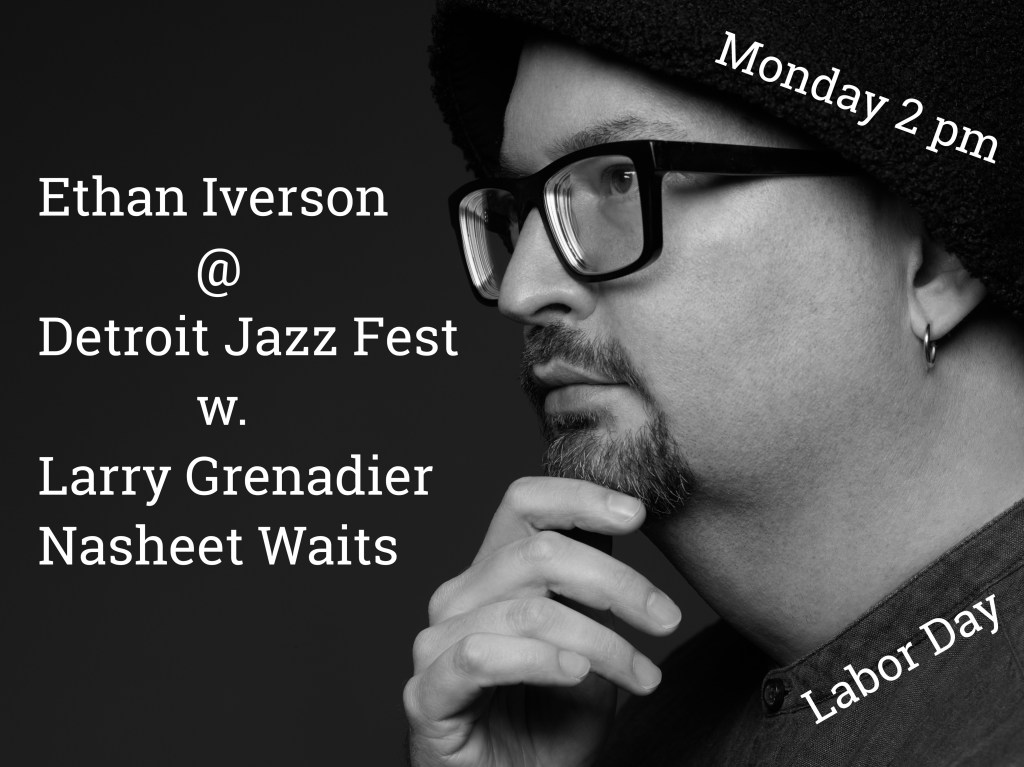
September 5 — trio with Larry Grenadier and Nasheet Waits at the Detroit Jazz Festival

If you see me out there, please say hi!


Time to take a break from DTM, Twitter, and FB. I’ll be back sometime in late August. (Probably I will not be able to resist posting photos on Instagram.)

Sign-up for Transitional Technology to be directly informed about my return. Sign-up is free…although sincere thanks to those paying for a subscription. Paid subscriptions help keep fresh DTM content coming after all these years.

New! DTM is easily searchable. The “search box” is located different places on different devices and screens, but the upper right corner is a likely place on a laptop, while the bottom of any given post is likely on mobile. Find the search box and enter your favorite jazz cat. I haven’t written about everybody yet, but I’d be surprised if your favorite wasn’t here somewhere.


Big interviews and essays of 2022 so far:

Interview with Anthony Cox

The Genius of Jaki Byard

A “New” (meaning “Old”) Approach to Jazz Education

50 ECM tracks for ECM at 50 (2018)

Doodlin’ (for Ron Miles)

More modest endeavors:

Vicissitudes: John Heard, Leroy Williams, and Grachan Moncur III RIP

The Second Piano Sonata of Poul Ruders

Lou Harrison’s octave bar

Andrew Hill: Shades and Strange Serenade

Lupu plays Brahms, Angelich plays Rachmaninoff

Birtwistle and Lupu, RIP

Charnett Moffett, RIP

photos of old cars

Ellen Raskin, Lee Server, Andrew Vachss

RIP Terry Teachout (with a guest contribution from Heather Sessler)

RIP Charles Brackeen and Mtume

Barry Altschul, You Can’t Name Your Own Tune

George Crumb, Ancient Voices of Children

Steve Lacy, The Window

Don Pullen, The Sixth Sense

Morton Gould in 1968

guest posts:

James P. Johnson Gets Dressed by Matthew Guerrieri

New Cecil and the Old Crew in ’70s NYC: A Remembrance by Richard Scheinin

Stanley Crouch on Classic Cinema by Paul Devlin


Recent reading…

Ursula K. Le Guin, The Left Hand of Darkness. Terrific sci-fi novel that digs deep into the topics of love and gender. Le Guin has some amazing passages of descriptive prose:

It had not rained, here on these north-facing slopes. Snow-fields stretched down from the pass into the valleys of moraine. We stowed the wheels, uncapped the sledge-runners, put on our skis, and took off—down, north, onward, into that silent vastness of fire and ice that said in enormous letters of black and white DEATH, DEATH, written right across a continent. The sledge pulled like a feather, and we laughed with joy.

Elmore Leonard, 52 Pick-Up and Swag. Somehow I never explored the two earliest crime novels that the author himself considered canon. They are far more downbeat and esoteric than later Leonard, and must have been a non-ironic influence on Charles Willeford’s Hoke Moseley series. I’m planning to keep reading Leonard in sequence; perhaps more to come from me on this topic. The Library of America edition Four Novels of the 1970s includes an extensive chronology as part of the endnotes.

Sally Rooney, Conversations with Friends. While I rarely look at contemporary literary fiction, my wife encouraged me to read this recent smash hit. Rooney follows the thread just so in an utterly compelling fashion. “My ego had always been an issue. I knew that intellectual attainment was morally neutral at best, but when bad things happened to me I made myself feel better by thinking about how smart I was.” Put it on my tombstone, baby!