Adès, Braxton, Barry, Beethoven

Thomas Adès and the Britten Sinfonia are surveying Beethoven chamber music and symphonies alongside diverse works by living Irish composer Gerald Barry. At Milton Court last Tuesday I heard an early entry in what promises to be a wonderful cycle for London concertgoers.

Interestingly, none of Adès’s own music is programmed, which makes it even a handsomer tribute to Barry, a new name to me, although he is well-known in the greater UK. (Tom Service’s guide is helpful.) It was kind of an insane thrill to sit in the front row in a terrific venue for chamber music and hear two major composers thunder out the two-piano Five Chorales from The Intelligence Park (excerpts from a Barry opera). It’s the only Barry piece I know so far but I can see why Adès digs him, the voice is surreal and witty yet utterly authentic to old-school harmony and flow. These two aren’t experimental composers, these are simply composers. My god, they are even composer-pianists! 30 years ago this breed simply wasn’t around, at least not like this.

The program began with Beethoven’s familiar Septet, an extended early potboiler that gets more inspired as it goes along. However I had never heard the Op. 70 No. 2 Piano Trio in E-flat. How many more utter masterpieces of the conventional canon am I still going to have a “first experience” with? There can’t be many, but, wow, what a piece. Adès is an excellent pianist, with a drive and urgent clarity recalling perhaps Rudolf Serkin. Beauty was there, but only as an afterthought to the taut lines and fierce argument. “Surprise” was the watchword, and while listening one wouldn’t have wanted it any other way. Thomas Gould and Caroline Dearnl were excellent on violin and cello.

Last night in Moers, the Anthony Braxton ZIM Sextet became a septet with the addition of star saxophonist Ingrid Laubrock. I’ve long admired Laubrock’s playing, she’s got a kind of breathy Ben Websterism to her modernist ethos. The rest of the band included Taylor Ho Bynum (brass and conductor), Shelley Burgon  and Jacqueline Kerrod (both on harp), Tomeka Reid (cello) and Dan Peck (tuba).

In a way a typical Braxton configuration: Outrageous for anyone else, of course, but typical of Braxton. Most of the musicians played most of the time for 55 minutes, but the textures were transparent and engaging. The gently chiming atonal harps were wonderful, it felt almost as if we were lost in an old film score. A lyrical duet of Braxton and Laubrock accompanied by Peck’s burbs and burbles was almost a romantic moment. Bynum led the group in a few thorny ensembles and delivered scorching cornet and trombone.

At one point I felt some sadness, similar to the sadness I feel when seeing George Cables or Harold Mabern play. Whatever this is: Anthony Braxton: AACM: Black Experimental Music: the precise meeting between John Cage and John Coltrane: the fire of the late 1960s…Whatever this is, the clock is ticking and when it’s gone we will miss it.

Braxton played some contrabass saxophone last night. Braxton fucking invented the contrabass saxophone. Hearing Braxton play contrabass saxophone was like hearing Jo Jones play a high-hat.

Truthfully, as I get older, I’ve had to realize that experimental music is not my true love. Whether it’s Cage, Braxton, or other geniuses from that moment where it all went to the furthest dimension, I know that part of me rebels at the need to break that many rules.  (I might have been scarred for life by a set of Braxton playing standards on piano in the early ’90s.) Still, it’s important that this dedication to experimentation existed — one hopes for but does not expect experimentalists the caliber of Cage and Braxton to ever come again — and when the concert concluded I leapt to my feet along with the rest of the packed crowd.

There is also simply this: If someone reaches age 72 dancing to their own drum, there is profound gravitas to their bearing. I was reasonably close to Braxton twice yesterday, once at the canteen, once in the dressing room, and both times the impact was visceral. Waves of energy radiated off the old master.

fullsizeoutput_54f

Afterwards: Ingrid Laubrock, Anthony Braxton, Taylor Ho Bynum


It was Fifty Years Ago Today

This Thursday, Friday, and Saturday:

“The City of Liverpool kicks off its Sgt. Pepper at 50 Festival, a summer-long tribute to the 50th anniversary of Sgt. Pepper’s Lonely Hearts Club Band with Pepperland, a new evening-length work by Mark Morris.

“Ethan Iverson’s score for an unusual chamber music ensemble teases out and elaborates on Pepper’s non-rock and roll influences. Arrangements of half a dozen songs from the album will intermingle with Pepper-inspired original pieces intended especially for Morris’s profound understanding of classical forms: Allegro, Scherzo, Adagio, and the blues.”

The hand-picked band is full of dynamic personalities and includes some A-list jazz players:

Clinton Curtis, voice
Rob Schwimmer, theremin
Sam Newsome, soprano sax
Jacob Garchik, trombone
Colin Fowler, harpsichord/organ
Ethan Iverson, piano
Vinnie Sperrazza, drums

Notes on the score:

  1. Sgt. Pepper’s Lonely Hearts Club Band. The original album ended with an unprecedented effect, a very long chord. Fifty years later, perhaps a similar chord is good place to begin…
  2. Magna Carta. A formal invocation of personalities from the LP cover.
  3. With a Little Help From my Friends. When Ringo sang it, he was on top of the world. Our version is more vulnerable.
  4. Adagio. In the age of Tinder, a Lonely Heart advertisement might seem hopelessly quaint. But everyone has always needed to find a match.
  5. When I’m Sixty Four. In between 6 and 4 is 5. All three (counts to the bar) are heard beneath the music-hall scuffle.
  6. Allegro. A single offhand line of trombone from “Sgt. Pepper” germinates into a full-fledged sonata form.
  7. Within You Without You. George Harrison’s sincere study of Indian music aligns easily with another Harrison interested in bringing the East to the West: the great composer Lou Harrison, one of Mark Morris’s most significant collaborators. The hippie-era sentiment of the lyric remains startlingly fresh and relevant today.
  8. Scherzo. Glenn Gould said he preferred Petula Clark to the Beatles. Apparently Gould, Clark, and a chord progression from “Sgt. Pepper” all seem to have inspired this mod number.
  9. Wilbur Scoville. The first thing we hear on the LP is a guitar blues lick, here transformed into a real blues for the horns to blow on. Wilbur Scoville invented the scale to measure heat in hot sauce: The original Sergeant Pepper?
  10. Cadenza. After seeing Bach’s Brandenburg 2 on the telly, Paul McCartney came into the studio and told George Martin to add piccolo trumpet to “Penny Lane.” Indeed, detailed references to European classical music are one reason so many Beatles songs still stump the average cover band.
  11. Penny Lane. Not on Sgt. Pepper, but nonetheless originally planned to be, and of course especially relevant to the city of Liverpool.
  12. A Day In the Life. Theremin nocturne, vocal descant, apotheosis.
  13. Sgt. Pepper’s Lonely Hearts Club Band. Another unprecedented effect on original LP was a reprise of the first theme, which is part of why it is called the first “concept album.” Our later vantage point enables us to project into the next decade, the 70s, and conjure a disco ball. Thank you, Beatles! Thank you, Sgt. Pepper!

I spoke about some of my history with Mark Morris in the Pat Zimmerli interview at New Music Box.

EI: One thing that was clear to me in the 1990s was that I needed to keep working on my ideas. I was still planning on being a jazz pianist, but I was in no rush to try to crack the secret of how to have a career in that music. To make money I did a lot of stuff, especially playing in a tango band with Pablo Aslan and Raul Jaurena and accompanying dance classes at Martha Graham.

The dance class work led to playing for Mark Morris’s company class in about 1995 or so. Eventually Mark asked me to be the rehearsal pianist for a full production of Rameau’s Plateé. At the first rehearsal Mark played everybody the complete opera on the stereo. To my surprise, when I checked something against the piano, the piano’s A was more like an A-flat on the record. I had sort of heard that Baroque performance used a lower tuning than modern A=440, but this was my first time encountering it in a professional situation.

At the end, I went up to ask Mark about the discrepancy between piano and the recording. He was changing, and I accidentally caught him between dance clothes and street clothes. Indeed, he was entirely naked when he got interested in my question and offered a learned and extended disquisition on 440, 415, and the varieties of contemporary interpretation of Baroque pitch.

I listened carefully. When he finally finished I said, “You know, Mark, I’ve never discussed intonation with a naked man before.”

Mark gave me a wicked grin and replied, “Stick around, baby!”

Which I did: Not long after the premiere of Plateé, I became Mark’s music director [and stayed] for over five years. This is when I really learned something about conventional European classical music. Mark Morris has an incandescent mind. I have often said, “I didn’t get to play with Miles or Mingus, but I did work for Mark Morris.”

In addition to watching his work every night, I got to play in the pit, and sometimes the other musicians were big stars. Somehow the very first chamber music from the standard repertoire I really worked on was Schumann’s Five Pieces in Folk Style with Yo-Yo Ma.

Later I met Mark Padmore through Mark Morris and we performed Schubert’s Winterreise together a few times. To this day I don’t know why I got to have these kinds of profound experiences, but I assure you I took detailed notes while they were happening.

I have several more fun stories about famous classical musicians from that time with Morris.  Simon Rattle came to a gig in Philadelphia, where were touring the marvelous dance V to the Schumann Piano Quintet. Afterward Rattle was standing around waiting to talk to Mark, and there he was, stuck next to the musical director. Rattle smiled at me and said, “Nice rubato in the Schumann!”

Of course he was just being nice, but it’s also true that we had played the piece many times and that I (along with the other musicians in the pit) had shaped a fairly unusual version of the score that really clung to the choreography onstage.

At the dawn of the century, Terry Teachout attended MMDG rehearsal and wrote up the experience (with a fairly big cameo by me) for the New York Times.

I am thrilled to be back with Mark Morris and MMDG again in a project that somehow really fits my capabilities. Tributes are hard — tributes to the Beatles are especially hard — but with the Bad Plus I learned something about how to shape old pop music in an invigorating way. It’s an appropriate evolution to bring that knowledge back to my former job.

To succeed, Pepperland has to have a balance of new and old/reverent and irreverent/high and low. Fortunately the choreographer/director/producer is a long time master of complex emotion. Peter Sellars attended the open rehearsal on Friday and told Mark and me, “You took it out of cliché,” which was very nice to hear.

In 2018 and onward there are plans to bring Pepperland to major cities in America and elsewhere.
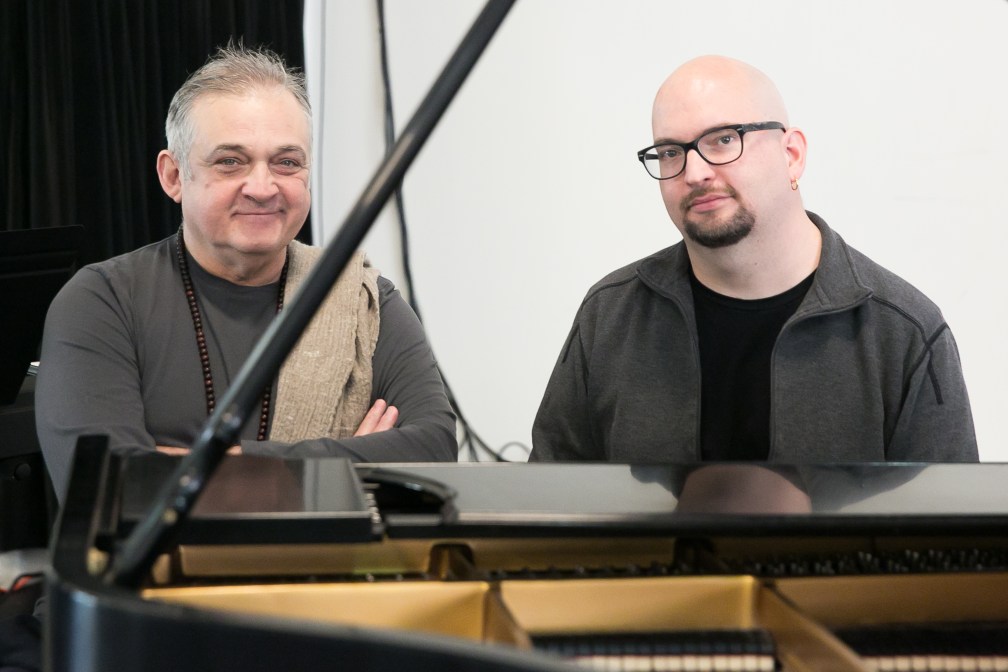
Mark Morris and Ethan Iverson

photo by Beowulf Sheehan

Grand Duo

Lou Harrison was born one hundred years ago today. He was a powerful presence, an authentic great composer.

The choreographer Mark Morris had a significant relationship with Lou, who composed Rhymes with Silver especially for Mark and Yo-Yo Ma. Other Morris dances to Harrison include Serenade (“Serenade for Guitar”), World Power (‘In Honor of the Divine Mr. Handel’ and ‘In Honor of Mr. Mark Twain’ from “Homage to Pacifica”; “Bubaran Robert”), Pacific (“Trio for Violin, Cello, & Piano”), and Strict Songs (“Four Strict Songs”). At the end of June, for the centenary, the Dance Group will premiere Numerator to “Varied Trio” at Tanglewood.

They are all wonderful, but the most familiar Morris-Harrison dance is Grand Duo, a popular MMDG repertory staple with about 300 performances since its premiere in 1993.  (I played piano on almost one hundred of those Grand Duos from 1998-2002.)

It’s a fantastic piece of music and possibly an even greater dance. The best American art is populist and sophisticated, engaging but aloof, high and low. Grand Duo is in the canon of the finest this country has to offer, with the added benefit of peak collaboration, the melding of two profound creative minds.

Harrison’s rough and tumble relationship to European classical music aligns him with the rest of the mavericks: Charles Ives and Henry Cowell (both mentors of Harrison), Conlon Nancarrow, Henry Partch, Colin McPhee, more recently the direct disciple John Luther Adams. Of them all, Harrison might have had the most astonishing gift for original tuneful melody, for example the unusual chiaroscuro cantabile in the second movement of Concerto for Piano with Javanese Gamelan:

Alex Ross: To Lou, with Love.

Bill Alves and Brett Campbell have authored a new biography.

Trailer for A World of Music by Eva Soltes:

Pop Musicology

Twitter poll

I’m a piano player, so I frequently lament the ever-dwindling harmonic content of commercial music. Three pieces I hear frequently on the radio, while not that complicated, at least have a few bits to dig into in terms of pitch collections.

What a horrible video! I hate looking at this singer. But, yeah, a catchy and funky tune, with a big diminished chord (a sound that has almost vanished in commercial music) that begins and closes the minor key four bar phrases of the verses. Then the chorus is in the relative major. At one point in the chorus the bass plays E natural: This should be a leading tone to F minor, but it goes back to C minor. Bad! Or: catchy?

Like most tracks in this genre, the harmonic content is four bars on a loop. What makes “American Boy” stand out is the light and shade in the harmony: The tonic is major, the rest is borrowed from minor. Minor plagal cadence to major? Estelle is from England, and Kanye even says, “Just touched down in London town,” so this “European” harmony makes sense. (Going to the absurd: Gershwin’s “A Foggy Day in London town” could easily be re-harmonized with this loop.)

So, this old thing that won’t die is superficially the blandest of these three tunes, but the harmony is actually arguably the weirdest, as the vamp cycles in the tonic from triad to major seventh to dominant to major seventh and back to triad. Huh. Can’t really remember hearing this effect in pop music before. One might even call it “Stravinskyian,” as the grammar is deliberately used incorrectly for gracious effect.

In the chorus there’s another surprise, a dominant that doesn’t resolve correctly. However, that “mistake” seems less interesting. Indeed, it is just plain wrong (Eb7 to F minor, yuck) and even less convincing than the incorrect bass motion in “This Love,” leading me to suspect that the composer of “Kiss Me” is just a lucky guitarist strumming away who doesn’t really know the rules before breaking them. (UPDATE: My complaint “Eb7 to F minor, yuck” is only valid in the key of Eb, of course it would be fine in Ab or when modulating elsewhere. If someone can find me tonic, tonic dominant, ii — all root position — anywhere in European harmony from Bach through Brahms I’ll give them $20. Admittedly, pop songwriting does not usually follow those old European rules, but tonic, tonic dominant, ii seems particularly egregious to me.)

On a related note, I learned about Adam Neely’s pop musicology videos because he linked to my Red Garland analysis:

I was quite taken with his personality and generally in tune with his ideas. There are many Adam Neely videos, he’s very popular, and I have no doubt a huge swath of the public is going to know so much more about how music actually gets made when he’s eventually done with this grand experiment. Of course I had to check out his latest, on the Real Book:

Adam has a diverse audience. Some of his fans started going after the elitism of jazz musicians in the comments, so (perhaps against my better judgment) I left a long comment of my own about the importance of race. Adam promptly pinned it. Thanks Adam!

Sir Ron at 80

Happy Birthday to the one and only Mr. Ron Carter, who has probably given me more hours of unadulterated listening pleasure than any other living musician.

In my experience the role of the bass is the hardest for non-musician jazz fans to understand. Even musicians can underrate the significance of the bass. More than anybody else, Ron Carter’s powerful personality makes a case for the bass to civilians and professionals alike.

Ron is of course a master accompanist, but he is also one of the most extreme avant-gardists this music has ever known. His provocative sallies work because they are rooted in absolute folkore. Hyland Harris watched a recent record session with Ron and afterwards said, “It must be a lot to carry on those shoulders, being the hardest-swinging man in the commonwealth.”

Jazz musicians who only play the authentic language are rarer and rarer. Ron’s exceptional gift is still luminous. Don’t miss any opportunity to pay tribute and see the man in person.

—-

Ron Carter on DTM:

2007 Interview 

2015 Interview 

Cedar’s Blues

Magic Numbers 1: Hank Jones, Ron Carter, Tony Williams

Magic Numbers 2: Ron and Tony With Other Trios