When I hit with Ben Street and Nasheet Waits Monday at Smalls, this will sadly be the final concert sponsored by Piers Playfair and the Catskill Jazz Factory. Thanks to that wonderful crew for 8 years of excellent work! Read the roll call and visit the archive…
Author Archives: Ethan Iverson
Quarantine Projects (1)

My next gig with Ben Street and Nasheet Waits is Monday, streaming free of charge at the SmallsLive site and associated FB page.
There are quite a few streamed performances happening — I’m planning to check out the Immanuel Wilkins Trio with Joel Ross and Lesley Mok tonight from the Jazz Gallery — but I’m also impressed with private quarantine projects from artists I admire. People who are just setting up their video cam or iPhone and documenting a kind of creativity that probably wouldn’t be happening except for quarantine conditions.
Miranda Cuckson offers the Six Caprices for solo violin by Salvatore Sciarrino. This astonishing music truly lives at the outer edges of expression, yet it also retains some kind of sublime grace and humor. The Caprices are very difficult, and the effort required by the performer is an important part of the message. As it turns out, lo-fi home videos of these short pieces are a perfect medium. Miranda discusses the Caprices further at her blog post.
Timo Andres is a composer/pianist I’ve been keeping my eye on. His Moving Études are in the surreal rhythmic process tradition of Ligeti and Adès, but Andres has his own concept of “tonal” harmony and the middle etude “swings.” American music, no doubt about it. It’s exceedingly impressive that he can knock ’em out on a home piano in a single take.
I wonder if Andres would be recording standard repertoire if there weren’t a pandemic? On his YouTube channel are quarantine performances of Debussy, Schubert, and an unexpected pairing of Copland with peer Scott Wollschleger. For Schumann’s relatively obscure Six Canonic Etudes, Op. 56, Andres made his own transcription. (The original was for a forgotten instrument, the pedal piano; Debussy’s transcription for two pianos hangs on the fringes of the repertoire.)
A few years ago I wrote up Vicky Chow’s record of Micheal Gordon’s Sonatra for the New Yorker Culture Desk. Chow and Gordon are collaborating again in quarantine. Each day in July, Chow plays a new short Gordon piece for Instagram. What an astonishing project! And what a good use of everyone’s time! I’ve been enjoying the varied works immensely, Gordon and Chow are giving us a unique snapshot of contemporary composition.
In the jazz world, Ron Carter is blowing everyone’s mind with frequent lecture/demonstrations on Facebook, while Billy Hart is preparing to give a talk on The Evolution of Contemporary Jazz Drumming for the Healdsburg jazz series. Marcus Gilmore and Eric Harland are two of Jabali’s favorites; it’s safe to say that the stream this coming Sunday is a must watch. Registration is free.
For myself, I keep shedding famous solos. Two more McCoy Tyner classics went up on my socials this past week. Social media rewards scolding more than positivity, and it remains up to the artist to keep bringing the light.
“Bessie’s Blues” with Coltrane, Garrison, Elvin:
“A Night in Tunisia” with Garrison and Tootie Heath:
Dry Martini
Chronology 12 for JazzTimes is about Paul Desmond, Ed Bickert, and Pure Desmond.
“Satisfactory, Archie.”
The Shadow of Johnny Mandel
RIP to a deep cat, someone who knew his way around the thorny environs of American entertainment and always left beauty in his wake.
Naturally, it was time for a quick rendition of “Suicide is Painless” for all my socials. During quarantine I had done two dozen TV themes, thought that was probably enough, but Johnny Mandel’s passing prompted a gentle encore:
I have been working on Johnny Mandel lately, specifically an appraisal of two of his greatest film scores Harper and Point Blank, to be published in the next issue of Noir City. You’ll have to wait for that, but for now, a few bits and pieces….
Bill Kirchner interviewed Mandel for the Smithsonian.
Marc Myers interviewed Mandel for JazzWax.
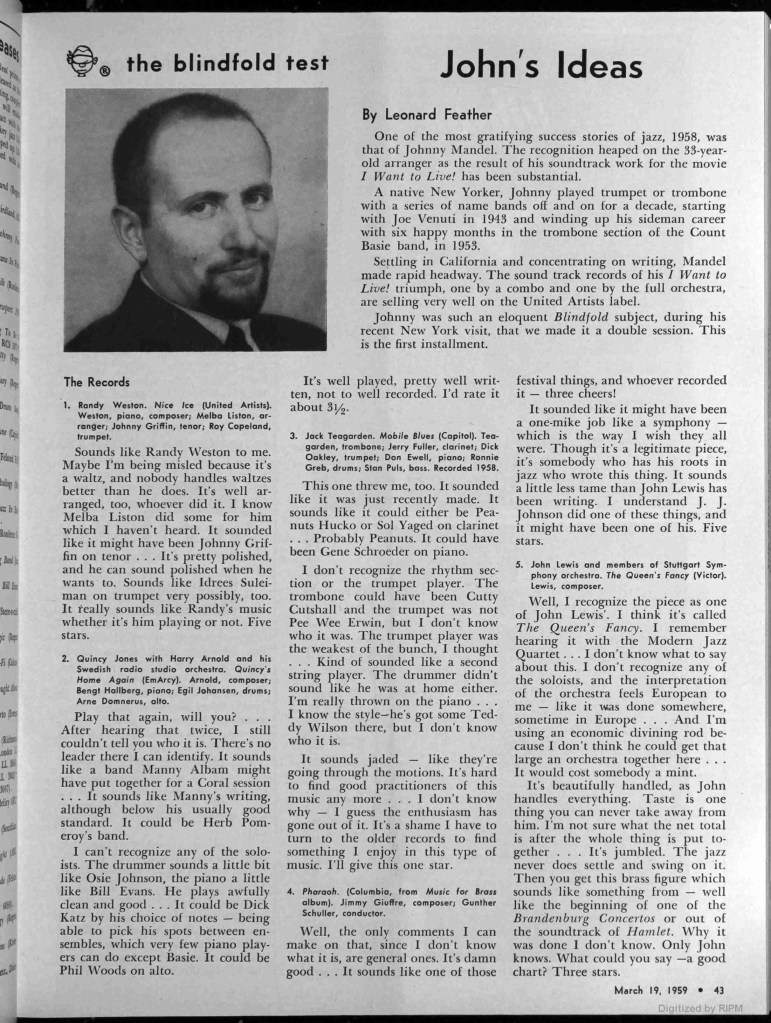
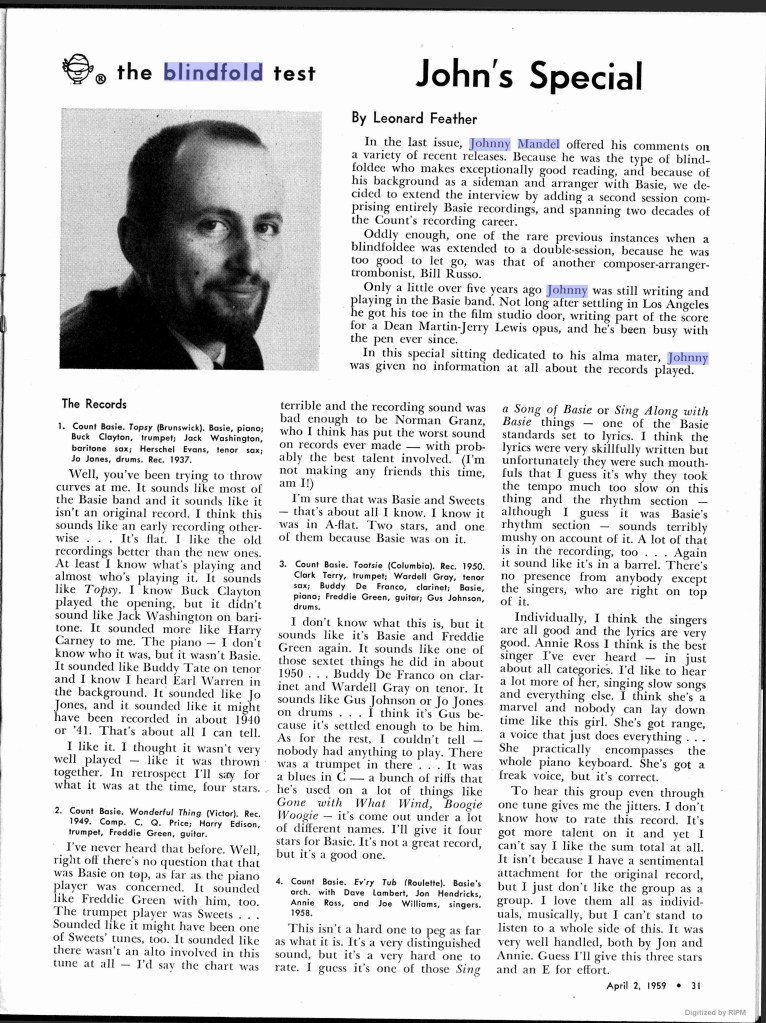
From 1958, there is audio of Leonard Feather giving Mandel a blindfold test. Mandel generally impresses with who he recognizes, even though Feather pitches him a few unfair curveballs. Mandel is also strikingly critical: “The recording quality is bad enough to be Norman Granz, who has put the worst sounds on records ever made with probably the best talent involved.”
Thanks to Loren Schoenberg for sending along the relevant pages from DownBeat.
Mandel wrote a few songs that were among the last “standards,” conventional themes generally taken up by jazz singers and instrumentalists. After The Sandpiper was released in theaters, dozens of eminent jazzers recorded “The Shadow of Your Smile.” One of the earliest was by Eddie Harris with Cedar Walton, Ron Carter, and Billy Higgins.
Carter told Mark Stryker, “I got a call from Eddie Harris saying he was going to do a song called “The Shadow of Your Smile” and so far he didn’t have a lead sheet. That was the theme song for the movie The Sandpiper. I was in Boston working with Tony Williams and Gábor Szabó, so I had to go into a theater in Copley Square with a pencil, a pad and a flashlight and write down the melody of this song…”
Mandel didn’t begin as a songwriter. He’d be the first one to tell you: He began as an arranger. As an appropriate memorial, Mark Stryker offers a careful listen to Mandel’s arrangement of “In the Still of the Night” for Frank Sinatra.
Two of my favorite Mandel songs have definitive performances. “I Never Told You” is played by Toots Thielemans over Quincy Jones’s sparse orchestration on Walking in Space. Shirley Horn sings and plays “Close Enough for Love” all by herself on the album of the same name.
The correct adjective is “haunting,” which the dictionary defines as, “poignant and evocative; difficult to ignore or forget.” These are the songs and the performances you need at certain points in your life. Don’t worry about finding them: They will find you.
Most of Mandel’s work was for the movies.
In the later 20th century, movies became the great connector in American society. A personal anecdote:
When I was very young I saw Point Blank with Lee Marvin and Angie Dickinson on television. However, I was just too young to understand the expressionist language employed by director John Boorman. Later on, in college, I took a course on film music, and ended up with a copy of Knowing the Score: Notes on Film Music by Irwin Bazelon. Mandel is interviewed in the book, and talks quite a bit about Marvin, Boorman, and Point Blank. Mandel’s comments made me curious, so I rented the VHS tape and watched again. The penny dropped and I started telling everyone I knew that this was one of the greatest movies of all time.
The movie was based on a book by Richard Stark, a name unfamiliar to me. Eventually I found a copy of The Green Eagle Score. Huh. Weird but good. Oh, Stark is a pen name. Who’s Donald E. Westlake?
In time I read all of Westlake, chased him down in person, and produced a major overview after he died. So, one could say that thanks to Johnny Mandel, I met Donald Westlake.
I write many more words about Mandel and his — why not use this adjective once more — haunting score for Point Blank in my forthcoming essay for Noir City.
However, space there didn’t allow for much comment on “Count Source,” a big band chart briefly danced to by Angie Dickinson oncreen.
The two minute cue can be heard on YouTube.
It’s a tribute to his old employer Count Basie, of course, and probably took Mandel all of half an hour to write. Still, “Count Source” is perfectly scored and perfectly played…a reminder of the breadth of American music, especially in those heady post-war years before rock, pop, and eventually hip-hop controlled the market.
“Live” at the Village Vanguard continues….
The Joe Martin quartet with Mark Turner, Kevin Hays, and Nasheet Waits streams tonight at 7 and tomorrow at 2. Great band! Please support the club doing what they can to pay the rent and placate the ghosts….
New from Lawrence Block
One of our greatest releases a book for his birthday: Dead Girl Blues.
Just left the following 5 star review on Amazon:
DEAD GIRL BLUES is a surprising late triumph: one of a kind, touched in equal parts with genius and sin. The author has been heading this way for a while — probably his whole life — but recent sensationalist tales like GETTING OFF (2011), THE GIRL WITH THE DEEP BLUE EYES (2015), RESUME SPEED (2016) and A TIME TO SCATTER STONES (2019) now seem like sketches for the real deal. Donald E. Westlake shared a lifelong friendship with Block. For me, the dark standalone THE AX is Westlake’s masterpiece; when the dust settles, I suspect I will give the same honor to DEAD GIRL BLUES. Not for the faint-hearted. If you have any trigger warnings around, put them on this book. Put ’em *all* on.
Posthumous Interview
New DTM page: Interview with John Cumming, a crucial promoter of jazz in England, who died a month ago.
Streaming at the Village Vanguard/Practicing McCoy
The Village Vanguard commences streaming this weekend with the Billy Hart quartet featuring Mark Turner, Ben Street, and me. 7 PM on Saturday, 2 in the afternoon Sunday. $7 a set…one time only, not archived. Tickets available at the website.
Billy played with McCoy Tyner and loves Coltrane most of all, so I am practicing. the piano solo from “Pursuance” off of A Love Supreme to start getting in the vibe.
77 and 88
Happy 77th birthday to Kenny Barron, one of the last giants of jazz piano. Barron must be one of the most-recorded pianists of his generation; he’s also gigged constantly since hitting the scene in the ’60s. Not a year has gone my during my time in New York where I didn’t get to see Mr. Barron at least once.
Seven moments off the top of my head:
1) A casual performance at the Artist’s Quarter with a local rhythm section, maybe Tom Hubbard and Kenny Horst. One of the very first jazz gigs I ever saw! Very fast “Back Home Again in Indiana” and a solo version of Barron’s heartfelt tribute “Song for Abdullah.”
2) “Song for Abdullah” is on Scratch with Dave Holland and Daniel Humair. This set has some of the freest Barron I’ve heard, for example the wild blues solo on “And Then Again.”
3) More straight up is the lovely LP of duos with Ron Carter and Michael Moore, 1+1+1. The brisk “The Man I Love” is fabulous.
4) I ended up listening to Scratch and 1+1+1 a lot in my high school years, but the first Barron LP I ever got was the moody electric Innocence, with a long version of Barron’s “Sunshower” with a great Sonny Fortune solo. The final time I saw Fortune live was one tune at a gala event with Barron, Ray Drummond, and Billy Hart, where they played “Sunshower.” I myself played “Sunshower” with a Barron-worthy rhythm section, David Williams and Victor Lewis, that was memorable.
5) The first time I saw Barron in NYC he was with Joe Henderson, Rufus Reid, and Victor Lewis at Fat Tuesday’s. The piano’s high “C” was notably out of tune; Barron built a significant statement on “Body and Soul” that highlighted that “wrong” note.
6) The YouTube era has been kind to Barron fans. Bootleg audios of Sphere are phenomenal, while videos of Barron with Yusef Lateef’s ’70s quartet and Dizzy Gillespie’s 60’s band may argue more forcefully for those eras than the related LPs.
7) And this morning a true find surfaced, Kenny Barron at Boomer’s in 1976 with Bob Berg, Charles Fambrough, and Al Foster. Wow! Great to hear this muscular ’70s style captured “in the wild.” Perfect.
 DO THE M@TH