Don Asher’s Battered Grand

SFJAZZ has an unprecedented outdoor tribute, the Raise Up Off Me Alley. Hampton Hawes’s memoir is celebrated by jazz buffs,  but it was still surprising to see SFJAZZ honor a book. The fog cleared when talking to Robert Mailer Anderson, the board member who proposed the alley’s name. Anderson is writer and literary maven, and when he showed me a first edition of Raise Up Off Me signed by both Hawes and co-writer Don Asher I may have drooled a little bit.

While Don Asher is generally known only for the work with Hawes, there is one other Asher that should be on the shelves of the serious jazz book lover: Notes From a Battered Grand: A Memoir: Fifty Years of Music, from Honky-Tonk to High Society. Apparently Asher never made a record but he was obviously a competent musician. He grew up next to Jaki Byard, and one gets the sense that Asher knew he was never going to be a Byard so settled for being a superior cocktail pianist.

In addition to great stuff about Byard, there’s much more of general importance in Battered Grand, including how black musicians taught him to swing and a detailed explanation of how 60’s rock music was hard for the veterans to play. Asher’s voice is amusing and secure. I wish I had interviewed him, or at least been in his presence once: Asher died in 2010, and apparently still played cocktail piano in San Francisco until near the end.

Despite being the kind of virtuoso who could easily outgun any competition, Oscar Peterson was a very good colleague. For example, in Raise Up Off Me, Oscar cameos as a kind of helpful older brother to Hawes.

A video has turned up of Oscar hosting an informal TV show with guest Jimmy Rowles. Rowles is in a blue leisure suit, shy and smoking on camera. There is unrehearsed dialogue and Oscar is very classy throughout. The whole cast (with Ray Brown and Bobby Durham) sounds great but Jimmy’s chorus on “Our Delight” is simply to die for:  improvised, surreal, vocal, swinging.

They Always Swing

America lacks support and venues for jazz music, especially outside the biggest cities. Only in a handful of comparatively smaller places is there some kind of team interested in presenting the music as a labor of love.

Jon W. Poses is the Executive & Artistic Director for the “We Always Swing” Jazz Series in Columbia, Missouri. Through Poses, The Bad Plus has played several times at Murry’s, a good restaurant that puts on jazz several times a season.

Jon is an old-school fan who began as a collector before getting more and more involved in the business: writing liner notes, managing artists, and now We Always Swing. He got addicted young and now still needs the jazz fix.

We Always Swing has a storefront in Columbia that has a remarkable lending library dedicated to the memory of Von Freeman. I stopped in for what I thought would be for a few minutes and ended up demanding to hear records. I’d been looking for Hod O’Brien’s first LP with Teddy Kotick and Jimmy Wormworth for years. Jon’s library gave me the chance to audition, and it proved to be a really nice bebop trio.

(Just recently I saw O’Brien at Mezzrow. He’s still got authentic notes and phasing; it was also a great opportunity for youngblood bassist Darryl Hall to get some really fabulous experience playing with the real deal.)

Once again, thanks to everybody who puts time and effort into this music. I tend to just praise the musicians themselves on DTM but the whole eco-system matters.

Jon and Ethan

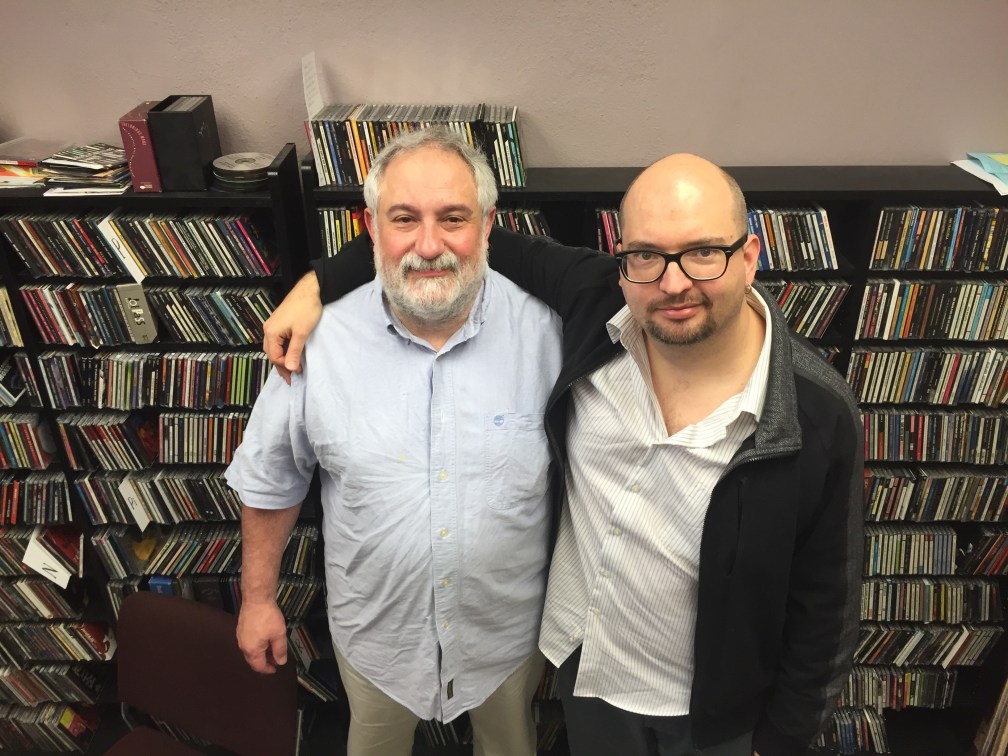
with Jon W. Poses

Progenitor of Modern High and Low

RIP Umberto Eco.

It was amusing to look at Foucault’s Pendulum again. At one point this was one of my favorite books, but when I got a little older I realized that Eco was trying too hard.

Pendulum predates the similarly themed The Da Vinci Code by over fifteen years. The Da Vinci Code is poorly written, yet in some basic way Dan Brown delivers proper escapism in a way that Eco can’t. In particular, the opening chapters of Pendulum are obtrusively dry and academic. When the narrator finally settles in to tell a juicy history of the Templars, the book gets a grip and surges forward.

“Juicy” could mean low brow, “academic” could mean high brow. Eco was ahead of his time when trying to combine the two. I remember being stunned by “Casablanca: Cult Movies and Intertexual Collage” from Travels in Hyperrality in about 1990. However, that essay doesn’t hold up in the era of the information superhighway. Compared to TV Tropes and Idioms, Eco’s attempt to anthologize genre references is a rusted Model T in Grampa’s backyard.

Despite reservations, Foucault’s Pendulum definitely has something, perhaps especially in terms of the existential ending. I formerly thought that was the weakest part of the book but now  I have enough life experience to understand it better.

Eco’s first bestseller The Name of the Rose continues to charm. While Foucault’s Pendulum is like a modern chase or conspiracy thriller, Name of the Rose is simply an Agatha Christie-style mystery, which proves to be an easier trope to bend to scholarly pursuits. The historical detail and philosophical perspective is shamelessly academic from the first page to last, and the reader receives an amusing and digestible education hung on the conceit of amateur detection.

Eco’s interview with Lila Azam Zanganeh for the Paris Review is a joy throughout.

The Name is Bond

Large_upload

These are the Bond covers I grew up with in the ’80s.

Because the movies dominate our culture, Ian Fleming’s original work can be underrated by those who care about other escapist espionage fiction. I’d argue that the books are essential to the canon; or at the least far stranger and more interesting than the movie franchise.

An interesting new essay, by Chris Ryan for Grantland: Spectre and the Age of Blockbuster Continuity. (H/T Vince Keenan.)

Raw-broccoli-lg

Like many American males, I recently thought it might be enjoyable to watch the Bond movies in order. I gave up because Thunderball and For Your Eyes Only were so bad as to be essentially unwatchable.

The most fun about that aborted project was relearning some of the early movie history I knew as a kid but had basically forgotten. Of course, broccoli is a designed vegetable – some kind of cross between kale and cabbage, just like cauliflower is – and Albert Broccoli was the younger son of the Broccoli family responsible for that vegetable’s invention. After Broccoli fell in love with the Fleming books, he decided to invest the family fortune. Broccoli acquired the rights to Doctor No, with the option to make the rest of the series, despite not knowing anything about moviemaking!

Amusingly, broccoli was a small factor in a few ways for the franchise in the beginning. Sean Connery was not a fan, and his rather “tough” attitude towards the complimentary bowl of raw broccoli outside of the casting room impressed director Guy Hamilton. And the famous opening gun barrel sequence? Albert Broccoli knew film designer Maurice Binder slightly as a boy, since Binder’s father was the first large-scale importer of broccoli into New York.

Espionage Encyclopedia

Yesterday I blogged about Skinner by Charlie Huston. In the very first chapter, Huston references Eric Ambler, which informs the reader that this is going to be a thriller with a political theme. It’s a nice touch.

I’ve now just finished the brand new All the Old Knives by Olen Steinhauer. Early on, a lead character is next to a woman reading Len Deighton on a plane. Steinhauer’s plot is not really that much like Deighton’s Berlin Game, but there are some related ideas including a romance/espionage partnership and a key airport crisis. Even chatting with someone on plane who gives up information is rather Deighton-ish. On the other hand, the last page is pure Le Carré.

Good work from Steinhauer. I’ve read the Tourist trilogy and found the characters more interesting than the Jason Bourne “badass assassin” playbook. With All the Old Knives there are no action heroes in sight, and the book is all the better for it. Highly recommended for espionage buffs. 

Hope the movie will be good too.

Crowd Control

I’ve just reread Skinner by Charlie Huston. It remains one of my favorite thrillers of recent years. Although the book ends up being a powerful warning about the current condition, along the way the reader enjoys varied vicarious thrills including much current technology: drone quadcopters, plastic guns manufactured by 3D printers, mobile robot surveillance spiders.

During an energy conference in Sweden, angry protesters confront something new on four wheels:

A new siren rises and fills the square, bounding off the faces of the tall buildings. A warning that something large and powerful is coming. At the far end of the square the police line splits open and a towering blue and high-viz truck, unholy product of a mating between a double-decker bus and a fully armored Humvee, rolls through, two water cannons above a high cab, windows covered by steel screens, a broad cow catcher mounted up front.

This must be a Carat Big Bear:

Bigbear-3

There’s a strange subset of YouTube videos: arms manufacturers’s advertisements.

Carat has one for their armed Unimog.

While I don’t see Carat’s armored water cannons on there yet, Alpine Armoring and IAG have you covered.

When flight MH17 was shot down over Ukraine, one of the logical questions was, “What was the gear?” Investigators decided it was a Buk SA-11 missile.

On YouTube there was already a rockin’ video of the missile system in action. It’s not totally clear to me if this video is an ad created by the company or simply the work of a rabid fan. At any rate the manufacturer is easy enough to find: Almaz – Antey, who have the slogan, “High Technologies Safeguarding Peaceful Skies.”

After MH17, I’m sure the military leaders of every country watched the YouTube video and picked up the phone to call Almaz – Antey. High-tech armament is notoriously fussy and unreliable, but now there was proof that the Buk SA-11 was a solid investment.

CNN anchor Rosemary Church was first criticized then fired for suggesting the use of water cannons in Ferguson. But what was used eventually seemed even more devastating. Questions were asked everywhere about the high-tech military gear. Where the heck did all that stuff even come from, anyway?

The answer was Homeland Security grants and the Defense Department’s 1033 program. Even if you are a just a small-time small town police chief, don’t worry, you can still afford to arm your team with shock and awe.

Newsweek: “How America’s police became an army”

“The Pentagon finally details its Weapons for Cops giveaway” at the Marshall Project.

I’ve spent some time reading about Bozeman’s debate about their new BearCat. They are keeping it, unfortunately: Apparently the tearful pleas from the cop’s wives at the town hall meeting sealed the deal.

Bearcat

Before the vote went down, Blake Maxwell at the Bozeman Magpie offered some clear-eyed commentary on what this kind of machine means for communities. I particularly admire Maxwell’s lead paragraph about the word “rescue.” (That word is painted on the side of Bozeman’s BearCat above. Photo stolen from Bozeman Daily Chronicle.)

The prevalent usage of rescue in the media now is lipstick on a warhorse, just 11th-hour spin, and the city manager’s unflagging repetition of it has become an insult to our intelligence. The BearCat has a turret and at least 10 different “gun ports.” This vehicle wasn’t designed for handing out medical supplies or basic human necessities; it was built for killing.

Richter at 100

At the masterclass with Ron Carter yesterday in Hartford, I mentioned the Sviatoslav Richter centennial, saying something the effect that Richter may have been the greatest 20th-century classical pianist. Ron interrupted me right away: "Yeah, but don't forget Walter Gieseking."

Fair enough. There are lots of wonderful classical pianists. Comparing them is usually pointless. I respect anybody who is genuinely competent in that esoteric profession.

Still, something about Richter sticks out. After Ron's interjection, I've been mulling over why I think Richter is so great. 

My conclusion is rather obvious: Richter was of his time. He was 20th-century. He was an unrepentant modernist. 

Everything that Richter played was informed by world war, by atonality, by Freud, by airplane travel, by recorded sound. The horrors and delights of his era were always present.

The vast Richter discography is complicated further by multiple versions of key pieces. One would need an extra lifetime to study the complete Richter on CD.

Off the top of my head, a selection of personal favorites:

Bach. From WTC II, the A minor prelude and fugue from the Phillips studio set. The prelude is somber (his teacher Heinrich Neuhaus suggested that especially chromatic Bach be played "without tone"), the crucifixion fugue strikes like a bolt of lightning.

Handel. Richter mentored several young musicians. When he got interested in the young and brilliant Andrei Gavrilov, Richter had them alternate on Handel suites. Nobody plays these suites on piano much – harpsichordists have a better chance – but hearing them as tag-team performance art makes them more accessible. On video, Richter starts the familiar "Harmonious Blacksmith" with the loudest, ugliest, longest low E imaginable. Before continuing, he stares at Gavrilov, who looks around the room in an unconcerned or even dour fashion. Russian modernist art, via Handel.

Mozart. Nope. Hard to "take over" Mozart. He doesn't fight back, so you've got to enter that space with grace. Surely there's a decent Richter Mozart track somewhere, though.

Haydn. The G minor sonata, Hob.XVI:44, is rendered with existential sadness. (Early 60s DG.) 

Beethoven. A key composer for Richter. It's all great. My offhand selection is a less-familiar sonata, the two-movement Op. 54 in F major on EMI. The opening minuet has gleaming sonority and ornamentation. Perhaps the octave outbursts are almost too loud, but that's Richter for you. The answering toccata goes like the wind. A perfect work and perfect for Richter.

Since Ludvig was so important to Slava, I'll offer one more: the live Diabelli Variations on Phillips, rather late, I think 1980's. Even the out-of-tune piano seems to play a part in declaiming a passionate message. This was my first Richter record and my first Diabelli; frankly I find almost everyone else pretty boring.

Weber. I believe Horowitz was the one who started the fashion of looking for classical-era pieces by Clementi and other minor composers. Not to be outdone, Emil Gilels played some Clementi better than Horowitz and also added Weber's second sonata. Richter's retaliated by unearthing the Weber third. It's a powerful enough work, especially under Richter's strong hands. The point is clear: If we listen to Mozart, Haydn and Beethoven, we should listen to Clementi, Weber, Dussek, Hummel, and Czerny as well. 

Schubert. Richter may still be somewhat controversial in long sonatas where he takes unusually slow tempos. I understand the objection; frankly I'd usually rather relax with Clifford Curzon or Wilhelm Kempff myself. On the studio recording of the intimate Allegretto in C minor D915, Richter's speed is more "Largo" than "Allegretto" but the emotion is starkly compelling. I'm not so sure of Schubert's awkward counterpoint in the brief canonic section, but if you can hear it "à la Shostakovich" that certainly helps! 

Chopin. Richter played lots of Chopin but for me it can be like his Mozart, either too brutal or too straight. In the centennial celebrations I have seen several mentions of his performances of Chopin Ballades. This surprises me, I will have to go back and re-listen.

My Richter Chopin selection is an obvious one: On the essential documentary Richter the Enigma the only complete performances are of Chopin études. The earlier performance of the C sharp minor Op. 10 is white heat. Chopin would have been astonished to hear the 20th century in action with all of its brutal power. The later era étude is the "Winter Wind" in A minor. Here we can see the ultimate professional: An old man who has played thousands of recitals casually sits down and delivers this classic fingerbuster.

Schumann. One of the great LPs in my collection is the recital of César Franck and Robert Schumann on Monitor. I believe Schumann's Humoreske was barely played until Richter discovered it for modern audiences. You want to talk about your modernist pieces! The Humoreske doesn't make sense unless you have a grotesque, occasionally almost military aesthetic. The rhythms are also exceedingly complex and a technical challenges formidable. Richter solves all interpretive issues.

Brahms. The pianist didn't like his recording of the Second Piano Concerto with Leinsdorf in Boston. It's true that there are some really notable finger slips. However, like so many others, I am bowled over by the recording's raw passion. The first two moments are especially marvelous.

Liszt. The Liszt selection is obvious, the étude "Feux Follets" from at the legendary Sofia recital from 1958. It's not just the speed, it's the sonority which is so magical. 

Franck. From the Monitor LP mentioned earlier, Prelude, Chorale and Fugue is the dead intersection between German and French music. There's a whiff of the sentimental and the falsely religious about this work, something like Busoni's plumped up transcriptions of Bach. However I never have a problem with this aesthetic if a truly great pianist is in residence. I can't imagine anyone playing this work better than Slava does here.

Debussy. Again for me an obvious choice: Estampes, the live recording from early 60s on DG. Somehow the piano sounds just like the gamelan Debussy was inspired by. 

Hindemith. Apparently the composer himself didn't think much of his Suite 1922. I don't know why: For me, it's his best piano piece. I admit I am probably influenced by Richter's phenomenal recording from late in life. He beats the piano into submission but in this context that is perfectly okay.

Tchaikovsky. Mussorgsky. Scriabin. Prokofiev. Shostakovich. Stravinsky. Rachmaninoff.  Richter's performances of composers from his homeland have special merit. 

Tchaikovsky's solo piano music is frequently trivial; however, the Grand Sonata in G becomes a major work in Richter's hands. 

Mussorgsky's Pictures of An Exhibition from the 1958 Sofia recital is Richter 101, frequently showing up on lists of "the best piano records ever made."  

I don't know Slava's many famous Scriabin recordings as well as I should. These days when I listen to Scriabin, I'm probably listening to Sofroninsky. One hopes that the familiar anecdote is true: When the pianists met, Sofroninsky greeted the other, "Genius!" to which Richter shot back, "God!"

Richter knew both Shostakovich and Prokofiev and his biography is often focused on those associations.

While not so familiar with either of these composers nor Richter's contribution to their discographies, I am impressed with the Shostakovich Piano Quintet which shows Richter's sublime abilities as a chamber musician. The insane brilliance of the Prokofiev Second Sonata is also inarguable.

Prokofiev 2 was composed just before Richter was born. Its mechanized ironies are totally of the 20th century, and was totally understood by the pianist when he learned it a couple of decades later. This aesthetic was Richter's birthright.

As significant as Shostakovich and Prokofiev are as composers, something else may have been even more important to the young Slava than the music itself: Actually working with great composers, seeing how they made new music that related intimately to current events. Richter somehow took that attitude along when exploring the whole history of piano repertoire, making everything he touched modern, exciting, and sad. 

Richter didn't record much Stravinsky. The most intriguing item is the piano concerto Movements. This is arguably Stravinsky's most recondite piece, and it shows just how curious Richter was about everything that he gave this unfriendly beast a try.

I want to conclude on an up note, so let's end with Rachmaninoff. 

In general Richter was an ideal Rachmaninoff interpreter. It would be hard to make a list of recommended Rachmaninoff recordings without Richter in there somewhere.

Was Rachmaninoff a truly great composer? I'm not sure; many others wonder this question as well. But perhaps because Rach always isn't the very best music, there is extra room for re-creative genius to take over and deliver a melding of composer and interpreter.

The collection of Preludes and Etudes-Tableux on Olympia from 1971 and 1983 is essential for any piano library. Four tracks come to mind right away: The heraldic B-flat major, the proto-Prokofiev F sharp minor, the Tolstoy carriage of B minor, and the Etude 7 in C minor, the one that unleashes a great torrent of bells near the end. The bells seem joyous at first, but then it becomes clear that happiness will be denied. The bells mark the passage of time, and mourn both the loss of old Russia and the birth of the 20th century.
Brand New Day

Donna Lewis, major pop star and singer/songwriter, has released Brand New Day with Reid, Dave and me. It’s produced by David Torn, who also wrote the arrangements, which is why we aren’t calling ourselves TBP for this one — it can’t really be TBP if I’m playing someone else’s piano parts, as cool as Torn’s are!

Donna and David were a dream to work with, and the resulting album is also dreamy to listen to. I brought it over to some friends for a listen and they went crazy for it. I suspect it will do very well indeed. If you are a collector of all things Iversonian, this is your chance to hear me as a pop pianist. I’m not gonna join Rick Wakeman or Mike Garson on a list of major figures, but I admit it’s got an interesting feel.

I always count my blessings to be associated with Reid Anderson and David King, and they really sound great on this record, too. Wow. A deep pocket.

Thanks Donna for giving us this opportunity! See you at the Grammys or something.