Old School Escapism

house-odds

There’s a certain amount of debate among musicians, “What is the correct response to Trump/Bannon/Devos/Flynn/Sessions/etc?”

It’s a good debate, but at least instrumental music is fundamentally abstract. As this new era surges forth, I wonder how many of my beloved mystery and thriller novelists are putting pre-Trump manuscripts aside. K.C. Constantine said, “The crime writer is society’s stoolie,” but how can an author reduce this level of large-scale corruption and ethical rot to a workable frame for a novel?

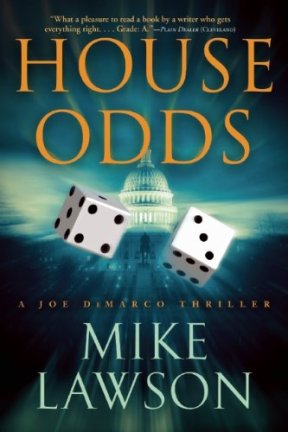
While society adjusts, we can take a tiny bit of solace in the large backlog of excellent material ready to help us forget our woes. Recently I discovered the work of Mike Lawson, who has been at it since 2005. His debut novel, The Inside Ring, featured Joe DeMarco, a D.C.-based fixer and bagman for the Speaker of the House. There are now ten great DeMarco books, very much in the Ross Thomas vein, full of seemingly true-to-life political detail leavened by laugh-out-loud humor. The Speaker,  John Mahoney, is based partly on Tip O’Neill, and frequent sidekick Emma is an ex-spook of wily resource. In this era of relentlessly good superhero characters, it is such a pleasure to read about the exceedingly fallible DeMarco, a guy just trying to keep his low paying job and not get killed or arrested in the process.

Lawson’s prose is smooth and the pages can’t be turned quickly enough. Many of the books have an unusual structure where the main plot is resolved three quarters of the way in before going on another tangent. Perhaps that is to increase word count (the books are all longish thrillers in the current vogue), but I never minded as almost every scene was a pleasure to read. Two of my favorites in the series are House Odds, about corruption in high-end housing in Boston, and House Divided, featuring the rather unlimited powers of the NSA. All the details are believable, nothing turns out quite they way anybody wants, and it is so nice to get genuine laughs along the way. Bravo.

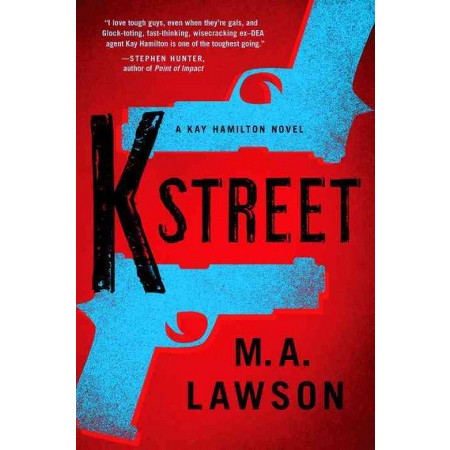
More recently there has been a new series under the name M.A. Lawson. (I first learned about Lawson when picking up the excellent Viking Bay in an airport.) The protagonist is Kit Hamilton, a more flawless and cowboy-derived character than DeMarco, perhaps a kind of female Jack Reacher. The Hamilton books are arguably a shade less distinctive than the DeMarco series but they are still a rollicking good time for lovers of the modern thriller. The latest is just published, K Street, which includes some fabulous scenes of cat-and-mouse worthy of Thomas Perry.

Fans of Perry, Lee Child, Olen Steinhauer, John Sanford, and the rest of the best “tough guy” escapist reading should definitely be enjoying Lawson as well.
k-street

Related DTM: Ah, Treachery!, an overview of Ross Thomas.


“Funny,” he intoned funereally, “how just when you think life can’t possibly get any worse it suddenly does.”

Thanks to all who came out see the group with Tom Harrell, Ben Street, and Eric McPherson. We recorded three nights, we’ll have to see but probably something will be released. At any rate Tom played like an absolute angel.

Next week I’ll be part of Blue Note at Sea with the Bad Plus. My wife and mother-in-law will be along for the cruise as well. Anchors aweigh!

However, in general, the news is too much. I have stuff to blog about but it can wait until there’s more clarity about the trajectory of Trump and Bannon in the White House.

This photo by Nuccio Dinuzzo has gone viral on my Twitter feed, with good reason:

c3eg_s7waaasiaz

W.G. Sebald’s four precious novels are essential reading, especially for those curious about how post-war Germany reckoned with its Nazi past. At this moment we live in fear of a kind of Reichstag Fire  in our country pushing us all the way into fascism. (It’s hard not to imagine Bannon plotting a false flag terrorist attack at this very moment.)

Sebald died in a car crash shortly after 9/11, otherwise he would have had a finer send-off from our American press. It’s just so hard to pay proper attention to the arts in times of stress.

Sarah just reminded me of a relevant quote from Sebald’s Austerlitz that she copied out a few years ago. The narrator first meets the title character in the massive Antwerp train station, which is the jumping off point for a tour de force historical analysis of the rise and fall of Belgium.

Belgium eventually became the butt of a joke by Douglas Adams, the man behind Marvin the Paranoid Android’s quote at the top of this post. One wonders what jokes may eventually be made at America’s expense, assuming there is a future, or at least a future with jokes.

At any rate, Austerlitz’s comment on fortifications (“the more you entrench yourself the more you must remain on the defensive”) seems terribly relevant to our blind and arrogant leaders alienating the rest of the world:

Yet, he said, it is often our mightiest projects that most obviously betray the degree of our insecurity. The construction of fortifications, for instance – and Antwerp was an outstanding example of that craft – clearly showed how we feel obliged to keep surrounding ourselves with defenses, built in successive phases as a precaution against any incursion by enemy powers, until the idea of concentric rings making their way steadily outward comes up against its natural limits. If we study the development of fortifications from Floriani, da Capri, and Sanmicheli, by way of Rusenstein, Burgsdorff, Coehoorn, and Klengel, and so to Vauban and Montalembert, it is amazing, said Austerlitz, the persistence with which generations of masters of the art of military architecture, for all their undoubtedly outstanding gifts, clung to what we can easily see today was a fundamentally wrong-headed idea: the notion that by designing an ideal tracé with blunt bastions and ravelins projecting well beyond it, allowing the cannon of the fortress to cover the entire operational area outside the walls, you could make a city as secure as anything in the world can ever be. No one today, said Austerlitz, has the faintest idea of the boundless amount of theoretical writings on the building of fortifications, of the fantastic nature of the geometric, trigonometric, and logistical calculations they record, of the inflated excesses of the professional vocabulary of fortification and seigecraft, no one now understands its simplest terms, escarpe and courtine, faussebraie, reduit, and glacis, yet even from our present standpoint we can see that towards the end of the seventeenth century the star-shaped dodecagon behind trenches had finally crystallized, out of the various available systems, as the preferred ground plan:

Star castle

a kind of ideal typical pattern derived from the Golden Section, which indeed, as study of the intricately sketched plans of such fortified complexes as those of Coevorden, Neuf-Brisach, and Saarlouis will show, immediately strikes the layman as an emblem of both absolute power and of the ingenuity the engineers put to the service of that power. In the practice of warfare, however, the star-shaped fortresses which were being built and improved everywhere during the eighteenth century did not answer their purpose, for intent as everyone was on that pattern, it had been forgotten that the largest fortifications will naturally attract the largest enemy forces, and that the more you entrench yourself the more you must remain on the defensive, so that in the end you might find yourself in a place fortified in every possible way, watching helplessly while enemy troops, moving on to their own choice of terrain elsewhere, simply ignored their adversaries’ fortresses, which had become positive arsenals of weaponry, bristling with cannon and overcrowded with men. The frequent result, said Austerlitz, of resorting to measures of fortification marked in general by a tendency towards paranoid elaboration was that you drew attention to your weakest point, practically inviting the enemy to attack it, not to mention the fact that as architectural plans for fortifications became increasingly complex, the time it took to build them increased as well, and with it the probability that as soon as they were finished, if not before, they would have been overtaken by further developments, both in artillery and in strategic planning, which took account of the growing realization that everything was decided in movement, not in a state of rest.

(translation by Anthea Bell)

Do or Die

A special one-off gig at the Village Vanguard this week, January 24-29: The Ethan Iverson quartet featuring Tom Harrell with Ben Street and Eric McPherson.

Two summers ago I played a couple of duo gigs with Tom at Mezzrow. They went really well. Everyone who attended agreed that it was wonderful to simply hear Tom Harrell play familiar standards.

Tom is a prolific composer and for many years has been delivering a constant stream of fabulous new tunes with varied and always valuable projects. However, he’s also one of the greatest soloists in classic repertoire, perhaps the last of the line of the melodic bebop/hard bop trumpeters. While tough enough to play with Horace Silver for six years, Tom also has the vulnerability of Miles Davis or Lester Young on a ballad. His lines are always fresh yet authentic.

In a recent DTM interview, Tom mentions favorite solos by Dizzy, Fats, Clifford, Miles, KD, Blue Mitchell, Chet, Lee, Donald Byrd, Freddie, and Woody. This is his tradition yet he also sounds like himself.

Completing the rhythm section at Vanguard will be two of my peers. Ben Street is my great compadre in standards playing and our invaluable academy has been many performances with Tootie Heath and Billy Hart. At this point Ben and I have a mutual harmonic understanding that is both telepathic and contrapuntal.

Eric McPherson comes to the tradition more naturally than Ben or me, having grown up loading in Freddie Waits’s drums into the Vanguard and meeting Max Roach, Billy Higgins, and other heroes while still a kid. Richard Davis is Eric’s godfather. At the age of 20 he went on tour with Jackie McLean, a decade later with Andrew Hill. Eric swings hard but also plays his complete life experience which includes a love of the avant garde and a deep understanding of clavé. Ben recently compared Eric’s conception to Paul Motian and Andrew Cyrille.

Ben, Eric, and me played three gigs together last year. It felt provocative and fresh. Ben and Eric are on the same page personally and musically. One of the gigs was with Dayna Stephens, who told me afterwards he thought that this was one of the deepest bass and drums hook-ups he’d ever heard.

The idea is to treat the band like a rhapsodic yet earthy backdrop for Tom’s gorgeous playing. We’ve all known all the music for decades so there will be no sheet music or intellectual conceits to distance us from spontaneous inspiration. The essential question is, can a quartet still do a hit at the Vanguard playing standards and have it be truly meaningful?

A window is closing. Those of us that really love jazz in all of its most esoteric yet soulful wonder must play well enough to keep this music alive. In my own long journey towards becoming an inarguably valid jazz pianist, this gig may be the final showdown.

I was surprised and delighted with two recent reviews by well-known European critics. Ueli Bernays wrote of Mark Turner and me performing in Switzerland: “Music is now open in all directions with overlapping historical references. In the dense fog of styles one finds no more right and no more wrong. Often one is satisfied with “better or worse” instead of “good and bad.” Yet the pianist Ethan Iverson and saxophonist Mark Turner search together for timeless, absolute qualities. Both have what you originally expected in jazz but most don’t dare to do anymore: an unmistakable personal style.” John Fordham reviewed the last trio disc with Ron Carter and Nasheet Waits: “The patient leader assembles new melody lines with trenchant invention in solos that sound increasingly like purposeful narratives.”

Well, I hope the overseas critics are right. This week we will find out at the ultimate testing ground, the greatest jazz club ever, the Village Vanguard.

Iverson/Harrell/Street/McPherson sets to be drawn from this list:

All the Things You Are
Invitation
Out of Nowhere
The Song is You
I Remember You
I’m Getting Sentimental Over You
I’ll Remember April
Stella by Starlight
Cherokee
Three and One (Thad Jones)
“Old” (John Lewis) Milestones
Wee (Denzil Best rhythm changes)
Dance of the Infidels
Moon and Sand
Sail Away (Harrell’s tune is a standard at this point)
Sentimental Journey
Polkadots and Moonbeams
The Man I Love
Lover Man
I Can’t Get Started

It was the 50’s

Feast your eyes on this detailed post at Darwination offering scans of the first issue of Duke, a short-lived men’s magazine aimed at an African-American audience. The literary content is astonishingly strong. So are the images, including an example of Esmond Edwards‘s photography.

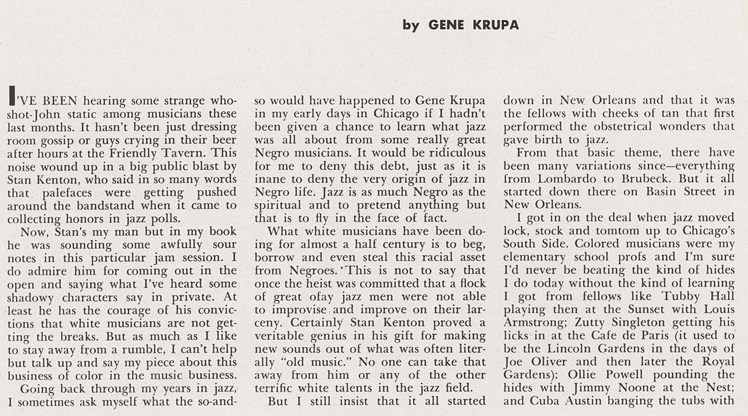
Of special interest to jazzers is a fairly long and provocative essay by Gene Krupa. (When working on my Whiplash essay a few years ago this would have been helpful.)

Krupa starts on a strange note, a kind of half-assed rebuttal to Stan Kenton’s infamous 1956 telegram to DownBeat claiming the critic’s poll created “a new minority group, white jazz musicians.”

krupa-lede

Throughout the article a lot of what Krupa says is correct, but in the end I feel like he’s not owning up to his massive stardom. At his height Krupa had much bigger name-recognition and made much more money than any great(er) black drummer. If Krupa is making an effort to give back, he’s not really doing enough. Still, it is an interesting read, and an interesting venue for such a missive.

There’s lot to be found in 20th century African-American periodicals about jazz: This would be a worthy research topic, as these sources are often overlooked. (Apparently Duke only lasted six issues. Two decades later another skin mag, Players, was more successful. The Players music critic was Stanley Crouch.)

Thoughts of the late Nat Hentoff prompted another look at some of The Jazz Review. David Reaboi tweeted the June 1960 issue. The tensions of the era are on full display, tensions that in some ways remain unresolved today. While the Review is hip enough to have a lot about the authentic blues, there are also broadsides more or less against the form from an unlikely pair, Leroi Jones (Amiri Baraka) and Gunther Schuller.

Most fans today consider Cannonball Adderley’s Quintet in San Francisco to be a classic disc. But at the time:

jones-on-cannonball-copy

In his way, Gunther Schuller is just as condescending about Thelonious Monk’s Alone in San Francisco:

gunther-on-monk

Frankly, I think there is only one response to hearing Thelonious Monk play a blues: reverence.

We should also bow down before Bobby Timmons on the Adderley date, especially on his classic “This Here,” which Cannonball describes in his spoken introduction as, “A jazz waltz…however, it has all sorts of properties. It’s simultaneously a shout and a chant.”

These two famous critics try and fail to make these records fit their own needs as historians and gatekeepers. In their defense, all of jazz was really incredible in 1959. A peak moment in human art. It is easier to miss the forest for the trees when there are so many beautiful trees!

Blues for the Old Man of Jazz

The late Nat Hentoff was one of the most important jazz scribes from the era of greatness and the era of innocence. For a moment he was even a record producer, with his Candid label making several stone classics including Charles Mingus Presents Charles Mingus and The World of Cecil Taylor. As a magazine editor he helmed a few wonderful years of the Jazz Review, the glories of which remain surprising to those first discovering the archive. There are also several hundreds of liner notes and a few notable books. Hear Me Talkin’ to Ya with Nat Shapiro remains essential for historians and the young adult novel Jazz Country had wide circulation.

The Hentoff I know best is his summation and valediction, Jazz Is from 1976. These philosophical and metaphorical essays about various legends are liberally sprinkled with evocative quotes and photos. Mark Stryker still recommends it as the best gateway book into jazz.

There’s no good reason to be in this profession unless you have an essentially romantic relationship to the heroes of the music. In Jazz Is, the chapter on Charlie Parker is called “The Great Speckled Bird.” I was so happily verklempt poring over that title and that chapter while still a teenager.

Hentoff had riffs, and eventually those riffs might have become predictable. However, Hentoff had a right to those riffs, for he was there.

In Jazz Is and on many other occasions Hentoff told of being in the room the last time Lady Day and Lester Young played the blues together, for the television show The Sound of Jazz produced by Hentoff himself. Damn, that Pres chorus is simply unbelievable. But really everyone participating is wonderful.

For Nat Hentoff, one more time:

The Last Days of the Mikado

Michael Cooper’s recent article in the New York Times prompts introspection.

Probably live performances of The Mikado will last only another decade or so, as this classic operetta is incontrovertibly racist.

This classic operetta is also an authentic work of human genius, arguably the finest example of its kind. But there’s a lot of great music out there; I guess we can afford to lose this particular item.

On the positive side, proper documentation of The Mikado will always exist. There are many recordings and the movie Topsy-Turvy is wonderful.

However, no record really will ever measure up to live performance, especially since The Mikado might be best served by enthusiastic amateurs in a collegiate or community theater who transcend their circumstances to produce a humble miracle of drama, comedy and music.

That’s really the sad thing, to lose amateur Mikados, but collegiate or community companies are the most vulnerable to political pressure.

Postmodern Mikados will now have their day in major venues, but it’s hard to imagine them maintaining much interest for too long. It’s only Gilbert and Sullivan, after all, not Wagner or someone else who can bear the weight of soul-searching investigation.

In Modern Music and After, Paul Griffiths writes of Cornelius Cardew’s move to the extreme left in the 1970’s:

“…The musical quality was not the point….Progress now, for Cardew and composers who thought like him, could only be political progress, and music must relinquish all its own hopes and histories in order to serve that cause.”

Shirley Henderson in Topsy-Turvy: