Early British Syncopation (Percy Grainger and Constant Lambert)

[Fourth post about the forthcoming Ethan Iverson Residency in London]

For “Ethan’s Rent Party” I am joined by two brilliant UK keyboard stylists, Adam Fairhall and Alexander Hawkins. I can’t wait to hear what Adam and Alex get up to. Among other things we are all playing a song by Ray Noble….

The following are notes for two of my own selections, “In Dahomey” by Percy Grainger and the first movement of “Piano Sonata” by Constant Lambert.

Black music from America went all over the world in the first part of the 20th Century. Eventually the 1920s would be called “the Jazz Age.”

The piano was central to the incursion, especially the notated ragtime of Scott Joplin. However Joplin never toured. African-American ensembles and shows were what made it to London. On the 16th of May 1903, Will Marion Cook’s revue “In Dahomey” played at the Shaftesbury Theatre. Percy Grainger was in attendance, and the resulting concert rag “In Dahomey” (based on themes by Cook and Arthur Pryor) is a rare example of exceptionally detailed notation in the service of a syncopated style. It also tries to emulate the slide trombone. Overall “In Dahomey” is of a piece with the transcription of folk elements exploited in so much Grainger, including what many consider his greatest work, “Lincolnshire Posy.”

Apparently Grainger worked off and on “In Dahomey” for six years, but then didn’t publish it. After Ronald Stevenson finally oversaw an edition in 1987, it has become one of Grainger’s most popular piano pieces. A brilliant concert pianist like Marc-André Hamelin plays it to the virtuoso hilt, but there’s also an argument for a more quotidian approach emphasizing dance rhythm and improvised variation. Incredibly, I had an exchange on Twitter with Mr. Hamelin about this very topic:

twitter 1twitter 2


Grainger’s exceptional recordings of Debussy’s “Golliwog’s Cakewalk” and Guion’s transcription of “Turkey in the Straw” have informed some of my stylistic choices.


Exactly twenty years after Will Marion Cook played the Shaftesbury Theatre, Constant Lambert saw Will Vodery’s black orchestra in the 1923 revue “Dover Street to Dixie” at the London Pavilion. Lambert immediately began trying to assimilate a syncopated influence in his compositions, including what remains Lambert’s most famous piece, “The Rio Grande.”

The “Piano Sonata” from 1929, written when Lambert was only 24 years old, is a shade over-ambitious, especially as the three movements get longer and harder as they go along. However, the first movement is reasonably self-contained and flows along in impressive fashion. It certainly is just as good (if not better) than other “concert” jazzy works from the era by George Gershwin, Aaron Copland, Darius Milhaud, and a forest of lesser composers. I played it for my hip NEC students this past Monday and they were flummoxed.

My joke is that some of it sounds like things Danilo Pérez would play in the Wayne Shorter quartet. (voice memo recording w. Brooklyn construction in the background)

lambert ex.jpg


Duke Ellington is a linking theme. Will Marion Cook and Will Vodery were two of Ellington’s teachers and mentors. Both Grainger and Lambert knew and respected Ellington. There’s a picture of Grainger with Ellington when Grainger invited Ellington to his NYU classroom in 1932. Lambert (who had a major career as a feisty critic) was one of Ellington most vocal supporters in the 1930s, writing in the famously caustic Music Ho! that Ellington, “…Has crystallized the popular music of our time and set up a standard by which we may judge not only other jazz composers but also those highbrow composers, whether American or European, who indulge in what is roughly known as ‘symphonic jazz.’”

Truthfully, most of Duke Ellington’s records are proving to be more immortal than most of the compositions of either Percy Grainger or Constant Lambert. However, all of us in this game strive towards better and better appropriations and synthesis. An opportunity to study and perform Grainger and Lambert is a wonderful and decidedly syncopated event!

—-

Bonus tracks: I feel a special connection to Constant Lambert because I adore the twelve book sequence A Dance to the Music of Time by Anthony Powell. Powell was close friends with Lambert and put him in Dance as composer Hugh Moreland. Lambert was also involved with literal dance: Indeed, some argue that Lambert’s greatest legacy was as the conductor of the Royal Ballet. Since I myself have been quite involved with the dance world (especially with the Mark Morris Dance Group and Dance Heginbotham), I relate to this side of Lambert as well.

While from this distance Grainger and Lambert seem to have a lot in common, I checked the indexes of the major biographies and they are barely name-checked in each other’s stories. They did meet at least once at a café table in France, in the company of composer Arthur Bliss, but that seems to be the extent of a documented connection. In the end, despite his reputation for English folk song transcriptions like the omnipresent “Country Gardens,” Grainger was a devout experimentalist, and pairs more easily with people like Henry Cowell or Ferruccio Busoni than most other composers of his era.  Lambert, for all his enfant terrible attitude in print, was actually more of an establishment figure than Grainger.

“Afterglow” by Marian McPartland

[Third post about the forthcoming Ethan Iverson Residency in London]

Marian McPartland was a pal of my teacher Sophia Rosoff. They were relatively close in age (Marian was born 1918, Sophia 1924) and had known a lot of the same people over the years. Thanks to Sophia, I was featured on Marian’s legendary radio show “Piano Jazz.” Wow, was Marian a pro! Just a wonderful radio personality. At the studio she made me feel really comfortable and even learned one of my tunes. In high school I had listened to “Piano Jazz” whenever I could — I particularly remember the Eubie Blake episode — and it was a bit surreal to be in that situation as a participant.

(Sophia would always tell her students about Marian’s daily question to everybody in her peer group, including Sophia: “Are you getting laid?” Sophia would then respond, “Marian, you are so very English.” Marian was around 90 and Sophia 84 at that time.)

The best McPartland album I know is a lovely recital of Alec Wilder themes. There’s a new interest in Don Shirley due to the movie Green Book, and in a way one can see Shirley and McPartland as part of a midcentury continuum of lush piano that intersects with jazz and song. Wilder and Cy Walter would be one end of the spectrum, Erroll Garner and Ahmad Jamal on the other, George Shearing and André Previn dead in the middle. If you dared you could put Ramsey Lewis and Roger Williams in there. Certainly both Liberace and Nat King Cole have a place.

I wanted to include a McPartland selection for the night of jazz composers partly because a solo ballad would give the full quintet a break. After listening to all the McPartland ballads I could find (Thad and Mel played “Ambience,” which might be the best known to McPartland piece to jazz buffs) I settled on “Afterglow,” which has a splendid live recording on YouTube.


I left this until the last minute to work out, and finally transcribed it last night. My rhythmic notation involves a lot of guesswork. It’s also just for me, so I cut a few corners that I wouldn’t if I was handing the chart around for rehearsal with a band.

Afterglow

Fooling around with it just now I felt it was too high in range for my usual ballad approach. At first I was transposing to lower keys but then I realized I could just drop the octave for the first half.  A voice memo recording from ten minutes ago shows potential.


I still have a couple of days to sleep on it, and then in concert, who knows, perhaps lightning will strike. One of the great things about jazz is how at the last moment, one can decide to do something completely different….

“And On the Third Day” by Michael Gibbs

[Second post about the forthcoming Ethan Iverson Residency in London]

Many jazz musicians roughly in my generation and a bit older used the Real Book when we were too young to know better.

The book was created by two students who were in the Berklee jazz program in Boston. Gary Burton was head of that department and the Real Book had a lot of lead sheets by musicians supported by Burton: Carla Bley, Steve Swallow, Pat Metheny, Eberhard Weber, Bob Moses, and so forth, most of whom could be found on ECM records. The most mysterious name might have been trombonist and composer Michael Gibbs. Burton recorded several Gibbs pieces and (I think) suggested “Sweet Rain” to Stan Getz.

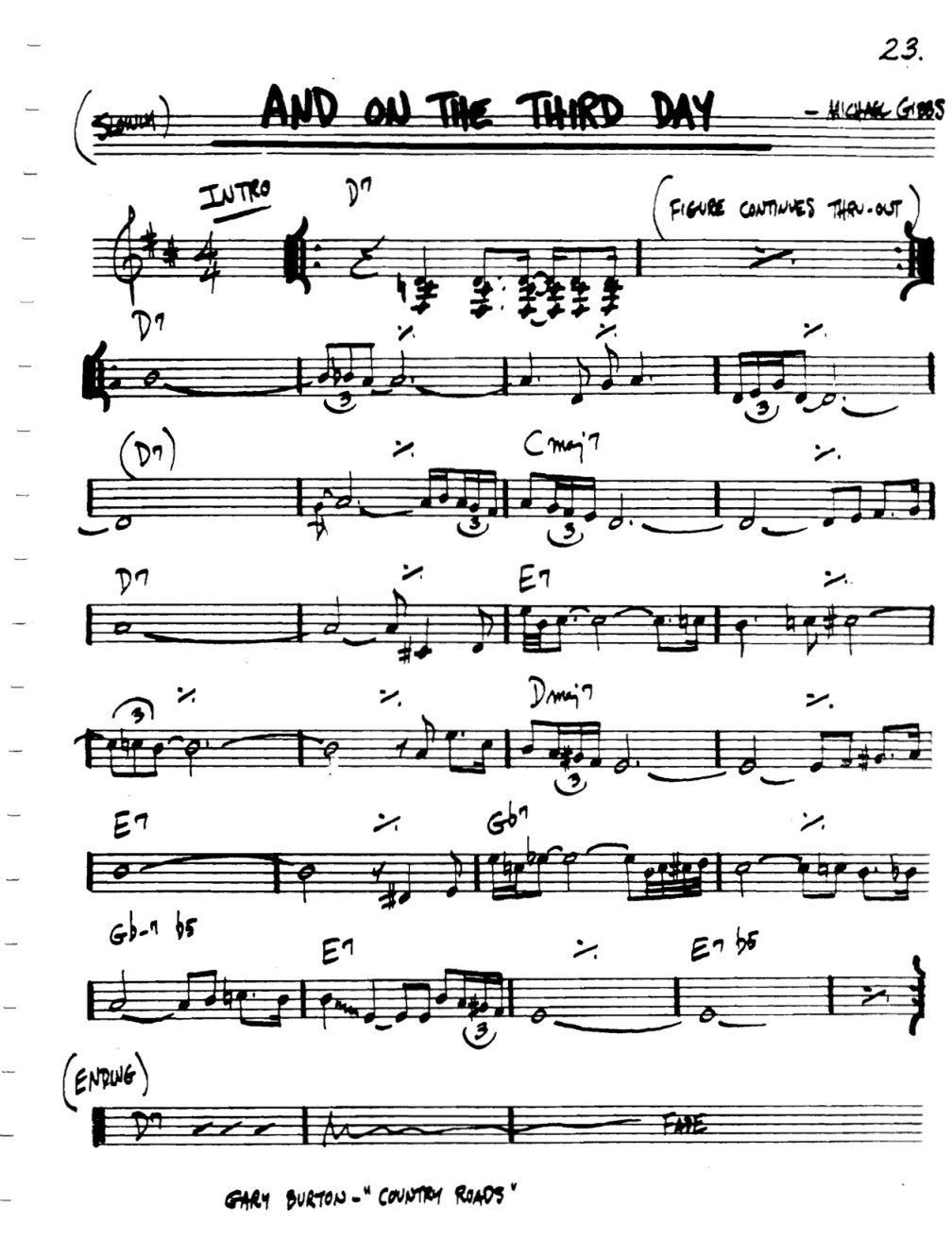
Early on in the Real Book was a chart to “And On the Third Day.”

gibbs real book


I read through this chart as a kid and it made no impression. However various people have kept mentioning Gibbs’s name to me over the years, so he’s stayed in the “to be investigated further” pile of my subconscious.

When I began assembling a playlist of British composers for my London residency I finally started checking Gibbs out. The 1970 debut album Michael Gibbs on Deram proved to be a thrilling listen, especially the last track, “And On the Third Day.”

“Day” is the precise intersection of British Invasion rock (Jack Bruce is on bass!) and the Ellington/Mingus big band tradition. Amusingly, the overall vibe strongly reminds me of the brilliant compositions of Reid Anderson (although I can guarantee that Reid never checked out Gibbs).

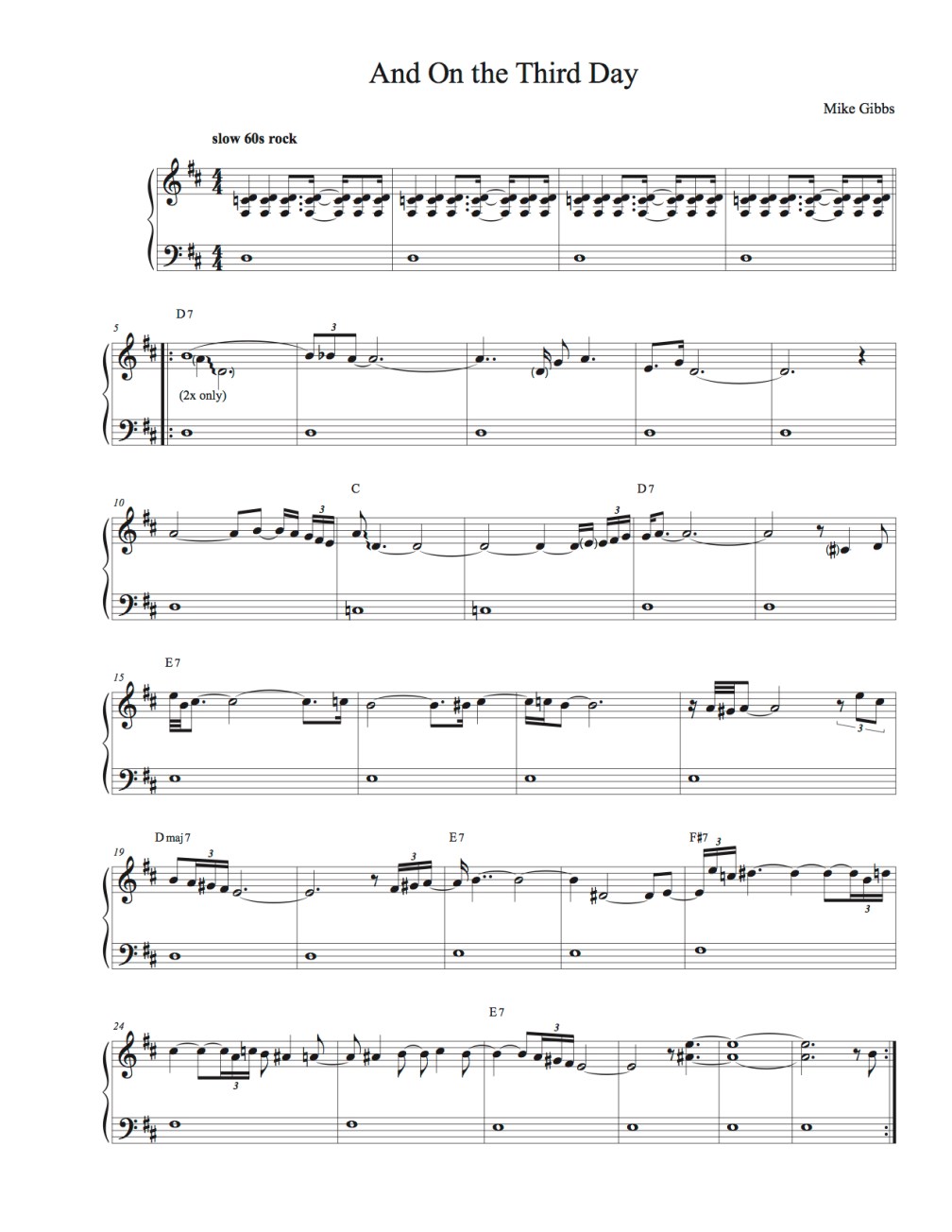
At one point I thought the Real Book charts of the Burton circle were much better than those of the jazz masters. To my surprise, the Real Book chart of “And On the Third Day” is just as bad as selections by Monk or Miles. I had to completely re-transcribe it:

And On the Third Day iverson

The take has hot trombone from Chris Pyne, incandescent baritone from John Surman, and a delightfully period beat from John Marshall. (Surman will also be represented in my quintet playlist at Kings Place.) Truly, I think this shambling anthem is one of the greatest things ever recorded.

RIP Sonny Fortune

In the early 2000s, I saw Sonny Fortune and Rashied Ali play duo at Sweet Rhythm. The set was “Cherokee” for an hour. After Ali set up the “Indian tom tom” intro, Fortune played for forty minutes, Ali soloed for about ten, and then Fortune played another ten. No bass; no piano: Duo.

Ali was no Max Roach when it came to uptempo bebop, but he hung in there. His stamina was one reason Coltrane hired him all those years ago. Fortune played a mixture of Bird and Trane spiced with his personal kind of incandescent lyricism.

They were already old men but they were there to prove something about intensity, black music, and the lineage. Cecil Taylor was in the corner, grinning. It was a real New York night of real New York jazz.

Time Tunnel

New at the New Yorker Culture Desk:  The Music of “Doctor Who” Makes a Glorious Return to Form.

My brain is far too full of Doctor Who trivia, musical and otherwise. A few things I left out of the essay:

Dudley Simpson died last November at 95, a passing I wasn’t aware of until this week. I once spoke to Simpson briefly on the phone. At that time I was doing a few interviews for the BBC, and thought it would be great to give Simpson some space. While in Sidney for a few days I called all the “D. Simpsons” in the Australian phone directory and reached the legendary composer. The BBC passed on the interview and Simpson was already in frail health and wasn’t up for a visit. However, at least I got to tell Simpson how much his music meant to me. He’s certainly a direct influence. One time in the late 90s I played the VHS of “Pyramid of Mars” for Reid Anderson and Jorge Rossy. They both started laughing at how much the music on the TV serial sounded like some of my compositions for Construction Zone.

Many of the 60s Doctor Who stories are lost. Recently “The Enemy of the World” was rediscovered and released. I loved the novelization as a child so couldn’t resist sitting through all six slow-moving episodes. There’s not much music, what’s there is “stock” and by Béla Bartók. I suspect in the end 20th century genre TV and movie composers imitated Bartók more than anybody else; he’s certainly a big influence on Simpson.

For “Rosa,” Segun Akinola uses some horns borrowed from the Aaron Copland tradition. It’s quite delicate but also suggests the whole span of American experience, which helps the episode from becoming too preachy.

About Murray Gold: Hiring a symphony is obviously a classy move, but the sampling, compression, and click track used in the studio to create a “flawless” product removes the natural grain of a real orchestra playing with a human beat. When auditing this kind of modern product (which is heard everywhere these days, from Hollywood on down), it is hard to tell the difference between real instruments and a good sample library. I want the players to have a gig, of course, but what’s the point of having a real band if they aren’t going to be at least a little out of tune once in a while?

“Ethan Iverson in London”

[As part of the EFG London Jazz Fest in November, I am curating a three-night overview of English jazz.]

I’m a lifelong Anglophile. When I was a little boy I loved Doctor Who, and won a contest for dressing up as Jon Pertwee at major science fiction convention in Chicago. (Many years later, when meeting Courtney Pine professionally, I surprised Pine by citing his performance in the Doctor Who episode “Silver Nemesis.”) The title of my recent ECM album with Mark Turner, Temporary Kings, comes in part from a favorite author, Anthony Powell, and his masterful cycle A Dance to the Music of Time.

I’ve also always loved English jazz, it’s one of the strongest non-American jazz traditions. It is high time a New Yorker paid tribute to London instead of it always being the other way around! Each night will flow naturally and be a lot of fun.

Concert One
Friday November 16 Kings Place Hall 2
Raising Hell with Henry Purcell

I first got to know Henry Purcell’s music when I was rehearsal pianist for Dido and Aeneas with the Mark Morris Dance Group. Purcell remains eternally fresh and surprising. In some ways he is a real avant-garde composer, with odd phrase lengths and strange resolutions. He was also a quintessential author of fanfares: Bright, clear melodies that raise the curtain for more complex emotions.

The current experimental jazz scene in London is very strong, and it will be a real pleasure to present some Purcell fanfares to unruly young masters and see what happens. I will be “directing” the affair from a harpsichord but I guess Brigitte Beraha, Mandhira de Saram, Cath Roberts, Dee Byrne, Kim Macari, and Olie Brice will be free to rebel against the concert master if they must…

Concert Two
Saturday November 17 Kings Place Hall 1
Ethan and the British composers

It’s comparatively unusual for non-Americans to make an impact on the serious NYC jazz scene, but there’s not a Manhattan bebopper who doesn’t play George Shearing’s “Conception” or Victor Feldman’s “Seven Steps to Heaven.” The innovations of Kenny Wheeler, John McLaughlin, Dave Holland, and Evan Parker have been absorbed into the language. Marian McPartland was a close friend of my teacher Sophia Rosoff, and as a result I was one of the hundreds of musicians to appear on Marian’s delightful radio show, “Piano Jazz.”

I’ve always been interested in all sorts of other wonderful English players, from Tubby Hayes to Joe Harriott to John Surman to Django Bates. One time when I was working in London I ventured on the tube to a distant pub to see Stan Tracey. More recently I have been gigging with Martin Speake.

At Kings Place I have a terrific quintet: Laura Jurd, Peter Wareham, Tom Herbert, Sebastian Rochford. We’ve been talking over the set list, but it will certainly include a chorale from Surman, a rock anthem from Michael Gibbs, a waltz from Gordon Beck, a blues from Nikki Iles, and other pieces that deserve “repertory status.”

Sunday November 18 Kings Place Hall 2
Ethan’s Last Rent Party

One of the first people who wrote something sensible about Duke Ellington was the English composer, critic, and ballet conductor Constant Lambert. As result the two became firm friends. The Lambert-Ellington connection is just one of many fascinating links between the English and American communities in the early days of jazz. I’m going to play the first movement of Lambert’s remarkable jazz-influenced Piano Sonata from 1929. (It’s better than comparable jazz-influenced piano pieces by Aaron Copland or Darius Milhaud.) An obvious pairing is Percy Grainger’s “In Dahomey,” a striking concert rag “dished up” after seeing a performance of Will Marion Cook’s revue of the same name on Shaftesbury Avenue. (Cook was Ellington’s teacher.)

Much of early ragtime, jazz, and other syncopated strains revolve around the piano. For this “Rent Party” I am joined by two brilliant UK keyboard stylists, Adam Fairhall and Alexander Hawkins. The original idea of this series was partially inspired by the Beaver Harris slogan, “From Ragtime to No-Time.” With Fairhall and Hawkins present, all the bases will be covered: When I last checked, William Byrd, Billy Mayerl, and Ray Noble were on the program. At a Rent Party in New York, we all play James P. Johnson’s “Carolina Shout.” In London I thought it would be amusing if we all had to play Grainger’s “Country Gardens.” Buckle up!

[tix here]

Eduard Erdmann plays Ernst Krenek “Little Suite Op. 13A”

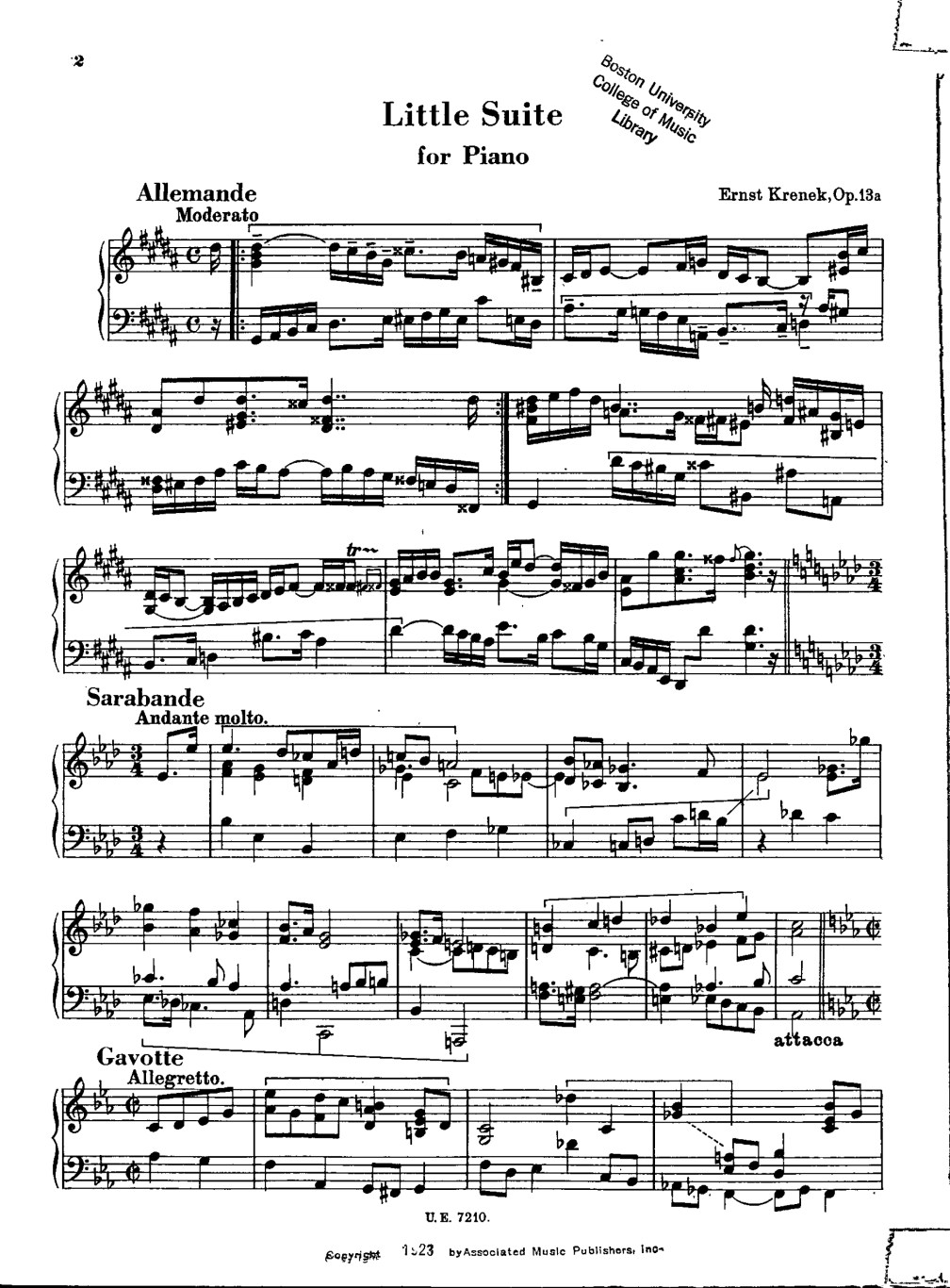
For some time I’ve been impressed by a rarity on YouTube, Eduard Erdmann playing Ernst Krenek’s Kleine Suite Op. 13A in 1928.

The score is very hard to find. I finally ran down a copy: Reading through it is fun, but the pages also prove that Erdmann’s wonderful handling of the keyboard is a major part of the recording’s charisma.


The tiny movements are: Allemande – Sarabande – Gavotte – Waltz – Fugue – Fox Trot.

Erdmann plays the repeats as written.

First two pages of score:

krenek 1

krenek 2.jpg

Wikipedia: Eduard Erdmann, Ernst Krenek.

Circles and Benchmarks, Friends and Neighbors

fullsizeoutput_e7d

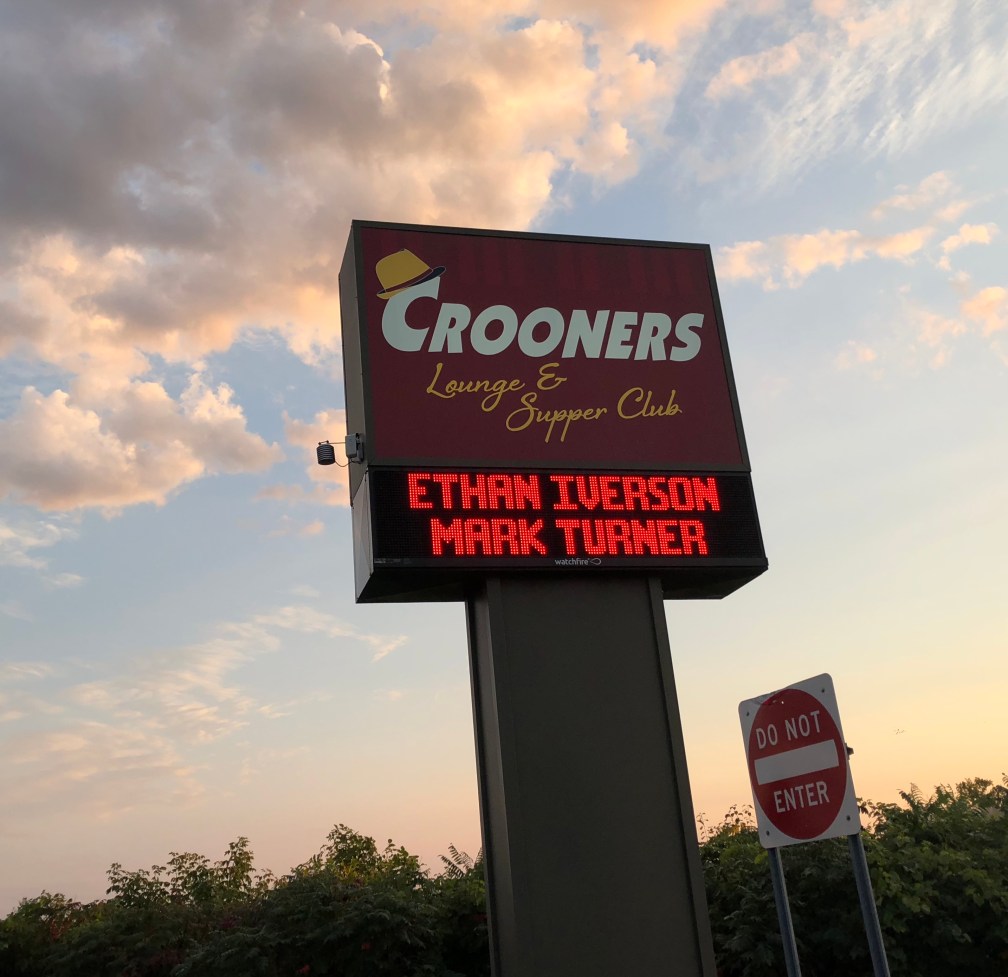
Duo tour with Mark Turner continues this week in Europe. If you come by, say hi!

TUESDAY, OCTOBER 23: DUC DES LOMBARDS, PARIS/FRANCE

WEDNESDAY, OCTOBER 24: DUC DES LOMBARDS, PARIS/FRANCE

THURSDAY, OCTOBER 25: BLUE NOTE MILANO, MILAN/ITALY

FRIDAY, OCTOBER 26: SALA VANNI, FIRENZE/ITALY SATURDAY,

OCTOBER 27: JAZZ CLUB FERRARA, FERRARA/ITALY

SUNDAY, OCTOBER 28: ARGUS COLLECTIVE@ IL CANTINIERE, ROME/ITALY

MONDAY, OCTOBER 29: BOGUI JAZZ, MADRID/SPAIN

TUESDAY, OCTOBER 30: BARCELONA JAZZ FESTIVAL, BARCELONA/SPAIN

WEDNESDAY, OCTOBER 31: DE SINGEL, RIKEVORSEL/BELGIUM

Philip Freeman spoke to us together for the podcast Burning Ambulance.  As I recall, both Mark and I were reasonably frank…

Guardian review of Temporary Kings by Dave Gelly.

We also were interviewed over email for an Italian magazine. Mark has rarely written anything about music or culture, so I was pretty excited to read these thoughtful paragraphs.  (Eventually these will be translated in Italian for the print issue of Musica Jazz.)

Mark Turner’s written comments are in bold.

1) Could you briefly recap your formative years?

I was born in 1965 at Wright Paterson Air Force Base in Ohio USA. Started playing the clarinet at 9 years old. I was introduced to Jazz, Soul, R&B through my parents as well as some of their close friends who were also Jazz enthusiasts. I would say that it was part of the culture at that time (mid 60’s though 80’s) for young black highly educated adults of their set to listen to this array of music. After college I went to NY and worked a day job and played in the street until moving to New Orleans for nearly a year. I moved back to NY and started working and recording there with many of the young musicians of the day. I also played for a while with Rufus Reid during this time and learned quite a lot from him.

2) Who are the musicians who mostly contributed to your growth?

Although I still learn from older musicians and those my age and younger, in my formative years that would be musicians like Billy Pierce and George Garzone who I studied with while at Berklee. Leo Potts who I studied with at Long Beach State. Also John Coltrane, Joe Henderson, Warne Marsh, Miles Davis, Wayne Shorter, Lester Young, Dexter Gordon, Sonny Rollins, Rufus Reid, Billy Hart. My peers would include Kurt Rosenwinkel, Ben Street, Jeff Ballard.

3) How do you regard your experience in a cooperative trio setting?

It’s been great with FLY. That said we do not play all that much but we have grown quite a bit in spite of that, as evidence our most recent tour last January. Maybe we are just getting older.

4) What is your opinion about the current European jazz scene, not only regarding musicians, but also promoters and audience?

Without Europe much of the touring we do would be gone. Each country is different of course but collectively there is a strong culture for support of the arts. I only have good things to say as it is a blessing that there are promoters, club owners, jazz societies, and audience that are even interested in hearing the odd/weird music that we play. In terms of musicians, I’ve spent a fair amount of time playing with European musicians. Some, like Jochen Rueckert and Jorge Rossy, are New Yorkers at this point as they have lived there for so long. Others are back and forth between US and Europe. Others less so. My point is that the European scene has gradations of proximity (close to far away) to the US in terms of sound/way of playing/compositions etc. All of it is of interest as each country incorporates it’s culture into an American art form.

An example: playing with Enrico Rava was a special treat and learning experience. He has the experience and mastery that any American musician of his age and stature. The difference is that his perspective is uniquely European. He and his generation did play with Americans of their day and he did do the New York pilgrimage. Yet his music is something that could only be an outgrowth of Italian culture. On  my first gig with him we were playing in a large hall in Rome. No rehearsal. Some of the tunes had a succession of repetitive II/Vs with late romantic type melodies. Really beautiful! They looked on paper like standards. I thought, “Ok this seems familiar.” Yet the melody/chord/form relationship was something that could not and would not ever originate in America. A bit like a Twilight Zone moment! The music lead me through a door that I would not have recognized otherwise. A fantastic juxtaposition of free form, melody, structure and old world wisdom. It felt familiar and utterly foreign. Like an American tourist might have felt in the 50’s or 60’s. The best of the European scene feels like this. Culture is strong…it can seep through in ways we cannot explain.

5) What about the present day American scene? What are the pros and cons?

Pros: audience, promoters, Jazz societies etc. are all fantastic for the same reasons as their European counterparts.

Cons: the US and Canada are large countries where mid size to large cities are very far apart ( the opposite of European countries). The audience, promoters, venues are there but spread out thinly on a vast landscape. This makes it difficult if not unfeasible to tour on the same level as in Europe. That said, I think this beginning to change.

Historically speaking the flight to the suburbs, urban planning, dismantling of public transportation (by oil companies), and the rise of home entertainment have significantly hurt live performance in the US among other issues. This phenomenon is particular to the US more than Canada, I believe. I don’t see this nearly as much or at all in Europe or Asia. Many people still live in cities and go out for entertainment, museums, dining, etc. They have proximity to each other and their culture…and more of a collective mind set with common cultural goals, relatively speaking. The US is a country of immigrants that even to this day do not share as much in common as say most Italians.

We also have the legacy of a caste or “Apartheid” type of society. Why do I mention this? Up until the 1950’s Americans were either rural or lived in cities. We were in some ways more like you in Europe. We were in separate “ethnic” parts if town but we were together in some shape or form within walking or trolley/subway distance to the nearest show. After World War ll their was a “white flight” to the suburbs…cities centers began a slow decline. Urban planning beginning in the 60’s and 70’s devastated many African American communities and city centers in general. Venues where a lot of Black entertainers including Jazz musicians performed, all racial groups attended.

By the the end of the 70’s much the infrastructure (venues, promoters, record companies) that maintained this Black entertainment culture (music, comedy, theater, etc.) was mostly dismantled. Meanwhile home entertainment demand rose as people in suburbs needed entertainment of some kind. Live entertainment of all types began a slow decline relegated only to the largest cities in the US (which are often 1600 kilometers apart or more).

Pre 1975-80 a North American musician could make a living in his/her city of residence and tour the US/Canada without ever going to Europe or Asia. Of course, musicians did travel to Europe and Asia but it was not a necessity. Today this is not the case although I think the tide is turning back to a pre 1980’s model. Why? There is a new relatively young leisure class that is moving back into cities from the suburbs all over the US and Canada. This means gentrification in cities all over North America with pros and cons in it’s own right. That said what it means for Jazz is that these people want things to do such entertainment, dining, recreation etc…which is creating a rise in venues to play. The most common example is venues like SF Jazz, Lincoln Center, Jazz St Louis, and others of a similar model.

Musically the scene is vibrant and exciting. Musicians young to old are making the music survive and thrive.

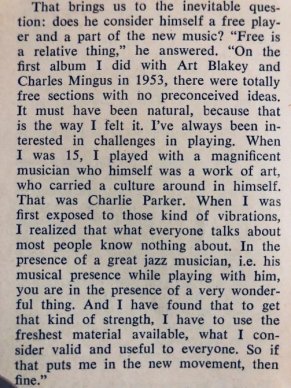
James Busby gave me an 1968 Downbeat that contained interviews with two of my favorites, Paul Bley and Hampton Hawes.

Bley on Bird:

Bley on Bird

Hawes:

Hamp on bassists and drummer

There was even a chart to Annette Peacock’s “Blood.” Damn. 1968!

Annette Blood

RIP Hamiet Bluiett. One of my all-time favorite tracks is “R&B” by the World Saxophone Quartet on Steppin’Sam Newsome offers a valuable anecdote.

PK5QK0CGT9W37QM3ryc6hg

Thomas Morgan and Eric McPherson finding the beat

IMG_0394.JPG

Miranda Cuckson after rehearsal in Brooklyn

wfZPyVqTTUi5GW2fByPTOQ

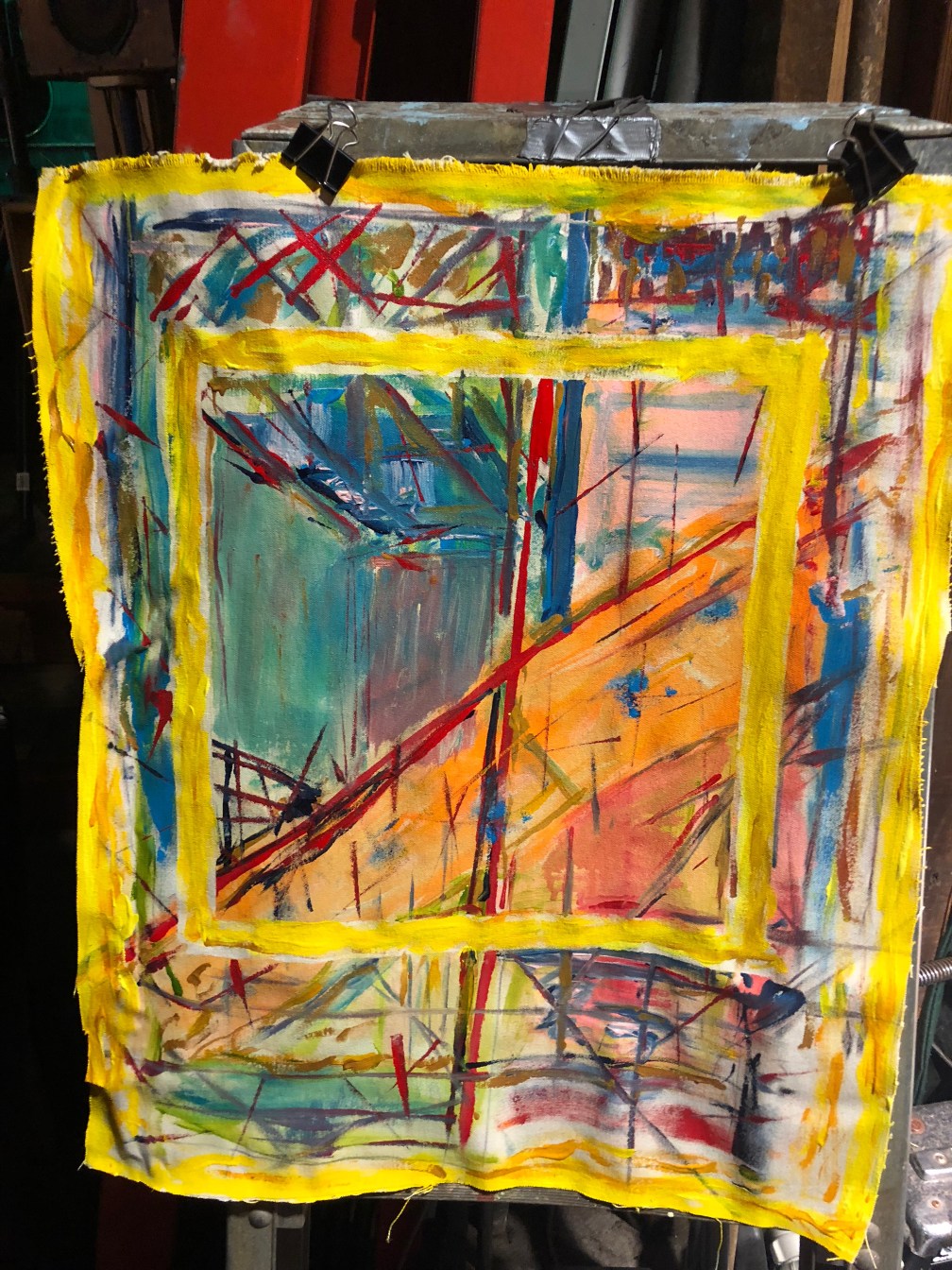
Justin Neely painted while Miranda and I played; the fabulous result is called “Everything That Was”

fullsizeoutput_e92

with Mark Morris

IMG_0379

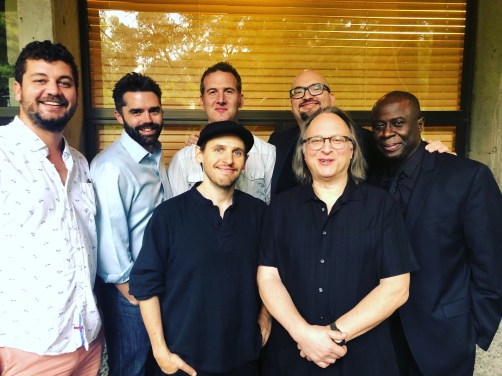
Pepperland band: Clinton Curtis, Colin Fowler, Jacob Garchik, Vinnie Sperrazza, Rob Schwimmer, Sam Newsome

(Rachel Howard review of Pepperland in Berklee for SF Chronicle Datebook.)

Do You Know What It Means

Curator David Kunian reached out and suggested that I play a visit to the New Orleans Jazz Museum. It’s located on high ground between the French Quarter and Frenchman Street in one the sturdiest of the city’s structures, the Old U.S. Mint.

fullsizeoutput_f22

There are currently exhibits on Professor Longhair

chIY0x4fRmWaKPgHEXwiqg

The museum was busy, it was hard to get a photo without many people. Listening to various Longhair tracks was really fun

fullsizeoutput_f37

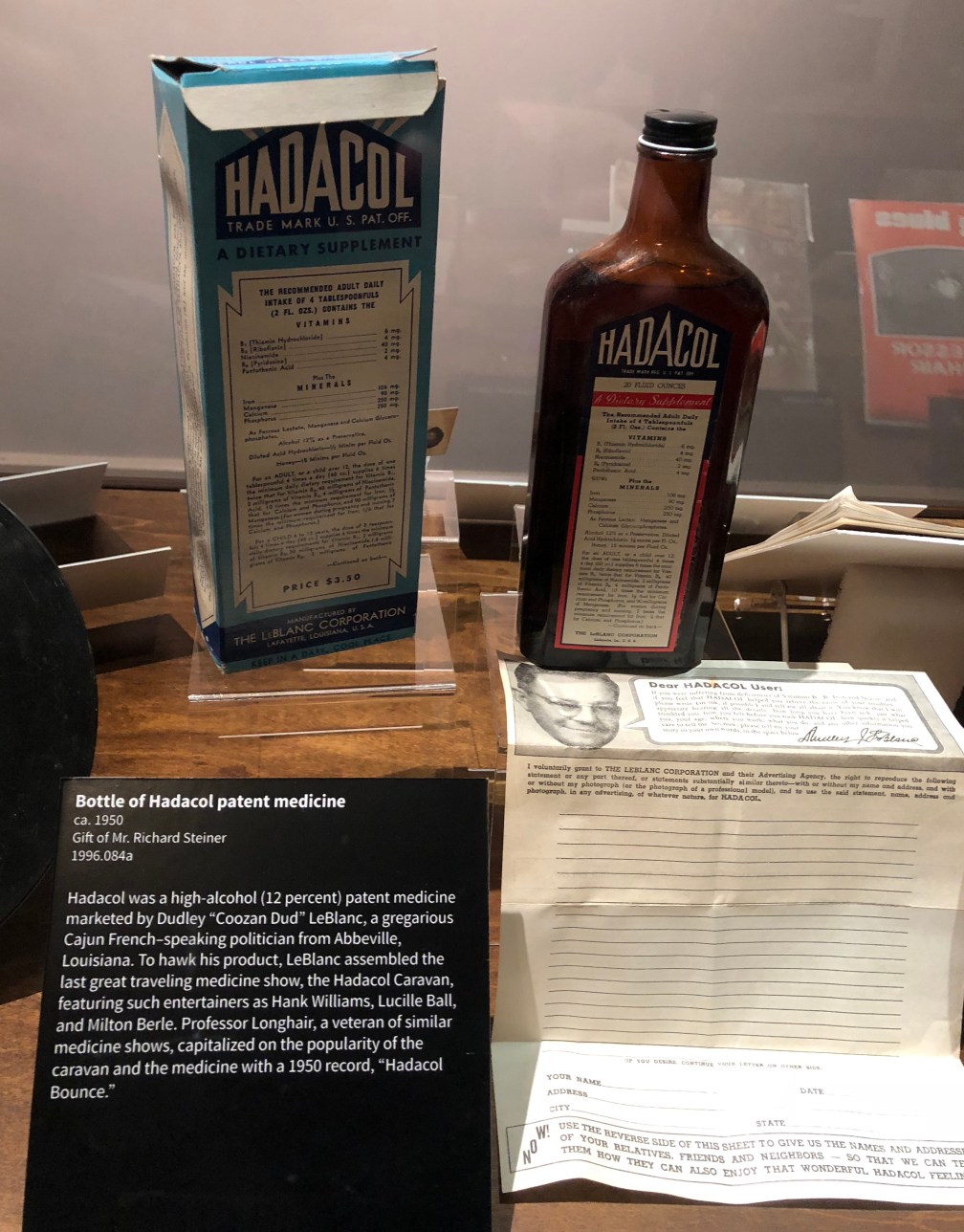
Let’s get high on medicine

6KGMEtlyQpeGlWzZtXA%Jg

I learned about Fess from the documentary PIANO PLAYERS RARELY EVER PLAY TOGETHER, which is newly re-released with additional interview footage as FESS UP

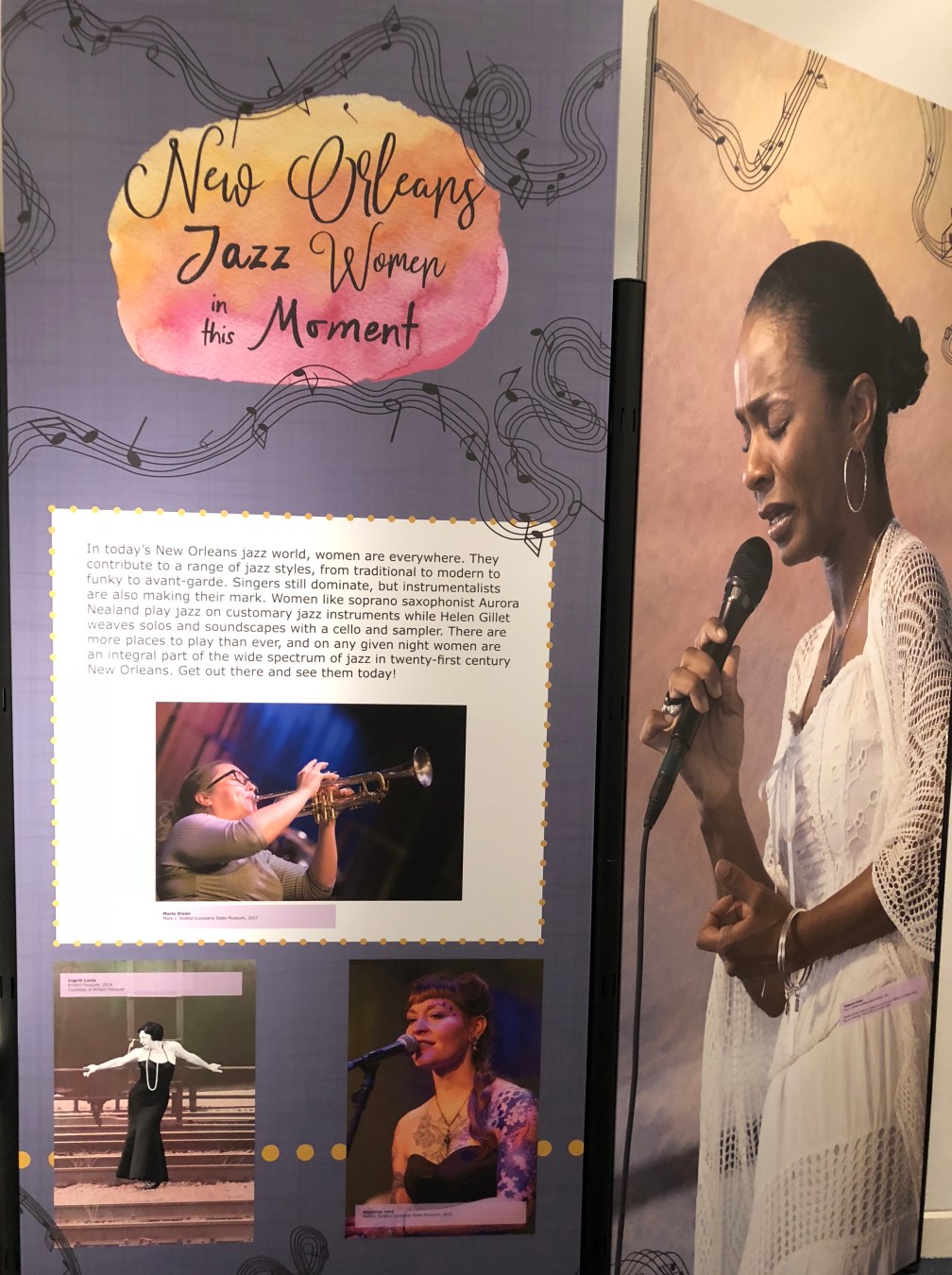
Women in New Orleans Jazz

fullsizeoutput_f3e

not pictured (too much glare): a recent orchestral score by Courtney Bryan

mWkRYawRQSijf3EQzY4aoA

there’s no jazz without women blues singers

and Pete Fountain.

72hKOS2GTDuxLCg4Zip+9Q

one of my first cassettes was Pete Fountain playing trad classics. I loved it

Among the most remarkable pieces on display are actual instruments played by the founders.

i%L7K8z1R4SxMaB2bswgQg

the pianos of Fats Domino and Dr. John

ETwrItwzTqeUuGRYb%kPHg

the first cornet of Louis Armstrong (!!!)

There’s a glamorous performing space that has a constant stream of performances, many of which are archived on YouTube.

WY2uFWa9T+atq5N28U+uMw

Running DTM has its privileges. David took me backstage to the “tower,” three floors of archives. After Katrina, the museum had to reset, and to some extent things are in flux. David is currently working on the forthcoming “Drums in New Orleans” exhibit, but many more things come in and out of the main space.

Yh2ZuycCTDSE9Q%YMmN6zA

David Kunian holds doorknobs to Mahogany Hall

fullsizeoutput_f36

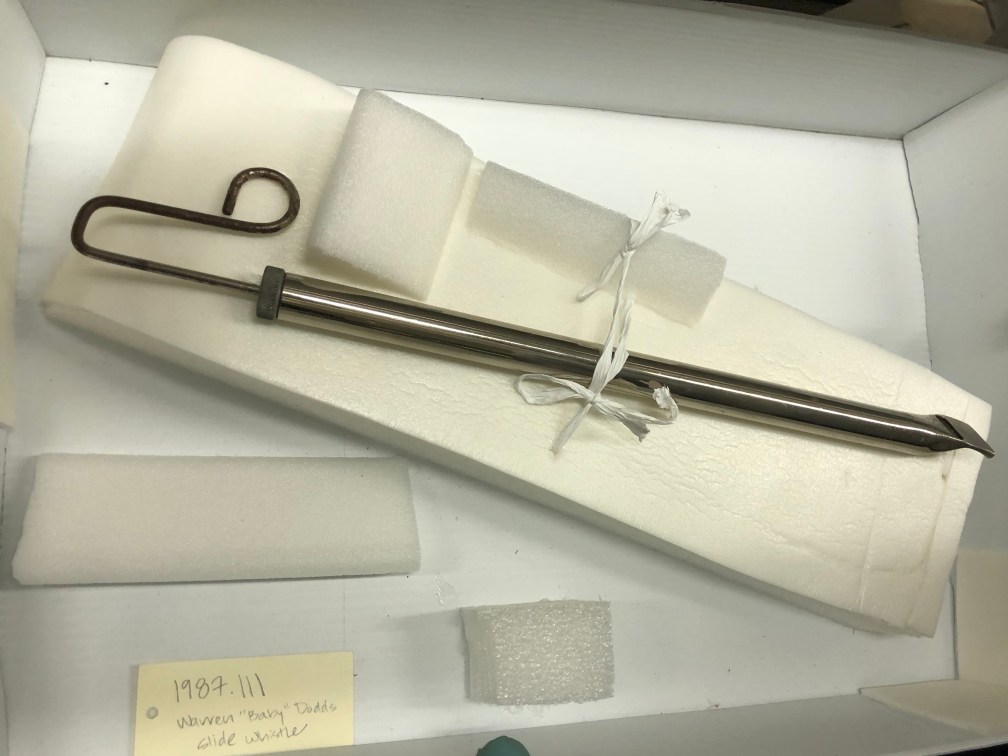
The actual slide whistle played by Baby Dodds on Hot Fives and Hot Sevens records (!!!)

WxwluVvZTCiuxuPqjUceSQ

the trombone of Papa Jack Laine. Some of the earliest jazz circa 1910 was performed on this instrument

d6BQOu+XSRC5yCDtiM8mLg

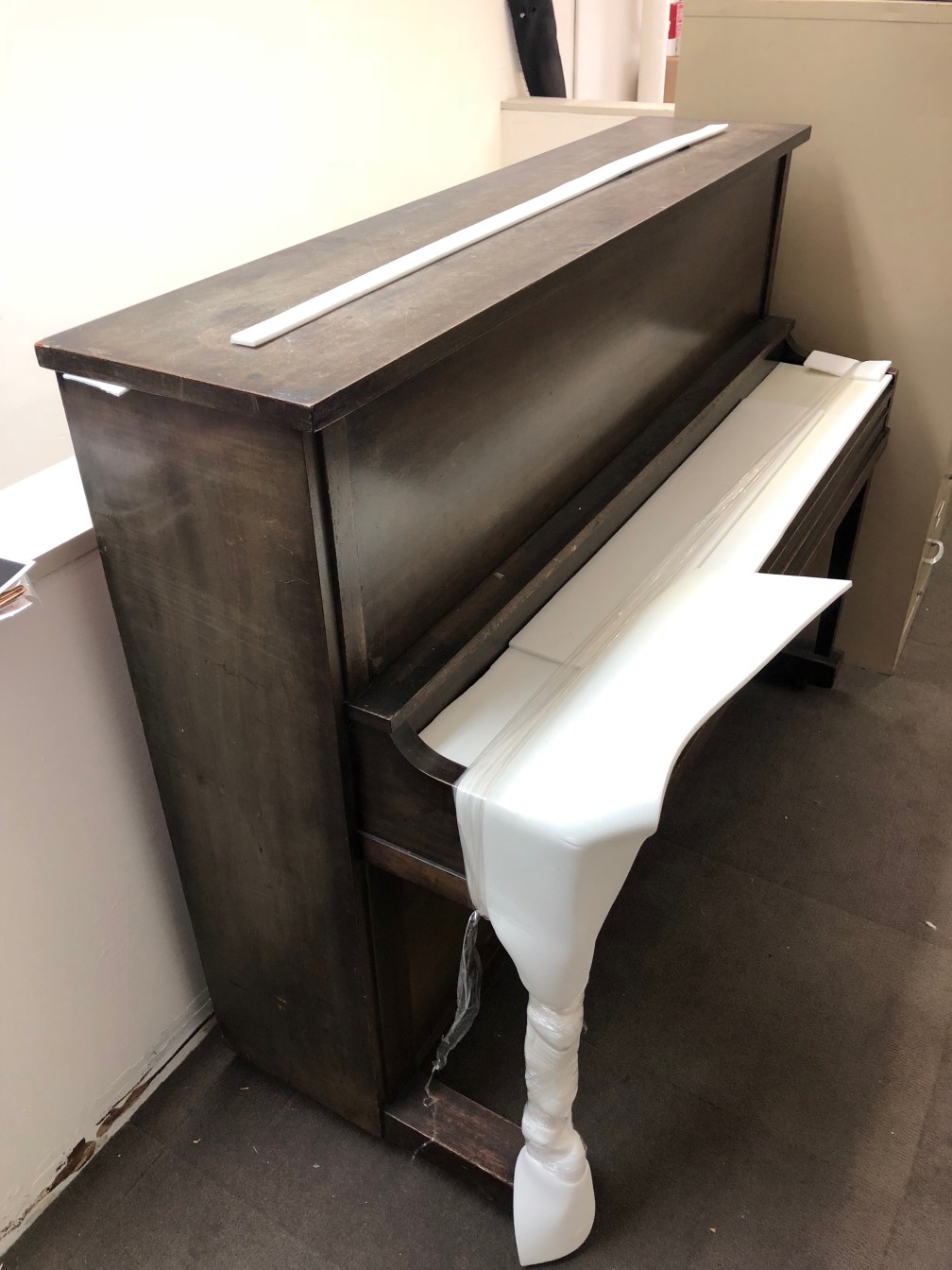
the piano of Leon Bismark “Bix” Beiderbecke

I’ve never been a whorehouse piano player, but if I were ever to take that gig, it certainly would be in the tradition. Storyville “Blue Books” are not that hard to find but I’d never actually seen one: A guide to legal prostitution with ads by famous names like Veuve Cliquot. The working girls are sorted by race.

fullsizeoutput_f1ffullsizeoutput_f1dfullsizeoutput_f1e

It was a fascinating trip! I wish David and the Museum the very best while continuing to expand and develop a site dedicated to the cradle of jazz.

fullsizeoutput_f1c

photo by David Kunian