Barry Altschul, “You Can’t Name Your Own Tune”

Recorded 1977 for Muse. Barry Altschul, drums and percussion; Sam Rivers, saxophones and flute; George Lewis, trombone; Muhal Richard Abrams, piano; Dave Holland, bass. Four pieces credited to Altschul; one apiece to Abrams and Carla Bley.

Barry Altschul turned 79 two days ago, on January 6, 2022. Altschul was a key player during the second wave of revolutionary jazz. More often than not, Dave Holland was the bassist; depending on how you count it, there are 30 or 40 sessions with Holland and Altschul holding down the churn. Notable discs include Circle Paris Concert, Braxton New York, Fall 1974, Holland Conference of the Birds, and Rivers The Quest.

You Can’t Name Your Own Tune is perhaps less-well known, but for no good reason, as it’s really an incredibly listenable session of the finest exponents of this rather hectic style. This is a one-off quintet, but everyone brings their A-game. In some ways it could pair with the early Tony Williams quintet session Spring, also with Sam Rivers. In both cases the drummer decides which directions an “out” date should take, with notably stylish results.

The title track dives right in. Sometimes medium-up swing time with no changes, especially when it is more dissonant than the Ornette Coleman version, is called “free-bop.” Not sure if that is truly a canonical genre or not, but at any rate this is a wonderful example. The charging head is charismatic, and then the solos are frankly amazing. I’ve rarely heard Rivers, George Lewis, or Muhal Richard Abrams playing quite like this: Head-solos-head, a knowledgable rhythm section, and flat-out atonal “jazz” blowing.

“For Those That Care” is a soulful piece of through-composed melodic counterpoint. Holland is on arco, Rivers on flute doubles Lewis. It moves morosely along, breaking apart for collective mourning. It’s all natural, Altschul’s de-constructed brushwork is hot in the mix.

“Natal Chart” surprises with a mix of disparate compositional elements. Partly it’s a literal triplet chatter, partly it’s a swing band gone very, very wrong. The blowing is noisy collective. A little of this goes a long way, especially on record, but the track is short (less than four minutes) and they bring it home with a fake old-timey ending. Bravo.

Muhal Richard Abrams brought an intense trio piece to the date, “Cmbeh.” A thorny head leads into crazy free-bop. If I heard this in a blindfold test, I’d have no idea who the pianist was, but I would want to hear more of them. A lot more. Part of the charm is definitely Holland and Altschul together, they had truly figured out a way to play this tempo that was both fierce and liquid. Holland’s bass solo is great, too. Maybe because it’s the drummer’s date, it feels like the bass and drums are both captured better than on other ’70s sessions with a similar cast and vibe.

Amusingly, Altschul calls his solo track, “Hey, Toots!” March cadences interact with “random” percussion and the eerie Waterphone. The Waterphone was patented in 1973, I suspect this is one of the earlier instances of it being used on a jazz record. The one gong hit is fabulous.

The LP concludes with a classic Carla Bley line, “King Korn.” Altschul played a lot of Carla Bley rep with Paul Bley on several important trio dates; the first time on record is on the only Paul Bley album with Holland and Altschul, Synthesizer Show.

This must be the only occasion Muhal Richard Abrams is documented playing Carla Bley. Interestingly, Abrams features her lines and harmonic concept quite literally in his accompaniment and solo feature. It’s still very abstract of course, but “King Korn” can be heard in there from the piano more often than not. Rivers and Lewis also play at an amazingly high level of fevered, noisy joy. Now, why didn’t this band make a record of Carla tunes? Oh well, at least we have Barry Altschul’s debut album as a leader, the first rate You Can’t Name Your Own Tune.

Manifesto!

My second recent podcast (the first was about Rex Stout), this one concerning Wynton Marsalis and his famous broadside, “What Jazz Is — and Isn’t.” We also listen to Wynton’s album J Mood.

Go to this Apple link or search Manifesto! wherever you get your podcasts.

If you know my writing well, nothing I say here will be a surprise, but it is also true that conversation reveals hidden depths of emotion that print may lack…

Manifesto! is hosted by Jacob Siegal and Phil Klay, two important and smart writers/thinkers/podcasters. Thanks Jacob and Phil!

George Crumb, “Ancient Voices of Children”

Ancient Voices Of Children (A Cycle Of Songs On Texts By Federico García Lorca For Mezzo-soprano, Boy Soprano, Oboe, Mandolin, Harp, Electric Piano & Percussion) was released on Nonesuch in 1971, with the same cast that performed the premiere a year earlier.

Arthur Weisberg conducts The Contemporary Chamber Ensemble featuring Jan DeGaetani, Gilbert Kalish, Susan Jolles, Stephen Bell, George Haas, Howard Van Hyning, Raymond DesRoches, Richard Fitz, Jacob Glick and Michael Dash.

A significant number of George Crumb’s moody and theatrical compositions have been settings of the Spanish poet Federico García Lorca. Ancient Voices Of Children tapped into the moment, including anti-Vietnam war sentiment, and remains one of the few genuinely abstract pieces from 20th-century formal American composition to have a cultural footprint larger than a shoebox.

The work is a feature for the wonderful mezzo-soprano Jan DeGaetani. Crumb wrote:

The vocal style in the cycle ranges from the virtuosic to the intimately lyrical, and in my conception of the work I very much had in mind Jan DeGaetani’s enormous technical and timbral flexibility. Perhaps the most characteristic vocal effect in Ancient Voices is produced by the mezzo-soprano singing a kind of fantastic vocalise (based on purely phonetic sounds) into an amplified piano, thereby producing a shimmering aura of echoes.

DeGaetani’s star turn is not supported by much harmony, traditional or otherwise; this leanness of texture helps create the “ancient” feeling proclaimed in the title. After voice, percussion is the most significant element. The score requires three official percussionists, while the pianos and harp play percussive roles as well.

1a. El niño busca su voz (The Little Boy was Looking for his Voice). Right away, a cadenza for DeGaetani, a document of extreme possibility. There are no words for the singer at first, rather simply phonetic sounds. Again, everything behind her is very sparse. The general feel throughout most of the movements is spacious, almost tentative. It works pretty well on record, but in live performance the execution of all the “tricks” (singing inside the piano, the instrumentalists taking turns with spoken dialogue, and so forth) adds another layer of tension.

1b. Dances of the Ancient Earth. Oboe and shouts of “hey” interact with the drums and harp. The oboe melody is derived from Mahler’s Das Lied von der Erde.

2. Me he perdido muchas veces por el mar (I have lost myself in the sea many times). DeGaetani whispers, the instruments circle and glisten.

3. ¿De dónde vienes, amor, mi niño? (Dance of the Sacred Life-Cycle). After another stunning operatic cadenza by DeGaetani, the drums take up a menacing bolero rhythm. Underneath the bolero, a tympani groans while slowly being tuned and de-tuned, a notable and rather aleatoric effect.

While intended for conventional classical music performers, the theatrical experimentation of Ancient Voices is absolutely a piece with all sorts of electronic and improvised music of the late ’60s. Indeed, simply reading the strange-looking score of Ancient Children requires the interpreters to go far outside the norms of common practice chamber music.

4a. Todas las tardes en Granada, todas las tardes se muere un niño (Each Afternoon in Granada, a Child Dies Each Afternoon). There hasn’t been much, if any, triadic harmony until now — not even with the Mahler oboe quote — but suddenly a rich D-flat major chord accompanies a quasi-flamenco preach from DeGaetani. Somehow this long sumptuous call is answered perfectly by a toy piano’s sad little marching Baroque cadence. The greatest movement of the suite.

(Note: in the Weisberg/DeGaetani issue, “Dance of the Sacred Life-Cycle” and “Each Afternoon in Granada, a Child Dies Each Afternoon” are complied into one continuous track.)

4b. Ghost Dance. The musical saw offers a plaintive whine and the castanets shake in dismissal. This movement is better in live performance.

5. Se ha llenado de luces mi corazón de seda (My silk heart has been filled with lights). Chimes, gongs, other percussion, a lonely oboe melody. The boy soprano is heard “offstage” in quick cameos in earlier movements, and finally comes onstage to meet the mezzo. However this is not a true apotheosis, but once again something sparse and fleeting. Rather than build an edifice, the composer gives us epigrams and runes.

Steve Lacy Trio, “The Window”

Recorded 1987 for Soul Note. Steve Lacy, soprano saxophone; Jean-Jacques Avenel, bass; Oliver Johnson, drums. All compositions by Lacy.

Steve Lacy the unique: a vital and uncompromising voice essential to seeing the whole picture. Steve Lacy the prolific: Lord lists 185 sessions as a leader, including many double LPs of long blowing by all hands. Lacy didn’t exactly have breadth, he played his thing on every occasion, so it comes down to who else is on the date and other, more intangible parameters. Where to start assessing this vast discography? Perhaps with The Window, which crops up here and there on critics lists. It is well-recorded, Lacy himself is at the top of his game, and the band is comprised of two key Lacy associates.

It’s a very good rhythm section, although it also says something that neither has a Wikipedia page in English. Jean-Jacques Avenel was a major practitioner, a lyrical poet who also had some good “thump” when playing time, hailed in his native France and underrated in America. Oliver Johnson had pedigree as a serious swinger (his first record seems to be with Charlie Shavers) before moving to Europe and collaborating with freer players. Both Avenel and Johnson recorded more with Lacy than any other leader, yet this is the only date where it is just the three of them.

“The Window” is a jazz waltz, with a wonderful chaotic head that leans to the more esoteric. Once the blowing starts, Avenel goes around the cycle in a pre-arranged fashion but Lacy hunts and pecks in the home key, telling a motivic story inspired by Thelonious Monk and Sonny Rollins.

“Flakes” is a lightly pulsing and repeating fragment that almost wears out its welcome before giving a way to a “chordal” bass solo. The long-limbed and searching soprano sax lines that follow are really beautiful. The band isn’t swinging, exactly, but they allude to steady time in addition to finding delicious moments of interplay.

Lacy plays very high in register at the top of “Twilight,” a substantial meditation in duo with Johnson. There’s a short repeating theme that helps organize the exotic exploration. Johnson stays on brushes throughout.

It’s time for something that moves, and the trio opens up with “Gleam.” The group isn’t trying to play serious bebop time, instead they offer ramshackle momentum and plenty of smear. Lacy’s tone is very intense and personal.

“A Complicated Scene” is in the Ellington tradition of “jungle music,” a familiar Lacy gambit. Everyone digs in, with Johnson at home in this groove..

The excellent LP closes with “Retreat,” another repetitive minor-key swinger that could only be from the pen of Steve Lacy. When improvising, the trio plays time, and then they don’t, and then they play time again. It’s not contrived, the phrases fall as naturally as breathing.

Don Pullen, “The Sixth Sense”

Recorded 1985 for Black Saint. Don Pullen, piano; Olu Dara, trumpet; Donald Harrison, alto sax; Fred Hopkins, bass; Bobby Battle, drums. All compositions by Pullen except the title track by Pullen and Frank Dean.

This fabulous album documents a moment of casual in/out in the music. Pullen played jazz at a high level, he held down the piano chair with Mingus, but Pullen also developed a throughly avant-garde style, with his palm and hand launching a fusillade of wild runs and clusters. He definitely plays changes with a glissando, which seems impossible. However he’s doing it, Pullen at full roar documents some of the most exciting and esoteric techniques ever created by a pianist.

“The Sixth Sense” is a funky slice of hard-bop in 5/4. Olu Dara is another player with an encyclopedic grasp of various jazz styles, having worked with Art Blakey before collaborating with all sorts of significant avant-gardists. Here Dara is bluesy and commanding over the meaty vamp. Good blindfold test! Donald Harrison is very young, and his presence on this disc reminds us that many so-called “young lions” of the mid-’80s had connections to more esoteric musicians. Harrison’s work here pairs with the Harrison/Terence Blanchard tribute to Eric Dolphy and Booker Little music with Mal Waldron, Richard Davis, and Ed Blackwell recorded a year later.

Pullen’s own solo begins somewhat in a conventional zone, but soon enough the astounding double-time flurries start. The left hand keeps the 5/4 going. As good as the horn soloists are — and they are very good — there’s never any doubt that the leader is the most commanding presence on this date.

Fred Hopkins was a star bassist of this peer group. Drummer Bobby Battle died relatively recently, in 2019. Battle isn’t mentioned often today, but he can be heard on about a dozen albums with Pullen, Arthur Blythe, David Murray, and others in that circle. Battle sounds just great on this whole album.

“In the Beginning” is comparatively “out,” with a melody that lunges between chaos and a few “tango” gestures. Battle’s free-form playing has an uptempo cast that works beautifully, while nobody did this style better than Hopkins. Harrison is fiery madness, Dara more lyrical. Hopkins listens to the soloists carefully, while Pullen is more like just molten lava.

Of course, during the piano feature, the heat becomes even more unrelenting. The piano is quite out of tune, but maybe it just got that way during tracking.

A hard-bop ethos returns in “Tales from the Bright Side,” which could be from Horace Silver (except for the piano clusters). The piano comping on “The Sixth Sense” was reasonably conventional, with Pullen demarcating the harmonic structure behind the soloists, but “Tales from the Bright Side” has more chaotic accompaniment. It’s almost like the fury of “In the Beginning” infected “The Sixth Sense” in order to become “Tales from the Bright Side.” The dance rhythm is very strong, but they are all really going for it as committed experimental improvisers; the time even gets turned around for a moment a few places, but who cares? In the wonderful piano solo, the bass-register percussive effects recall the more outlandish places in modernist concertos by Bartók or Prokofiev.

The gospel-infused “Gratitude” is a graceful feature for Harrison in duo with Pullen. There’s no improvisation here, nor none required for such a heartfelt yet sophisticated composition. The final piano chords radiate from deep space.

“All is Well” is — surprisingly — another piece with no obvious improvisation. The parade beat approaches and recedes in a traditional NOLA fashion. Less than two minutes of a happy feeling. The first time I heard this in high school it really kind of blew my mind. You were allowed to do this kind of special effect on a serious jazz record?

Five tracks: 41 minutes. Three extended pieces with solos — one odd-meter, one free, and one on a vibrant drone — followed by a hymn and a parade.

Morton Gould in 1968

Random YouTube find:

Morton Gould: Venice
(Audiograph for Double Orchestra and Brass Choirs)
and
Vivaldi Gallery
(For Divided symphony and String Quartet on Vivaldi Themes)
Seattle Symphony Orchestra conducted by Milton Katims, recorded 1968.

Liner notes sourced from eBay:


At one point I owned this LP, but it made no impression, for I was searching out Gould’s most modernist and meaty works, some of which I wrote up at the time of the unheralded Morton Gould centennial. Listening now, I find the music beautiful and unpretentious. Part of the idea is sonic opulence, and this record documents RCA casually footing the bill for what was a decidedly experimental and non-commercial project.

In Venice Gould is poly-stylistic to a fault; the result is a bit like a random assemblage, a familiar Gould problem, and surely one reason this composer is all but forgotten today. Still, his command of orchestration is undeniable, and certain moments seem absolutely perfect. “Grand Canal” is best, thirds all over the orchestra, a fantastical night journey, the double orchestra and brass in wonderful concord. In a blindfold test, I would recognize “Grand Canal” as Morton Gould.

Vivaldi Gallery doesn’t sit exactly in one place or another: it is hardly a literal transcription but the avant-gardisms are subtle. Is it Stravinskian? Not quite, it is too cheerful, straightforward and strangely undemanding, although this suite would absolutely fail at a classical pops concert. If everything Gould does to Vivaldi had have been done with a more obviously radical motivation, it would make the whole thing less equivocal. The last two movements, “Continuo e Recitativo” and “Alleluia,” are the most dissonant and perhaps also the most successful.

On the other hand, there’s nothing else like Vivaldi Gallery, at least as far as I know. It is something Gould himself understood, something that only Gould could do, and he sent it out into an unheeding world with a smile on his face. I’ll give it another go-around again sometime, especially if I have the chance to listen to that wonderful 1968 RCA heavy vinyl on a quality hi-fi system. The Seattle musicians play with heart and the sound reproduction is simply gorgeous, even on YouTube.

Xmas 2021

Most of NYC entertainment is basically shut down for a couple weeks; the rest of my Zinc bar engagement and NYE with Marcy Harriell is canceled. We all hope we can re-open soon.

To help manage my disappointment, I made a little chaotic arrangement of “Go Bless Ye Merry Gentlemen,” which one can see on Twitter.

Last night Sarah read the first chapter of Winnie-the-Pooh to me. It is so great! I was just floored. I guess it’s been about 40 years since I checked in. WOW. A.A. Milne was a genius. Always good to remember to count your blessings even as not all tidings are joyful.

The Written Word in 2021

I’m always a bit surprised to look back at the end of the year and see how much scribbling I’ve done. Thanks for reading, thanks for listening.

for The Nation

Billie Holiday
John Coltrane
Barry Harris

for JazzTimes

Eubie Blake
McCoy Tyner
Ron Carter
Pete La Roca (as told by Steve Swallow)
Ralph Peterson with Geri Allen

DTM commentary about music

Keith Jarrett/Dewey Redman/Charlie Haden/Paul Motian
TV Themes
24 Standards
Dave Frishberg
Frederic Rzewski
Richie Powell/Brown+Land

Two interviews

Alex Ross
Jeff “Tain” Watts

Only one substantial essay on crime fiction, but it’s pretty good if I do say so myself

Thomas Harris

Shorter, quicker, fun things

Get into modern jazz!
Fusion!!
Happy Birthday MAH!!!

Bonus: Mark Stryker on DTM

Chick Corea
Barry Harris


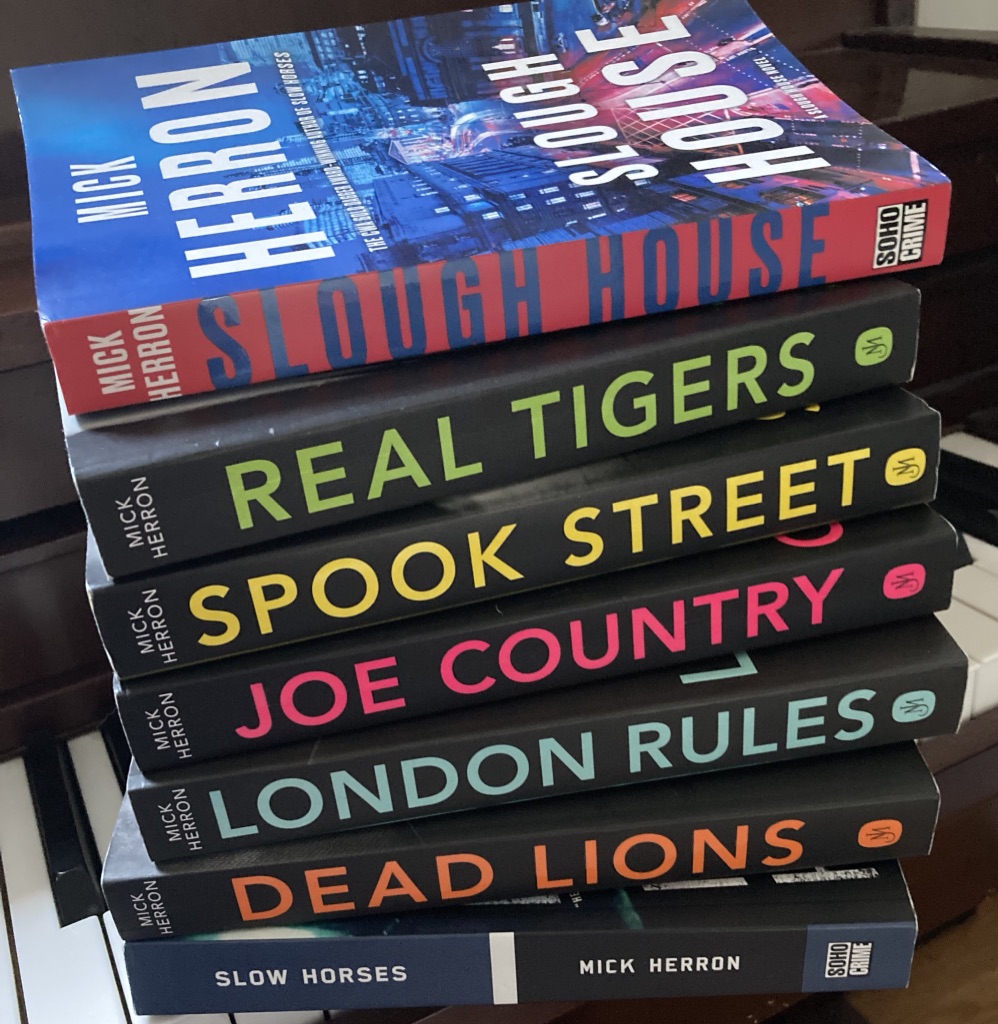
2021 was also the year I discovered Mick Herron, who is now in my pantheon, especially for his Slough House series, although his other books are good as well.

There is a “hero,” the unlikeable Jackson Lamb, but most of the time we are with Lamb’s collection of misfits, the “slow horses,” a group of demoted British espionage agents who operate out of Slough House. Each character is wonderful, and the way they interact with each other is even more wonderful.

The comic touches recall Len Deighton, but Herron’s true master is John Le Carré.

In early Le Carré, the author was against Russia in conventional Cold War fashion. The real world traitor Kim Philby was the direct inspiration for Le Carré’s greatest book, Tinker, Tailor, Soldier, Spy, and George Smiley’s arch enemy was the Russian super spy Karla. There is a certain amount of investigation into the British social order, but those questions are posed with a light touch. We love George Smiley, and there’s nobody more Establishment than Smiley.

In time — especially after the fall of the Berlin wall — Le Carré realized that the true enemy might come from within the ranks of his Establishment, and the books took on a genuinely revolutionary cast, almost as if Noam Chomsky were writing thriller fiction.

Herron takes up the anti-Establishment theme of Le Carré’s later years with far more pizzaz. Almost all the action concerns infighting within the British Government, strongly recalling the bureaucratic chaos from the great ITV series The Sandbaggers written by Ian Mackintosh, although Mackintosh’s politics remain essentially conservative. Herron is a leftist — and has so much fun being a leftist!

I just adore these books. True kudos to a contemporary master.


There’s a lot to look forward to in 2022. If you haven’t yet, take just over a minute to watch “The More it Changes, the More it Stays the Same.”

An Insider’s look at Dexter Gordon’s “Homecoming”

In my article on Barry Harris published yesterday, I mention Dexter Gordon’s Homecoming, and contrast it with another 1976 album by Gordon, Bitin’ the Apple.

Bill Kirchner responded by sending along this fascinating and surprisingly long article by Peter Keepnews, who worked Jazz PR for CBS for a few years. The success of Homecoming is contextualized in a way I hadn’t seen before:

It didn’t take me long to discover that Lundvall’s signing of Dexter Gordon had been barely tolerated by many key people in the company, and that his subsequent jazz signings were provoking a definite backlash. The reason was simple: There was a deep-seated belief that, with very rare exception, jazz records, no matter how ostensibly “commercial,” could not sell.

To an extent, that belief amounts to a self-fulfilling prophecy—if you don’t work a jazz album, it definitely won’t sell. And while no amount of high-pressure salesmanship is ever likely to get Dexter Gordon a gold album—at least not until there is a much more fundamental change in the fiber of our culture than the record industry alone could ever bring about—a well-planned marketing campaign that precisely targeted Gordon’s audience and found the most effective ways of reaching them could conceivably jack up his album sales from their current level (roughly 35,000 per album, not bad for bebop) to as high as 80-or 90,000. The trouble is that in the record business, even in these recessionary times, an album that sells 90,000 copies is not considered a success in corporate terms even if it turns a comfortable profit. And the amount of money, not to mention time and thought, that would be required to get results like that would make the small amount of profit from a 90,000-seller look even less desirable—and even conceivably wipe out the profit margin entirely. Therefore, the reasoning goes, why knock yourself out pushing Dexter Gordon?

But, some readers might be asking, didn’t Columbia in fact give Dexter Gordon a major push? The answer is yes and no. It certainly looked like a major push, especially in New York, where there were not only big advertisements but lengthy articles throughout the daily and alternative press at the time of his first Columbia LP, Homecoming. Personally, I interviewed Gordon for the New York Post, and I remember being impressed by the elaborate press kit I received from CBS when Homecoming was released. As a matter of fact, that was one of the factors that persuaded me to leave the Post when CBS offered me the publicity job: I took it to be a sign that the company really was putting its money where its mouth was as far as Dexter Gordon (and, presumably, the rest of its jazz roster) was concerned.

But what did this push really amount to? The advertising campaign and the press kit cost a lot of money, but required no follow-through. The press blitz was partly the result of diligent work by one CBS publicist and by Gordon’s manager, but I think it was primarily the spontaneous result of a lot of jazz writers wanting to write about Dexter Gordon, who after all was not only a great musician and a colorful personality but, as an expatriate returning home in triumph, very good copy. I know that I went out of my way to persuade my editor at the Post to let me interview Gordon because I wanted to, not because Columbia Records was hyping him—in fact, at the time I interviewed him he hadn’t yet signed with CBS.

There was a push on Dexter Gordon’s behalf in that Lundvall let it be known to his staff that he took a personal interest in the success of Homecoming. As a result the sales people leaned a little more heavily than they otherwise might have on their accounts to buy it in decent quantities, and the radio people gave it an extra effort in spite of the fact that music on Homecoming was not compatible with most formats of commercial radio. The album attained a much higher sales level than anything Gordon had ever recorded previously; for that matter, it was probably the best-selling bebop album of all time.

But its success was not due to a commitment on the part of CBS Records to jazz, and it was not due to a sales strategy based on the nature and quality of the music and its potential market. It was due to executive arm-twisting, and it must surely have left a bad taste in the mouth of the people in the field (and some of their superiors in the home office) to know that time that might have been spent working “big” records was diverted to Dexter Gordon because of what could easily be construed as Bruce Lundvall’s whim.

The Defiance of Barry Harris

New from me in The Nation: “The Greatest Teacher of America’s Great Art Form.”

Thanks to my editor Shuja Haider for major help whipping this essay into coherent shape.

There are Barry Harris memorial ceremonies today and tomorrow:


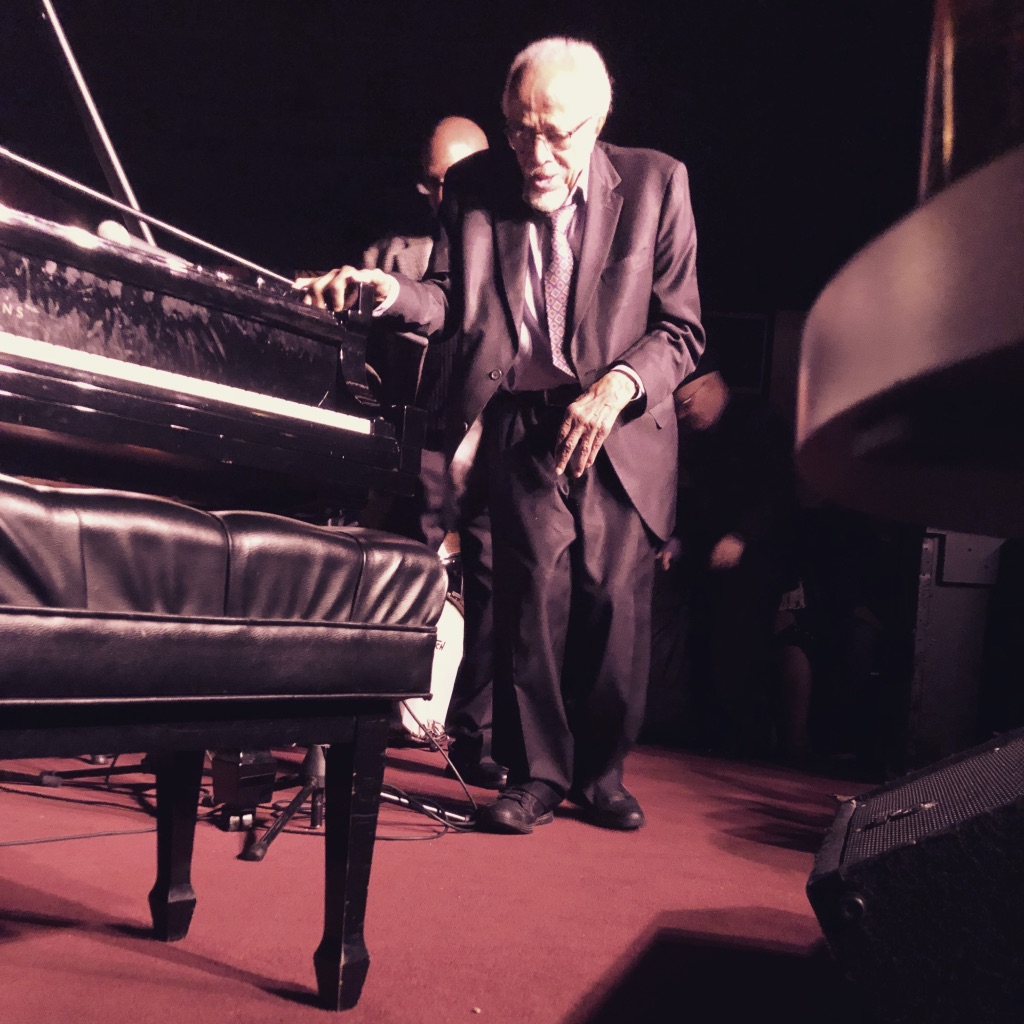
Below: Sunday night, the last set, the final time Barry Harris played the Village Vanguard in October 2019. As he made his way to the piano, I suddenly realized this was it, that I wouldn’t get to bathe in his presence again, so I broke protocol and took this photo.


The first record Leroy Williams and Barry Harris made together was Magnificent! with Ron Carter in 1969. For me, this trio album is the beginning of the most profound Barry. A key is turned in the lock and for over a decade the maestro will be at his peak as a player. (Mark Stryker’s invaluable list offers a more detailed and informed viewpoint.)

During that time, Leroy and Barry kept on trying to play the upbeats later than the other. Heavy swing. Leroy is invaluable on any record he’s on, but those tracks with Barry are truly something else. Leroy Williams and Barry Harris together! No doubt about it.

I didn’t know Barry, but I was around him occasionally because we shared the same piano teacher, Sophia Rosoff. At one of those gatherings (around 2005 or so) I got up the nerve to ask him, “Hey Barry, how many trio gigs have you done without Leroy Willams since 1969?”

Barry thought about it for a moment, then replied, “One.”