Kick a Hole in a Stained Glass Window

What fun to read Matthew Shipp's takedown of Keith Jarrett in The Talkhouse today! (It also makes my own critique of Joss Whedon's music in the same venue look mild indeed.)

Jarrett owns too much real estate and is too abrasive a personality not to be taken down a peg once in a while. I'm glad Shipp is out there, pulling no punches. (He did the same with Wayne Shorter and Herbie Hancock a while ago.)

Keith is, of course, one of my guys, one of my inspirations, so I feel compelled to rebut a few things Shipp says. Also, full disclosure: In the September issue of DownBeat, I interview Jarrett about Somewhere and the new album of Bach Violin Sonatas.

Shipp says, "He never seemed to me to have sculpted a specific language system, but instead seemed like someone who had a lot of piano chops and knew a lot of devices from classical music and had some jazz chops and could get a line going when needed." 

Keith has a language. You can put on any Keith record anywhere (where he is improvising) and instantly know it is Keith. Sure, that language isn't as uncompromising as Cecil Taylor's! But surely it is only Keith's.

I also query Shipp's comment, "Guess my main beef is the tremendous status that is accorded to Jarrett's trio….by middle-aged white jazz critics."  

Historically, I believe that Keith has not had that much favor with jazz critics, at least in America. (I don't doubt that in Europe he is accorded more status.)  Certainly many of the New York critics have been suspicious.

I can't think of a Jarrett rave by Gary Giddins, Whitney Balliett, Howard Mandel, Kevin Whitehead, or Francis Davis.  In Ben Ratliff's The New York Times Essential Library of Jazz Records, the Jarrett – Peacock – DeJohnette trio gets some of the book's coldest pronouncements:  "The standards trio, at its worst, can bog down in a tepid lyricism…" At  Marc Myers's vast Jazz Wax site there are no mentions of a Jarrett record or performance

Indeed, my casual perception is that jazz history books have been loath to give Jarrett his due! (Especially for his group with Dewey, Charlie, and Paul, a major influence on most musicians I'm associated with. If Shipp had at least name-checked that quartet as important I probably wouldn't have written this post.)

The critics have had to fall in line with a public that responds to the undeniable charisma of Keith Jarrett. My mother-in-law loves The Köln Concert. She's always playing that album when I go over. Hey, it's not my favorite Keith, either, but it has something that reaches out and touches the people.

If all the critics never wrote another thing about Keith, his concerts would still be sold out. 

Shipp is most compelling when comparing Keith to Bud, Monk, Hawes, and Newborn. I agree that when Keith appropriates bebop something can be missing, especially in recent years. Probably Keith should stay away from composers like Benny Golson entirely. On a related topic, Keith sometimes plays a straight boogie-woogie blues these days, and that doesn't sit right with me, either. What I want to hear from Keith are the outer-space atonal rhapsodies. (There's an astonishing one on Somewhere right at the beginning of the disc.)

I'm intrigued by Shipp's praise of Joe Sample, someone I've never really listened to. Since I know NextBop editor Anthony Dean-Harris is a fan, I hit him up on Twitter for some Sample recommends:

(1/3) 2004's solo album 'Soul Shadows' is poignantly beautiful. 1995's 'Old Places Old Faces' feat. Charles Lloyd is my fav… (2/3) The Jazz Crusaders' 'Lighthouse '68' has the best version of "Eleanor Rigby" I've ever heard. (3/3) Also for some reason, The Grammys often uses 2004's "The Pecan Tree" as walk-up music in the non-televised awards.

I don't mean to discourage Shipp from writing more pieces like this! Again, they are really fun. Keith Jarrett, of all people, can certainly take it!

The Image, the Page, the Pen, the Terror

R.I.P. Richard Matheson, conjurer of a vast number of dark stories essential to the mythic strata of contemporary culture.

Four memories: As a kid I had stone-cold fright watching Twilight Zone's "Little Girl Lost," the one where the daughter rolls under the bed into limbo. As a teen I obsessed over the movie Duel, where a monstrous, never-seen truck driver chases Dennis Weaver for no reason whatsoever. As a young man I started crediting authors as much as directors after reading the short story Duel: The whole movie is outlined in a few brilliant pages. Just recently I blew through Hell House in a day or so and marveled that a "haunted house" novel could still scare me today.

There are of course, many more Matheson stories of great importance, and most of them I haven't experienced yet. It's a nice feeling, knowing that some his most famous tales are still lurking behind closed doors, waiting to pounce.

Wikipedia

How Did You Get In Here?

After fighting our way through various alarms and imbalances encountered while working on our South Korean visa applications, Billy Hart and I arrived at the JJA Awards ceremony yesterday 15 minutes late, or just in time for Billy to collect his award for drummer of the year and say a few gracious words. At our table was Tina Pelikan, the expert publicist for ECM records, and Amiri Baraka, the legendary poet, playwright, and critic. 

Baraka introduced Willard Jenkins, who won a Lifetime Achievement Award. At 78, Baraka proved he was still a bad motherfucker by making everyone in the room uncomfortable by calling out all of America for racial inequality. Afterwards he asked me where I was from, and I said, "Wisconsin." He said he hadn't ever been. I told him that I was from the most lily-white belt in the nation, and joked that they wouldn't let him off the plane if he tried to land there.

I enjoyed Baraka's speech, but his analysis of Willard Jenkins was superficial. He seemed to think that Jenkins's posts about black jazz writers at Open Sky, "Ain't But a Few Of Us," meant that Jenkins didn't know who the canonical black critics are. On the contrary, Jenkins's posts have unearthed far more black jazz critics than I knew about, and certainly Jenkins knows all the older names too. But I doubt Jenkins minded much, it's kind of an honor to be chastised by the old firebrand. 

Looking at Billy, Tina, and Baraka around me, I remembered various stages of my early development:

Like getting the live Herbie Hancock Mwandishi LP and Stan Getz The Master in my first forays in modern jazz and just loving the drummer, Billy Hart, which led me to buy all sorts of records that Billy was on, including a Wilbur Little quartet with Danny Mixon on piano — and I heard Mixon live for the first time yesterday at the JJA awards, backing singer Paulette Dozier.

Like the time when I would try to listen to anything on ECM, because that label had a style and sound completely different from everything around it.

Like getting Black Music and more or less memorizing it. How many people were just like me, determined to hear Albert Ayler after reading Baraka? Man, you could not get Ayler records in Wisconsin in the late '80s. Maybe they really did stop them at the border! At last, when I tracked down Vibrations, (the sensational quartet with Don Cherry, Gary Peacock, and Sunny Murray), I fell in love. But would have I been ready for that crazy romance if I hadn't read Black Music first?

I thank musicians on DTM frequently. Today I thank everyone else: the record labels, the publicists, the critics, the managers, the bookers, the fans…There are so many jobs that need to be done well in order to keep this music going. Thank you, thank you, thank you.

2013 JJA nominees and winners.

Near Future/Recent Past

Tuesday and Wednesday this week Reid Anderson debuts his first solo project since the forming of The Bad Plus, The Rough Mixes, in St. Paul. It is an evening-length work for three classical strings, Jeff Ballard, and Reid on electronics. Read Pamela Espeland's nice piece in the Star Tribune. We all wish Reid the very best for what is a seriously momentous occasion! I'm looking forward to hearing it, hopefully live in NYC as soon as possible.

I will be escorting Billy Hart to the JJA award ceremony on Wednesday. Billy is their drummer of the year, DTM is nominated for blog of the year. While I have the utmost respect for all working jazz critics I somehow have never been to this important annual event before. I suspect Billy and I may make it over to the Village Vanguard afterwards, where Mark Turner is playing all week with his new working band starring Avishai Cohen, Joe Martin, and Marcus Gilmore.

Just back from Ojai Festival and Ojai North! with Mark Morris, his dancers, his musicians and an incredibly generous serving of American classical music.

The Alastair Macaulay NY Times review of Spring, Spring, Spring is positive but more guarded about the dance than the music. More than one critic has been stumped by Mark's drastic recasting of Stravinsky's basic emotion: rather than torment, Mark gives us joy. Why not? At any rate, The Bad Plus found his fresh perspective to be wonderfully freeing. We are recording it next week, and Mark's dance will help us to remember to keep our teeth unclenched even in the most intense sections.  (We never liked killing virgins, anyway.) 

It was fascinating to hear so much John Cage, Henry Cowell, Lou Harrison, and John Luther Adams during the past two weeks. I enjoyed playing Cage's Four Walls, 45 minutes of white notes, rests, and an unaccompanied soprano. Maile Okamura made costumes for me and Yulia Van Doren:

IMG_3102

(photo by MMDG company manager Sarah Horne)

Our admittedly over-the-top performance was received well by audiences but not by LA Times critic Mark Swed, who gave me the worst review I ever remember getting. Swed is an expert on Cage, so he knows what he's talking about, but, just to clarify, I wasn't making fun of the piece.  My choices were intended to protect Cage by presenting a compelling performance. After all, Cage was a genius and must have known that Four Walls was not piano recital music like Beethoven and Chopin. I certainly observed Cage's dynamics, which include many long sections repeatedly marked fff, fffz, or even the rather ludicrous ffff, all of which basically means "as loud as possible." The "light, focused" touch that Swed asks for is correct for the opening pages and a few other places, but once it gets going…I dunno. For me, it needs to rage. Several people told me they were unsettled by Four Walls, and that was entirely the intention.

Through Mark, I had heard much of the major Harrison and Cowell pieces before, but somehow Harrison's Piano Concerto with Javenese Gamelan was brand new to me. I was astonished, and after one hearing consider it one of Harrison's greatest pieces. As good as the relatively conventional Harrison Piano Concerto is, the Gamelan one is even better, with a slow movement that has one of the most purely gorgeous melodies classical music has produced in recent memory. Ojai director Tom Morris told me that the piano started getting tuned to the Gamelan a full month before the performances by Colin Fowler and Gamelan Sari Raras. Extraordinary sounds!

I'm less close to Cowell than Harrison, especially Cowell's work for larger forces. Still, it was nice to hear so much extremely rare music live. For me, though, the greatest Cowell is the CD of his own piano performances, where guttural rhythm, fecund idea, and precise gesture align perfectly. Everyone should own that essential recording of American originality. ("Anger Dance" from that disc is the soundtrack for Mark's dance with Muppets for Sesame Street.)

John Luther Adams is very much in the grain of American mavericks. Mark exposed me to his hour-long meditation for string orchestra, string quartet, and two pianos For Lou Harrison a few years ago. Live the greatness of piece became even clearer to me, even thoush I could tell what a struggle it was to navigate the canvas of 4:5:6:7 polyrhythm.  (I heard talk about how some of the orchestra complained.) In addition to whatever travails the orchestra went through, much of the audience didn't like it and grew noticeably restive. Someone even jeered "play it again" at the end at both performances. It didn't matter. For Lou Harrison was invulnerable and intoxicating even in adverse conditions.

It is not hard to listen to if you know what to listen for. There are only two sections, and while it may seem like there is nothing but repetition, in fact there is no harmonic repetition.

The problem I occasionally have with minimalism, post-minimalism, and even with forebears like Cowell and Harrison  is a certain inelegance in the harmony.

Not here. Luther Adams exhibits marvelous harmonic control in For Lou Harrison. Each change in the slow-moving chord progression is unexpected yet absolutely correct. At last we have Bruckner-level chorales for the new style! The recording by Stephen Drury and The Callithumpian Consort is wonderful and includes extensive and helpful notes by Peter Garland.

The California weather was terrific for two solid weeks. TBP took Hwy 1 instead of the freeway for the first part of the trip from Ojai to Berkeley, and I got a nice shot of Dave King.

IMG_3081

Bay Area LPs

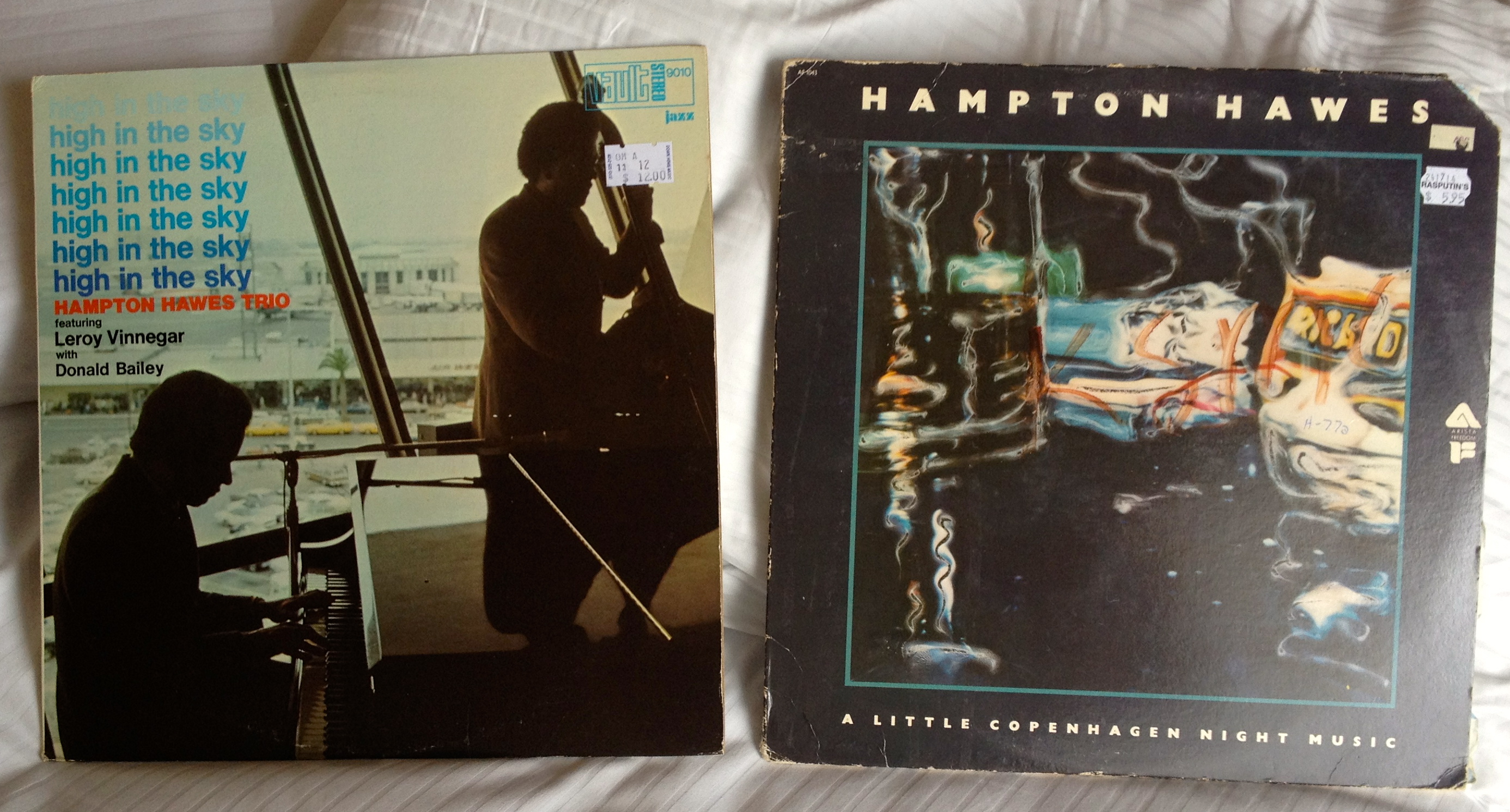
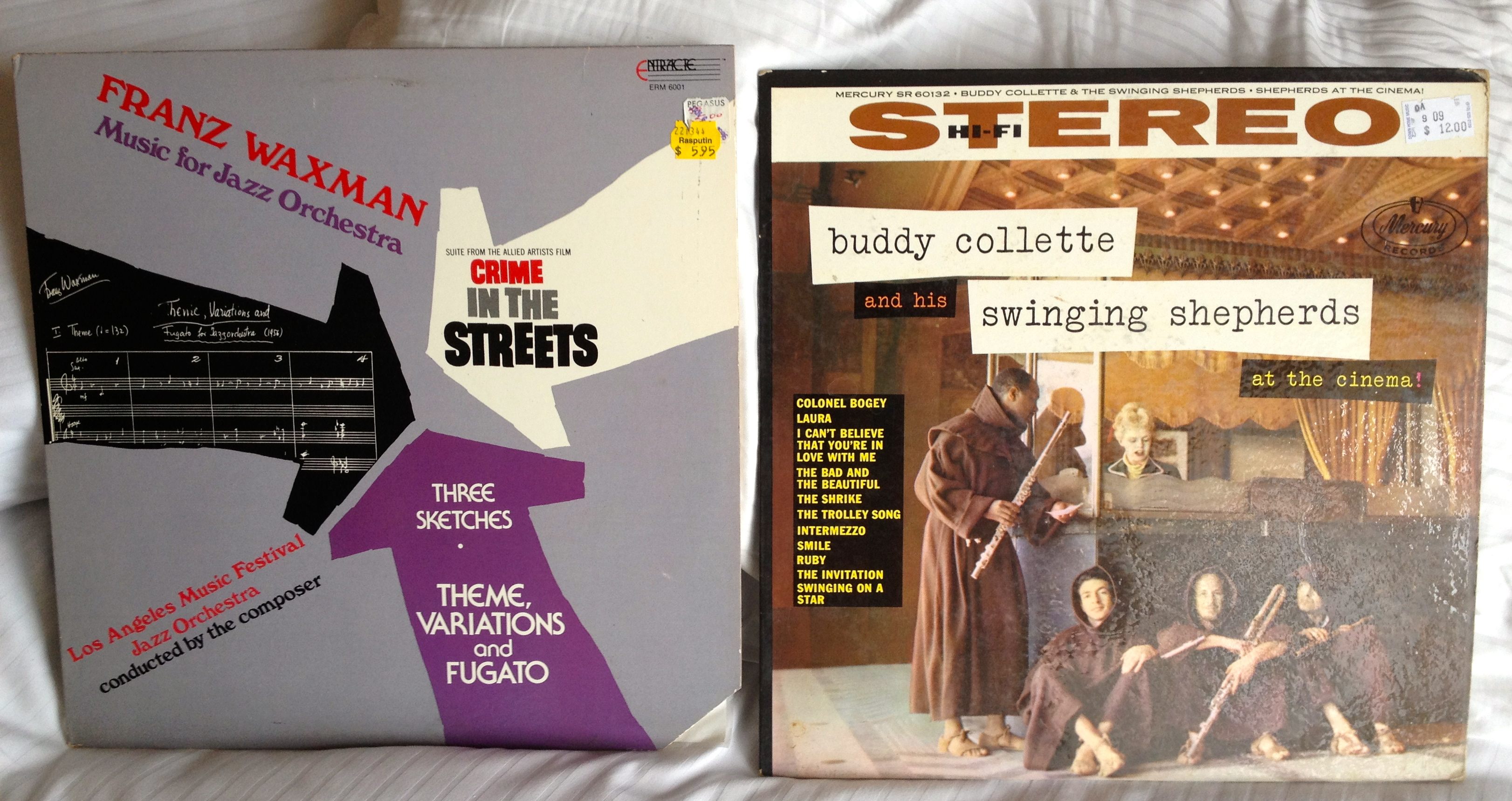
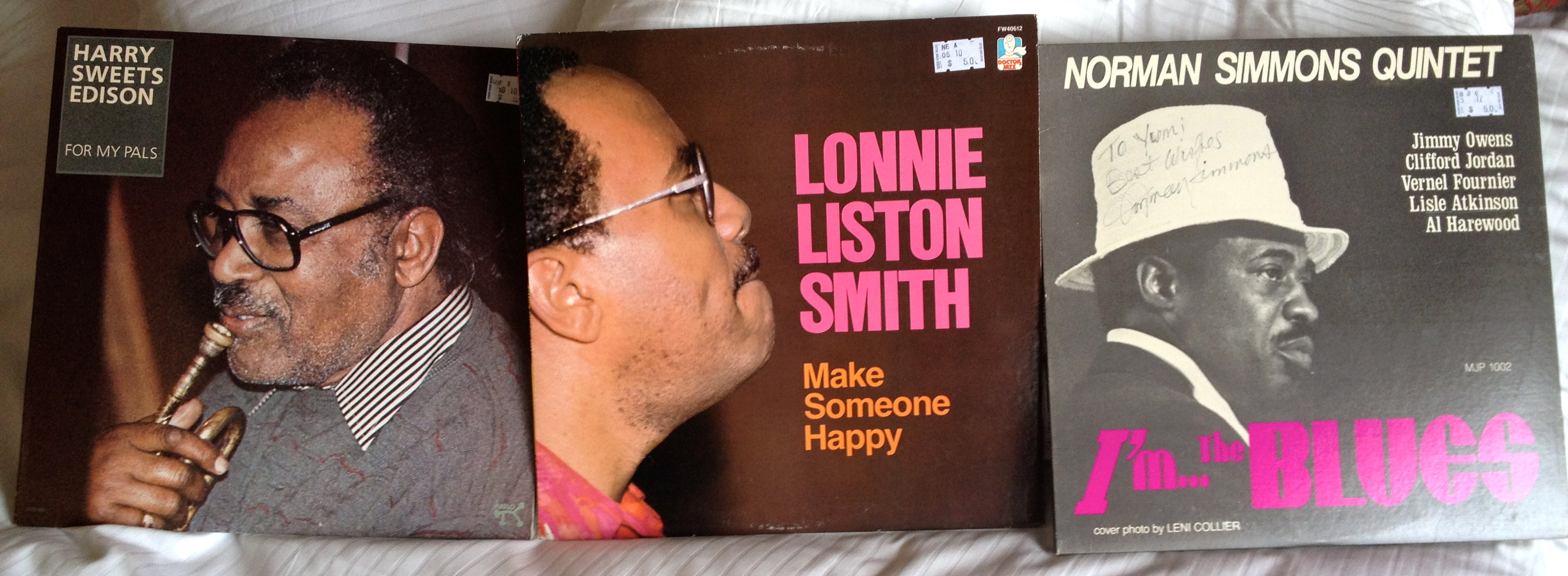
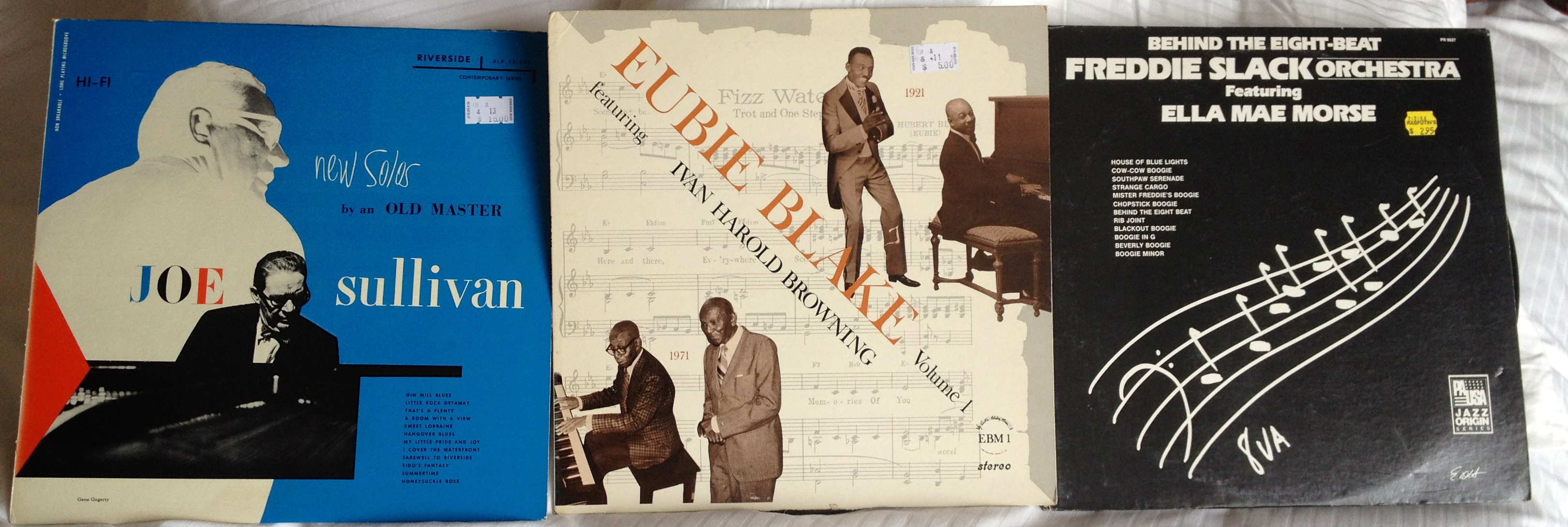
I found some obscure treasures this past week. A few of them were from Rasputin’s on Telegraph Avenue (just down the street where we’ve been working with MMDG at Cal Performances) and the rest were from Down Home Music, a really wonderful store that Aaron Greenwald drove me to yesterday.

IMG_3086

Starting with the obvious, some late Hawes that for some reason I don’t have anymore. Neither of these made much impression previously, but I may be wrong. Nice humble liner note by Hawes on High in the Sky.

IMG_3088

I like the score to Sunset Boulevard (who doesn’t?) so I’ll give Waxman’s “jazz” a try. Never owned a Buddy Colette record, but know he was important to Mingus and Dolphy. These are apparently jazz treatments of film music, could be interesting.

IMG_3090

Slide Hampton is someone I need to know more about, the repertoire is solid and the rhythm section is A+: Albert Dailey, Ray Drummond, Leroy Williams. McPherson has Williams too along with Ron Carter and Barry Harris (the production on those Mainstream discs are usually disappointing, though). I believe Sam Most died the day I purchased Flute Flight, one of the few albums with Donald Bailey I’ve never heard.

IMG_3092

The Sweets has Tootie Heath on drums! I’m sure that’s going to be great. I had no idea that Lonnie Liston Smith made a piano trio record with Cecil McBee and Al Foster. And Norman Simmons has a great cast for some bop blues. Al Harewood just turned 90, by the way. He’s not playing that much anymore but his health is reportedly excellent.

IMG_3094

The Joe Sullivan was kind of expensive but I’m quite curious to hear it. From 1953, as far as I know unavailable on CD despite being on Riverside. Eubie Blake’s discography is hard to find your way around in, but this 1971 one has “Dicty’s on 7th Ave.” and a few other rags written using the Schillinger System. (I’m available for research and liner notes if Blake’s estate wants to finally produce a definitive box set of his best.) I haven’t heard any Freddie Slack in years! I think he’s pretty good, actually, I know Hampton Hawes liked him.

IMG_3096

And finally, four LPs of pianists on Euphonic Sound Recordings. Larry Kart just recently told me about Paul Lingle, a major talent. There’s only one CD, split between Lingle and Burt Bales (who’s also good) called They Tore My Playhouse Down. I was very impressed, and am looking forward to hearing these hard-to-find LPs. Don’t know much about Euphonic, but it seems to me that they deserve a proper reissue box, too. 

Ojai 2013

The Ojai Music Festival has shown up once before on DTM, on a 1962 program by Gunther Schuller where Eric Dolphy played Varèse.

Over the years it has grown into one of America’s most respected classical musical festivals.  The current artistic director is Thomas W. Morris, and this year the music director is Mark Morris.

Mark is my former boss and mentor. (This old Terry Teachout NY Times profile explains further.) One day I’ll write a proper essay about everything I’ve learned from Mark Morris. That will be a long essay. The first TBP/Mark Morris Dance Group collaboration was Violet Cavern in 2004. Reid, Dave, and I are thrilled about his next premiere, Spring, Spring, Spring.

Ojai has never focused on American composers before, but since Mark has choreographed Charles Ives, Henry Cowell, Henry Partch, John Harbison, Kyle Gann, and especially Lou Harrison, it only makes sense for the Morris-curated year to invite Californian classical music lovers to discover who lives in their neighborhood. My own first exposures to Cowell and Harrison were through Mark:  I can’t wait to see the new dance Jenn and Spencer set to Cowell’s unjustly obscure but utterly delightful neo-baroque Suite for Violin and Piano.

The full program for the Ojai Festival includes not just MMDG in flight and important concert music by Cowell, Harrison, and Ives, but also generous servings of John Cage and John Luther Adams, plus glimpses of Samuel Barber, William Bolcom, Carl Ruggles, Vincent Persichetti, and even Terry Riley’s In C.  At least some of TBP is planning to join in the latter…

Other TBP engagements include a “concert” version of our Rite of Spring alongside original music, a (relatively) spontaneous score to the legendary Charles Bryant/Alla Nazimova film Salomé and an open mic night (!) led by Mark.

With Yulia Van Doren I’ll be playing Four Walls by John Cage. This early work is long but easy on the ear.  Apparently it was the first major Cage/Cunningham collaboration from the mid-40s.  As always, Cage gave himself some strict rules. All white notes: two metronome markings: extreme dynamics: a surprise easter egg (the vocal in the middle). It’s my first time working on Cage. I’m planning to be pretty theatrical with it, especially since Yulia and I won’t have dancers. At least I will have a “Four Walls Costume” made by Maile Okamura.

The following week we all travel up to Berkeley for Ojai North! and the premiere of Mark Morris’s dance to the Rite of Spring. I hope I’m not letting a cat of the bag here: Mark told me years ago that the Rite was “unchoreographable.” (Apparently that was Balanchine’s ruling.) Of course, it is famous as a ballet, but I understood what Mark meant after I saw assorted terrible Rite dances over the years.

I’m glad Mark has changed his mind. Reid and I played through our version with MMDG last week. To see all of Stravinsky’s complex yet clear, frankly prog rock mixed meter rhythms translated precisely and perfectly to Mark’s brilliant company was heart-stopping. We expect Spring, Spring, Spring to be a hit.

TBP/Salomé and Four Walls reprise in Berkeley, too.

LA Times preview of Mark Morris at Ojai.

NPR: Why Jazz Musicians Love The Rite of Spring.

DTM: Mixed Meter Mysterium.

Postmortem

Recently Mark Morris has been exposing everyone within earshot to Ivor Cutler, culminating in the recent dance A Wooden Tree starring Mikhail Baryshnikov, reviewed well by Joan Acocella in The New Yorker.

Last week one of Mark’s composition assignments at the Dartington choreographer/composer retreat was “Women of the World.” My hasty transcription reflects the duet with Linda Hirst more than Cutler’s solo version.

Women of the World (Cutler)

H’mm! Generous review of the Vortex gig by John Fordham.

Westlake and Rabe

Big news for fans for Donald E. Westlake: Levi Stahl is going to edit a miscellany of the late author's best bits and pieces. There's a lot to choose from, some of which I cite in my Westlake overview. I hardly know everything, though, so I eagerly look forward to finding out what else may be available.  

Levi has asked for help in finding out what should be included, so if you are a collector of Westlakiana, head over there and weigh in.

There's quite a few Westlake diehards on the internet. In addition to Levi and myself, there's Trent Reynolds, who runs The Violent World of Parker website, and Nick Jones of the always amusing Existential Ennui blog. Nick's response to Levi's announcement suggests a few interesting things that may appear in the forthcoming anthology.

Another smart Westlake fan showing up in the comments at all these watering holes is "Chris." We have a nice exchange in this post about a Westlake essay that really must be reprinted, the frank appraisal of Peter Rabe. 

As I've written before, Rabe would be much less well known these days if Westlake hadn't been so sincere in his appreciation. I like Rabe a lot, but if you haven't read Westlake or his alter ego Richard Stark yet, there's no rush to track down Rabe…

…except for the cover art that Nick has been posting! OK, now I know what I want. I want a high-res poster of this delicacy by Robert McGinnis

It's my favorite Rabe book, besides. 

Murder me for nickels

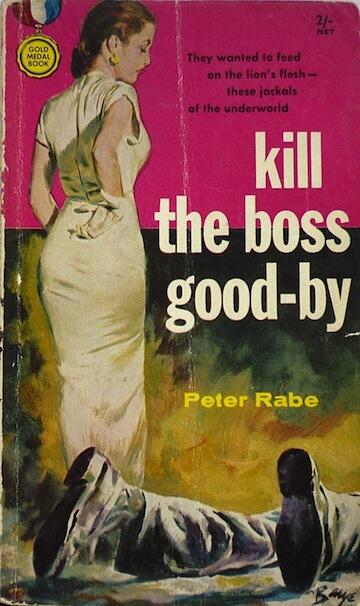
Here's another great one, this time by Bayre Phillips:

Kill the Boss Goodbye

Both my wife and Oonaballona went nuts for the dress: I proposed being the dead body for the photo shoot if Oona conjured the threads. Oona also liked the title Kill the Boss Good-by. I do too. I also like title Murder Me for Nickels. Interestingly, Westlake didn't like those titles: Indeed, he hung his entire essay around the conceit of the books being so much better than the titles.  I can't say I agree! The contents, titles, and covers add up to a pretty perfect Gold Medal package. 

Legacies

Donald Byrd and Van Cliburn: When they were at their best, there was no one better. 

I'm listening to Byrd's Royal Flush right now. Someday I'm going to go through all the records with Byrd and Herbie Hancock together. There's about ten of them, begining in 1961. In their own way, it is just as a magical combination as Miles Davis and Hancock.

Those years were right when Van Cliburn was at his height. I really admire those early records — who doesn't? I particularly like Cliburn in Rachmaninoff.

Both men, however, had trouble navigating a long-time successful career in the arts. It's always regrettable when the tracks you want to spin when somebody passes are 30, 40, or 50 years old.

Frannie Kelley: Remembering Donald Byrd, Jazz Trumpeter Who Spanned Generations

Michael J. West: Byrdland: Why Donald Byrd Mattered to Jazz, Its Legitimacy, and D.C.

Terry Teachout: Van Cliburn, R.I.P.

Matthew Guerrieri: Competitions