Harold Mabern R.I.P.

Harold Mabern’s name ended up being slightly incorrect on his birth certificate. It actually was “Harold Will Burn.”

A major legacy. Just a few things that come to mind:

I wish I had seen at least one of the early ’80s nights at the Village Vanguard with George Coleman and Mabern, when these two master Memphis musicians were at their peak of ferocious virtuosity and they were playing to a small group of select NYC initiates…

…Still, three summers ago I saw Mabern play “Just One of Those Things” with Eric Alexander in Chicago as fast as you could count it, and Mabern could still swamp the rhythm section with cascades of perfectly organized sound.

The best Mabern-led record I know is Straight Street, a fantastic trio date from 1989 with Ron Carter and Jack DeJohnette that gets the most out of all three players.

One of Mabern’s best compositions is “The Beehive,” immortalized in a smoking rendition with the Lee Morgan Quintet Live at the Lighthouse with Bennie Maupin, Jymie Merritt, and Mickey Roker. (Off on a tangent: There is current amount of handwringing about the participation of African-Americans in “Classical Music,” for example a viral think piece by Joseph Horowitz, “New World Prophecy.” I’m sympathetic to Horowitz’s perspective here (I also admire Horowitz’s criticism in general), but I also wonder why the best American music academics and music students don’t seem to spend more time deciphering what the hell goes into the profound intellectual and virtuosic elements of something like this performance of “The Beehive.” In a way, if Live at the Lighthouse isn’t “classical music,” then nothing is “classical music.”)

https://www.youtube.com/watch?v=xw8LS9XJECM

The lore goes that Mabern knew every standard and many pop tunes after 1970, including most of Stevie Wonder.

His teaching at William Paterson made a profound impression on several of my peers and friends. The truth will set you free.

I hosted a lively roundtable with Joanne Brackeen, Kenny Barron, and Mabern at the 2018 Jazz Congress. Many people have told me this was an unusually successful panel, and perhaps it was. Mabern was in fine form and played a soulful blues in G at the end. The event starts 25 minutes in.

Trio Tour with Two of the Best

+ tour with Joe Sanders and Jorge Rossy — a recent collective of unrestrained souls

September 11 – Jimmy Glass, Valencia
12 – Jazzhus Montmartre, Copenhagen
13 – Jazz Summer meeting, Lugano
14 – Jazzclub Unterfahrt, Munich
15 – Pizza Express, London
17 – Porgy & Bess, Vienna
18 – Jazz Dock, Prague
19 – Blue Note, Milano
20 & 21 – Duc des Lombards, Paris

Iverson Sanders Rossy 1Iverson Sanders Rossy 3Iverson Sanders Rossy 2

[Photos by Alessandra Freguja]

If you come to a gig, please say hi!

I Like Harmony

I’m having a rather blissful time listening to the CD American Dream, compositions of Scott Wollschleger played by Bearthoven, a bonafide “piano trio” comprised of Karl Larson, piano, Pat Swoboda, double bass, and Matt Evans, percussion. “Gas Station Canon Song” is for quiet solo piano, “We See Things That Are Not There” is for hesitant piano and vibes, and the dramatic centerpiece “American Dream” is for the complete trio. The performers are all great and the production is top-notch. Anne Leilehua Lanzilotti contributed helpful liner notes.

Sometimes I worry just a little bit about the direction of “post-minimal” American “classical” music, especially if there are “indie” or “rock” references. Of course there are good things, like Caroline Shaw’s Partita and John Luther Adams’s Become Ocean, and I wrote about Michael Gordon’s Sonatra for the New Yorker Culture Desk, but just last week I was at a concert where the minimalist works went over big with the audience yet left me cold.

Wollschleger is “process” oriented, the harmonies and melodies repeat and mutate over time, but the raw materials are notably compelling. Possibly Morton Feldman is Wollschleger’s biggest influence. If you like Feldman, get hip to Wollschleger right now

I admit Scott is also a friend, today we walked in the park together.

IMG_2307


Tales of Fantasy and Wonder (Ursula K. Le Guin + Terrance Dicks)

In Ursula K. Le Guin’s 1971 science fiction novel The Lathe of Heaven, a future Portland, Oregon is redrawn according to the dreams of a gentle man who doesn’t want to hurt anybody. Sometimes I worry that old-school SF novels will bore me with endless world-building, but The Lathe of Heaven is earthy and direct, packing a wallop more like a great SF short story.

Mark Turner loves the book so much he named an album for it. My wife Sarah Deming was on a Le Guin kick recently, and read The Lathe of Heaven after I told her Mark was a big fan. She loved it as well, so I finally came to my senses and read it for myself. Highly recommended.

To let understanding stop at what cannot be understood is a high attainment. Those who cannot do it will be destroyed on the lathe of heaven. — Chuang Tzu 

A 1980 PBS production has a cult following. Sarah told me I would dig this made-for-TV movie because, “It’s like old Doctor Who.”  Yeah, the PBS translation is also great, and apparently Le Guin approved of it as well.

Speaking of: Doctor Who fandom has been processing the death of Terrance Dicks last week. Dicks was the script editor for the Jon Pertwee era and wrote a few classic stories of the Tom Baker era including Robot, The Brain of Morbius, The Horror of Fang Rock, and State of Decay. With that, he is in the pantheon for Doctor Who fans already…but there’s also his work offscreen. It is quite extraordinary how so many of us read so many Dicks novelizations for Target Books in the late 70s and early 80s.

I’ve copied the following list of off the Tardis Wiki. The books I read as a boy are in bold.

Doctor Who and the Auton Invasion
Doctor Who and the Day of the Daleks
Doctor Who and the Abominable Snowmen
Doctor Who and the Giant Robot
Doctor Who and the Terror of the Autons
Doctor Who and the Planet of the Spiders
The Three Doctors
Doctor Who and the Loch Ness Monster
Doctor Who and the Genesis of the Daleks
The Revenge of the Cybermen
Doctor Who and the Web of Fear
Doctor Who and the Planet of the Daleks
Doctor Who and the Pyramids of Mars
Doctor Who and the Carnival of Monsters
Doctor Who and the Dalek Invasion of Earth
Doctor Who and the Claws of Axos
Doctor Who and the Brain of Morbius
Doctor Who and the Planet of Evil
Doctor Who and the Mutants
Doctor Who and the Deadly Assassin
Doctor Who and the Talons of Weng-Chiang
Doctor Who and the Face of Evil
Doctor Who and the Horror of Fang Rock
Doctor Who and the Time Warrior
Death to the Daleks
Doctor Who and the Android Invasion
Doctor Who and the Hand of Fear
Doctor Who and the Invisible Enemy
Doctor Who and the Image of the Fendahl
Doctor Who and the Robots of Death
Doctor Who and the Destiny of the Daleks
Doctor Who and the Underworld
Doctor Who and the Invasion of Time
Doctor Who and the Stones of Blood
Doctor Who and the Androids of Tara
Doctor Who and the Power of Kroll
Doctor Who and the Armageddon Factor
Doctor Who and the Nightmare of Eden
Doctor Who and the Horns of Nimon
Doctor Who and the Monster of Peladon
Doctor Who and an Unearthly Child
Doctor Who and the State of Decay
Doctor Who and the Keeper of Traken
Doctor Who and the Sunmakers
Meglos
Four to Doomsday
Arc of Infinity
The Five Doctors
Kinda
Snakedance
Warriors of the Deep
Inferno
The Caves of Androzani
The Mind of Evil
The Krotons
The Time Monster
The Seeds of Death
The Faceless Ones
The Ambassadors of Death
The Mysterious Planet
The Wheel in Space
The Smugglers
Planet of Giants
The Space Pirates

I can’t remember how I got the money to buy all those books from the Little Professor Bookstore in Menomonie. I was definitely helping keep them in business:  they’d be sure to stock a copy of each one as it came out because they knew ol’ Ethan would be around to grab it before too long.  The books weren’t expensive — under two dollars each, I think — but my parents were broke and I didn’t have much of an allowance. H’mm. I must have saved up any holiday gift money from relatives, plus one summer I mowed the grass at cemeteries with my Dad.

At any rate, any dedicated reader of DTM knows I can be obsessive about collecting information. The work of Terrance Dicks was one of my first “projects.”

These novelizations are not for adults, and truthfully when I’ve looked at one or two recently I can’t quite see why I loved them so much as a child, either. It’s still easy for me to enjoy the prose of brilliant young-adult stylists Ellen Raskin or Daniel Pinkwater (two others I joyfully read as a boy), but Dicks is just getting the job done in brisk and competent fashion.

As with so many dusty artifacts of pop culture, the first high romance must have been a convergence of time, place, and something in the air. Tom Baker says that Doctor Who fans, “Are in love with their own vitality,” and I guess rolling up to the Little Professor to buy Terrance Dicks was a vote of confidence in myself.
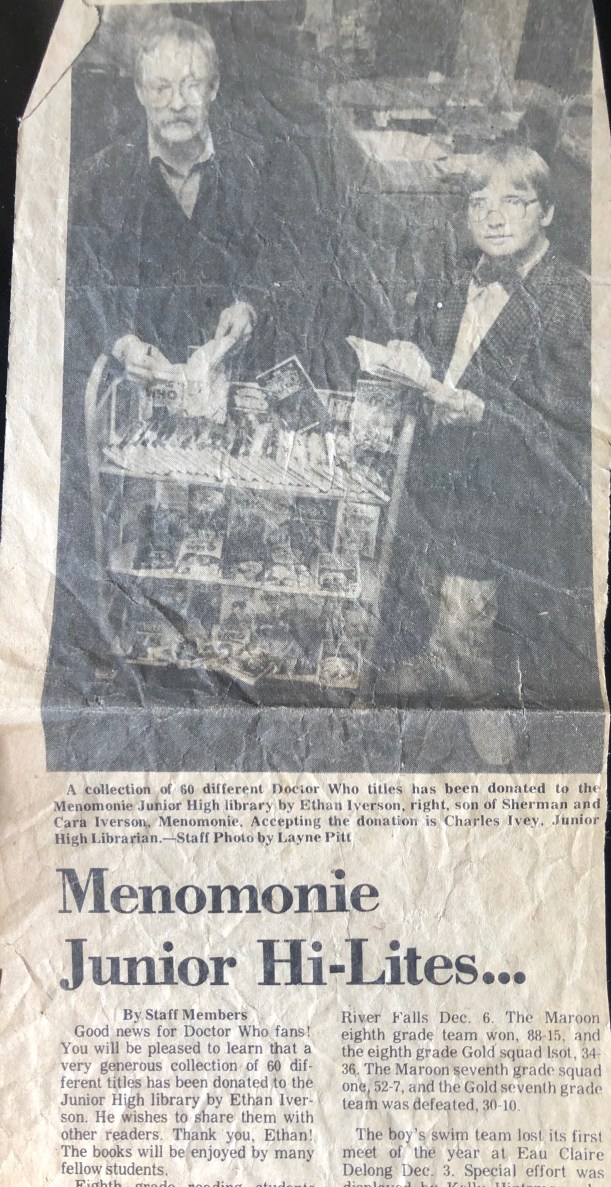
fullsizeoutput_130c

When I was “done” with the series, I donated my Terrance Dicks collection to the school library. Yep, that’s tape on my glasses. 

Matthew Guerrieri tribute.

Elizabeth Sandifer tribute.

Productive Household

Fans: Nothing helps us more than preordering the new releases!

Sarah Deming, Gravity, out on November 12 — already two starred reviews from Kirkus and Booklist. From the new Make Me a World imprint at Random House curated by Christopher Myers.

Ethan Iverson Quartet with Tom Harrell, Common PracticeA 2017 live date at the Village Vanguard with Ben Street and Eric McPherson. Engineered by Andreas Meyer; produced by Manfred Eicher for ECM; liner notes by Kevin Sun.

A track is up on YT:

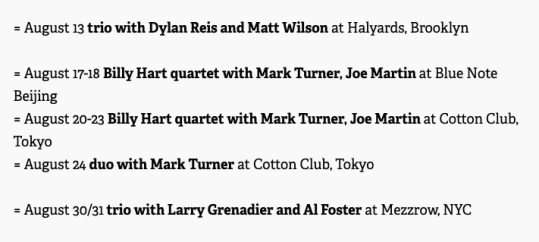
August Break

Aug gigs.png

(as above)

If you come to a gig say hi!

I haven’t heard Larry and Al in a piano trio since a nice gig with Renee Rosnes at Bradley’s in…what…1993 maybe? Definitely a hit I’m looking forward to…

Taking the rest of the month off from DTM and my socials…

2019 DTM big pieces so far:

Write it All Down (overview of American Classical Piano Music)

Interview with Mark Stryker and part 2 on saxophonists

Are Polychords Problematic? (for my students)

Theory of Harmony (for my students)

Colin Dexter Diary

Lil Hardin Teaches the Blues (for my students)

Major updates to old pieces on Lennie Tristano, Geri Allen, and James P. Johnson

Guest posts:

The Bard of Bebop (Ira Gitler, by Mark Stryker)

A Depressing Gig (by Desmond White)

A History of the Blues…Scale? (by Asher Tobin Chodos)

coming soon:

fullsizeoutput_122a.jpeg


Near and Far

Matthew Guerrieri has a new book out, The Black Archive: Horror of Fang Rock. The Black Archive is a project by Obverse Books to publish a detailed monograph on every episode of Doctor Who.  It’s frankly amazing that this old kid’s show has prompted so much analysis over the years. For whatever it is worth, a direct line can be drawn from my reading of Who criticism — especially the anthology edited by Paul Cornell, Licence Denied: Rumblings from the Doctor Who Underground — to Do the Math and the music articles I publish elsewhere.

Guerrieri is a friend, and our friendship is partly based on liking the same kinds of semi-obscure things. To say that The Black Archive: Horror of Fang Rock is in my wheelhouse actually understates the matter. I felt like Matthew wrote this book just for me. I naturally give it a ringing endorsement!

From his blog entry:

If you have an interest in the show—or in the relative lighting power of oil and electricity, or the scavenging habits of coastal Scots, or the hidden 19th-century history of tentacular monsters, or Leslie Stephen’s anti-materialist philosophy, or the numerology of the tarot, or Guglielmo Marconi’s marital misadventures, or Odysseus consulting with the dead—you will hopefully find something interesting.

Let me add to this impressive list that three of my own favorite parts concerned Virginia Woolf, H. P. Lovecraft, and Peter Maxwell Davies.

I’m no Quentin Tarantino diehard. Like many people my age I was bowled over by Reservoir Dogs and Pulp Fiction. but then I thought he became kind of a bad influence on the culture. (At the least, he was way too easy to imitate. I quit watching Breaking Bad because I was turned off by the Tarantino-style beats of absurd comedy and absurd violence.) I didn’t connect with downbeat Jackie Brown or bloated Kill Bill and sort of wrote Tarantino off as something for other people.

However, the mysterious commercials for Once Upon a Time…In Hollywood were intriguing, and yeah, I loved it! I didn’t know anything about the plot in advance and was shocked and delighted. The film moves rather slowly by today’s standards — at times it is almost 1968-era automobile porn — so if you think it might suit, I recommend checking it out on the big screen.

Once Upon a Time…In Hollywood reminded me of two other movies I really enjoyed in recent years, Hail Caesar! by the Coen brothers and The Nice Guys by Shane Black. All are ironic elegies for “the way things used to be” and all give great actors huge parts to bite into. I must say Brad Pitt never made an impression on me before, but after Once Upon a Time…In Hollywood I’m ready to sign on the dotted line as a card-carrying member of the Brad Pitt fan club

I have read criticism to effect that Tarantino makes his movies out of other movies. Everybody does this, of course — there are no new ideas, just new ways of putting together old ideas — but with Tarantino it is unusually explicit, and the director himself is willing to cite his sources chapter and verse. For my generation and social circle, Wes Anderson might have been even more important then Tarantino, and I experienced a full-body chill when I realized part of Once Upon a Time…In Hollywood was a straight-up homage to Anderson (the Italian sequence with voiceover).

Wes Anderson is hardly the only reference in Once Upon a Time…In Hollywood. It goes on and on. I’m not really a movie buff, but I suspect every scene is lifted from another source. It took 40 years for a Guerrieri to come along and unpack Horror of Fang Rock top to bottom, but I expect the full breakdown of the latest Tarantino to land sooner — like by Christmas, probably — and I’ll be eager to read all about it.