It’s distressing how many masters lack video representation in the archives, but once in a while something turns up. Mark Stryker has alerted me to a newly-rediscovered tape of Gene Ammons, AKA “Jug.”
According to Stryker, the Chicago band includes King Kolax, George Freeman, Wallace Burton, Chester Williamson, and Bob Guthrie. At times Jug is hooked up to a Varitone, which is — actually kind of cool? Purists may dismiss such a move but I kind of dig it. At any rate it was a conscious way to keep up with the times. (It’s always worth remembering that these masters didn’t regard their styles as immutable.)
Josh Redman told me that Dewey Redman gave a lot of credit to Ammons. I really see that in this video: The abstract phrasing on the opening ballad, the hunt and peck on “Jungle Strut.” Total Dewey!
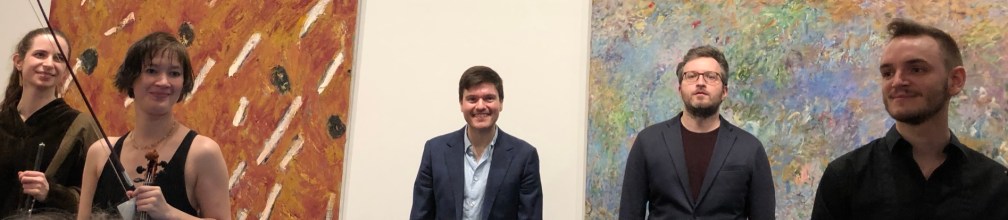
On January 11, the AMOC offered a chamber music program at the Milton Resnick and Pat Passlof Foundation on the lower east side. The Foundation is a beautiful art gallery, and the recital room was packed to hear five players from the American Modern Opera Company perform four pieces without pause. It was a conceptual and theatrical event, with recent work arranged around a piece of core repertoire, the Charles Ives piano trio.
Emi Ferguson, Miranda Cuckson, Jonny Allen, Conor Hanick, Coleman Itzkoff
An expanded arrangement of Three Études by Matthew Aucoin began the program. Pianist Conor Hanick played one “straight” before being joined by flautist Emi Ferguson and percussionist Jonny Allen. This music was solid, disjunct, of the moment; a good opener.
The Ives trio was essayed by Hanick, violinist Miranda Cuckson, and cellist Coleman Itzkoff. It’s one of Ives’s best pieces, a classic by any standard, and it was thrilling to hear a high level performance up close in a small room.
I was sitting next to Scott Wollschleger, the composer of Secret Machines, Nos. 1 & 2. Many of Wollschleger’s compositions are slow process pieces, quite dissonant, even “punk,” but underneath the groaning and moaning lurks a truly refined sense of harmony. Now united as a full band, the five musicians bent to the task and the room reverberated with controlled chaos. Scott’s a friend, as is Miranda (I wouldn’t have been aware of this concert otherwise) and I experienced a moment of self-conscious pleasure simply by remembering that I knew some of the hippest people in town.
The tension was released by Robert Honstein’s Unwind. All the musicians stayed onstage and unspooled mellow polyrhythmic counterpoint in pure diatonic harmony. It was just what we needed, almost a “rock and roll coda.” I hadn’t been to an AMOC concert before but they frankly blew me away.
—
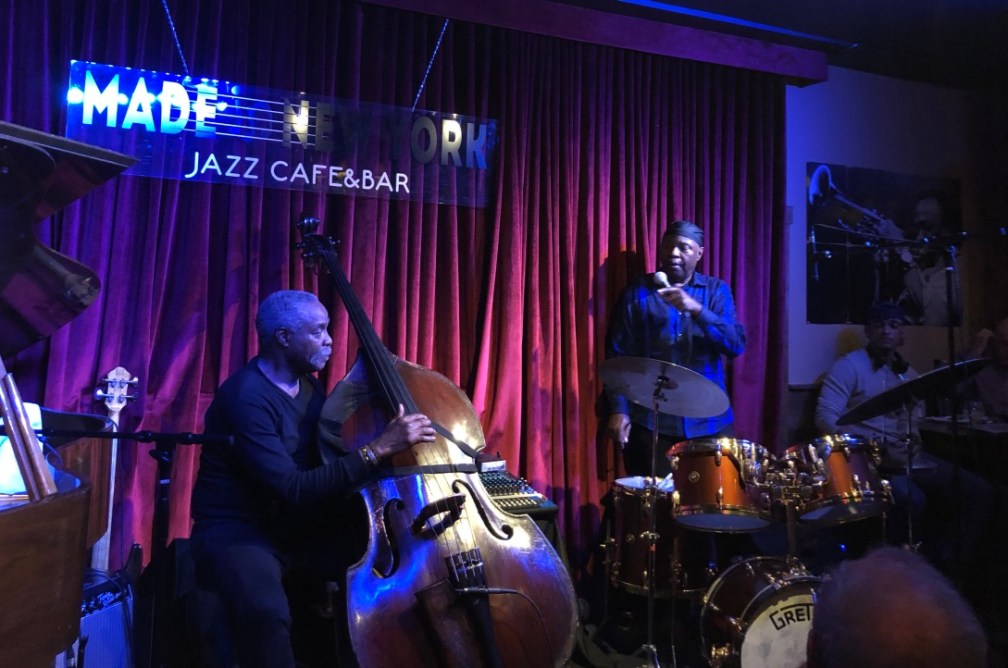
Lenny White is 70, and celebrated with a bevy of gigs at the new joint in Park Slope, Made in New York. I finally got there for the last set, a trio with George Cables and Alex Blake. White called this the “hood trio,” as they grew up playing in Queens together.
Alex Blake and Lenny White
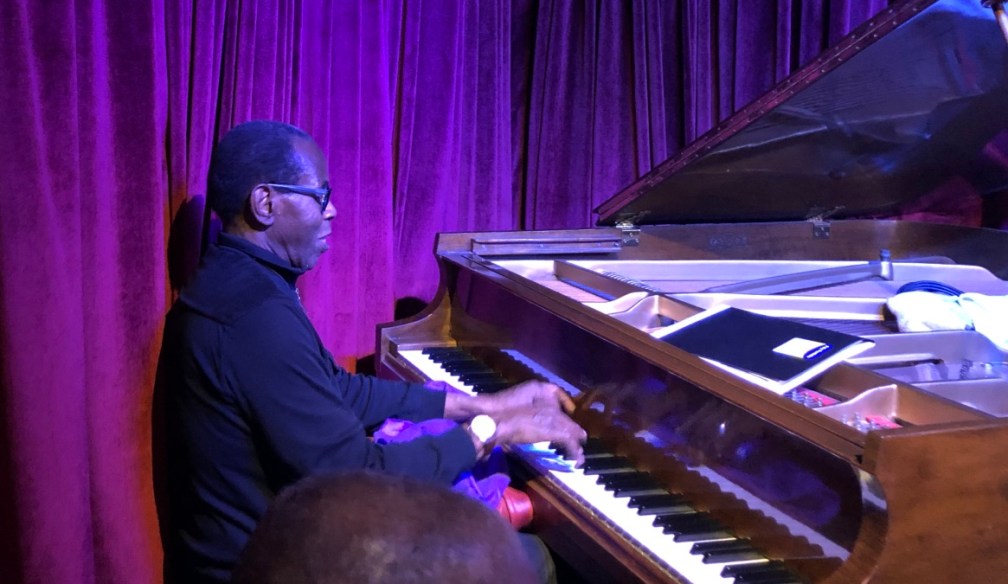
It was a high-energy set of burning modal jazz: Business as usual since about 1968. They even played Cables’s famous “Think on Me,” a song that entered common-practice repertoire on Woody Shaw’s Blackstone Legacy featuring both Cables and White.
George Cables
Nobody is getting any younger but everyone sounded up on their chops. Lenny White is a swinger — at this point, he is much closer to Big Sid Catlett than so many young players only comfortable with even eighths — but, of course, he owns funky beats and stuff to make the steady syncopations pop, just the way he did for Return to Forever or on Freddie Hubbard’s Red Clay.
White’s an interesting personality. One of his most outrageous discs is The Adventures of Astral Pirates (which includes Alex Blake on bass). My buddy Guillermo (a real connoisseur of the genre) considers Astral Pirates one of the greatest fusion LPs. Fusion has kind of returned to the New York scene in recent years, so it’s good to go back and remember how big and bold this stuff was back then. Hell, this stuff is still just impossible….
In general I approve of the bookings at Made in New York: It’s great to have a new joint in Brooklyn for masters of the tradition.
—-
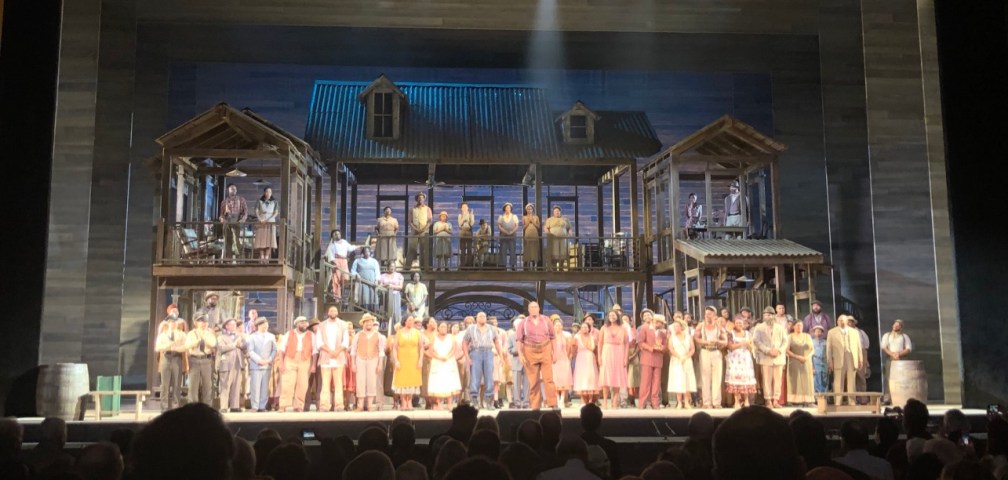
Porgy and Bess has been a unqualified hit for the Metropolitan Opera this season. I hadn’t seen a staged version in decades, so it was refreshing to enjoy such a high-end production. This is indisputably George Gershwin’s best concert music, and the score is also full of songs (“arias”) that are as familiar as the hit Gershwin tunes birthed on Broadway.
The opera is essential Americana. I suppose it is also almost by definition “problematic” from a few different modern viewpoints, but music this good has a way of carrying the day over all objections. It was nice to see so many black people in the audience. There are always a few at the opera — more then you might think if you never go — but naturally, when it’s an all-black cast, the audience responds.
Eric Owens and Angel Blue were wonderful in the leading roles. Janai Brugger, Latonia Moore, Denyce Graves, Frederick Ballentine, Alfred Walker, and Donovan Singletary all had moments to shine. David Robertson conducted and the production was designed by James Robinson.
I ran into pianist Bill Charlap at the interval. Bill is famously a deep student of American composers, so I joked to him, “I guess you are checking out these voicings.” He looked at me solemnly and replied, “This score has every voicing you will ever need.”
Apparently extra performances of Porgy and Bess have been added thanks to overwhelming demand.
Jimmy Heath was not just a musician. Jimmy Heath was a lifestyle, a mood, a way to make sense of the world.
The last time I saw Jimmy play was in 2016 at the Village Vanguard with Jeb Patton, David Wong, and Al Foster. I never heard a set of Jimmy Heath where there wasn’t some down ‘n dirty blues, and that night he was particularly inspired on Sonny Red’s “Bluesville.” The snaky tenor lines burst through the air like soulful sparkles. It was a good reminder that Jimmy was the same age as John Coltrane, and that Jimmy and Trane had learned the blues together as teenagers in Philadelphia.
Jimmy was the middle child of one of the great jazz families. Percy was the elder, a major bassist for Charlie Parker and Miles Davis and eventually the bottom end of the Modern Jazz Quartet. Tootie was the younger, a quicksilver swinger who has played comfortably with everybody from Wes Montgomery to Don Cherry. For a time they joined together as the Heath Brothers, a band that must have appeared at every major jazz festival in the world.
When Jimmy, Percy, and Tootie played together, it was a conversation. Not just musically, but literally: They would talk to each other, the whole time, the whole gig. It was hilarious. They’d talk about who looked funny in the audience and who had the better hotel room that night. One time I saw Tootie play a loud cymbal crash during a piano solo, prompting Jimmy to yell, ‘That was a big one!” Tootie yelled back, “It had to be done!”
All the brothers had amazing verbal skills, they were all born comics and could riff like nobody’s business. After “Winter Sleeves,” one of the pieces in the Heath Brothers book, Jimmy Heath would address the audience in rhyme:
That piece was called, “Winter Sleeves”…
based on a song called, “Autumn Leaves”…
so I could collect the royalties…
for my melodies.… Please!
The most familiar of Jimmy’s many compositions is probably “Gingerbread Boy,” thanks to a classic performance of Miles Davis with Wayne Shorter, Herbie Hancock, Ron Carter, and Tony Williams. The tune’s jagged themes just sort of hang there, a set of questions and answers. Conversation in music, conversation on the bandstand. Miles recorded a few Jimmy Heath tunes and didn’t always give credit. “Miles! Could I have the royalties for my melodies….please?”
I Walked With Giants is Jimmy’s autobiography. It’s a valuable read, but no jazz master gives up all their secrets. Now that Jimmy is gone, he took a big part of what was living history with him.
Tootie told me a great story recently: While Jimmy was serving time at the Lewisburg Penitentiary, he put a band together that included William Langford, better known to jazz fans as The Legendary Haasan. When Langford decided to quit the prison band, he wrote Jimmy a letter to explain that he didn’t want to do it any more. Of course, Haasan saw Jimmy all day long, every day, at chow and exercise time etc. Still, Haasan sent Jimmy a letter.
I’m not sure what this story proves, exactly, except that it’s another reminder that when Jimmy played the blues, it was the real blues.
Jimmy Heath’s extensive discography deserves a serious critical overview. There’s a lot there, and most of it isn’t nearly as well known as it should be. As I type this, I’m listening to the truly brilliant composition “Six Steps” from Swamp Seed. The orchestration includes two french horns and tuba. Harold Mabern (also recently gone) gets the first say, Donald Byrd is supremely tasty, and then Jimmy himself tells it like it is. His brothers Percy and Tootie are in the rhythm section. Family, community, conversation, mystery, the spiritual, the unknowable, the slick, the smart, the surreal: Whatever I love about jazz, it’s all right here in this fabulous track.
A buddy told me about the long and outrageous series of Burt appearing on Johnny. My parents didn’t watch Carson when I was growing up, and honestly I don’t know the Reynolds filmography (such as it is) that well either. No matter. These clips are pretty astounding: Off the wall, nearly obscene, and just beautiful top to bottom. If late night TV were like this today, I’d buy a set.
My jaw dropped open several times watching this 1974 clip.
In 1978, they begin with a long palaver about a party at Burt’s house where Ed McMahon was invited and Johnny wasn’t. There’s a boffo finish.
Later that same year, Steve Martin filled in for Carson and got Burt to go for broke.
On Saturday I’m going to this 5 PM concert, AMOC AT THE RESNICK PASSLOF FOUNDATION
MATTHEW AUCOIN, arr. EMI FERGUSON / Three Études
CHARLES IVES / Piano Trio
ROBERT HONSTEIN / Unwind
SCOTT WOLLSCHLEGER / Secret Machines, Nos. 1 & 2
I’m a fan of composers Aucoin and Wollschleger, am curious about Honstein, and think the Piano Trio is one of Ives’s best pieces.
—
On a related topic, I’m slowly becoming a little more aware of composer Harold Meltzer. His Virginal is strikingly attractive.
Sara Laimon is the harpsichordist; Laimon’s CD American Piano Music of the 1940’s is one of my treasured documents, especially her recording of Leon Kirchner’s piano sonata.
I learned about Meltzer from Miranda Cuckson, who is performing with AMOC on Saturday. Everything in Cuckson’s email blast looks fabulous, I encourage DTM readers to go if these events are nearby! There’s even a gig a Shapeshifter!
This Saturday, January 11, I’m playing in a chamber program at the Resnick Passlof Foundation with my amazing friends in AMOC.
AMOC is a collective of artists making discipline-colliding work combining theater, music, dance, opera but our musicians also like to play together and just get into the music. We’ll be playing music by Ives, Aucoin, Wollschleger, and Honstein. Students tickets are available for $15.
If you’re upstate on Jan 26, Conor Hanick, Coleman Itzkoff and I are playing the Ives Trio there as well, on the Union College Concerts series in Schenectady, on a program also featuring AMOC’s brilliant tenor Paul Appleby with Conor performing songs by Schubert, Aucoin and Berg. I’ll be playing transcriptions of three early Berg songs as well.
On Jan 30 at 2pm, I’m playing at Merkin Hall on the PREformances series, which presents artists performing music they’re about to play on other concerts. With my colleagues and longtime friends violist Dan Panner and cellist Sophie Shao, I’ll be playing trios by Kodaly and Beethoven and a duo by Xenakis.
This is in preparation for the “Miranda Cuckson and Friends” concert at the Library of Congress in Washington on Feb 21. In addition to those three works, we’ll be joined by pianist Stephen Gosling for the Schumann Op. 47 Quartet and for Harold Meltzer’s violin/piano duo “Kreisleriana” (which I play on Harold’s currently Grammy-nominated album with Blair McMillen). I’ll also play the US premiere of a violin piece written for me by Iranian composer Aida Shirazi. The concert honors Leonora Jackson McKim, whose fund supports the LOC’s McKim commissions (Harold’s piece among them) and I’ll play some of the concert on her Stradivarius violin. Tickets are apparently already “sold out” but please check back in case spots open!
On Jan 31, my new-music group counter)induction celebrates its milestone 20th anniversary with a concert at Shapeshifter Lab in Brooklyn. I’ve been playing with the group for ten of those years and we’ve done a lot of very exciting music. The program will feature pieces by four of c)i’s nine members: Douglas Boyce, Kyle Bartlett, Ryan Streber, Jessica Meyer.
Amid all this, I’m doing a weeklong residency at Shepherd School of Music at Rice University in Houston, Jan 13-19. I visited there two years ago and the quality of music-making there is outstanding. I’ll be playing Scelsi’s incredible work Anahit for violin&ensemble with the student ensemble and conductor Jerry Hou on Jan 15 8pm. Jan 16 I’m joined by a wonderful group I’m bringing from NYC – Emi Ferguson, Sammy Resnick, Blair McMillen, Jeff Zeigler – for a concert of works by Chris Trapani, Jürg Frey, Mary Kouyoumdjian, Franco Donatoni and Magnus Lindberg. The following day we’re doing readings of works by nine student composers. Jan 18 I’m giving a violin masterclass and Jan 19 7:30pm I’m playing a solo concert of fantastic pieces by Aida Shirazi, Reiko Füting, Rozalie Hirs, Anthony Cheung, Anna Meredith, and Xenakis. All the concerts are open to the public, so please tell your Houston-area friends!
The jazz world is insular — too insular, by far! — but I wish John Halle had more command of the terrain in his broadside, “In Defense of Kenny G.”
Halle is right about a generic starting point, that jazz musicians generally don’t like Kenny G’s music, especially G’s saxophone playing. Halle enjoys quoting Pat Metheny on this topic. However, Halle misses the reason Metheny spoke up. Metheny waded in because Pat was defending Louis Armstrong (a name that doesn’t appear in Halle’s article). Pat’s a nice guy, he wouldn’t have ranted like this if he wasn’t trying to stand for Pops.
Halle gets even further afield by citing European techniques like counterpoint and composers like Steve Reich, Richard Wagner, and William Byrd. None of that stuff will help us assess Kenny G. Indeed, these pointless references are exhibiting the kind of snobbishness Halle is decrying in the first place.
Kenny G is within a genre, a genre called smooth jazz. Before we get a step further down the road to enlightenment we need to define what that is, specifically what smooth jazz saxophone is. Incredibly, the only other saxophonist mentioned in Halle’s article is Eric Dolphy, one of the most original and important avant-gardists of the 1960s.
When talking about Kenny G, Eric Dolphy is not relevant, unless you simply want to scream into the unseeing void.
Here is a partial list of saxophonists that might help you discuss the soulful origin story and continuing smooth context of Kenny G: Earl Bostic, Louis Jordan, Stanley Turrentine, Houston Person, Grover Washington, John Klemmer, Tom Scott, David Sanborn, Michael Brecker, Jay Beckenstein, Dave Koz, Boney James…
Halle doesn’t use the words “rhythm” or “feel” in his article. I suspect the problem many jazz professionals have with Kenny G is simply rhythmic. Of course, this is the side of the music that traces back to Africa, and also the side that is hardest to write about in an academic way. Is there any rhythmic difference between one of David Sanborn’s records and one of Kenny G’s? In my opinion, yes! David Sanborn’s records are way better rhythmically! (Back to Metheny: I feel certain that Pat is standing up for Pops because Louis Armstrong gave us so much in terms of the basic beat of American music.)
All that said, I am actually willing to play on Halle’s team, at least up to a point. There is a way that hardcore jazz fans look down on smooth jazz that can be rather unsophisticated. After all, smooth jazz is far more beloved by the black community than any kind of “avant” or “straight-ahead” jazz, and it’s been that way since the beginning of smooth jazz. There’s genuine diversity in the audience for smooth jazz. Of course, all this connects to R&B as well. At times smooth jazz and R&B share the same audience. Indeed, Kenny G has many black fans! I personally think “modern creative jazz” — or whatever the hell this stuff is called in Brooklyn these days — needs more outreach, more beat, and more black audience.
(There are some who claim that Kenny G is not smooth jazz, but instrumental pop. I’m actually on firmer ground if that is the case, for I naturally approve of various classic pieces of upscale kitsch by Henry Mancini or even Enya — there’s no beef with “Orinoco Flow” in my household — in a way I don’t naturally approve of smooth jazz. However, Kenny G plays with a soulful, bluesy melodic expression and even “improvises,” so I see him more like Sanborn than Yanni, although I certainly understand the “instrumental pop” argument.)
Halle gets closer to what Halle is really trying to talk about when he examines the positive effects of Kenny G’s music on casual listeners. But when trying make sense of bigger political issues involved in that transaction, there’s not much to gain by gathering the opinions of jazz insiders…
To take the Kenny G political-critical discourse further, we need to look at other artistic figures who command an amazing amount of general interest but lack respect from fellow professionals. Offhand I might suggest classical pianist Lang Lang, the late painter Thomas Kinkade, and the “writer of the decade,” Rupi Kaur. An article assessing Kenny G, Lang, Kinkade, and Kaur in the terms of Halle’s socialist beliefs would be entirely valid. Indeed, I would be eager to read Halle on such matters.
But don’t come to me complaining about why I hate on Kenny G — unless you also want to talk about why Grover Washington is so much better than Kenny G.
—
(I have heard from a few people over the years that Kenny Gorelick is a nice person who doesn’t take himself too seriously, and I admit this clip is very funny.)
 DO THE M@TH