Charles talked to me about patterns a bit, which surprised me as I don’t think of the classic bebop language as pattern-based in the way that John Coltrane and McCoy Tyner’s music is. According to Charles, Charlie Parker didn’t play patterns, but Dizzy Gillespie did, simply because when exploring in a fashion that makes complex harmony the base, patterns are a logical way to elaborate the harmony. Charles said that Dizzy Gillespie had a copy of Nicolas Slonimsky’s Thesaurus of Scales and Melodic Patterns in the 1940s. (It was published in 1947, but most of us think of it entering the jazz practice room with John Coltrane’s recommendation a decade later).
Charles mentioned “Lover” as a good place to hear how Bird avoided patterns. The harmony is all parallel, but Bird never plays sequences. This is not true (at least not in the same way) when Coltrane plays “Lover.” Tellingly, Bird starts with a major chord, Trane starts with a II/V.
I wanted to hear Charles on “Lover,” and he stomped it off at Coltrane’s fierce tempo but with a melodic purity that is closer to Bird. Lynn McPherson caught the moment on video.
To my discredit, I rarely read poetry. However, I do occasionally take recommendations from friends I trust, and as a result I’ve enjoyed two recent prose books by celebrated modern poets.
Mary Ruefle’s Madness, Rack and Honey offers collected lectures and essays about poetry. Like many creative types she fears analysis, and her apologia for the book is brilliant:
I do not think I really have anything to say about poetry other than remarking that it is a wandering little drift of unidentified sound, and trying to say more reminds me of following the sound of a thrush into the woods on a summer’s eve – if you persist in following the thrush it will only recede deeper and deeper into the woods; you will never actually see the thrush (the hermit thrush is especially shy), but I suppose listening is a kind of knowledge, or as close as one can come. “Fret not after knowledge, I have none,” is what the thrush says. Perhaps we can use our knowledge to preserve a bit of space where his lack of knowledge can survive.
The themes of the lectures mostly concern Ruefle’s own work in relationship to other great poets (interestingly, the copyrights pages are buried in the back, one needs to read carefully to always understand who she is quoting), but there are also surprise guests like Socrates and advertising copy. Ruefle is funny, elliptical, and profound.
In the New York Times review, David Kirby writes,”This is one of the wisest books I’ve read in years, and it would be a shame to think that only poets will read it.”
Kirby’s right, this is a book for anybody. I will be returning to Madness, Rack and Honey often.
Claudia Rankine’s Citizen: An American Lyric is comparatively direct. Indeed, it is a steamroller, an astonishing and lucid explication of everyday racism. Rankine uses the second person to achieve a kind of grandeur. I can’t recall reading a voice like this before:
When you arrive in your driveway and turn off the car, you remain behind the wheel another ten minutes. You fear the night is being locked in and coded on a cellular level and want time to function as a power wash. Sitting there staring at the closed garage door you are reminded that a friend once told you there exists a medical term — John Henryism — for people exposed to stresses stemming from racism. They achieve themselves to death trying to dodge the build up of erasure. Sherman James, the researcher who came up with the term, claimed the physiological costs were high. You hope by sitting in silence you are bucking the trend.
It’s all devastating, but the chapter on Serena Williams was all new to me (as with poetry, I rarely interact with sports) and shocked me to my core. The New Yorker review by Dan Chiasson makes a great point:
“Citizen” conducts its business, often, with melancholy, but also with wit and a sharable incredulity that sends you running to YouTube. These kinds of errands into the culture could not have been performed before the Internet, which provides, for all of us, the ultimate instant replay.
To my surprise I have been watching Serena Williams videos, trying to fathom how such injustice could exist under such a bright glare, for example the sequence of bad (racist!?) calls by umpire Mariana Alves in the 2004 U. S. Open. Rankine is a thoroughly modern artist using the very latest news to achieve lasting impact.
How lovely to have some light shown on pianist/composer Emahoy Tsegué-Maryam Guèbrou by Kate Molleson in the Guardian: There’s both an essay and a radio documentary with Emahoy Tsegué-Maryam Guèbrou speaking in English.
My own experience must be fairly common. One day several years ago I was at Pete Rende’s house. Pete put on the 21st volume of Francis Falceto’s Éthiopiques series, my eyes widened in shock, and I ordered my own copy that night. (It turned out later that many Brooklyn jazz cats are hip to Emahoy Tsegué-Maryam Guèbrou, but she was new to me.)
As far as I know, that CD is the only digital issue of Emahoy Tsegué-Maryam Guèbrou’s music. It’s a must-own for those interested in the possibilities of the piano.
The first track, “The Homeless Wanderer,” is quite involved with something akin to a one-chord blues.
However, this seven-minute lead-in also might give the wrong impression about Emahoy Tsegué-Maryam Guèbrou’s music in general, for most of her compositions are comparatively complex harmonically. (I accept the Guardian‘s headline, “The Honky-Tonk Nun,” only if it gets more clicks on Molleson’s work.)
“The Mad Man’s Laughter” is noticeably chromatic.
The reference that I hear is European piano music. Not exactly the biggest names like Liszt and Chopin, but rather turn-of-the-century drawing-room composers like Moszkowski and Chaminade. These two maintain a place in the repertoire today mostly with a handful of encores, but all of their music has high finish and a perfect understanding of the instrument. Both were also wonderful pianists. Sadly there are no recordings of Moszkowski, but Chaminade has to be heard to be believed.
One flaw with comparing Emahoy Tsegué-Maryam Guèbrou to Moszkowski and Chaminade is that Emahoy Tsegué-Maryam Guèbrou is a deeply spiritual artist. Her music has never been played for profit: Indeed, she has perpetually given all proceeds to the poorest of the poor.
Also, the rhythms and melodic phrasing from Emahoy Tsegué-Maryam Guèbrou are not European, for example the “free” (but actually precise) melodies over a habanera bass in “Homesickness.”
However, I stand by my comparison to Moszkowski and Chaminade because there is something so antique about the way Emahoy Tsegué-Maryam Guèbrou handles the piano. Even though the recordings on the CD are from 1963-1972, they somehow sound like a historical piano track from the 1920s .
Recently I heard Yolanda Mero’s 1926 disc of a once-popular encore by Vogrich.
I’m convinced that Emahoy Tsegué-Maryam Guèbrou is in this same family. The piano seems to just play itself, with immense technical skill allied with a reservoir of pre-20th century charm.
Even some of Emahoy Tsegué-Maryam Guèbrou’s titles are like those one could find in a old anthology of intermediate-level European piano music tucked away in your grandmother’s piano bench. Tekla Bądarzewska-Baranowska’s “The Maiden’s Prayer” was a huge hit in about 1890: Emahoy Tsegué-Maryam Guèbrou’s (much more soulful) work is “A Young Girl’s Complaint.”
Thanks again to Molleson for the recent Guardian pieces. It’s wonderful that Emahoy Tsegué-Maryam Guèbrou is still here (now in her mid-’90s) and still modeling a selfless, profound, and personal way to live. And that music!
Saw two excellent gigs last night. At the Jazz Gallery, Cory Smythe offered selections from new release A U T O TROPHS, where a modernist compositional aesthetic meets piano virtuosity and playful electronics. Frankly I was floored, this was an amazing gig. A finely-wrought and controlled meeting of composition and improvisation has been en route for so long that I was beginning to wonder if it was ever going to show up. Maybe Smythe is the next true advance.
At the Drawing Room, Jacob Sacks led a quintet with Ellery Eskelin, Tony Malaby, Mike Formanek, and Dan Weiss. All Jacob’s tunes for a recording to be done today (I think). In a way these are our masters now: Eskelin, Malaby, Formanek: there’s so much depth to their abstract improvising. Jacob has done really incredible work integrating the sound world of Conlon Nancarrow into jazz, and Dan Weiss can always learn it all, remember it all, and play the dynamics of the room perfectly.
It’s true: At the end of the year I will no longer play in the Bad Plus. Orrin Evans, a great pianist, great guy, and long-term associate of Reid Anderson, will take over the piano chair.
Sign up for Floyd Camembert Reports if you want me to keep you posted on forthcoming non-TBP gigs. A lot of stuff is going to be happening in 2018.
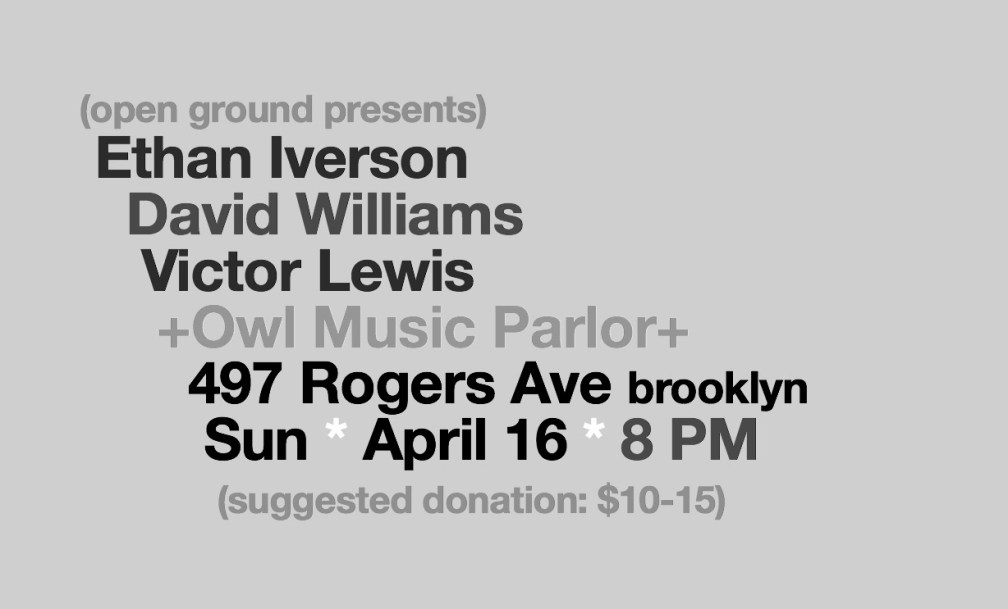
A couple of common practice hits, near and far: In Brooklyn on Sunday with a pair of legends:
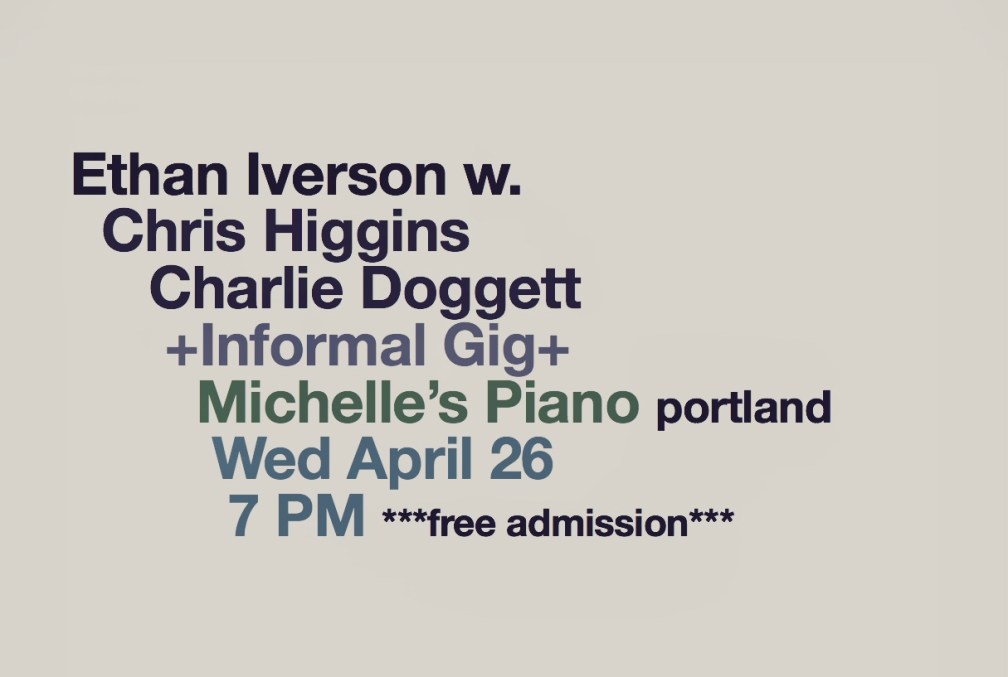
And in Portland in a couple weeks with two big local talents:
At one point, jazz was sharply defined by the local communities in the major cities. Billy Hart is from Washington D.C.: I’ve heard Billy talk about Shirley Horn, Butch Warren, Joe Chambers, Andrew White, and others so much I feel like I know them myself.
There are two Buck Hill albums recorded in 1981 at North Sea with Reuben Brown, Wilbur Little, and Hart. if you really know how to listen to straight-ahead jazz, these discs show a specifically Washington D.C. way of handling the common practice repertoire.
Reuben Brown isn’t well known but he was a big talent who had a year-long trio gig with Butch Warren and Billy Hart in about 1960. Wilbur Little was also a member of the D.C. scene around that time.
These are all well-educated musicians, but there’s also an element of jazz as folk music. When teenagers of that generation got interested in jazz there was no manual. If the local gatekeepers thought a youngster had potential, they were indoctrinated into the mysteries mostly through the oral tradition.
In this circle the queen was Shirley Horn, who eventually gave Hill his biggest exposure on a few of her later major label releases. I hear something similar in Brown and Horn: Herbie Hancock also got some of the same information because Miles Davis had Horn double bill with Davis at the Vanguard. The intro Brown plays on “Easy to Love” is not quite “normal.” It’s some D.C. stuff. Horn probably invented some of those voicings, and Herbie grabbed at least one of them too.
As for the tenor solo, what can you say? This is it, this is the mid-century Afro-American tenor saxophone tradition stretching from walking the bar to Interstellar Space. One only needs to hear a phrase or two to know that that truth is being spoken. Now that Hill’s gone, that once vital branch of American music, old-school tenor saxophone, has that much less of a connection to modernity.
Farewell to the wonderful Arthur Blythe. “Black Music: Ancient to the Future” was a slogan coined by the Art Ensemble of Chicago but embodied by many provocative musicians of that era. With a huge lyrical sound and blues for days, the connection of Blythe to 40s-era R&B saxophonists like Earl Bostic was obvious. That was the “ancient” part, but Blythe was also a consummate modernist concerned with “future.” In 1991 I saw Blythe at the Village Vanguard with Kelvyn Bell, Bob Stewart, and Bobby Battle. It was so weird and fresh: definitely ahead of its time.
Blythe’s reputation was secured by a series of valuable and high-profile discs made for Columbia from 1977 to 1986. While it’s an important legacy and absolutely part of the canon, I admit that the band aesthetic can be a little too chaotic for my own taste. For example, In the Tradition is considered a classic but whenever I go back to it I come to the same conclusion: I wish I could have heard Blythe, Stanley Cowell, Fred Hopkins, and Steve McCall live at the Tin Palace. Undoubtedly the right set would have made me a lifelong believer.
Regrettably the next wave of stars to get a push from major labels, the so-called Young Lions, tended not to be so aware of the “future” side of the continuum. The way (for example) Arthur Blythe receded and (for example) Wynton Marsalis ascended has still not been worked through in our history. To this day many of us are reactionary against one side or the other.
As a teenager the Blythe disc I listened to the most was the now-obscure 1986 album Mudfoot by the Leaders with Chico Freeman, Lester Bowie, Kirk Lightsey, Cecil McBee, and Don Moye. Frankly this rhythm section is a little more transparent than on most of Blythe’s own records. A comparison of Blythe’s own tune “Miss Nancy” on Mudfoot with the earlier Blythe quartet version on Illusions is a clear illustration. And, damn, does Blythe take a great solo on this song with the Leaders. It’s all there: the honk, the surreal, post-Coltrane pentatonics, even nailing the hard parallel changes when needed. Yeah!
My mother introduced me to most of my early crime fiction favorites including Inspector Morse. Colin Dexter created a wonderful world, a perfect riff on the tradition of the British “cozy.” The erudite voice of the author is consistently charismatic; as male domestic comedy, the team of Morse and Sergeant Lewis rival Nero Wolfe and Archie Goodwin; unlike most successful franchises Dexter didn’t continue past a natural conclusion (after a dozen books, Morse’s drinking and smoking took its final toll). The only false note in the development of the beloved characters was not problematic, only amusing: Dexter gave Morse a Jaguar and changed him to look like John Thaw (not to mention taking a few years and pounds off Lewis) after the phenomenal success of the television show.
I avidly read the whole series as a teenager into early adulthood but these days I regrettably see the flaws. The near-lurid interest in the sex lives of dead teenage girls may have been edgy at the time but now seems like an inappropriate cliché. Perhaps even more distracting is how the plots go quite a bit beyond byzantine into ludicrous. How many false solutions can the murder of a college don really have?
Still, I will always have a soft spot for these stories, mainly because the author has such marvelous command of language. Unlike most mysteries, one can finish a Dexter book with the feeling that you just got a bit smarter. A classical education was the source of Morse’s taste in music and poetry. Persnickety but practical lessons in spelling and grammar were presented with entertaining flair, but not all of the teaching was highbrow. When I was a drinker, I liked to emulate Morse by sauntering through the doors of a pub in England and ordering a “large Bell’s” (something that you simply can’t do in America).
Dexter was a celebrated creator of fiendishly difficult crossword puzzles, and in most of the books Morse timed himself solving the latest newspaper cryptic. A peak of the series, The Way Through the Woods, is driven almost entirely by a crossword problem. The author was also a devoted student of history, an attribute displayed to the fullest in the virtuosic The Wench is Dead.
The best crime fiction establishes location. It’s impossible to imagine Hammett, Chandler, and Ross Macdonald without California. Lawrence Block is the bard of New York, Elmore Leonard is the poet of Detroit. Agatha Christie couldn’t have existed without a manor just outside the limits of a small English town.
I’ve barely been to Oxford but feel like I know it well thanks to Morse and Dexter. I admit three copies of The Wench is Dead is excessive — especially since I can’t find on my shelves even one copy of the moody and haunting Service of All the Dead — but since I seem to be in the habit of buying yet another edition to read on a train or plane it was the obvious nominee to supply some local scenery. Here’s the perfect bit, from Chapter 34:
Morse left his flat in mid-morning and posted his single letter. He met no one he knew as he turned right along the Banbury Road, and then right again into Squitchey Lane; where, taking the second turning on his left, just past the evangelical chapel (now converted into a little group of residences) he walked down Middle Way. It was a dark, dankish morning, and a scattering of rooks (mistaking, perhaps, the hour) squawked away in the trees to his right. Past Bishop Kirk Middle School he went on, and straight along past the attractive terraced houses on either side with their mullioned bay-windows – and, on his left, there it was: Dudley Court, a block of flats built in cinnamon-coloured brick on the site of the old Summertown Parish Cemetery. A rectangle of lawn, some fifty by twenty-five yards was set out behind a low containing wall, only about eighteen inches high, over which Morse stepped into the grassy plot planted with yew-trees and red-berried bushes. Immediately to his left, the area was bounded by the rear premises of a Social Club; and along this wall, beneath the straggly branches of winter jasmine, and covered with damp beech-leaves, he could make out the stumps of four or five old headstones, broken off at their roots like so many jagged teeth just protruding from their gums. Clearly, any deeper excavation to remove these stones in their entirety had been thwarted by the proximity of the wall; but all the rest had been removed, perhaps several years ago now – and duly recorded no doubt in some dusty box of papers on the shelves of the local Diocesan Offices. Well, at least Morse could face one simple fact: no burial evidence would be forthcoming from these fair lawns…
He walked past Dudley Court itself where a Christmas tree, bedecked with red, green, and yellow bulbs, was already switched on; past the North Oxford Conservative Association premises, in which he had never (and would never) set foot; past the Spiritualist Church, in which he had never (as yet) set foot; past the low-roofed Women’s Institute HQ, in which he had once spoken about the virtues of the Neighbourhood Watch Scheme; and finally, turning left, he came into South Parade, just opposite the Post Office – into which he ventured once a year and that to pay the Lancia’s road-tax. But as he walked by the old familiar land-marks, his mind was far away, and the decision firmly taken. If he was to be cheated of finding one of his suspects, he would go and look for the other!

 DO THE M@TH